

Winter’s Curse is Anime Last Stand’s Christmas event: a limited-time gamemode built for farming Snowflakes, crafting materials, and exclusive crates while you push through scaling hazards and difficulty modifiers.
Winter’s Curse basics: Modes, modifiers, and hazards
Winter’s Curse sits alongside the usual Story and Infinite modes as a separate event playlist. It is playable solo or in a squad of up to five players.
The mode has two variants:
- Progressive Mode – a fixed-length stage with waves that ramp up to a boss (Frost King). This is where you clear “10 curses” on Purgatory for high-value rewards and certain quests.
- Infinite Mode – an endless run focused on wave pushing and scaling rewards rather than a set endpoint.
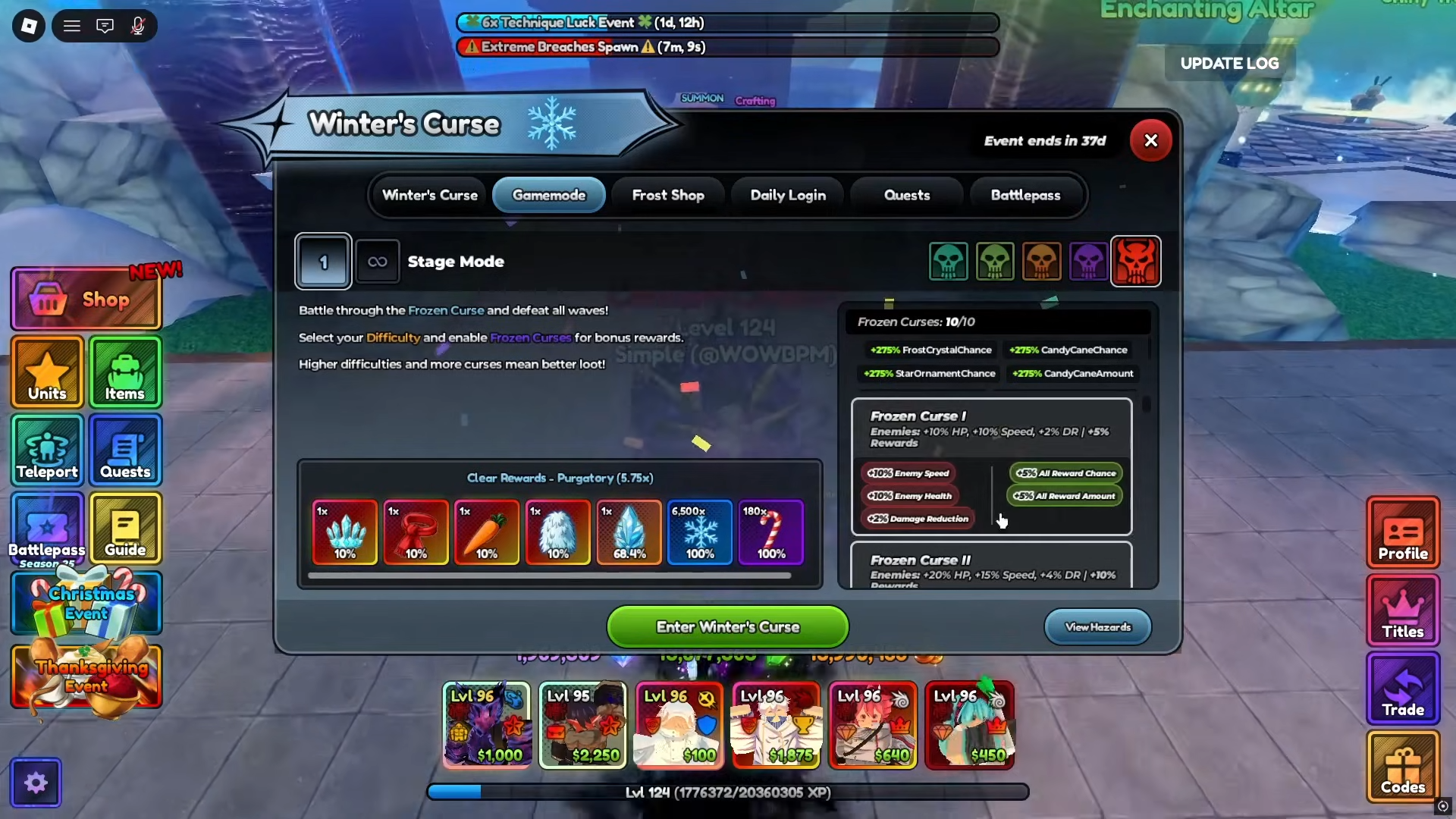
Difficulty is split into five tiers:
| Difficulty | Intended use |
|---|---|
| Easy | Early-game teams, title grinding, basic materials |
| Normal | Mid-game players learning hazards |
| Hard | Comfortable event farming with decent units |
| Nightmare | Meta units recommended, better drop scaling |
| Purgatory | End-game target with all hazards and max rewards |
Each run can stack up to 10 “curses” (difficulty modifiers). These hazards alter things like:
- reduced cash gain
- tougher enemies
- mobility or health tweaks
The more curses you enable, the stronger the drops and event materials you earn from that clear. Purgatory with 10 curses is the current ceiling: it is demanding but can be handled consistently with the right setup.
Event currencies and what they’re for
Winter’s Curse uses its own event loop built around Snowflakes and crafting materials.
- Snowflakes – main event currency used to buy items in the Frost Shop and other winter content.
- Other drops (Candy Canes, Yeti Fur, etc.) – materials for crafting Snowman pets and Winter crates.
On top of this, the event plugs into the wider progression systems:
- Christmas Battlepass Experience XP – earned from Winter’s Curse quests and used to level an event Battlepass.
- Daily login currency and items – Winter Crates, Premium Shards, and Shard Locks from checking in each day.
Snowflakes and titles interact tightly: snow-themed titles can raise Snowflake gain by up to 300 percent, turning each clear into significantly more shop currency.
Daily login rewards and Winter Crates
The Winter event adds a dedicated daily login track tied to Winter’s Curse. You claim these from the Winter’s Curse menu under Daily Login.
- Shard Lock – protects traits when rerolling.
- Premium Shard – premium-quality reroll material.
- Winter Crates – event-only crates that can roll exclusive units.
Winter Crates can drop four headline characters:
- Luffy (Gear Evil)
- Goku (Limit Breaker SS4)
- Reinhard (Phainon Worldbearer)
- Soi Fan (Wonderland)
Logging in daily during the event also grants titles like Red-Nosed Reindeer on day seven, which feed back into your Snowflake multiplier.
Winter’s Curse quests and the Christmas Battlepass
Winter’s Curse comes with its own quest system layered on top of the core game’s tasks. Quests are split into:
- Daily – simple objectives you repeat each day (e.g., clear Winter’s Curse runs, defeat hazards).
- Weekly – chunkier tasks that take multiple sessions.
- Lifetime – long-horizon goals for the entire duration of the event.
Completing these quests primarily pays out:
- Snowflakes
- Christmas Battlepass Experience XP
XP levels up a winter-themed Battlepass, which contains:
- Jewels
- Technique Shards
- Gold
- Limit Breaker items
- Other event-flavored rewards
There are free and premium tracks, mirroring previous seasonal passes. The design pushes you to play Winter’s Curse regularly rather than stockpiling everything in a single grind session.
Frost Shop and Christmas Shop: Where Snowflakes go
Snowflakes feed directly into a dedicated event store. Naming can vary slightly, but the core winter shop functions are the same: you trade Snowflakes for cosmetics, capsules, and high-end materials.
In the Frost Shop, you can buy:
- Ho Ho Ho! – a title that sharply boosts Snowflake income, up to roughly triple in the right setup.
- Christmas Capsule 2025 – a capsule with seasonal units and items.
- Magician's Weapons
- Father's Insignia
- Kai Stitches
- Sorcerer Love
On the broader Christmas Event track, Snowflakes and materials also let you:
- Craft Snowman Pets that increase max unit levels, XP gain, and currency drops at higher tiers
- Craft Winter crates that mirror the login Winter Crate pool but add more items
Strong recommendation: prioritize titles like Ho Ho Ho first, then work toward high-tier Snowman pets. Both pay off across all your remaining Winter’s Curse runs.
Event crafting: Soul of Giving and Godly Snowman
Winter’s Curse materials can be combined into two standout items designed specifically for this mode:
- Soul of Giving – a craftable item that boosts your stats while inside Winter’s Curse.
- Godly Snowman (Colour variants) – top-end Snowman pets that provide major buffs, including up to +10 extra levels for units.
These aren’t optional if you care about higher modifiers. Once you move past mid-tier curses, the stat gap from these items is large enough that unbuffed teams will struggle to keep up.
New units in the Christmas Part 1 update
The winter patch adds several units on top of the crate and capsule exclusives. These appear on banners or event content:
- Devil & Spirit
- Salamander
- Shady Scientist
- Yuko
- Silver Horse
- Nature's Scientist
There is a separate set of Update 79 winter-limited units tied more directly to banners and some event drops:
- Senku + Shiny (Event exclusive)
- Asta and Yuno
- Natsu
- Kisuke
- Silver Chariot Requiem
- Yuki
These units rotate through event banners and are not permanent additions, so they sit in the same “grab them now or wait a year” bucket as previous seasonal characters.
Event codes for extra rolls and Snowflakes
The winter patch comes with several limited-time codes that accelerate your setup:
- MerryChristmas! – 200 Rerolls, 20 Pearls
- WinterUpdate1! – 10 Reroll Locks
- WinterCurseEvent! – 10 Premium Rerolls
- Snowflakes – 1000 Snowflakes, 5 Winter Capsules
Redeeming these early gives enough Snowflakes to immediately buy titles and capsules that would otherwise take several runs to earn.
How hard Winter’s Curse actually is
On the lower settings, Winter’s Curse is forgiving. Easy and Normal difficulties demand little beyond having a somewhat leveled roster and basic understanding of tower placement.
Once you step into Nightmare and Purgatory, the expectation shifts:
- strong, meta-relevant DPS like Gojo, Asta Sukuna, True Dracula, or high-value godlies
- reliable farms (Bulma, Idol, and similar units) with decent traits and souls
- characters with range or global coverage to handle the map’s multiple paths
Purgatory with all curses enabled is tuned for late-game: enemies are tanky, income is constrained by hazards, and missing upgrades or misplacing a key unit can wipe the run. With the right comp, though, it remains manageable and can even be automated.
Solo Purgatory (10 curses) strategy with Makima, Gmy, and Regulus
One of the most consistent Purgatory clears runs a backline built around Makima, Gmy (often called Grammy), and Regulus, supported by Idol and Bulma as farms. This works both for manual play and for macro setups.
Team core:
- Slot 1: Any strong godly lead (Goku, Simon, Luffy, Naruto) or a filler if you want to prove the clear without godlies.
- Makima – primary damage engine and pseudo-buff through her attack mechanic.
- Gmy – units that replicate some of Makima’s damage when placed in her range.
- Regulus – additional multi-target DPS in the same kill zone.
- Idol – farm plus occasional damage or utility, depending on version.
- Bulma – main money farm.
Traits and trees matter, but this comp can win without godly traits:
- Crit-focused skill trees on Makima and Regulus
- Damage-focused skill tree on Gmy
- Double money traits on Bulma and Idol if available (for faster, safer scaling under cash penalties)
Manual Progressive Purgatory clear (solo):
Step 1: At the start of Wave 1, immediately place Idol and Bulma and turn on auto-upgrade for both. Prioritize Bulma with two upgrade slots and Idol with one so your main income ramps up as early as possible.
Step 2: While the farms level, set up your kill zone near a central bend in the path where multiple lanes overlap. Place Makima there first as soon as you can afford her.
Step 3: After Makima is down, add Gmy and Regulus around her so they all share the same coverage. Keep them near enough that Makima’s attack mechanic can interact with them.
Step 4: Once both farms are maxed, dump cash into Makima. Put her on auto-upgrade up to a safe breakpoint (for example, her third major upgrade), and trigger her active ability if a wave looks threatening. Avoid using her contract ability, as that sells your field.
Step 5: When Gmy unlocks his extra placements through his internal event effect, place all allowed Gmys in Makima’s range. This multiplies her damage across the lane, letting the group melt even high-HP hazards.
Step 6: Use Bulma’s wish for wealth once, if needed, to bridge a money gap and finish maxing Makima earlier. With fully leveled Makima, Gmys, and at least some upgraded Reguluses, the remaining waves up to Wave 20 stabilize.
Step 7: On Wave 20, let the group clear trash until Frost King becomes targetable. At that point, the Gmys and Makima begin shredding hundreds of billions of HP per volley. Optional: fire any remaining burst abilities (e.g., Colossal Meteor) to shorten the fight.
This setup clears Purgatory with all curses while leaving a compliance gap for a godly lead; if you add Goku for boss damage or Simon for extra buffs, clear times drop further.
Alternative Purgatory teams without Makima or godlies
Not everyone has Makima or wants to run top-end godlies. There are slower but viable compositions if you’re willing to micro more and accept longer clear times.
Purgatory team with Simon lead
Core units:
- Simon – main carry and boss shredder.
- Regulus and Gmy – mid-map damage and coverage.
- Idol and Bulma – farms.
High-level flow:
Step 1: Place Idol and Bulma early, then add placement for your DPS block (Guru/Regulus, Simon, Gmy) around Wave 5 or 6.
Step 2: Max Guru or your early DPS first so enemies don’t leak while farms are still climbing.
Step 3: Upgrade Simon to around upgrade level 11, then use his active ability to push his damage to the trillion-range for the later waves.
Step 4: When the boss spawns, re-activate your burst abilities and set one of the heavy hitters to “Strongest” to focus Frost King. The kill is fast; the limiting factor is cleaning up stragglers on distant paths.
Purgatory team using Naruto for range support
This variant trades Makima’s mechanic for range buffs from Naruto.
Core units:
- Simon – carry.
- Naruto – range buffer.
- Regulus and Gmy – DPS.
- Idol and Bulma – farms.
Step 1: Place Idol and Bulma on the path the boss will eventually use. Put Simon, Regulus, Gmy, and Naruto near that intersection.
Step 2: Auto-upgrade Simon and keep investing until his range plus Naruto’s buff covers most of the map, even if some far segments remain outside.
Step 3: Use Naruto’s presence to ensure your carry hits enemies earlier in their route. This shaves off enough HP that they die before reaching the final curves, even if coverage is imperfect.
The clear is slightly slower but still handles 10 curses reliably once everyone is leveled and on crit/damage-focused skill trees.
Non-Makima, non-Naruto fallback
A final backup comp combines Simon with other heavy damage dealers (such as Gmy and Regulus) and covers both sides of the map manually:
Step 1: Place Simon and Regulus to cover one half of the map, then sprint to the far side to place your secondary DPS (like Gmy and another carry).
Step 2: Rotate abilities and upgrade priorities between both sides, watching mini-map icons so no path gets overrun.
Step 3: Accept that clear time will be longer, since not all units can reach all paths and some enemies linger after the boss dies.
This configuration is more work for less reward and is only recommended if you lack Makima and Naruto and still want a path to 10-curse clears.
AFK and macro farming in Winter’s Curse
Because Progressive Purgatory has a fixed wave count, it is a prime target for macros. Macro players commonly run:
- Makima, Gmy, Regulus as the core trio
- a godly in slot 1 (often Goku or Simon) to stabilize damage
- Idol and Bulma with souls that increase gold gain
A standard macro sequence looks like this:
Step 1: Disable “Seamless Stages” in settings to prevent memory issues during repeated runs.
Step 2: Start recording in your macro tool, load into Purgatory with all curses, and use the O key and arrow keys to zoom out and orient your camera toward the central tree landmark.
Step 3: Place Bulma and Idol as fast as possible, open unit manager, and turn auto-upgrade on.
Step 4: Spam place Gmys and Reguluses around Makima’s planned spot so all placements happen even if there are minor timing differences in future runs.
Step 5: Once farms are maxed mid-run, upgrade your godly lead to a strong breakpoint, then funnel upgrades into Makima.
Step 6: At around the 1:30 mark (varies per team), hit one final key press to buy a key upgrade on your lead, then do nothing until the boss dies.
Step 7: After the victory screen appears, wait a few seconds, then record input that clicks “Retry,” waits for the map to reload, and returns to the starting camera position before ending the macro recording.
The result is an AFK loop that clears 10-curse Purgatory repeatedly, feeding Snowflakes, materials, and Battlepass XP with minimal supervision—as long as your PC and Roblox session stay stable.
With all of this in place, Winter’s Curse becomes less of a mystery and more of a predictable grind: assemble one strong event team, unlock titles and Snowman pets early, stack difficulty modifiers as you grow comfortable, and use Progressive Purgatory to funnel event currencies into crates and limited units before the snow melts and the Christmas event disappears.