

Devil Hunter turns Chainsaw Man’s world into a Roblox brawler built around a few big choices: which Devil you sign a Contract with, whether you play as a Fiend, and if you eventually grind your way into a Hybrid form. Those decisions define your entire kit – damage, survivability, crowd control, and how hard you can punish mistakes in PvP.
The rankings below reflect how each option performs in real missions, raids, and arena fights in early 2026, with a focus on consistency rather than one-off highlight plays.
Devil Hunter Contract tier list (humans)
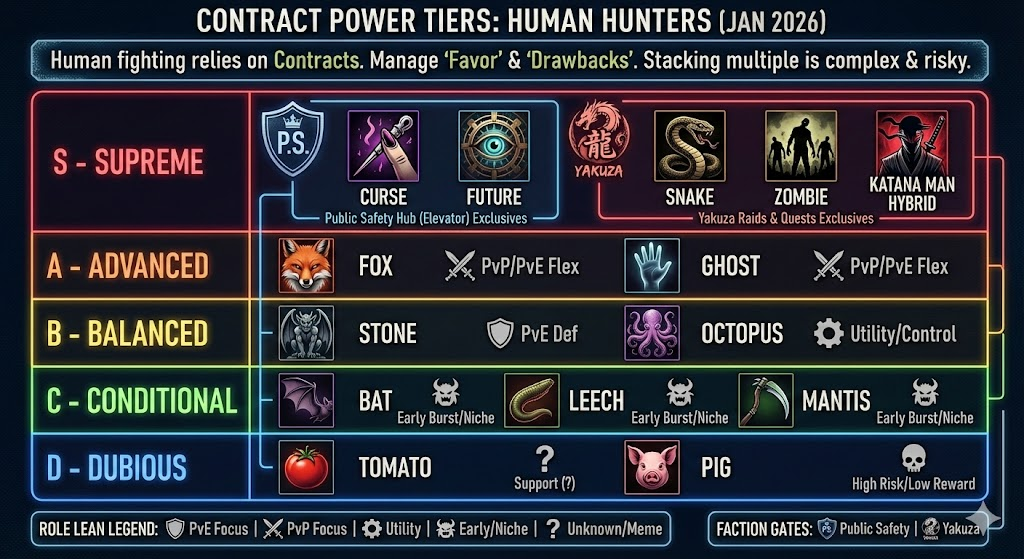
Contracts are the main way human characters fight. You can hold several at once, but each comes with its own favor system and drawbacks, so stacking too many is not always practical.
The table shows their general power level once you understand the kit. Notes on role lean (PvE vs PvP) come after.
| Tier | Contract | Role highlight |
|---|---|---|
| S | Snake, Ghost, Future, Mantis, Curse, Octopus | Meta-defining picks for both raids and PvP; high damage or control plus strong combo tools. |
| A | Zombie, Fox, Sea Cucumber, Bat | Very strong PvE, situational but workable in PvP; good for progression. |
| B | Leech, Stone, Tomato | Comfortable for early and mid-game, mostly PvE-focused with clear weaknesses in serious PvP. |
| C | Frog, Mold | Telegraphed, single-purpose moves that struggle once enemies dodge and parry consistently. |
| D | Fish | Minimal toolkit with low impact; outclassed in every mode. |
Faction alignment gates a few of the strongest options. Public Safety gets Curse and Future from the elevator hub, while Yakuza gains access to Zombie, Snake, and the Katana Man Hybrid by clearing their raids and quests.
S-tier Contracts: late-game anchors
S-tier Contracts either hard-carry raids or completely change how opponents are allowed to play in PvP. They pair high damage with reliable setups or defensive tools.
- Snake is a late-game monster that asks you to clear a boss gauntlet before you even unlock it. In return, you get heavy-hitting M1 and M2 variants and the ability to swallow low-HP devils, then resummon them to fight for you. In raids that effectively turns bosses into extra allies, and in PvP it gives brutal combo extensions once someone drops under a health threshold.
- Ghost runs on a high bar cost, but its M1 and M2 grabs are among the best openers and extenders in the game. At max favor you can summon Ghost for sustained DPS and field control; holding the right mouse button on a player that downed you lets you flip engagements by dragging them into your range.
- Future is deceptively simple. Its Counter will punish almost any move if you time it correctly, and landing several in a row grants an automatic dodge chance that makes you extremely hard to kill in duels. It shines in PvP but still helps in PvE when you learn boss patterns. Combined with other counter-style passives and moves, Future can turn your character into a parry-focused build that wins through denial rather than raw damage.
- Mantis is a PvP specialist. The summoned mantis arm can grab targets in ragdoll, after an uppercut, or mid-combo to keep your strings going longer than most players expect. The red-light telegraph gives skilled opponents a small dodge window, but if you condition them or catch them in recovery, Mantis feeds you some of the most oppressive chains in the game.
- Curse demands a tedious, high-risk quest that resets on death. Finishing it unlocks both curse skills and a sword. The weapon’s basic attacks and crits hit hard and slot naturally into PvP combos, while the overall kit also shreds in PvE once you learn the timing. Curse rewards players who are comfortable playing around precise windows rather than spamming.
- Octopus appears alongside these at the top tier thanks to its strong offensive pressure and utility; it rounds out an S-tier pool where every Contract can carry content if you build around it.
A-tier Contracts: progression staples and PvE workhorses
A-tier Contracts are easier to farm and safer to play. They excel in missions and raids and are good enough to bring into PvP while you work toward S-tier picks.
- Zombie focuses on summons. In PvE, zombie minions soak boss attention and contribute steady DPS over long fights. In gank-style PvP, they disrupt spacing and punish players who tunnel-vision. The trade-off is that killing your summons can grant health packs, so it never becomes overwhelming in arenas.
- Fox is one of the best beginner Contracts. Its M1 and M2 variants both deal strong damage in missions and raids and are simple to use. The slow, committal nature of the heavy hit makes it much harder to land in PvP, but for grinding yen and drops, Fox remains excellent well into mid-game.
- Sea Cucumber occupies a similar space to Fox. It offers two strong damage skills and an M2 lock-on that deletes unaware or inexperienced players and clumps of PvE enemies. Once people start perfect blocking and dodging on reaction, the telegraph becomes a liability; until then, it’s a very comfortable farming tool.
- Bat sits on the border of A and B in different rankings, but its wide-area damage and raid grind speed make it easy to justify for PvE. Its long wind-up is an open invitation for parries and side-steps in PvP, so it’s best treated as a farming Contract rather than a dueling centerpiece.
B-tier Contracts: safe but limited
B-tier Contracts feel good in early and mid-game PvE, especially if you are still learning positioning and parry timings. Their weaknesses show up once enemies punish telegraphed moves.
- Leech is one of the most comfortable PvE sustain tools. In raids and missions it lands easily, deals steady damage, and generates health packs on kill so you can stay in the field longer. In PvP, perfect blocks and clean dodges blunt its impact, but it still helps in attrition-style fights.
- Stone provides a straightforward stun that is easy to understand and use. Against groups of basic enemies, dropping a stun in place and following with M1s works well. The problem is that the move channels without movement. In serious PvP or against mobile bosses, whipping Stone in the wrong spot gets you punished hard.
- Tomato has been heavily nerfed. The M1’s slow start-up makes it trivial to dodge in arenas, which strips away most of its dueling value. The second move can function as a pseudo-revive in both PvP and PvE and gives you extra leeway in raids. That safety net is useful for progression, but Tomato no longer competes with top options once you have other choices.
C- and D-tier Contracts: reroll candidates
Frog, Mold, and Fish are technically functional, but their kits are narrow and easy to play around.
- Frog has a grab that looks appealing on paper, especially if you know the Tongue Snatch Fiend talent. In practice the Contract’s grab is slow and extremely telegraphed, whiffing constantly in PvP. In PvE it can pull a stray enemy into range, yet the lack of strong follow-up damage or sustain means you often end a cast exposed.
- Mold mirrors Frog’s problems. You get a single projectile-style move that is simple to dodge in PvP and only modestly effective as chip damage in PvE. It’s a passable starter in raids when enemies stand still, but it quickly feels one-dimensional.
- Fish sits at the bottom. It offers a basic bite-style attack without the second utility move that props up Tomato. Damage is unimpressive and the lack of extra mechanics (heals, grabs, stuns, summons) leaves it outclassed in every mode.
Faction-locked Contracts and Katana Man Hybrid
Some of the strongest options are tied to your employer choice in Tokyo.
- Public Safety hunters can access Curse and Future from the elevator hub. This path is well suited to players who want high-skill, high-reward PvP builds built around counters and precise combos.
- Yakuza hunters can pick up Zombie and Snake through faction content, and unlock the Katana Man Hybrid by clearing the Katana Man Raid and farming five Katana Heart Fragments. Consuming the crafted heart grants the Hybrid form and wipes your existing Contracts, effectively turning Katana into a full build pivot that roughly sits around A-tier power.
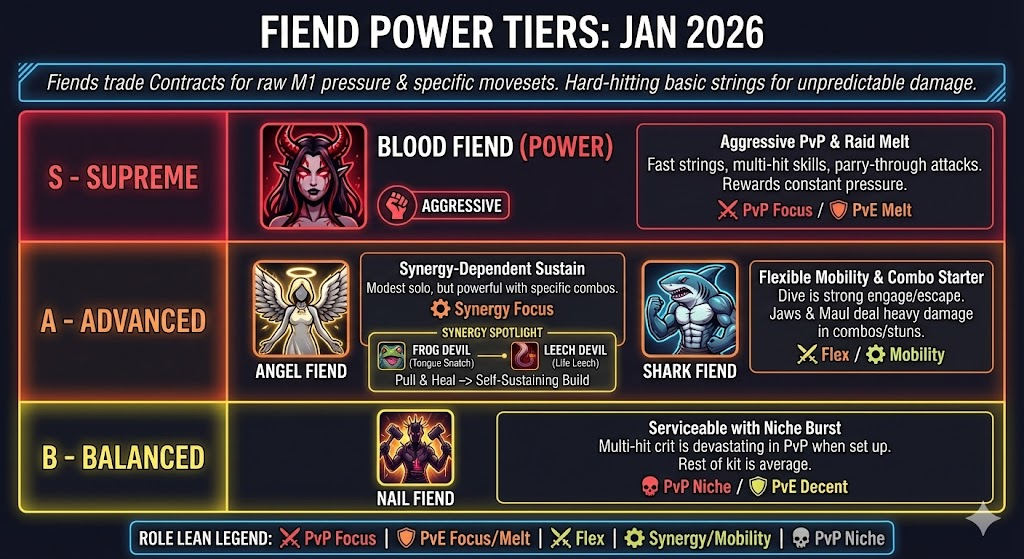
Devil Hunter Fiend tier list
Playing as a Fiend trades Contracts for a smaller set of full movesets and a deeper focus on raw M1 pressure. Fiend basic attacks currently hit very hard and behave slightly differently from human ones, which makes them great for unpredictable damage strings.
| Tier | Fiend | Notes |
|---|---|---|
| S | Blood Fiend (Power), Angel Fiend | Best overall mix of PvP threat, sustain, and PvE DPS when built correctly. |
| A | Shark Fiend | High-ceiling moveset with great mobility and combo extension if you can land its skills reliably. |
| B | Nail Fiend | Strong crit tool for PvP, otherwise outpaced by higher tiers. |
- Blood Fiend (Power) sits at the top. Fast basic strings, multi-hit skills, and attacks that keep going through parries make Power especially oppressive in PvP, while also melting raid targets. It rewards aggressive players who stay on top of opponents rather than waiting for openings.
- Angel Fiend is more synergy-dependent. On its own it feels modest, but pairing it with the Frog Devil talent Tongue Snatch lets you pull enemies into you for Year Drain healing. Combine that with Life Leech from the Leech Devil and Angel becomes a self-sustaining build that can grind both PvE and PvP without constantly backing off for heals.
- Shark Fiend lives in A-tier as a flexible, high-mobility kit. Dive works as both an engage and an escape, making it a strong combo starter, extender, and repositioning tool. Jaws and Maul deal heavy damage but are easy to dodge if you throw them raw; they shine when you weave them into knockdowns or stuns from other sources.
- Nail Fiend rounds out the list. Its multi-hit crit can be devastating in PvP when you line it up, yet much of the rest of the kit is simply serviceable instead of exceptional. In PvE it does the job but does not reach the speed or safety of Blood or Shark.
Devil Hunter Hybrid tier list
Hybrids are the game’s prestige transformations. Unlocking them is significantly more involved than rolling a Contract or Fiend, but the payoff is a cinematic power spike and a unique kit.
| Tier | Hybrid | Summary |
|---|---|---|
| S | Bomb, Chainsaw, Flamethrower | Top-end transformations with strong damage and spectacle; ideal long-term goals. |
| A | Deep Sea | Very capable Hybrid that only slightly trails the top three. |
| B | Katana | Solid Hybrid form, roughly on par with strong Contracts. |
| C | Shield, Whip | Functional but less explosive; more niche playstyles. |
Hybrids replace or override your previous investments, so they make the most sense once you understand how you prefer to fight. For example, players who enjoy Revenge-style brawling and close-range pressure often work toward Chainsaw, while those who like big, flashy area control may gravitate to Bomb or Flamethrower.
How Fiend rerolls work
Rerolls are the main way to fix a bad Fiend identity without starting from scratch.
Step 1: Open your inventory and locate any Fiend reroll items you have earned or redeemed. These sit alongside other consumables rather than in your equipment slots.
Step 2: Move the Fiend reroll onto your hotbar. This lets you trigger it directly in the field without digging through menus each time.
Step 3: While playing as a Fiend, activate the reroll from your hotbar. Your Fiend identity will randomize, letting you chase higher-tier options such as Blood or Shark.
Note: Fiend rerolls can be used while you are currently in a human state, but doing so has no effect and still consumes the item. Make sure you are in a Fiend slot before you click.
Early-game Contracts worth chasing
Not every strong pick is locked behind late-game raids. A few Contracts stand out for being both accessible and structurally sound for new players:
- Future Devil is relatively easy to obtain and teaches you timing through its Counter mechanic. You get valuable survivability in both raids and duels while learning enemy animations.
- Zombie Devil and Fox Devil provide straightforward PvE power. Both have kits that chew through missions and mid-game fights without demanding perfect execution, and their debuffs are manageable compared with some more extreme Contracts.
Those three let you learn spacing, blocks, and damage windows while still performing well into mid-game content, so they are practical stepping stones toward late-game S-tier setups.
Devil Hunter’s meta will keep shifting as Contracts, Fiends, and Hybrids are tuned, but a few patterns stay stable. Movesets that combine reliable openers with either sustain or hard crowd control tend to climb to the top, while slow, single-purpose skills fall off once players start perfect blocking and dodging. Treat Contracts like long-term investments, reroll aggressively away from bottom-tier picks, and work toward one or two S-tier centerpieces that match how you like to fight.