

The Dahlia is a Fire Nihility support built entirely around the super break playstyle in Honkai: Star Rail version 3.8. She dramatically upgrades break-oriented teams, but contributes very little to standard crit-based hypercarry or follow-up teams.
Whether she is worth your jades depends almost entirely on how invested you are in break units now, and how much you plan to lean into that archetype over the next few patches.
The Dahlia’s role in version 3.8
The Dahlia acts as the central enabler for super break teams, in the same way that Kafka defines DoT teams. She lets allies deal large amounts of break damage even when enemies are not currently weakness broken, accelerates how quickly enemies are broken, and patches energy and rotation problems for existing break DPS.
Her main strengths are:
- Super break without breaking: Toughness damage dealt to unbroken enemies can be converted into Super Break DMG, greatly raising damage uptime.
- Fast breaking and scaling: A strong team-wide Weakness Break Efficiency buff and Break Effect sharing make every break unit more explosive.
- Robust support package: Guaranteed DEF reduction, weakness implantation, skill point generation and speed/energy support for key partners like Firefly.
The trade-off is just as clear. Almost everything she offers is tied to break mechanics and Super Break DMG. She does not provide generic ATK, crit or normal damage buffs, and she wants teammates who stack Break Effect rather than crit stats. Outside of break teams, her value drops sharply.
How The Dahlia’s kit works
The Dahlia’s kit is built around three ideas: the zone from her skill, dance partners from her talent, and several traces that convert weakness implantation and toughness damage into Super Break DMG, speed and energy.
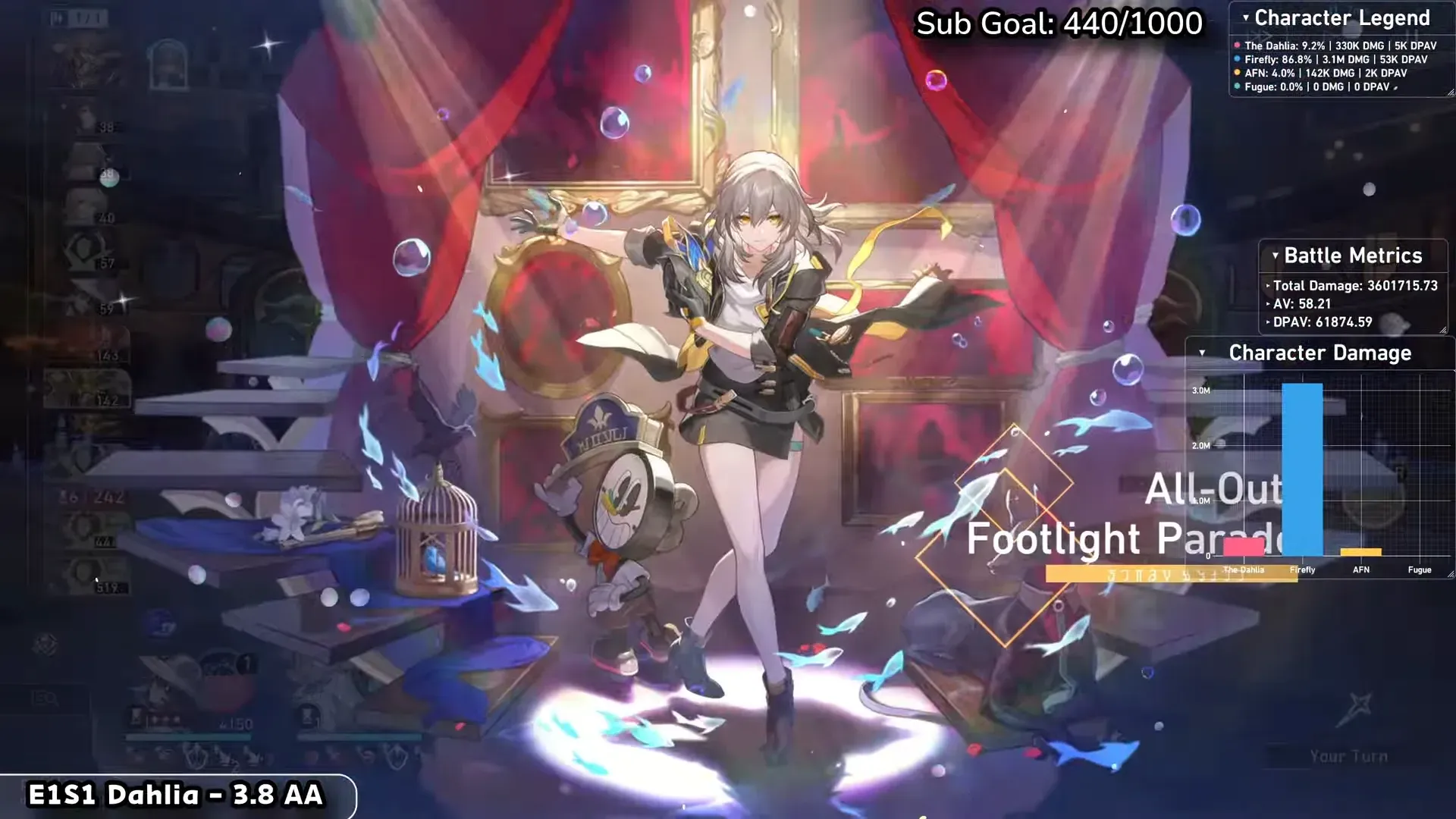
Skill and zone. Her skill hits a main target and adjacent enemies, then creates a zone that lasts for three of her own turns. While this zone is active, all allies gain a large Weakness Break Efficiency increase (50%), so every hit shaves more toughness off enemies. In addition, as long as enemies are not weakness broken, the toughness reduction they take is converted into Super Break DMG. Her technique can place this zone before combat starts, so a fight can open with super break damage online.
Ultimate and Wilt. The Dahlia’s ultimate is a 130-cost AoE Fire attack that applies the Wilt state to all enemies, reducing their DEF by 18%. This defense drop is guaranteed and does not rely on Effect Hit Rate. Afterward, the ultimate implants the weakness type of both dance partners into enemies, so they gain Fire weakness and the element of the chosen partner. That makes it much easier for break DPS to hit weakness, even against off-type enemies or enemies with locked weaknesses.
Dance partners and follow-up attacks. Through her talent, The Dahlia always has two dance partners on the field: herself and one ally. At battle start, she marks herself and the character who initiated combat. If no ally qualifies, the mark goes to the teammate with the highest Break Effect. A visible icon above their heads shows who is marked.
Dance partners receive special benefits:
- When a dance partner attacks a weakness broken enemy, part of the toughness reduction from that hit is converted to Super Break DMG (60% of the toughness reduction value).
- Every time the other dance partner attacks, The Dahlia performs a follow-up attack once per turn, hitting a random enemy five times. Against a weakness broken target, each instance converts its toughness damage into Super Break DMG at a high multiplier (200%).
Her talent also regenerates 35 energy when entering combat, letting her reach her first ultimate quickly. One of her traces refunds 1 skill point every two follow-up attacks, so over time she becomes skill-point positive rather than a drain.
Break Effect sharing and sustain interaction. A major trace lets her increase the Break Effect of other allies by a percentage of her own Break Effect plus a flat bonus. This buff activates at battle start and can be refreshed for several turns whenever she receives healing or a shield from a teammate. Teams that include a sustain, or a support that grants shields, keep this Break Effect share active more consistently.
Weakness implantation and speed/energy buffs. Her final trace triggers whenever an ally implants a weakness on an enemy. That ally gains 30% speed for two turns, which is extremely valuable for fast-acting break DPS. Fire characters receive extra perks: when they implant a weakness with an attack, they inflict additional fixed Fire toughness reduction on each target with that weakness and regenerate 10% of their max energy per affected target, up to half of their max energy per trigger.
This interaction is especially important for Firefly, who can use her skill to implant Fire weakness. With The Dahlia on the team, Firefly can often achieve “one-turn ultimates” – after leaving her ultimate state, one skill can generate enough energy to re-enter her ultimate immediately. That fixes a key rotation and energy issue and allows almost permanent uptime on Firefly’s Combustion state.
How her damage scales. Super Break DMG scales with Break Effect, the toughness reduction of the hit and character level. It cannot crit and is not affected by generic damage bonus effects, which is why The Dahlia wants Break Effect and speed instead of crit stats. Her job is to multiply the break damage output of the team, not to act as a conventional DPS.
Best teams with The Dahlia
The Dahlia slots into almost any super break team that focuses on toughness damage and Break Effect. She is most impactful when paired with high-volume attackers who can break or re-break enemies repeatedly.

Firefly super break core. Firefly gains the most from The Dahlia. With Dahlia’s zone, Firefly breaks enemies faster, and with the speed and energy trace she can maintain extremely high Combustion uptime. Adding Fugue and Harmony Trailblazer or Ruan Mei creates a sustain-less composition that delays enemies, breaks them quickly and converts that into consistent Super Break DMG.
Rappa and Boothill teams. Rappa benefits heavily from Dahlia’s weakness implantation because she does not implant weakness herself. Dahlia’s ultimate lets Rappa treat more enemies as weak to her element while still enjoying super break conversions. Boothill gains speed and Fire weakness from Dahlia, which allows him to take three to four turns per cycle and run the Forge planar set instead of the older Talia set, raising his performance significantly.
Comfortable sustain variants. Some players prefer to include a healer like Lingsha or Gallagher. Lingsha can act as both sustain and break DPS, while her healing also helps activate The Dahlia’s Break Effect-sharing trace. These teams trade a small amount of peak damage for more safety and longer-lasting buffs.
Alternative break DPS. The Dahlia also works with other break-leaning characters such as Himeko, Xueyi, Boba March 7th and main DPS Lingsha. While these options may not reach the same ceiling as Firefly, Rappa or Boothill, they form functional super break teams for players who lack multiple limited break DPS.
| Team core | Sample lineup | Key notes |
|---|---|---|
| Firefly sustain-less | Firefly · The Dahlia · Fugue · Harmony Trailblazer or Ruan Mei | Highest ceiling for current super break; Firefly gains one-turn ultimates and constant Combustion. |
| Firefly with sustain | Firefly · The Dahlia · Fugue or Harmony Trailblazer · Lingsha or Gallagher | Safer for difficult content; healing or shields help keep Dahlia’s Break Effect share active. |
| Rappa core | Rappa · The Dahlia · Fugue · Harmony Trailblazer or Ruan Mei | Dahlia supplies weakness implants and extra speed, solving Rappa’s main limitations. |
| Boothill core | Boothill · The Dahlia · Fugue · Harmony Trailblazer or Ruan Mei | Fire weakness implant lets Boothill use the Forge planar set; extra speed enables 3–4 turns per cycle. |
| Budget break DPS | Himeko or Xueyi · The Dahlia · Fugue or Harmony Trailblazer · flex support | Accessible option if you lack limited break DPS; still benefits strongly from Dahlia’s zone and buffs. |
Account-level value: when The Dahlia is worth pulling
The Dahlia’s pull value is highly polarized. For some accounts she is close to mandatory; for others she is one of the easiest five-stars to skip in version 3.8.
- If you already main break teams. Players who own one or more of Firefly, Rappa or Boothill and use them regularly gain enormous value. The Dahlia roughly doubles or even triples the damage of well-built break teams by enabling Super Break DMG outside of break windows, fixing rotations and providing Break Effect buffs. For this group, she is by far the most important new unit in 3.8.
- If you own a partial break core. Owning Firefly without The Dahlia leaves her noticeably underpowered against the inflated HP and toughness of newer content. Conversely, having The Dahlia but no dedicated break DPS still lets you build functional teams with units like Himeko or Xueyi, but you will not see her full potential. In practice, super break feels best when you commit to at least one proper break DPS plus Dahlia, and ideally Fugue or Harmony Trailblazer as well.
- If you already have top crit-based DPS. Accounts that already field premier version 3 hypercarries such as Casteris, Evernight or Fon generally get more from supports like Sirene and Sunday than from The Dahlia. While she raises break teams to a level comparable to many version 3 teams, they still tend to lag behind the strongest crit-focused line-ups outside of content specifically tuned for break.
- If you are new or returning without strong DPS. For players who missed most of the version 3 damage dealers, a break team centered on The Dahlia can outperform many older version 2 teams. In that case, she is a reasonable foundation, especially if you like the break playstyle and plan to pick up a break DPS during their reruns. Be prepared, however, to eventually invest jades into both Dahlia and at least one main break DPS; otherwise your team may feel incomplete.
- If you spend little and care most about future flexibility. Break teams use unique stats and have relatively few units compared with crit-based archetypes. If you have limited jades and no particular attachment to break, saving for more flexible supports (for example Sunday) or for upcoming characters in the next region is safer. In that situation, The Dahlia is a textbook “choice” unit rather than a universal upgrade.
Summarizing these cases, The Dahlia is essentially a must-pull only if you want to play break as one of your main archetypes. If you do not, she is easy to skip without hurting the rest of your account.
How The Dahlia compares to other 3.8 banners

Version 3.8 runs an extended schedule with six five-star banners: The Dahlia, Firefly, Fugue, Lingsha, Aglaea and Sunday. Deciding on The Dahlia means forgoing or delaying some of these.
Versus Firefly. The Dahlia and Firefly share the first phase. Firefly is a strong super break DPS whose energy and damage issues are heavily fixed by The Dahlia. Without Dahlia, pulling Firefly at E0 in the current environment can feel like “pulling a brick” because she struggles against high toughness and HP. Without a proper break DPS, however, The Dahlia also has limited impact. Ideally, you want both together. If you must choose only one and you do not already own a break DPS, Dahlia is usually the better first pick because she can still support other break-leaning characters while setting up for a future main break DPS.
Versus Fugue. Fugue is another Fire Nihility super break support who offers high Super Break multipliers, exo-toughness bars for double breaks and powerful Break Effect buffs. She is extremely valuable for Rappa and Boothill in particular. For players starting from zero in the break archetype, The Dahlia is generally the higher initial priority, with Fugue as the next target. For players already owning Fugue, adding Dahlia completes a very strong support core; for those with Dahlia but no Fugue, pulling Fugue later is still highly recommended if you want to keep break competitive.
Versus Lingsha. Lingsha is a Fire Abundance healer who also contributes break-focused follow-up damage and applies a debuff that makes enemies take increased break damage. She can fit super break teams that want a sustain and can even be built as a main DPS. However, general-purpose sustaining is now largely covered by free units like Dan PT and premium sustainers like Hyacine, both of whom fit a wide range of crit-based teams. As a result, Lingsha’s pull value is much lower than The Dahlia’s. Her main remaining niche is as a third sustain in Anomaly Arbitration or as a comfort choice in break teams.
Versus Sunday. Sunday is an Imaginary Harmony support who buffs a single ally with action advance, crit rate, crit damage, damage boosts, energy and skill points. He synergizes especially well with units that have summons and remains an excellent hypercarry support for many DPS including Aglaea, Mydei, Saber, Phainon, Anaxa and more. For accounts lacking a premier hypercarry support, Sunday often brings more overall value than The Dahlia because he fits so many different teams and will remain relevant even if the meta shifts away from break. If you are not invested in break, Sunday is usually the better long-term pick.
Versus Aglaea. Aglaea is a Lightning Remembrance DPS who relies on very high speed and a 350-cost ultimate. She can be powerful but has severe energy needs and depends on vertical investment: her E1 is almost mandatory to feel good to play, and she prefers partners like Sunday or Sirene. Even with that investment, her damage does not generally surpass the very top DPS of version 3. For most players she is a “favorites-only” pull. Compared with her, The Dahlia offers more focused value if you are a break main, while Sunday offers more general value if you are not.
Eidolons, light cone and build priorities for The Dahlia
The Dahlia functions well at E0 with a standard five-star or four-star Nihility light cone. Her Eidolons and signature light cone are strong upgrades for players who are deeply committed to the super break archetype, but they are not required to make her viable.
 Shivam Malani
Signature light cone. Her signature, Long Road Leads Home, is one of the strongest break-focused light cones. It raises the wearer’s Break Effect by 60%. On entering combat, it increases break damage dealt by the wearer and the ally who initiated combat by 32%, using a rare break damage multiplier that stacks on top of existing modifiers and functions as roughly a 32% DPS increase for many super break teams. Whenever the wearer implants a weakness, the cone also restores 1 skill point, further improving team economy. For players building serious break teams, this cone is a premium offensive option.
E1 and E2. Her first Eidolon spreads the Super Break DMG multiplier that was limited to the dance partner to all allies, while giving the dance partner an additional 40% Super Break DMG. It also causes the dance partner’s attacks to inflict extra toughness reduction equal to 25% of the enemy’s max toughness (capped at 300), which is extremely valuable in modes where bosses have large toughness bars, such as Anomaly Arbitration or Apocalypse Shadow. Her E2 improves the consistency and coverage of her weakness implants, which is particularly helpful for Rappa teams.
 Shivam Malani
Alternative light cones. Without her signature, The Dahlia can run other Nihility cones such as Lies Dance on the Breeze, Resolution Shines as Pearls of Sweat, Holiday Escapade, Solitary Healing or Before the Tutorial Mission Begins, as well as five-star Nihility cones from other characters like Fugue or Cipher. Many of these require reasonable Effect Hit Rate to maintain their debuffs, so an Effect Hit Rate body main stat becomes more attractive when using them. They do not replicate the unique break damage multiplier of her signature but still keep her supportive role strong.
Stat and relic priorities. For relics, a dedicated break set (“iron break” set) is ideal, with alternatives like Thief of Shooting Meteor, Eagle of Twilight Line or mixed two-piece break sets if needed. On planar ornaments, sets such as Forge, Talia, Vonquac or Lushaka are strong options for Break Effect and speed. Recommended main stats are HP or DEF on body, speed boots, HP or DEF on orb and Break Effect or Energy Regeneration Rate on rope. Substats should prioritize Break Effect and speed. Super Break DMG cannot crit and ignores standard damage bonus stats, so crit and ATK are low priority; survivability is more important, especially in sustain-less teams.
For players who enjoy break teams and already own or plan to own a break DPS, The Dahlia is one of the most impactful pulls in version 3.8 and effectively the linchpin of the super break archetype. For everyone else, she is a highly specialized unit whose value does not justify the jade cost compared with more flexible supports. Decide based on whether super break will remain one of your main team types over the coming patches; if the answer is no, it is safer to skip and save.