

SPLITGATE: Arena Reloaded is less a routine update and more a do-over. What launched as Splitgate 2 earlier in 2025 has been stripped back, rebuilt, and rebranded into a free-to-play arena shooter that leans into what made the original stand out: fast gunfights and creative portal play, without hero-style abilities layered on top.
The relaunch went live on December 17, 2025, at 9AM PT, on PC (Steam, Epic Games Store, Windows), PlayStation 4 and 5, and Xbox One and Series X|S. Existing Splitgate players carry forward their accounts into a very different structure built around “Arena” rather than “factions.”

Platforms, structure, and what “reloaded” actually means
SPLITGATE: Arena Reloaded is positioned as a 4v4 competitive multiplayer FPS with cross-platform play and in-game purchases. On PC the game is available through Steam’s Play Game launcher, and on consoles it can be installed from the respective platform stores.
The core promise is “no factions, no abilities, no limits.” That tagline reflects the most important decision behind the relaunch: stripping away faction-based loadouts and active abilities so each match feels closer to a classic arena shooter, where map control, aiming, and portal positioning matter more than passive stat stacks.
Gameplay changes: back to arena fundamentals
The most visible shift is philosophical. Splitgate 2’s layered systems are gone in favor of a simpler, competitive sandbox:
- No Factions or Abilities: Factions, abilities, and selected equipment have been removed outright. Every player now competes under the same ruleset instead of leaning on class-style perks or faction-specific power spikes.
- Map Pickups return: Legendary Weapons and Powerups now spawn on the map. Controlling those spawn points becomes a key objective, echoing classic arena games where rockets, snipers, and overshields dictate the pace of a match.
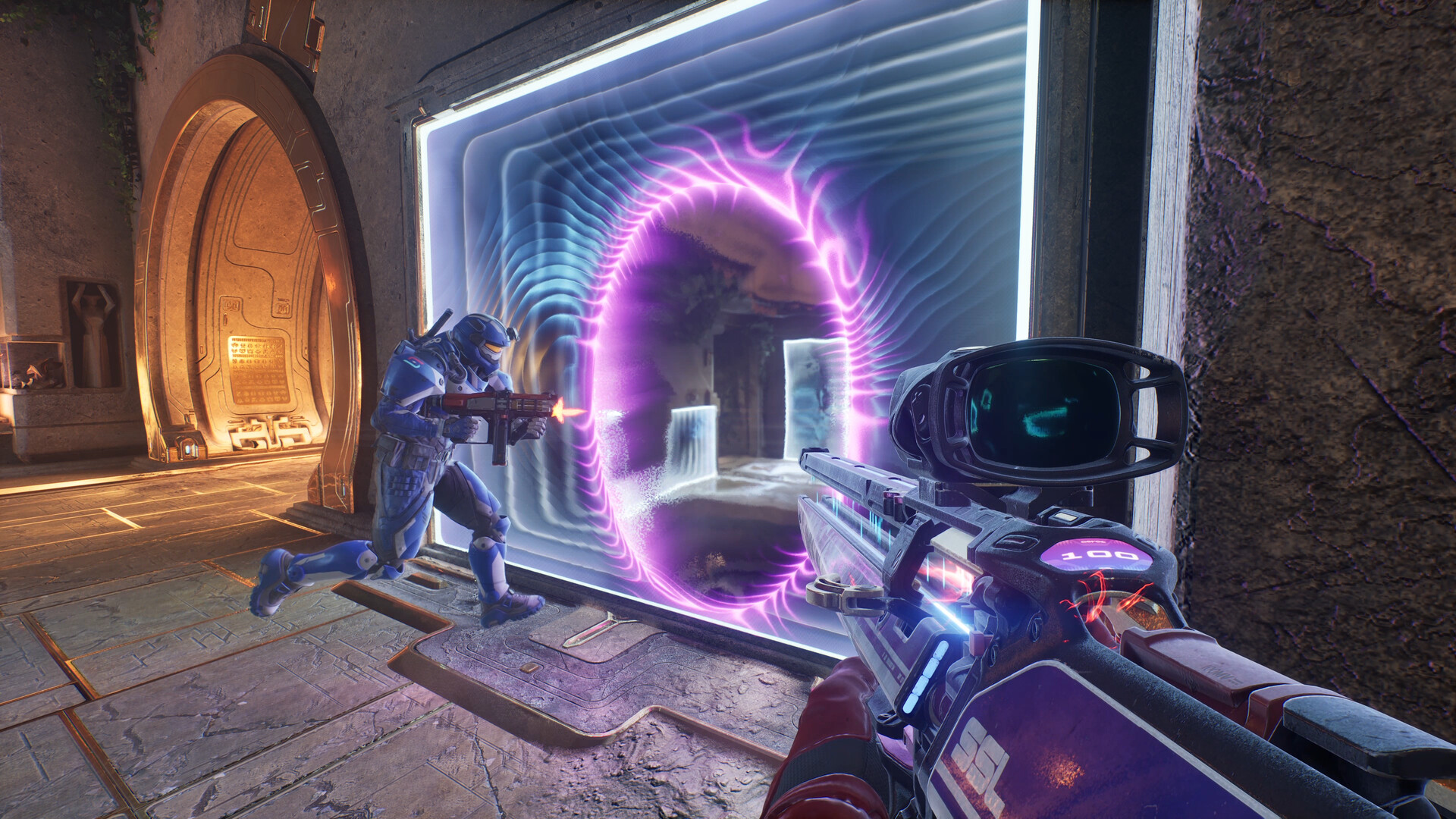
- Portal counters: Portal Overloading lets you place both portals onto a single wall to lock that surface out of play, while EMP Grenades wipe portals from a wall and temporarily hand control of it to your team. Both tools add a layer of counterplay against players who dominate with portal routes.
- Portal Trails: Lightweight trails now follow portal users, making it easier to read team movement, chase flankers, and understand where pressure is coming from.
Under the hood, weapons and movement have also been retuned. Time to Kill has been nudged upward so fights last longer than a single flinch, giving you room to react, strafe, and out-aim someone who landed the first shot. Visual recoil has been reworked across the arsenal to look smoother and interfere less with visibility, and combat readability benefits from updated audio and visual effects that better highlight when you are dealing and taking damage.
Controller support has been a focus. Aim acceleration issues that plagued earlier builds have been corrected, and overall controller “feel” has been tightened to be more predictable, which matters in a game where snap-aiming through portals is a core skill.
Performance and engine tuning on older hardware
Underneath the game’s systems, a long list of optimizations targets frame stability rather than headline visual upgrades. Work inside Unreal Engine and the studio’s own tech stack boosts framerates during hectic firefights and respawn waves, with last-gen consoles and lower-end PCs seeing the most noticeable gains.
Map and asset audits trimmed unnecessary rendering and memory use. Shaders and effects are now prepared more reliably to avoid stalls mid-match, and hitching and micro-stutters have been substantially reduced. The overall effect is a game that feels more consistent from spawn to scoreboard, which directly supports the higher-skill, longer-TTK gunplay the team is pushing toward.
Modes, Classic Arena, and the new matchmaking flow
Modes in Arena Reloaded are structured around one big idea: give players control over what they queue for, without fragmenting the player base too thin.
- Classic Arena: A dedicated mode where everyone spawns with the same fixed loadout — an Assault Rifle and a Carbine — mirroring the original Splitgate. There are no custom loadouts here; the advantage comes from map knowledge and portal usage.
- Mode Select: A new selector lets you choose which modes you are willing to play in Quickplay and selected playlists. At launch, you must opt into at least three modes so matchmaking can still find active games quickly.
- Multi-Queue: You can queue for several playlists at once, and the system will match you into whichever pops first. A cumulative XP bonus encourages opting into multiple playlists instead of hard-locking one mode.
- Quickplay expansions: FFA Deathmatch, Shotty Snipers, Team SWAT, Gun Game, and Team Fiesta are now part of the standard Quickplay rotation.
- Custom Games: Custom match configurations can be saved and reused for private lobbies, which is important for communities running scrims or regular events.
Core arena-style modes like Deathmatch, Domination, Graffiti, Firecracker, Takedown, Splitball, Hotzone, and King of the Hill continue to define the competitive side of the game, with Classic Arena acting as a purist option on top.
New maps, reworks, and Practice Range
Arena Reloaded ships with 20 arenas in rotation, built from five entirely new maps and six fully reworked classics, alongside previous arenas updated for more meaningful portal routes.
| Map | Type | Key traits |
|---|---|---|
| Hammerhead | New | Set on a moving Sabrask convoy, with multilayered combat over and under massive vehicles. |
| Terra-13 | New | Mars farming complex centered on a large irrigation silo, currently the largest arena map. |
| Abyss | Return | Cavernous layout with big vertical drops and outer-ring skirmishes, cleaned up visually and slightly adjusted. |
| Karman Station | Return | Compact space outpost with tight interiors and a long central lane for portal-heavy plays. |
| Oasis | Return | Seaside arena with long sightlines, now tuned for portal overloading on chokepoint walls. |
Beyond live matches, a Practice Range lets you try weapons, test loadouts, and get comfortable with portal tech in a low-pressure setting.
Weapons: Railgun and three LMG primaries
The sandbox grows in a deliberate way rather than with a full new class of guns. Arena Reloaded introduces a single Power Weapon and three Light Machine Guns that slot into primary weapon roles.
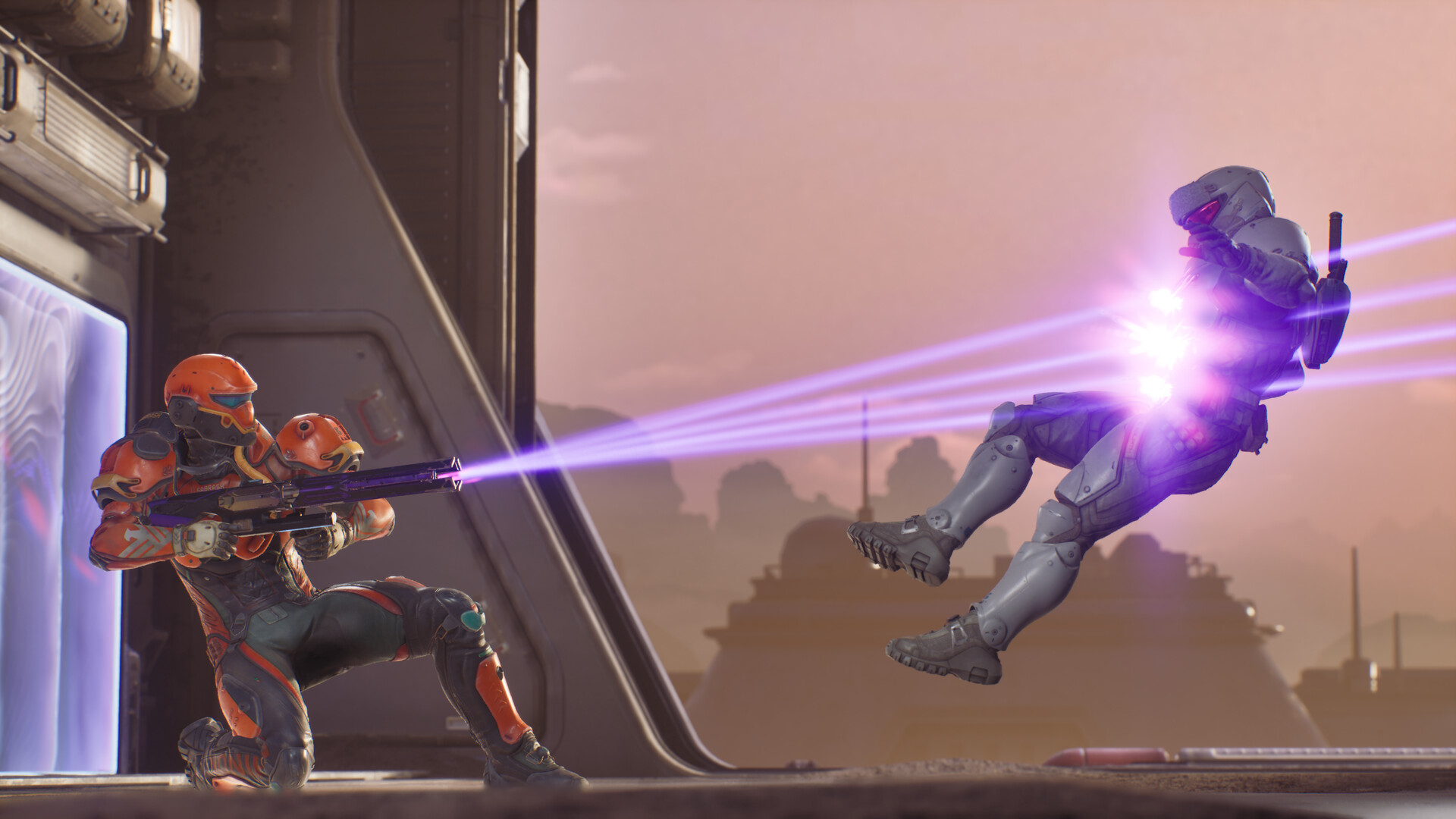
- Railgun: A map-controlled Power Weapon that charges and fires a piercing beam capable of hitting multiple targets in a line. It sits in the same mental space as classic railguns in other arena shooters — high risk when charging, high reward when timed correctly.
- Velocity: A more traditional LMG with a large magazine and strong multi-kill potential, framed as an Aeros-engineered weapon focused on sustained fire.
- Strata: A burst-fire LMG built by the Meridians that fires a distinctive four-round burst, giving it a unique rhythm compared with full-auto rifles.
- Barrage: A close-range chaingun that throws multiple projectiles in a wide spread, designed to shred opponents who push into its effective range.
Each of these weapons integrates into progression tracks with cosmetic unlocks and mastery goals, giving long-term players more reasons to specialize without introducing stat advantages that distort competitive balance.
Progression overhaul: Career Levels, Proelium, and stats
Progression is where Arena Reloaded diverges most sharply from Splitgate 2. Instead of scattered unlocks and a more opaque account level system, everything routes through Career Levels and a retooled currency called Proelium.
- Career Levels: Rookie Levels cover levels 1–75 and act as an onboarding phase that gradually unlocks weapons, equipment, perks, and other essentials. Challenger Levels stretch across 1,000 levels in 10 tiers once the core kit is unlocked, opening up prestige cosmetics and long-term goals.
- Proelium currency: Proelium is now a pure progression currency earned simply by playing — through challenges, the Battle Pass, Career Levels, and limited-time events. It can be spent on cosmetic variants for items you already own or used in the Proelium Exchange for new cosmetics.
- Player Stats: Detailed personal stats are now visible so you can track performance over time, which pairs with the overhauled Ranked system.
- Weapon cosmetics and Daily Login: Every weapon progression track now includes unlockable cosmetics, and a Daily Login reward system awards additional customization items to regular players.
Daily play now feeds clearly into visible account progression, reducing the sense of grind without relying on complex upgrade trees.
Battle Pass: linear, automatic, and longer tail
The Battle Pass has been restructured into a conventional linear track with more than 115 rewards. Instead of juggling tickets and manual spending, progress is now automatic:
- Tickets as XP: Battle Pass tickets effectively function as XP, pushing the pass forward as you play matches.
- No manual claims: You do not need to claim challenges or actively spend pass currency; rewards are granted as you hit tiers.
- Pass Epilogue and Ultra Pass: At the end of the main track, a Pass Epilogue adds extra cosmetics for players who keep grinding. An optional Ultra Pass upgrade increases the overall value of the pass, adding more premium rewards on top of the base line.
- Chapter-free progression: Rewards are no longer gated behind chapters, so you can complete the pass at your own pace without being blocked by time-locked segments.
Cosmetic quality and variety have also been stepped up across both the Battle Pass and the in-game store, with an emphasis on character and weapon skins that look more detailed than earlier offerings.
Store changes, Proelium Exchange, and Splitcoin refunds
The in-game store has been reworked to adjust for the removal of factions and to address pricing concerns.
- Cheaper bundles: Prices for most bundles have been lowered to better line up with Splitcoin currency pack sizes. For example, the Harpy Epic Bundle drops from 1295 to 1100 Splitcoin, the Wash Epic Bundle from 1460 to 1300, and the O.G. Epic Bundle from 1530 to 1400. The Astra Mythic Bundle is now split into a Yuri Mythic Character Bundle (1850) plus Vostok Mythic Weapon Bundle (1750), costing 3600 collectively instead of 4000.
- Proelium Exchange: A new Proelium Exchange tab provides a way to buy weapon cosmetics using the progression currency instead of premium Splitcoin.
- 100 Splitcoin pack: A small 100 Splitcoin pack helps players top up balances for specific purchases without buying a large bundle.
- No upgrade tax on bundles: Cosmetic upgrades that previously required extra Proelium spend are now fully included in the bundle price. Any Proelium already spent to upgrade store bundle cosmetics is automatically refunded to player accounts.
- Extended availability: Bundles remain purchasable for the rest of a season even after rotating out of the main store carousel, and can be bought via customization menus.
On top of these adjustments, Splitcoin reimbursements are being rolled out automatically to players who bought affected items at higher original prices. Most refunds fall between 50 and 400 Splitcoin per applicable purchase, credited directly in-game.
Ranked system and leaderboards
Ranked play has been rebuilt to be less opaque and more accurate in placing players of similar skill into matches.
- New skill system: A bespoke ranking model underpins Arena Reloaded’s Ranked, replacing earlier implementations that struggled with volatility and clarity.
- Placement matches: Each Ranked season starts with 10 placement matches to more quickly zero in on your appropriate rank. This launch includes a soft skill reset, so the first weeks will naturally feel a bit more unstable until the system gathers enough matches per player.
- Ranked Leaderboards: Global and possibly regional leaderboards highlight top performers, creating a public ladder for the most dedicated players to chase.
The combination of better performance, longer TTK, and improved input feel should make Ranked more readable moment to moment, which matters when every gunfight affects rating gains or losses.
Audio redesign and match atmosphere
Audio work in Arena Reloaded goes beyond new menu sounds. The design aims to make positional awareness easier while giving matches a stronger sense of being watched in an arena.
- Music refresh: All in-game music has been updated to better match the high-energy, sports-like framing of Splitgate’s arenas, with new musical cues for the closing phases of specific modes.
- Crowd audio: Dynamic crowd noise responds to match events, and a dedicated volume slider lets you decide how prominent that ambience should be.
- Footsteps and movement: Enemy footstep sounds have been retuned so it is easier to track opponents, while your own movement and equipment sounds now feel more grounded and consistent.
- Portal and traversal sounds: Jump pads, portal entries, and exits now feature more detailed variations, including differences based on traversal speed.
- Threat cues: Specific audio cues call out important threats such as enemies emerging from portals, gunfire traveling through portals, and opponents flying through the air.
- UI soundscape: Menu UI sounds have been redesigned to be clearer and less fatiguing.
UI, visual identity, and MVP spotlight
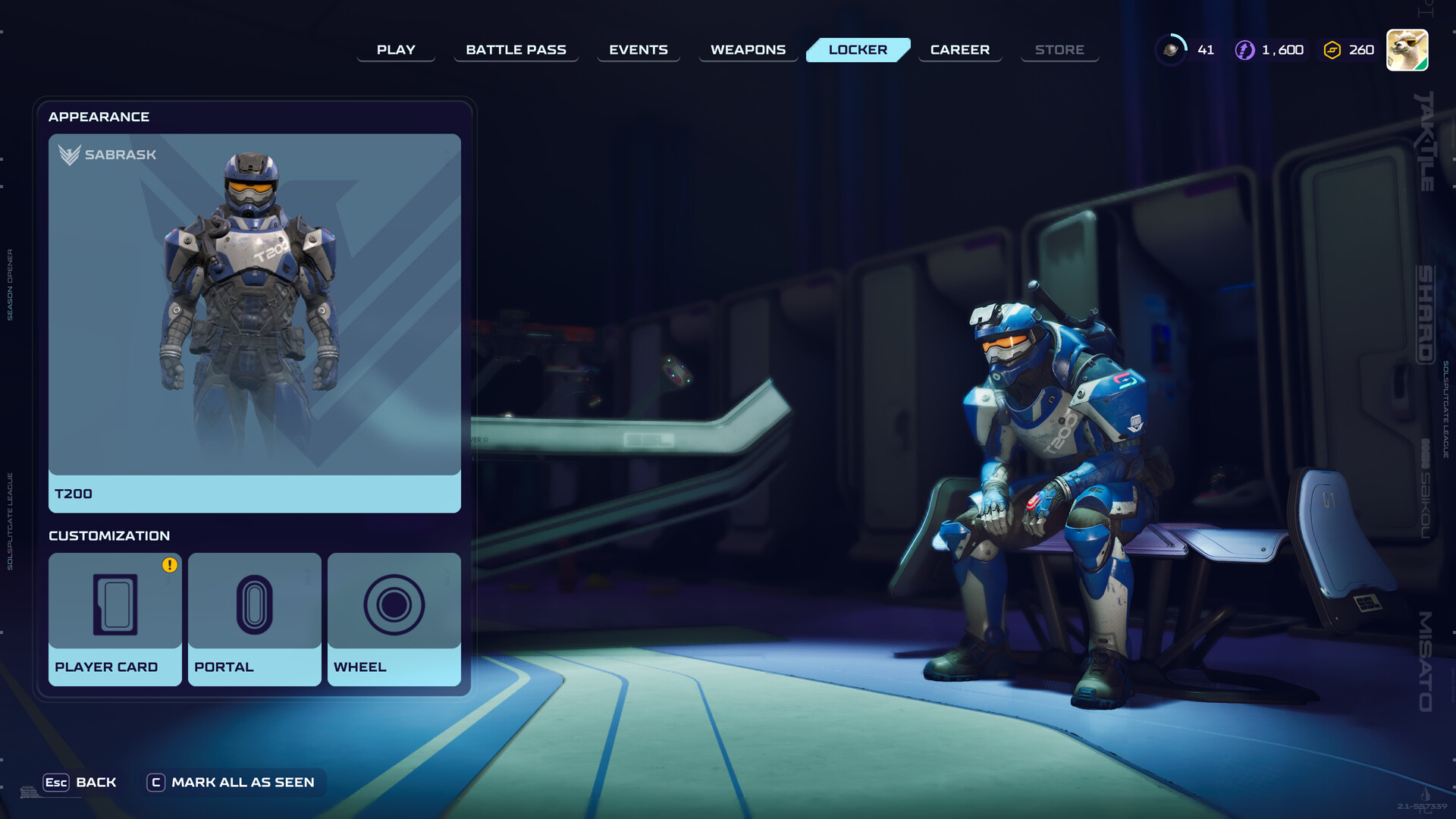
The user interface and overall presentation have shifted away from the brighter, more playful aesthetic of Splitgate 2 toward a more restrained, “classic arena shooter” look. Menus are cleaner, with faster navigation and more prominent surfacing of key features like Custom Lobbies and the Map Creator.
Post-match screens now highlight changes to your Rank, Career Level, and Weapon progression in a single flow, rather than scattering updates across multiple menus. An MVP Spotlight shows off the standout player from each match, reinforcing the game’s competitive framing.
A Refer-a-Friend feature adds shared rewards when linked players squad up and play together, offering a structured way to bring friends back into the ecosystem.
Map Creator upgrades for community builders
The Map Creator has not been left behind in the relaunch. Several updates give designers more control and better tools.
- Material swapping and props: Custom materials can now be swapped more flexibly, and additional props and meshes expand what can be built.
- Skybox and lighting options: New skyboxes and lighting presets offer greater control over mood and visibility in player-made maps.
- Gamepad controls: Creation controls on controllers have been refreshed to respond proportionally to joystick movement, easing fine adjustments.
- Color picker and property copy: A dedicated color picker and the ability to copy and paste property groups streamline iterating on designs.
The emphasis on Custom Lobbies in the main menu reinforces the idea that community maps and modes are a core part of Arena Reloaded rather than an afterthought.
The relaunch of SPLITGATE: Arena Reloaded is a clear attempt to reset expectations around what Splitgate is supposed to be. By cutting factions and abilities, re-centering on clean arena gunfights, and rebuilding the economy and progression around long-term cosmetic goals instead of layered stat systems, 1047 Games is betting that there is still room for a portal-driven arena shooter on modern platforms. The next few months of post-launch support and player response will show how well that bet lands, but the foundation is now much closer to the game that first put Splitgate on the map.