

The Misthorn set in Arc Raiders is one of those cosmetics that instantly rewires how a match feels. It’s tall, aggressively weird, and immediately readable from a distance. That’s why a single image from the Flickering Flames winter event was enough to spark pages of reactions, comparisons to everything from Jenova to Rita Repulsa, and even jokes about “headshot magnet” fashion.
Where Misthorn fits in Arc Raiders’ world
Arc Raiders is a multiplayer extraction adventure set in the Rust Belt, where Raiders climb to the surface from the underground city of Speranza to scavenge, fight ARC machines, and sometimes ambush each other. Run after run, you’re deciding how loud you want to be, when to take a fight, and how much risk you’re willing to stack before extract.
Cosmetics sit on top of that loop. You build a Raider’s identity out of a face, body type, outfit, backpack, attachments, and charms, then push that character through harsh weather, shifting map conditions, and threats like Leapers, Bombardiers, and the towering Queen. The Misthorn set drops into this framework as part of the Flickering Flames winter event, a season that also introduces a frostbite mechanic and colder visual mood topside.
What the Misthorn set looks like
Misthorn leans hard into cult horror rather than the more grounded scavenger gear that dominated the game’s early cosmetics. The core silhouette has three elements players immediately noticed:
- A gold, expressionless mask that reads almost ceremonial, like something between an Egyptian funerary plate and a space-age idol.
- High, protruding headgear – described as horns or “snail eyes” – that extend above the mask and turn the whole profile into a looming figure. Many players are already hoping those can be toggled off while keeping the mask.
- Layered, wrapped torso with a cloak, suggesting bandages or ritual garb under a shouldered mantle. The lower half is less visible in the teaser, but the general impression is of a robed hunter rather than a soldier.
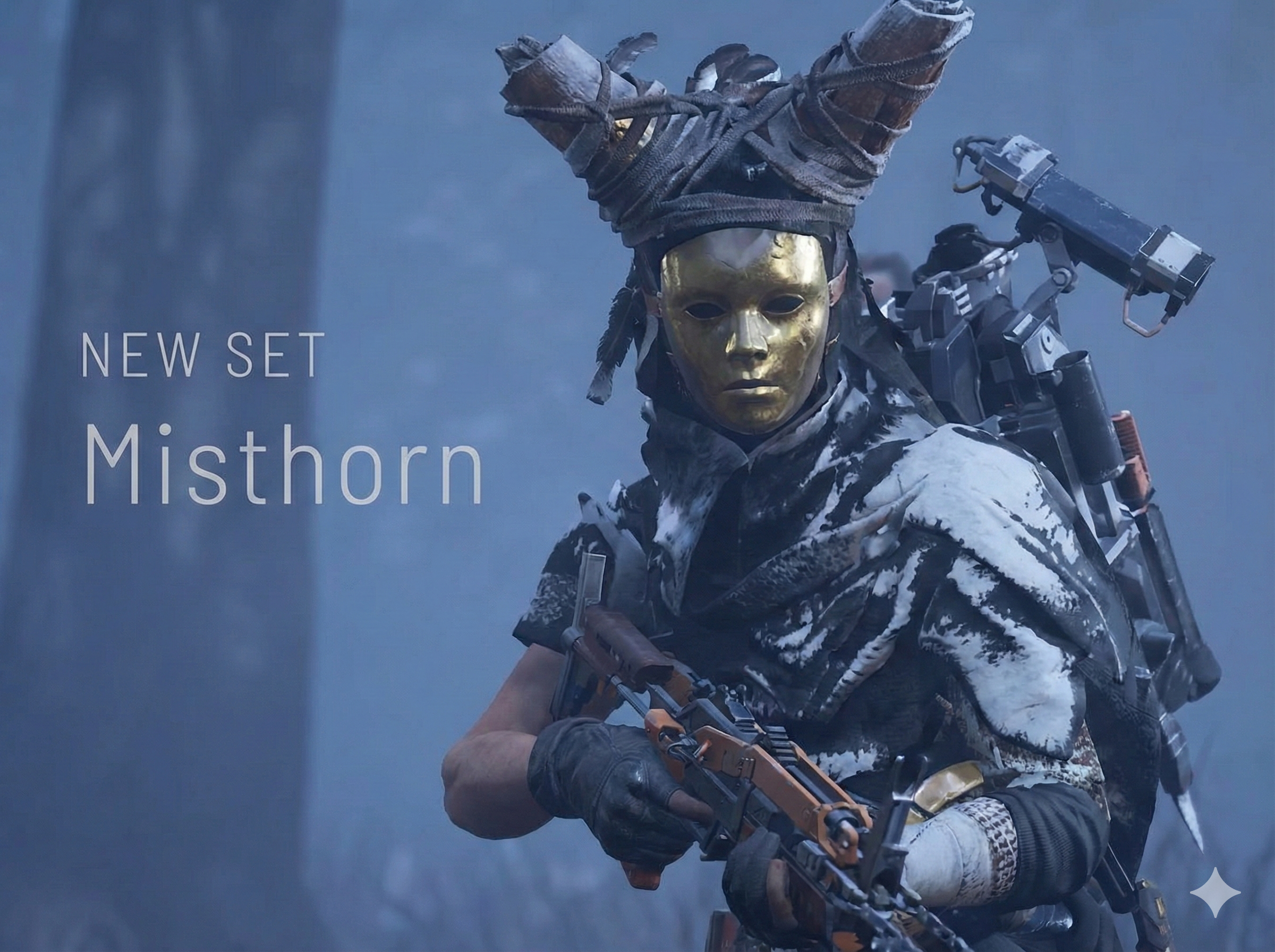
Snow appears to be built up on the shoulders and torso in the promo footage, tying the set visually to the Flickering Flames winter event. That could be a fixed cosmetic detail, or it could end up echoing the new frostbite mechanic as your Raider spends too long in the cold.
On video, Misthorn is shown looting a recently killed Raider, which is part of why players immediately tagged it as a “sweat” or “griefer/rat” outfit. The combination of unnerving mask, ritual styling, and predatory context gives it a very specific identity before anyone even equips it.
How to get Misthorn
Misthorn is tied to the Flickering Flames winter event window. The early look comes from a developer video, and players expect it to land with a regular weekly refresh rather than as a quest reward.
So far, the community discussion leans toward Misthorn being a shop cosmetic rather than a Raider Deck (battle pass–style) reward. That tracks with how other high-impact outfits have appeared: Decks handle long-term progression cosmetics you unlock with Cred by completing Feats and leveling, while the in-game store rotates more standalone sets that can be purchased directly with Raider Tokens.
Event timing and store placement can shift, but if you want Misthorn specifically, the practical takeaway is simple: log in during Flickering Flames, watch the store refreshes, and be ready with premium currency rather than expecting it to be buried in a Deck page.
Customization options players expect
Arc Raiders already allows a surprising amount of per-piece tweaking on outfits. Many cosmetics let you toggle hoods, helmets, goggles, and small attachments without losing the underlying torso or legpieces. That history is why players are almost certain Misthorn will let you separate mask and headgear.
Two expectations stand out:
- Mask-only configuration – keeping the gold faceplate while removing the large horns/head extensions, for players who like the horror aesthetic but don’t want the extra vertical profile.
- Full “cultist” profile – running the entire set as shown in the teaser, likely paired with more muted backpacks so the head remains the focal point.
There’s also a quieter but important concern about pants. Earlier outfits have occasionally paired strong upper-body designs with less-loved legpieces, so some players are waiting to see Misthorn’s full model before committing Raider Tokens.
Does Misthorn change your hitbox or stealth?
The first mechanical question any oversized helmet draws in a PvPvE game is whether it affects where bullets land. Arc Raiders’ existing cosmetics already include bulky helmets and hoods, and those do not expand the underlying hitbox. Misthorn is expected to follow the same rule: the horns make you more visible, not easier to register a hit on from the game’s point of view.
Visibility is a different story. Misthorn is bright, tall, and visually noisy around the head. In tight interiors, those horns will stick up over cover that a low-profile helmet would hide behind, and in dark forests they’ll silhouette more easily against sky or distant firelight. That’s why so many players describe the set as “pay to lose” or a “headshot magnet.”
It’s also why a lot of people say they’ll run it anyway. Arc Raiders is as much about performance as it is about personality; some players already queue into Dam Battlegrounds wearing bright orange jumpsuits. Misthorn is being adopted as the new “I’m here to cause trouble” skin long before it hits the store.
Community reactions and pop culture echoes
Misthorn hits a very specific visual frequency, and players immediately triangulated it against other genre touchstones. A few of the comparisons being thrown around:
- Brandon Sanderson’s Mistborn/Mistborn Adventure Game – the name “Misthorn” and the gold mask pulled at least one player straight to Sanderson’s world of ash, masks, and hard magic systems. It’s not an official crossover, but it shows how quickly cosmetics can evoke other IP, the same way a Mistborn skin in Fortnite pushed players toward the novels.
- Rita Repulsa and other “evil space witch” designs – the towering headpiece and theatrical mask instantly reminded people of ’90s tokusatsu villains. That led to calls for more overt “character archetype” cosmetics, like Alpha 5–adjacent looks for support-focused players.
- Jenova and other JRPG horror icons – the golden, almost biological plating on the mask reads a bit like the unsettling faces in Final Fantasy and other sci‑fi fantasy series.
- Wendigo and feral cult imagery – several players saw Misthorn as a first step toward “raider cult” aesthetics: hunters in animal masks and ritual wraps who live topside rather than commuting back to Speranza.
Those echoes matter because Arc Raiders is still defining its visual vocabulary. The base game emphasizes grounded hardware, scrap tech, and utilitarian clothing. Misthorn stretches that into more gothic, ritualized territory without leaving the world entirely. Where some players worry that it feels “too fantasy,” others are excited to see the art team experiment this far from default military gear.
How Misthorn plays against Arc machines and other Raiders
Once Misthorn is live, it will collide with the game’s core loop: dropping into locations like Dam Battlegrounds, Buried City, Acerra Spaceport, or Blue Gate; picking routes around ARC patrols; and looking for an opening to steal, third-party, or just survive long enough to extract.
A few practical effects the set will have on that loop:
- Psychological pressure – turning a corner and seeing a silent gold mask leaning over a fresh corpse is a very different emotional beat than encountering a standard scavenger model. Cosmetics can’t change damage numbers, but they can absolutely amplify intimidation or signal playstyle.
- Fewer “non-aggression” assumptions – players are already joking that Misthorn is incapable of sending a “hey, don’t shoot” message. In a game where ad‑hoc truces sometimes form, certain outfits become informal social signals. Misthorn is headed for the opposite category: the default “kill on sight” costume.
- Role‑play fuel – some squads are planning to run full Misthorn trios, form “cults” topside, and lean into proximity chat with chants and ritual behavior. That kind of self-imposed fiction fits naturally into an extraction game with loose faction structure and open-ended PvP.
Mechanically, nothing about Misthorn changes how you push on ARC machines like Ticks, Snitches, Leapers, or the Queen. But Arc Raiders is designed around emergent encounters where human unpredictability is as important as AI. Outfits that change how others read you can shift who hesitates first, who retreats from a downed body, or who tries to negotiate instead of opening fire.
Why a single outfit matters for Arc Raiders’ future
Misthorn lands at an interesting moment for the game. The official overview of Arc Raiders highlights customization freedom as one of its four pillars, alongside ARC boss fights, extraction tension, and UE5‑driven visuals. Cosmetics are not just decoration; they’re a primary way players express neighborhood allegiances, imagined factions, and playstyles in a city where Raiders already come from competing districts.
The reaction to Misthorn shows a few things about where the community wants the game to go:
- Deeper role‑play hooks – players are asking for more primitive, cult, and animal‑mask sets that match pilgrimage markers on Blue Gate and the idea of feral topside factions. Misthorn is being read as a proof of concept for that direction.
- Stronger cosmetic identity tied to factions – threads around Misthorn quickly veered into calls for Raider factions with bespoke looks, similar to sponsor systems in other Embark games. A set this distinctive would fit naturally as a signature outfit for a particular crew, not just a one‑off store drop.
- Comfort with “pay to lose” fashion – for many players, the appeal of wild skins outweighs minor stealth disadvantages. That gives the studio room to push silhouettes and colors even further without worrying that the community will only buy low‑profile gear.
On paper, Misthorn is just another cosmetic set tied to a seasonal event. In practice, it’s a visible sign that Arc Raiders is comfortable mixing grounded scavenger fiction with stranger, more ritualistic imagery – and that players are ready to build their own myths on top of it, even if it means painting a target on their heads.