

The Headwinds (Update 1.13.0) patch for Arc Raiders adds two new Epic augments: Looting Mk. 3 (Safekeeper) and Tactical Mk. 3 (Revival). Both sit on top of the existing augment ecosystem and target two things players care about most in an extraction shooter: keeping rare gear safe and staying alive long enough to extract it.
Quick answer: Looting Mk. 3 (Safekeeper) gives you a safe pocket that can hold any item, including full weapons, while Tactical Mk. 3 (Revival) combines Combat Mk. 2-style passive healing with an integrated, reusable defibrillator on a four-minute cooldown.
What Looting Mk. 3 (Safekeeper) Does
Looting Mk. 3 (Safekeeper) is an Epic looting augment built around one headline feature: a safe pocket that accepts any item type, including guns. That is the key difference from previous augments, which restrict safe pockets to smaller items like consumables, ammo, or materials.
Safekeeper also functions as a high-capacity looting augment. It increases your overall backpack space and offers trinket slots, while supporting heavier shield options.
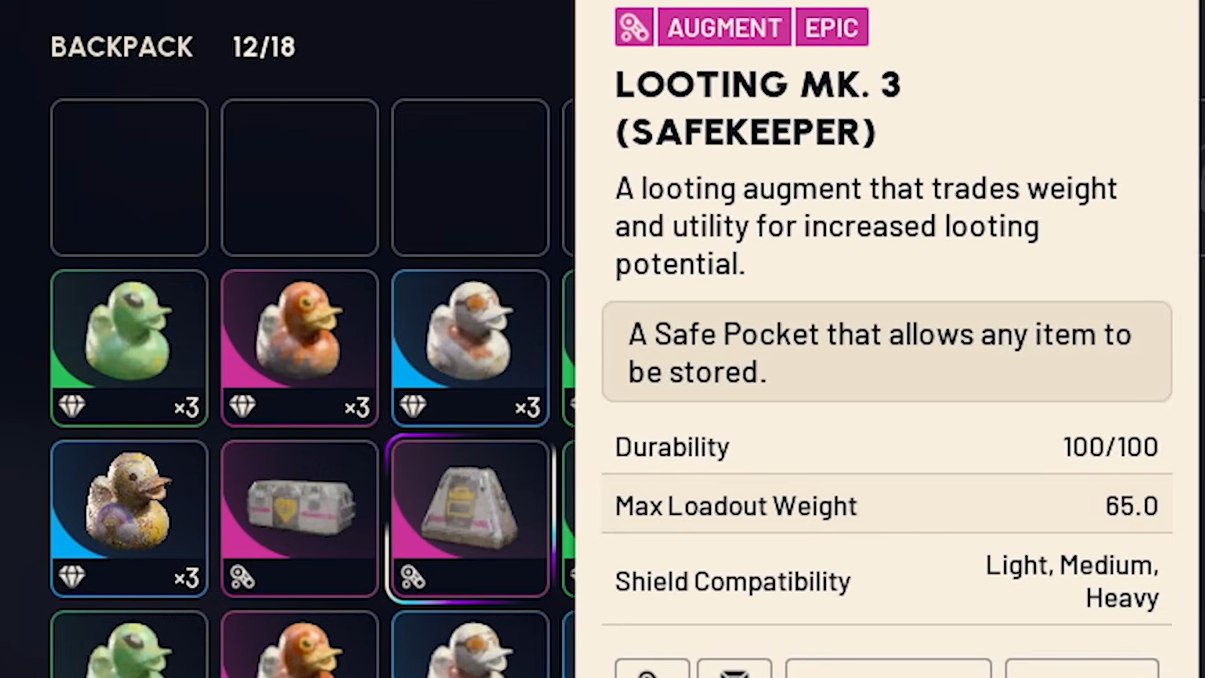
Looting Mk. 3 (Safekeeper) key properties
The exact layout is tuned around trading off some utility for more loot capacity and that universal safe pocket. In practical terms, players can expect:
- One safe pocket that accepts any item (including full weapons)
- High backpack capacity for regular inventory
- Two trinket slots
- Support for all shield types up to Heavy
Safekeeper behaves like a heavier-weight looting augment: more carrying power and flexibility at the cost of some utility slots compared to the most efficient all-around options.
How The “Any Item” Safe Pocket Works
The central mechanic of Safekeeper is that single safe pocket with no item-type restriction.
With Safekeeper equipped, you can move a weapon or any other item into the safe pocket during a raid. Anything in that slot is protected on death, just like regular safe pocket contents on other augments.
That means you can secure:
- Legendary boss weapons (Equalizer, Jupiter, etc.)
- Fully kitted high-tier rifles or shotguns
- Expensive attachments and shield units
The trade-off is volume versus flexibility. Looting Mk. 3 (Survivor), for example, gives three conventional safe pockets, but none of them can hold weapons. Safekeeper drops to one safe pocket, but that single slot can secure your most valuable gun or other large item.
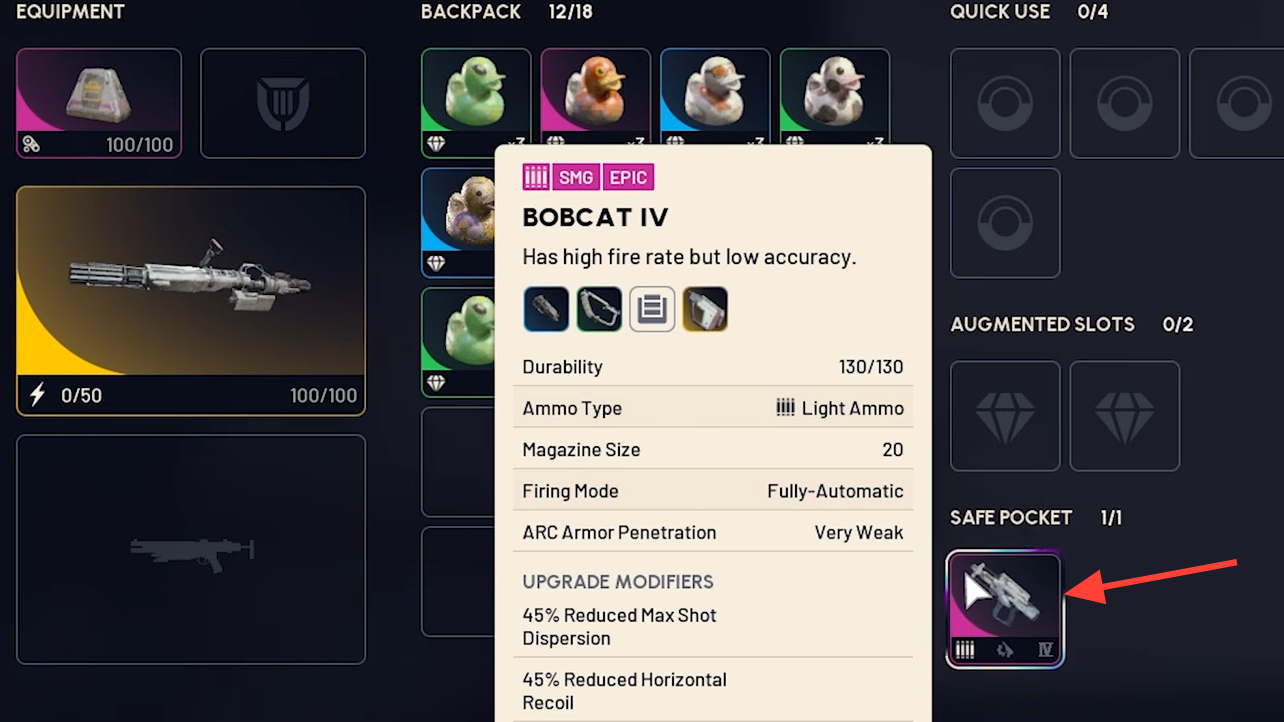
Best Uses For Looting Mk. 3 (Safekeeper)
Safekeeper is not designed as a straight upgrade over other looting augments; it specializes in runs where one item matters more than raw stash growth.
High-stakes PvE boss runs
Safekeeper shines in encounters with high-value drops where the main risk is losing an expensive, specialized weapon:
- Bringing a legendary or otherwise rare weapon to Queen/Matriarch events
- Running boss-focused trials with a single, heavily invested gun
You can commit that weapon to the fight knowing you can secure it in the safe pocket if the situation collapses and extraction becomes unlikely.
Protecting fully kitted PvP guns
For PvP-focused players, Safekeeper can mitigate losing a fully modded primary:
- Carry two strong weapons, but plan to stash the more valuable one in the safe pocket if the fight turns against you.
- Use a cheaper backup gun as your “finish the raid” weapon once the main gun is secured.
Execution speed matters. On mouse and keyboard, it is easier to flick an item into the safe pocket mid-fight; on controller, you may need to pre-plan your backpack layout and keep the pocket empty so you can quick-send a weapon with minimal input.
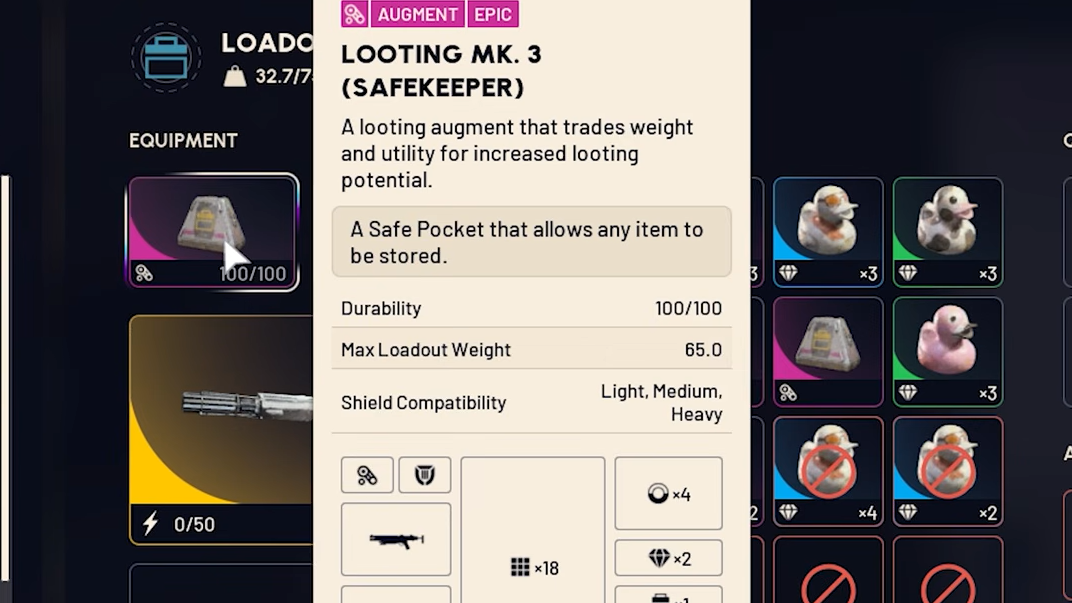
When Safekeeper is weaker than other augments
Safekeeper is a poor fit when your priority is pure economy:
- Early progression when you care more about filling your stash with diverse loot than protecting a single gun.
- Farming expeditions where three regular safe pockets (Looting Mk. 3 (Survivor)) give more total value protection by covering multiple stacks of rare materials, cores, or high-quality attachments.
If you already own blueprints for most weapons and attachments and can cheaply replace gear, the universal safe pocket becomes more of a quality-of-life perk than an essential safety net.
Tactical Mk. 3 (Revival) Augment Explained
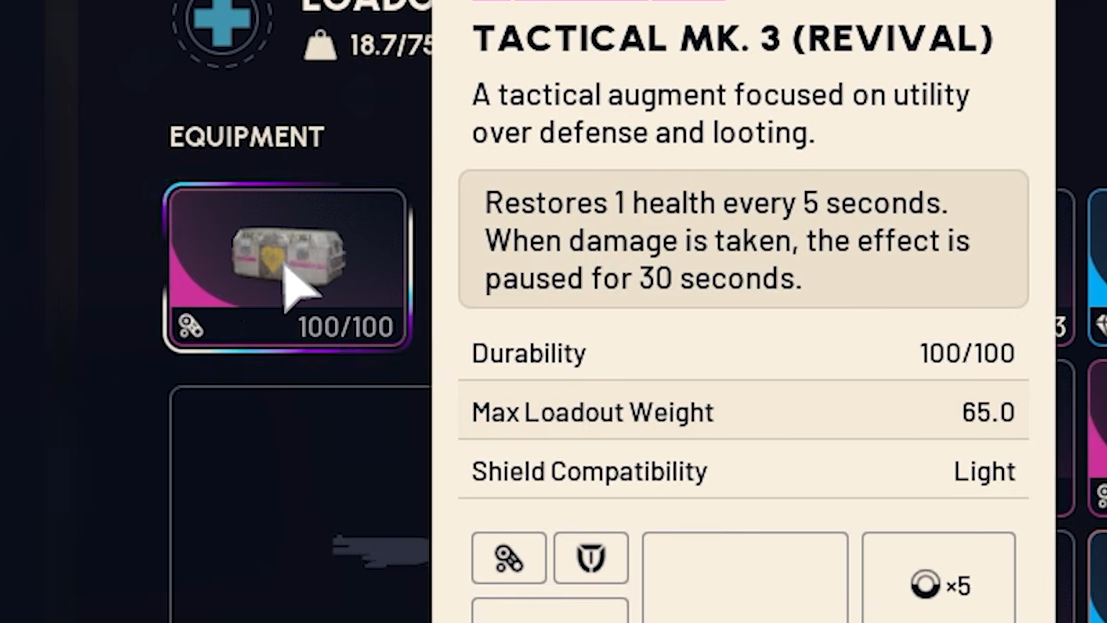
Tactical Mk. 3 (Revival) is an Epic tactical augment that merges passive sustain with built-in revival utility.
It inherits the same passive effect as Combat Mk. 2:
- Restores 1 health every 5 seconds
- Healing pauses for 30 seconds after taking damage
On top of that, Revival includes an integrated, reusable defibrillator tied to a long cooldown.
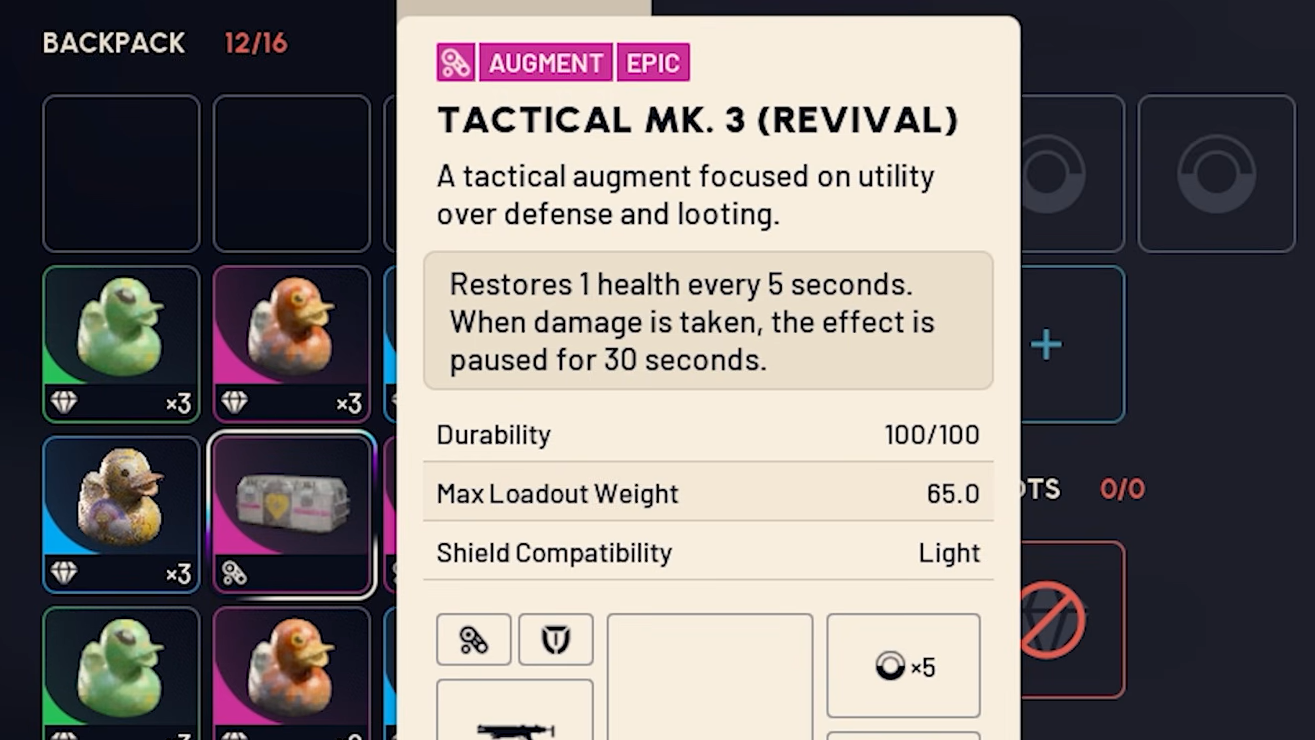
Tactical Mk. 3 (Revival) key properties
- Passive HP regeneration (1 HP / 5s, paused on damage for 30s)
- Integrated defibrillator with a 4-minute cooldown
- Two safe pockets (standard, not weapon-safe like Safekeeper)
- Light shield compatibility only
- Moderate backpack slots compared to other Mk. 3 tacticals
The light-shield restriction is the main structural limitation. You gain survival tools over time but sacrifice access to medium or heavy shields, which many players consider mandatory in endgame PvP or high-intensity PvE.
How The Integrated Defibrillator Works
The integrated defibrillator behaves like a built-in, infinite-charge defib item with a long recharge:
- Usable to revive downed Raiders without consuming a carried defib item
- After use, goes on a 240-second (4-minute) cooldown before it can be used again
- No hard limit on total uses within a raid, as long as you respect the cooldown
In practice, the cooldown is long enough that you cannot rely on it as your only revival option during hectic fights. Squad-focused players typically still benefit from carrying extra defibs in their safe pockets or backpack to handle multiple downs in quick succession.
When Tactical Mk. 3 (Revival) Is Worth Using
Revival sits in an awkward spot between quality-of-life and hard survival, but it does have specific niches.
Small squads and support-focused players
Revival suits players who frequently take responsibility for keeping a team on its feet and value not having to remember a separate defib slot:
- Duo or trio squads where one player plays “combat medic,” staying slightly back and focusing on revives.
- Players who forget to restock defibs between runs and want safety against that oversight.
The passive healing also reduces bandage usage between fights, especially in PvE-heavy expeditions with frequent chip damage rather than continuous pressure.
Why many players prefer alternatives
Compared to running Looting Mk. 3 (Survivor) or other strong Mk. 3 augments plus a stack of defibs, Revival pays several opportunity costs:
- Only light shields, which are fragile in high-level content.
- The same passive healing is already available on Combat Mk. 2 without the shield restriction.
- A 4-minute cooldown on the integrated defib is long enough that most squads still want multiple crafted defibs on hand.
For many builds, dedicating a safe pocket to three defibs on a more flexible augment gives more reliable revival throughput while preserving access to stronger shields and better slot distributions.
How The New Augments Fit The Existing Augment Roster
To understand whether to adopt the new augments, it helps to compare them to the established Mk. 3 options.
| Augment | Role | Safe Pocket Behavior | Shield Types |
|---|---|---|---|
| Looting Mk. 3 (Survivor) | High-value stash growth | 3 safe pockets, small items only | Light or Medium |
| Looting Mk. 3 (Cautious) | Scouting and general looting | 2 safe pockets, small items only | Light |
| Looting Mk. 3 (Safekeeper) | Protecting a single critical item | 1 safe pocket, can hold any item (including weapons) | Up to Heavy |
| Combat Mk. 3 (Aggressive) | Grenade-heavy fighting | 1 standard safe pocket | Light, Medium, or Heavy |
| Tactical Mk. 3 (Defensive) | Shield-focused utility | 1 standard safe pocket | Light, Medium, or Heavy |
| Tactical Mk. 3 (Healing) | Healing item focus | 3 safe pockets | Light or Medium |
| Tactical Mk. 3 (Revival) | Revive utility and passive healing | 2 standard safe pockets, integrated defib (4 min CD) | Light only |
Safekeeper is clearly positioned as the boss- or treasure-run specialist: one weapon-safe slot and all shield options. Revival, by contrast, is a hybrid support pick that trades shield flexibility for passive sustain and a cooldown-based revive tool.
Other Headwinds Update 1.13.0 Changes That Affect Augment Choices
Several surrounding changes in Update 1.13.0 indirectly influence how attractive these augments feel.
- Solo vs Squads matchmaking gives level 40+ solo Raiders a toggle to queue into squad lobbies with a flat +20% XP payout on both successful extracts and deaths. Higher-risk PvP lobbies can make Safekeeper more appealing to protect a single top-tier gun.
- Trophy Display, a long-term project tracked across expeditions, rewards blueprints, Raider Tokens, a howl emote, a guitar, and 300,000 coins for full completion. The coin influx reduces pressure to protect every mid-tier weapon but makes saving extremely expensive builds more sensible.
- Bird City adds a permanent Buried City map condition focused on rooftops, birds, trinkets, more flying ARC, and more player proximity. The increased PvP risk around high-ground loot spots is another environment where securing one rare weapon with Safekeeper can matter.
- Higher-tier weapons in weapon cases raise the ceiling on what you can find mid-raid, giving more opportunities for Safekeeper to lock in a sudden high-value find.
- Reduced reactor drop chances from Queen and Matriarch armor pieces make crafting some legendary weapons more resource-intensive, which in turn boosts the value of any augment that can consistently protect those guns once you obtain them.
Together, these changes tilt the economy slightly toward fewer, more valuable items rather than endless duplication of the best weapons. Safekeeper’s universal safe pocket aligns with that direction.
Which New Augment Should You Prioritize?
If you mainly want one of the new augments and need to choose where to focus your effort:
- Looting Mk. 3 (Safekeeper) is the higher-impact and more broadly useful option. It meaningfully changes how you approach legendary and fully kitted weapons by letting you secure an entire gun or other large item.
- Tactical Mk. 3 (Revival) is more niche. It improves comfort and adds backup revival in squads that can live with light shields and already use Combat Mk. 2’s passive healing, but it does not dramatically alter how you play.
For most players, Safekeeper is worth targeting first for high-risk boss content and weapon-heavy PvP runs. Revival is best treated as a specialist pick for support-minded players who prioritize passive regen and an always-on, if infrequent, revive option over raw durability.