

Coal and charcoal sit at the foundation of Hytale’s crafting economy. They are not flashy late‑game loot, but without a steady supply of fuel, mining stalls, metal bars never smelt, and a lot of machinery simply does not run.
Coal, charcoal, and fuel in Hytale
Hytale leans heavily on a classic survival loop: gather raw materials, turn them into usable resources with fuel, then use those resources to push deeper into the world. Coal and charcoal are central to that loop.
Coal appears as a mineable resource in caves and underground, much like other ores. It is a solid fuel that powers smelting and machinery. Anywhere recipes or machines call for “fuel” rather than a specific item, coal is one of the default answers.
Charcoal fills a similar role but comes from processing wood rather than mining. It lets you convert renewable materials like logs into a dense fuel source, which is crucial when you either do not want to go caving yet or have exhausted easy coal veins near your base.
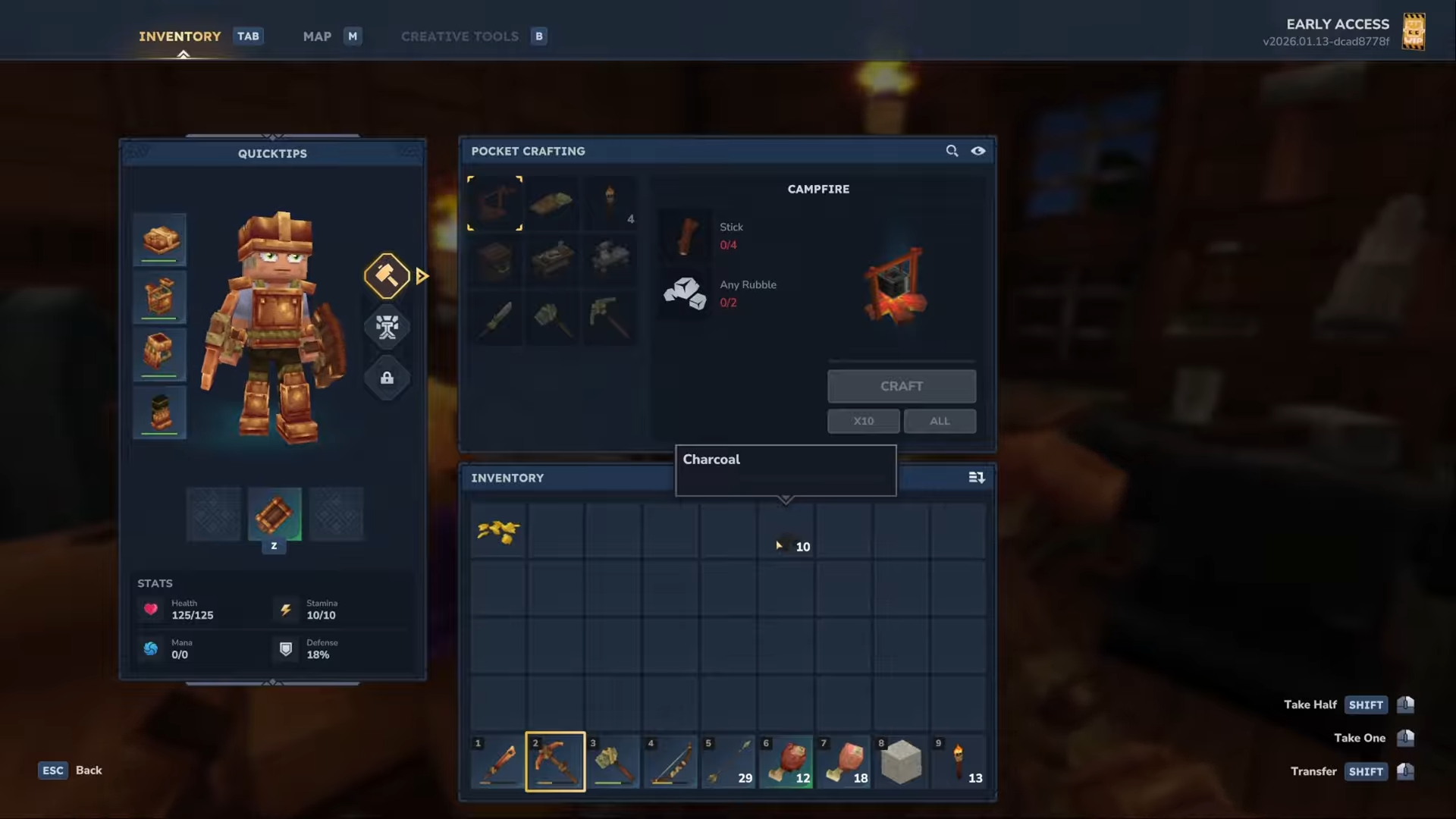
Both items plug directly into the broader ore and bar system. Ore blocks are extracted from the world, then refined into bars using furnaces or other processing devices, with coal, charcoal, or logs acting as the input that makes that transformation possible.
How ore, bars, and fuel connect
Hytale treats ore as a category rather than a single block. Ore is any naturally occurring material that can be refined into metal bars. Those bars then become the backbone for tools, weapons, armor, and higher tier machinery.
The refinement step sits between exploration and power progression. You dig up ore, bring it back to a base or outpost, then pay a fuel cost to smelt it. Coal and charcoal are what cover that cost:
- Smelting ore into bars consumes fuel in furnaces or other smelting devices.
- Secondary processing such as crushing ore into powder for efficiency upgrades also relies on fuel like coal or logs.
- Automation and late‑game machines continue to depend on a steady fuel supply, even as recipes and outputs become more complex.
That link between ore, bars, and fuel means that any serious mining or crafting plan has to include a parallel plan for coal and charcoal production. You are not just stocking metals; you are stocking the energy that turns them into something usable.
Charcoal production in Hytale
Charcoal is crafted rather than mined. The basic pattern mirrors other survival sandboxes: start with raw wood, then cook it in a structure or device that turns it into charcoal instead of ash.
Step 1: Gather logs or wooden blocks from trees. Any early forest biome gives you what you need here, and this step is often your first reliable access to fuel.
Step 2: Place the logs into the relevant crafting device alongside a fuel source. The device then processes the logs over time into charcoal.
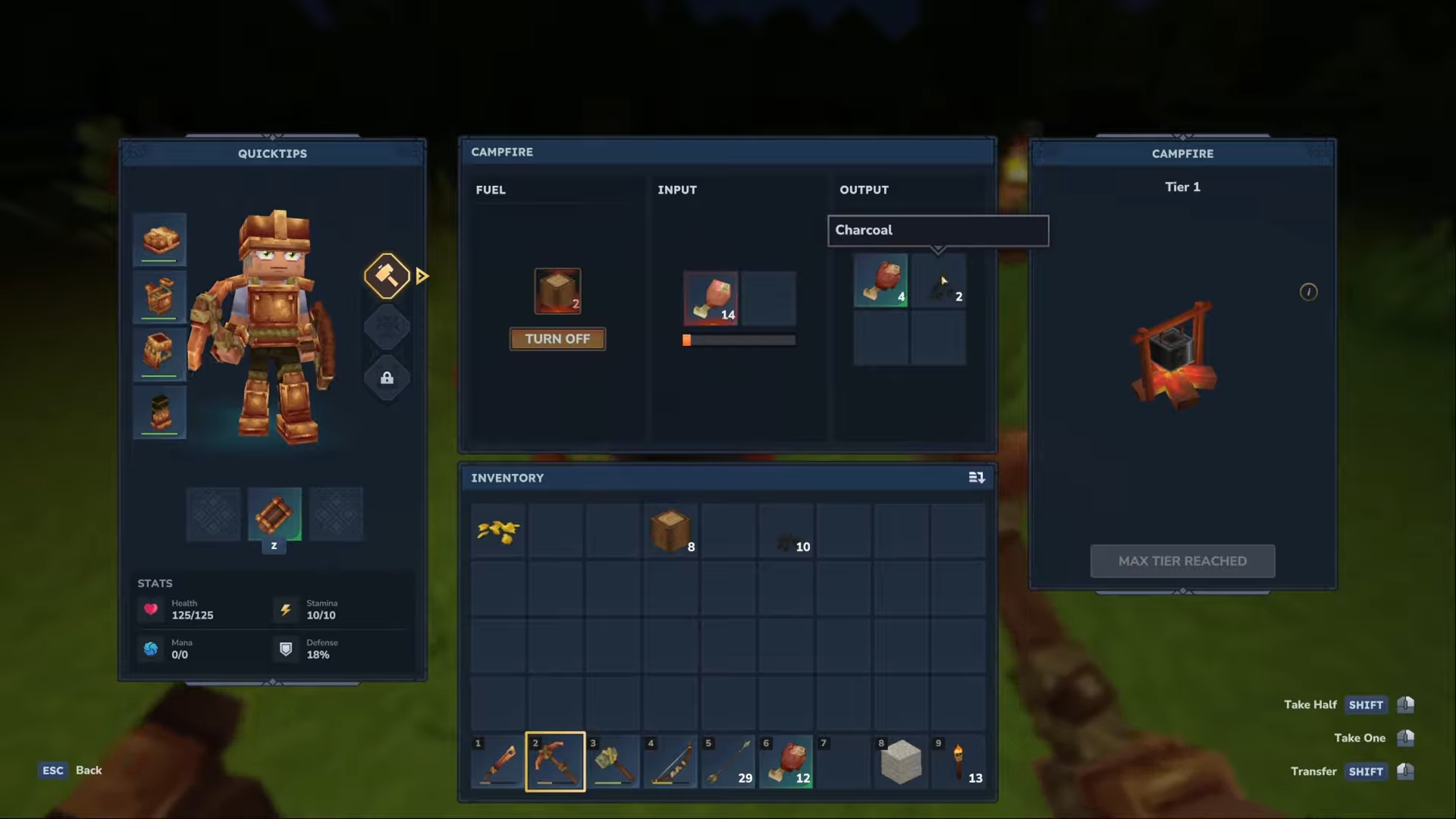
Step 3: Collect the finished charcoal and move it into furnaces or machines that require a compact, efficient fuel rather than raw wood.
Charcoal has two main advantages over burning logs directly. It usually burns longer or more efficiently per inventory slot, and it lets you turn common wood into a “universal” fuel for metalworking and machinery. This becomes more important as your base grows and localized coal deposits thin out.
Coal in mining and processing machines
Where charcoal is about turning trees into fuel, coal is what keeps the heavy industry running once you are deep into mining.
One clear example is an ore crushing machine that accepts fuel like coal or logs to convert raw ore into powder. Processing ore into powder effectively doubles output, as one ore block becomes two powder units, which can then be smelted or used in recipes. Coal’s role here is simple but critical: without it, the machine does nothing.
This pattern repeats across Hytale’s tech stack:
- Coal powers furnaces that smelt ore into bars.
- Coal or logs fuel crushers and similar devices that improve the efficiency of mining runs.
- Any future machinery with a generic “fuel” input can be assumed to accept coal, placing constant pressure on your coal supply as your infrastructure scales up.
Coal is therefore not only a starter resource. It scales with your ambitions. The more metal you want, and the more you rely on powered machines to process it, the more coal you burn in the background.
Where coal fits into exploration and caves
Coal’s position in the ore hierarchy makes it one of the first meaningful finds when you head underground. While high‑tier metals and rare materials define late‑game gear, coal underpins your ability to sustain those deeper expeditions:
- Coal veins discovered while caving let you top up fuel on the fly instead of returning to base.
- Coal stacks back at camp become insurance that you can smelt whatever you bring home without delay.
- If you are using ore‑doubling processes like crushing, coal determines how much of your raw haul can be upgraded instead of smelted in basic form.
Over time, coal becomes a quiet resource check. You can have enough ore to craft a full set of metal gear, but if coal stores run low, everything slows down. That pressure nudges players toward planning fuel outposts near rich cave clusters and paying attention to coal veins instead of sprinting past them for shinier ore.
Coal, trains, and other fuel‑hungry transport
Discussion around Hytale’s movement systems highlights more than just running and jumping. Concept art and community expectations point toward steampunk‑style propulsion gear, parachutes, back propellers, and even simple locomotive carts. All of these ideas point to a world where fuel is just as important for movement as it is for metalworking.
For ground transport, players have floated the idea of minecarts and trains that behave more like dedicated vehicles than simple containers. The comparison to furnace‑powered minecarts in other games is instructive: you load coal or an equivalent fuel into a minecart engine, then it pulls other carts along a track without constant player input.
Translating that model into Hytale would give coal an additional job as the “battery” for rail networks. You would load a stack of coal into a cart or engine, send it off along pre‑built tracks, and let it run until the fuel burns out. In that scenario, coal stops being just a base fuel and becomes the currency that makes long‑distance infrastructure worth building.
Players also expect air‑movement gear such as propeller packs, gliders, and parachutes to be tied to fuel in some fashion. Pure, cost‑free flight tends to trivialize exploration and combat, so tying powerful mobility to resource consumption keeps it in check. Coal, charcoal, or comparable fuels are obvious candidates to limit how often players can rely on advanced movement tools.
Early‑game fuel strategy
Coal and charcoal shape how the first few hours of a Hytale world feel. A stable fuel loop is what separates a fragile camp from a functional base.
A simple early‑game pattern looks like this:
Step 1: Use wood directly as fuel while you rush to gather basic stone tools and the first ore. This keeps the loop going before coal veins are common.
Step 2: Set up charcoal production as soon as you have a surplus of logs. This gives you a buffer of compact fuel so that smelting sessions do not compete with your need for building blocks.
Step 3: Once you begin regular caving, prioritize coal runs alongside metals. When you find a dense coal pocket, mine it aggressively and stash the excess near smelting and processing stations.
This approach keeps ore processing, machine use, and any fuel‑based transport from stalling. It also means that when you unlock higher‑tier devices that burn fuel more quickly, you already have the habit of treating coal and charcoal as first‑class resources instead of afterthoughts.
Coal and charcoal may never be the most glamorous items in Hytale, but they quietly decide how fast you progress. From your first metal bar to late‑game ore processing and powered movement, they form the energy budget that everything else depends on. Treat them as core resources, and the rest of the game’s systems open up much more smoothly.