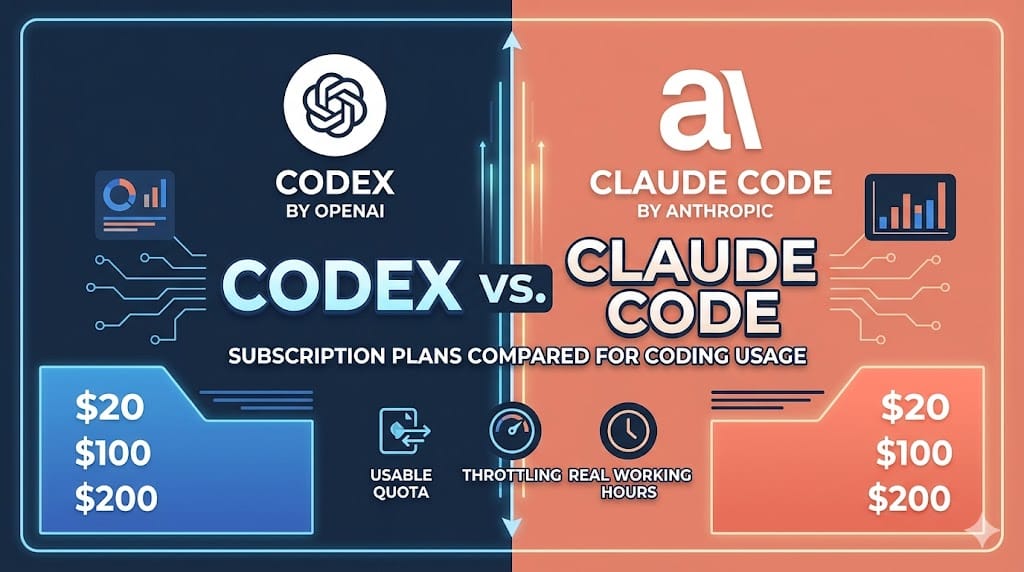
Picking between Codex and Claude Code on a paid plan mostly comes down to one question: how many hours of actual coding can you squeeze out before rate limits kick in? Both OpenAI and Anthropic run tiered subscriptions at similar price points, but the practical quota you get per dollar has diverged sharply, with Codex currently giving more usable throughput at every tier.
Quick answer: For pure usage-per-dollar on coding agents right now, Codex wins at every plan level. The $100 Codex tier is the current sweet spot, especially while its temporary usage multiplier is active. Claude Code plans deliver stronger default behavior on ambiguous tasks but hit weekly caps far faster.
Plan-by-plan comparison
Both services structure their plans around a 5-hour rolling window plus a weekly cap. The dollar amounts line up closely, but the amount of work you can actually complete inside those windows is not equivalent.
| Tier | Codex (ChatGPT Plus/Pro) | Claude Code (Pro/Max) |
|---|---|---|
| ~$20/month | Several hours of daily coding typical; weekly cap reachable in 4–5 full workdays | Roughly 20–30 minutes of active agent work before the 5-hour limit triggers; weekly cap hit after ~3 heavy days |
| ~$100/month | Currently running a boosted usage multiplier; heavy users report rarely hitting the cap | Noticeably more headroom than Pro, but still more constrained than Codex at the same price |
| ~$200/month | Max tier; practical ceiling is hard to reach for a single developer | Highest Claude tier; still reports of caching-related token burn inflating usage |
Anthropic and OpenAI both adjust these limits frequently. Codex recently tightened the Plus tier while pushing a promotional multiplier on the $100 plan. Claude shipped a model update that consumed more tokens per turn, then raised limits partially to compensate.
Which plan hits the sweet spot
The $100 Codex tier is the best value right now for a working developer. The promotional multiplier means a full day of agent-driven coding rarely exhausts the quota, and the gap versus the equivalent Claude Max tier is wide enough that side-by-side users report roughly 6–10x more usable volume on the $20 plans alone.
The $20 plan on Codex is the sweet spot for hobbyists and part-time use. You can run multi-hour sessions daily without touching the ceiling most of the time. The same $20 on Claude Code runs out inside a single focused session.
The $200 Max tiers are only worth it if you are running parallel agents, managing multiple repos simultaneously, or burning tokens on very large context windows. A solo developer on a single project will not hit the $100 ceiling often enough to justify the upgrade.
Matching the plan to how you work
Usage volume is not the only variable. The two tools behave differently, and that changes which plan is actually cost-effective for your workflow.
| User profile | Best plan | Why |
|---|---|---|
| Solo dev, full-time coding, tight specs | Codex $100 | Executes precise instructions without pushback; quota handles full workdays |
| Solo dev, exploratory work, vague prompts | Claude Max ($100–$200) | Tends to push back on bad plans and reason about trade-offs; worth the quota hit for design-heavy tasks |
| Hobbyist or weekend builder | Codex $20 | Enough headroom for multi-hour sessions without upgrading |
| Team with parallel agents or many repos | Codex $200 or Claude Max $200 | Only the top tiers sustain simultaneous sessions without throttling |
| Planning-heavy workflow, execution elsewhere | Claude $20 plus free/cheap execution model | Use Claude for plan generation, hand off code writing to a cheaper model |
| Pure value-per-dollar, intelligence secondary | Open-weight model via OpenRouter or local | GLM, Qwen, and similar models cost roughly half of proprietary APIs and avoid subscription caps entirely |
Where each tool is genuinely stronger
Codex executes literal instructions with fewer deviations. If you hand it a detailed spec, it will implement exactly that, which is why users who like tight control prefer it. The downside is that the reasoning model, at the high-effort setting, can spend a long time thinking through trivial operations like a git commit. Drop to a normal reasoning level for routine work.
Claude Code pushes back more often. It will question a plan it thinks is flawed, sometimes refuse to execute, and occasionally substitute its own approach. That behavior helps on ambiguous problems and hurts on well-scoped ones. It also burns tokens faster per turn, which is part of why the same dollar amount buys less work.
On planning specifically, reports are mixed. Some users find Codex produces more thorough plan documents when run in plan mode with a high-reasoning model. Others prefer Claude for planning because it resists executing flawed approaches. A common hybrid pattern is to draft the plan in ChatGPT or Claude, save it as a markdown file, then hand execution to Codex in plan mode.
Caveats that affect real value
Both providers have shifted limits repeatedly over recent months. The Codex $100 multiplier is a promotion, not a permanent policy. Claude’s effective quota has been complicated by reported caching issues that inflate token counts beyond what the user actually consumed.
If you commit to a plan, reassess monthly. The cheapest path today is Codex, but the gap has narrowed and widened repeatedly. For users who treat the subscription purely as a token pipe and don’t care about the default behavior of either agent, an open-weight model on OpenRouter or local hardware still undercuts both on raw cost per token.
Note: If your employer already pays for Claude Code, the calculus changes. Running a personal Codex $20 alongside a company-provided Claude Max gives you a fallback when either quota drains, and lets you pick the stronger tool per task without a second full-price subscription.