

Discord announced on February 9, 2026, that it will begin enforcing age verification worldwide with a phased rollout starting in early March. The change places every new and existing account into a "teen-by-default" mode, restricting access to age-gated servers, sensitive content, and certain communication settings until a user completes a one-time age check. The platform, which has more than 200 million monthly active users, already tested this system in the United Kingdom and Australia throughout 2025. The global expansion makes it one of the most aggressive age-verification deployments by a major social platform to date.
Quick answer: Starting in March 2026, you will need to verify your age through a video selfie (facial age estimation) or a government-issued ID scan if you want to access age-restricted Discord servers, unblur sensitive content, modify content filter defaults, or change message request settings. Most everyday features — DMs, non-restricted servers, and voice chat — remain unaffected without verification.
What triggers the age verification prompt
Discord will not ask every user to verify the moment they log in. The prompt appears only when you try to do one of the following for the first time:
- Unblur content flagged by Discord's Sensitive Media Filter
- Change the default Sensitive Media Filter settings (which blur content in friend DMs and server channels, and block content from unknown senders)
- Access an age-restricted (18+) channel, server, or app command
- Turn off the Message Request inbox, which routes DMs from unknown users into a separate folder
- Speak on a Stage channel inside a server
If you never interact with age-gated content or try to change those default settings, you may never see the prompt at all. Discord's global head of product policy, Savannah Badalich, has stated that "a majority of people are not going to see a change in their experience" because most users are not actively seeking explicit or graphic material.
How the two verification methods work
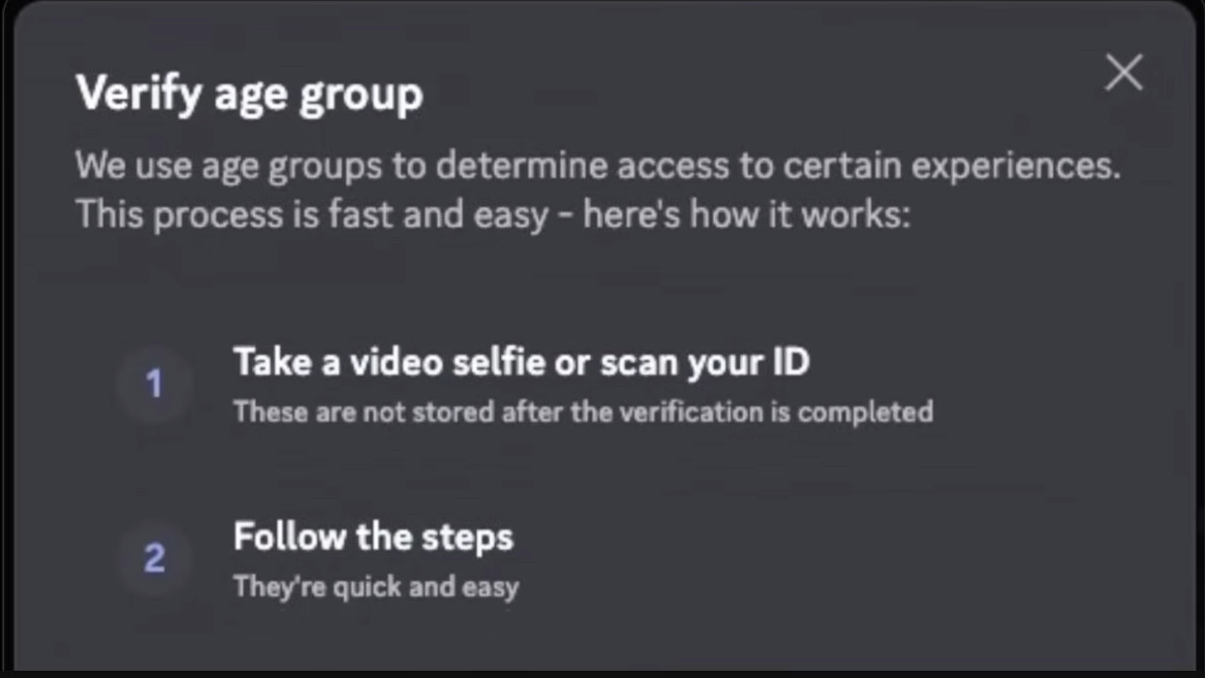
Option 1 — Face scan (facial age estimation). You select "Take a selfie" inside the verification window, grant camera access, and record a short video selfie. An on-device AI model estimates whether you fall into the "teen" or "adult" age group. Discord says the video never leaves your device — the model runs locally, and no facial imagery is uploaded to Discord's servers or shared with a third party. If the estimate is wrong, you can appeal and switch to the ID method.
Option 2 — Government ID scan. You select "Use your ID," scan a QR code with your phone, photograph a government-issued ID on a flat, dark surface, and then take a selfie so the vendor can match your face to the document. This data goes to a third-party verification vendor (currently k-ID for most regions, or Persona for some UK users). Discord states that identity documents and the matching selfie are deleted "directly after your age group is confirmed" — in most cases, immediately. For UK users in the Persona experiment, documents may be stored for up to seven days before deletion. Only your photo and date of birth are used; other ID details are blurred.
In some cases, Discord may require both methods if the facial estimation alone doesn't produce a confident result. The process is designed to be one-time: once your age group is confirmed, it persists on your account, and you won't be prompted again.
Discord's background age inference model
Beyond the two user-facing methods, Discord is also deploying an age inference model that runs silently in the background. This system analyzes account-level signals — account tenure, device data, activity patterns, and aggregated community-level behavior — to estimate whether an account belongs to an adult. Discord has explicitly stated that this model does not read private messages or any message content. For long-standing accounts with clear adult usage patterns, this inference layer may allow users to bypass the selfie or ID step entirely.
What unverified users lose access to
If you don't verify or are classified as a teen, your Discord experience changes in several concrete ways:
- Age-restricted servers and channels are hidden behind a black screen and cannot be entered or browsed.
- Sensitive content remains permanently blurred with no option to reveal it.
- Stage channels are listen-only; you cannot speak.
- DMs from unknown users are routed to a separate Message Request inbox that you cannot disable.
- Friend requests from unfamiliar accounts trigger a warning prompt.
Servers and DMs that are not age-restricted continue to work normally. If you were already a member of an age-restricted server before the rollout, you'll still lose access until you verify — the server will appear obfuscated until you complete the process.
Privacy concerns and the October 2025 data breach
The announcement arrives under a cloud of skepticism, largely because of a data breach in October 2025. A third-party customer service vendor working with Discord was hacked, exposing government ID images of roughly 70,000 users — primarily from the UK and Australia, where age checks were already live. Discord confirmed the incident and said it immediately stopped all verification flows with that vendor, switching to a different partner.
Discord draws a distinction between facial age estimation and facial recognition. Badalich has emphasized that the platform is "not doing biometric scanning or facial recognition" but rather "facial estimation," and that no personal information like names or addresses is retained after verification. Critics point out, however, that even if Discord itself deletes the data promptly, the involvement of third-party vendors introduces a persistent risk surface — as the October breach demonstrated.
The company also says a user's verified age group is visible only to that user (under User Settings → My Account) and cannot be seen by other Discord members.

How to check or change your age group
Step 1: Open Discord and navigate to User Settings, then select My Account. You'll see an "Age Group" field showing either your verified group (teen or adult) or "Unverified."
Step 2: If you're unverified, press the Verify button to enter the age assurance flow. If you've already been verified as a teen and believe the result is incorrect, press Retry next to the Age Group field to attempt verification again.
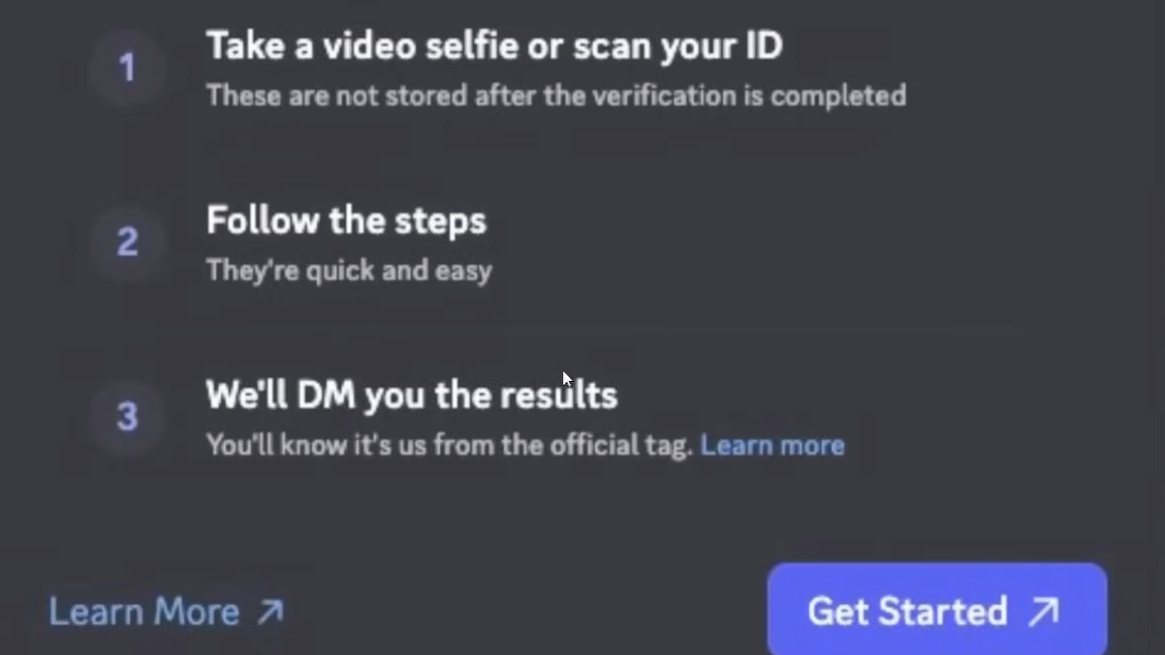
Step 3: After completing verification, Discord sends a confirmation DM from its official system account. Your experience immediately adapts to the verified age group — adult users gain access to restricted content and settings, while teen users retain the default protections.
If the system incorrectly flags you as below the minimum age for your country, your account may be banned. You can appeal by submitting a government ID through Discord's age appeal process.
Earlier workarounds and Discord's response
When age verification launched in the UK in 2025, users quickly discovered that the video selfie system could be fooled using in-game photo modes — most famously, footage from Death Stranding's character creator was enough to pass the check. Discord says it patched that exploit within a week and expects users to keep finding creative bypasses, pledging to "bug bash as much as we possibly can." Reports from UK users suggest that virtual cameras, screen recordings, and static images are now detected more reliably than they were at launch, though the system is not foolproof.
The Teen Council and broader context
Alongside the verification rollout, Discord is recruiting for an inaugural Teen Council — a group of 10 to 12 users aged 13 to 17 who will advise the company on safety features, product design, and policy. Applications are open until May 1, 2026.
The global age-check push follows years of regulatory pressure. Discord CEO Jason Citron testified at a US Senate hearing on child safety in 2024, and the UK's Online Safety Act already mandates age assurance for platforms hosting user-generated content. Reports from early January 2026 also indicated that Discord had confidentially filed for an IPO, and the timing of the safety overhaul — coinciding with a potential public offering — has not gone unnoticed by observers who see the move as partly motivated by liability management ahead of going public.
Discord acknowledges the rollout may cost it some users. "We do expect that there will be some sort of hit there, and we are incorporating that into what our planning looks like," Badalich said. "We'll find other ways to bring users back." Whether the platform can thread the needle between regulatory compliance, teen safety, and the privacy expectations of its heavily tech-literate user base will become clearer once the March rollout begins.