

NVIDIA's DLSS 5 preview at GTC sparked widespread confusion after the demo ran on two GeForce RTX 5090 graphics cards simultaneously. Many viewers assumed this meant the feature would require a dual-GPU setup to function, raising alarms about cost and practicality. That assumption is wrong.
Quick answer: You need only one RTX GPU to use DLSS 5 when it launches. The two-RTX-5090 configuration shown at GTC was a tech demo arrangement, not a consumer hardware requirement.
Why the GTC demo used two RTX 5090s
In the early preview demo, NVIDIA dedicated one RTX 5090 to rendering the game and the second RTX 5090 exclusively to running the DLSS 5 AI model. This split allowed NVIDIA to showcase the technology's full capabilities without the AI workload competing for resources on the same GPU that was handling the game's rendering pipeline. It was an engineering convenience for a controlled demonstration environment, not a reflection of how the feature will ship to consumers.
NVIDIA has built every version of DLSS — from DLSS 2 through DLSS 4.5 — to leverage the Tensor Cores inside a single GPU. DLSS 5 follows the same architectural principle. The Tensor Cores handle the AI inference workload on the same card that renders the game, and NVIDIA has confirmed the final release will be optimized to run on a single GPU at launch.
Which GPUs will support DLSS 5
DLSS 5 is expected to target RTX 50 series GPUs, including the RTX 5090, RTX 5080, RTX 5070, and potentially the RTX 5060. No SLI setup, no multi-GPU configuration, and no special hardware beyond a single compatible RTX card will be needed. If you already own an RTX 5080 or another RTX 50 series GPU and can run DLSS 4.5, you are on the right hardware track for DLSS 5 support.
DLSS 5 versus DLSS 4.5 — different goals
DLSS 4.5, which launched at CES 2026, focuses on a second-generation transformer model for Super Resolution, Dynamic Multi Frame Generation up to 6X, and improved temporal stability. It works across more than 400 games and apps, and the Super Resolution model is already available to all GeForce RTX users. Multi Frame Generation features, including the new 6X mode, are rolling out to RTX 50 series GPUs.
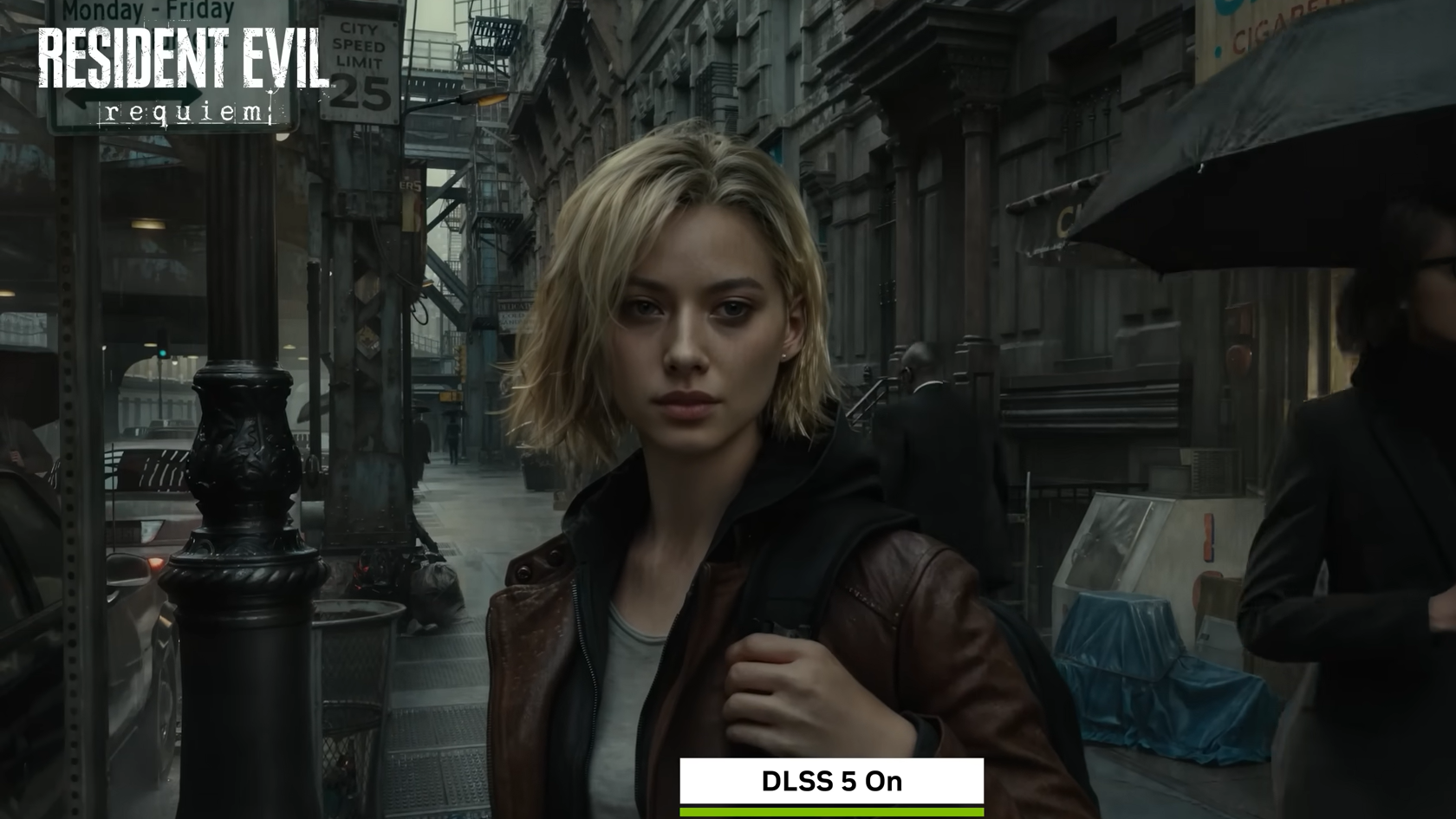
DLSS 5 takes a fundamentally different approach. Rather than refining upscaling and frame generation, it introduces an AI-driven model that attempts to reconstruct lighting, materials, and scene details in real time. The early preview showed dramatic changes to character faces, environmental lighting, color grading, and shadow behavior across titles like Resident Evil 9, Starfield, The Elder Scrolls IV: Oblivion Remastered, and EA Sports FC.
| Feature | DLSS 4.5 | DLSS 5 (preview) |
|---|---|---|
| Status | Available now (Super Resolution); Multi Frame Gen coming spring 2026 | Early preview only, no public release date confirmed |
| Primary function | Upscaling, frame generation, temporal stability | AI-driven lighting, material, and scene reconstruction |
| GPU requirement | One RTX GPU (all RTX generations for SR; RTX 50 for MFG) | One RTX GPU at launch (demo used two RTX 5090s) |
| Game compatibility | 400+ titles | 750+ games targeted |
| Developer control | Backwards compatible with existing DLSS integrations | Developers can choose whether to enable it |
The controversy around visual quality
The DLSS 5 preview generated significant backlash from the PC gaming community. The most common criticism centers on what many describe as an "AI filter" effect, particularly on character faces. In the Resident Evil 9 demo, the character Grace appeared noticeably altered — smoother skin, changed facial proportions, and modified hair color — leading to comparisons with AI-generated imagery and social media beauty filters.
Beyond faces, critics pointed out that the technology appears to alter color grading, remove ambient occlusion and fog effects, flatten shadows, and homogenize the visual identity across different games. Lighting that was intentionally moody or stylized in the original rendering appeared washed out or uniformly bright with DLSS 5 enabled. Some observers noted that scenes from different games began to look visually similar once the AI model was applied, raising concerns about the erosion of artistic intent.
A smaller group of viewers found the environmental lighting improvements genuinely impressive, particularly in titles like Starfield, where the original character models were already considered visually dated. NVIDIA has stated that DLSS 5 will honor the creator's intent and that adjustment sliders will be available, though specifics on those controls have not been detailed.
Importantly, developers retain the choice of whether to integrate DLSS 5 into their games. It is not a forced, system-level filter. If a studio decides the technology does not suit their visual direction, they can simply not implement it.
Lighting inconsistencies in the demo
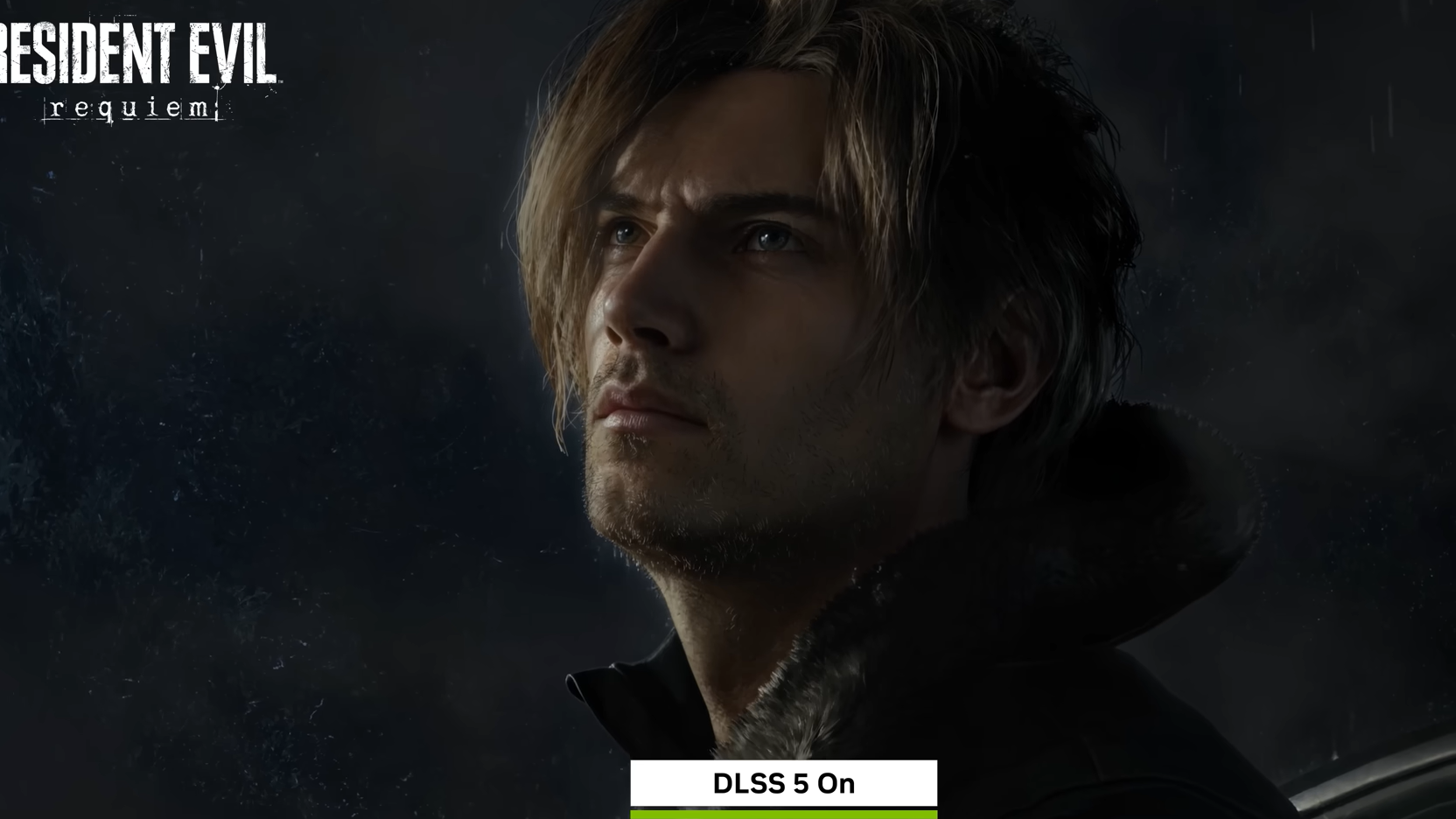
One specific technical issue caught attention during the Resident Evil 9 demonstration. When DLSS 5 was toggled on, certain light sources in the scene appeared to vanish entirely. Areas that showed visible light reflections with DLSS 5 off had no corresponding reflections with the feature enabled. This inconsistency suggests the AI model may struggle with screen-space lighting information, where light data is only available for what the camera currently sees. Whether this is a fundamental limitation or an artifact of the early preview build remains unclear.
What to do right now
If you own any GeForce RTX GPU, you can already use DLSS 4.5 Super Resolution by updating the NVIDIA app and selecting the recommended model presets under "DLSS Override - Model Presets" in the Graphics tab. RTX 50 series owners will gain access to Dynamic Multi Frame Generation and 6X mode this spring.
DLSS 5 has no confirmed public release date. The technology is still in active development, and the GTC preview was explicitly a demonstration of work in progress. There is nothing to download or enable for DLSS 5 at this time, and you should not need to plan for any multi-GPU setup when it eventually arrives.