

Mutations in Escape Tsunami for Brainrots turn ordinary brainrots into serious money printers. They change the look of a brainrot and, more importantly, apply a multiplier to its cash per second. Stacking a strong mutation on top of a high-rarity brainrot is where late-game income really comes from.
The game currently uses a simple structure: each mutation has a fixed multiplier, and only one mutation can sit on a single brainrot. Some mutations are always in the pool, while others are event‑only and tied to Admin Abuse events.

How mutations work in Escape Tsunami for Brainrots
A mutation does three things at once on a brainrot:
- Changes appearance – the brainrot gets a distinct color or visual effect.
- Applies a flat multiplier – its base money per second is multiplied by a fixed value (for example, 1.25×, 2×, 10×).
- Counts in your index – collecting all obtainable brainrots of one mutation unlocks an alternate base color option in your settings.
Only one mutation can sit on a brainrot at a time. Traits are separate and can combine with mutations, but traits do not change the mutation multiplier itself.
Mutations appear directly on the runway brainrots you pick up. There is no re-roll button: you are working with whatever mutation a spawned brainrot already has.
Permanent mutations and their multipliers
Permanent mutations are always part of the normal game loop. They include the default “no mutation” case plus three money-focused variants.
| Mutation | Multiplier | Visual effect | Spawn notes |
|---|---|---|---|
| Default | 1× | Normal appearance for that brainrot. | Baseline; any brainrot with no special color. |
| Gold | 1.25× | Yellow / gold tint on the brainrot. | Very common; roughly half of mutated spawns on a row. |
| Diamond | 1.5× | Cyan / diamond‑colored appearance. | Less common than Gold but still frequent. |
| Rainbow | 10× | Cycles through RGB colors continuously. | Rarest permanent mutation; about 1% chance on the red carpet. |
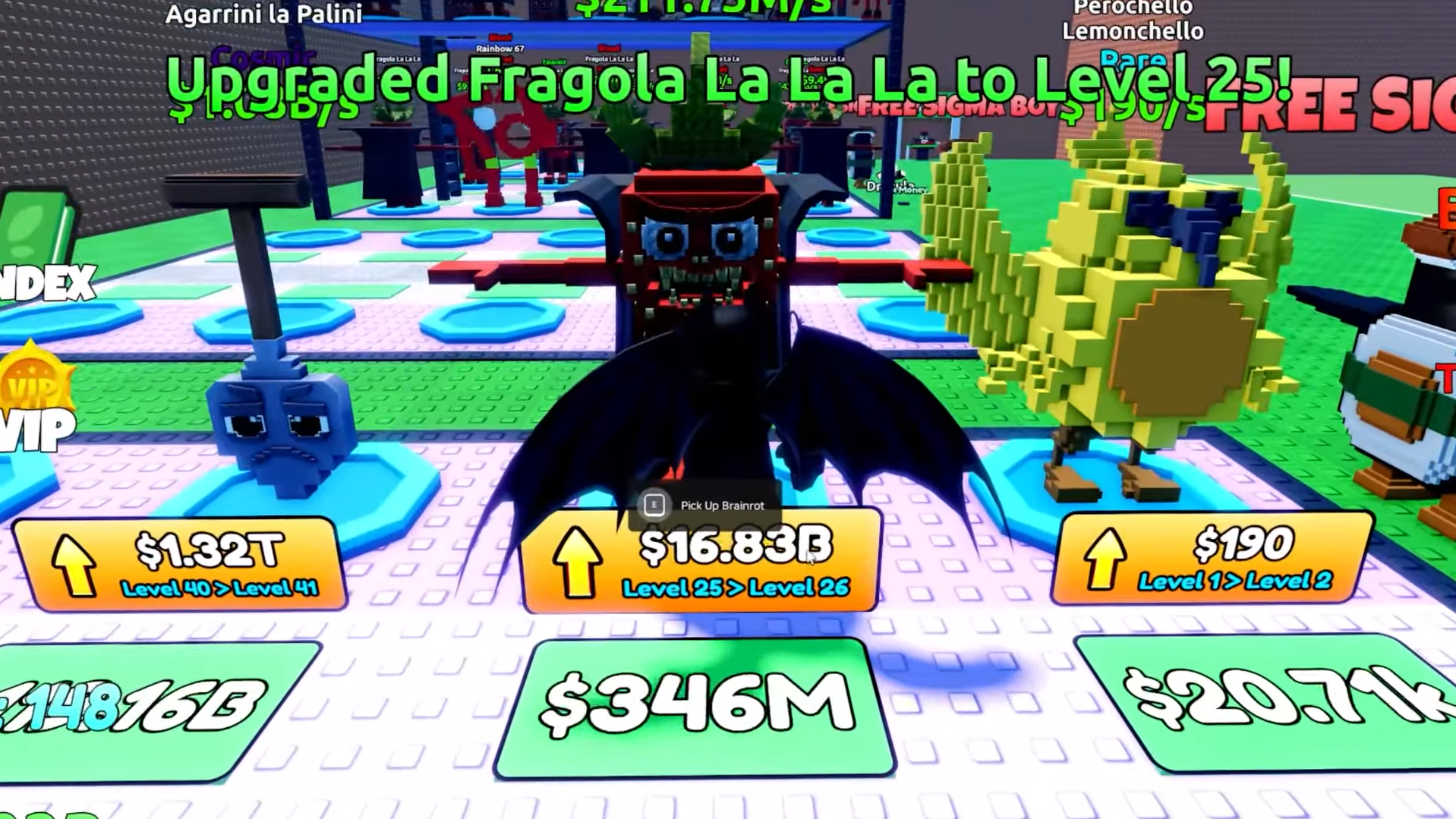
Even the “small” permanent multipliers are significant on late‑game brainrots. A 1.5× Diamond Alessio or Fragola La La La quickly outruns a full row of unmutated high‑rarity brainrots once upgraded.
Limited and event‑only mutations
Limited mutations are tied to themed events and Admin Abuse. They come with much higher multipliers but are not part of the normal day‑to‑day spawn pool.
| Mutation | Multiplier | Visual effect | Access |
|---|---|---|---|
| Bloodrot | 2× | Dark red coloration. | Associated with the Bloodmoon event; unobtainable without Admin Abuse. |
| Candy | 4× | Pink coloration. | Associated with the Candy Aurora event; unobtainable without Admin Abuse. |
| Lava | 6× | Neon orange appearance. | Associated with the Molten event; event‑only in earlier activation windows. |
| Galaxy | 7× | Neon purple appearance. | Associated with the Galactic event; event‑limited. |
| Yin Yang | 7.5× | Black‑and‑white look matching the Yin–Yang icon. | Associated with the Yin Yang event; Admin Abuse‑gated. |
These limited mutations sit between Diamond and Rainbow in raw power. Because they depend on Admin Abuse and themed events, they are among the rarest modifiers in the game. Bloodrot and Yin Yang are often treated as the hardest to find in practice.
In regular public servers, most players will interact primarily with Default, Gold, and Diamond, with Rainbow as the extreme high‑end chase. Limited mutations tend to show up when an admin deliberately sets the event behavior.
Which mutations give the best money multiplier
In terms of pure multiplier alone, the hierarchy is clear:
- Rainbow sits at the top with a 10× increase in value.
- Yin Yang follows at 7.5×.
- Galaxy at 7×, then Lava at 6×, then Candy at 4×.
- Bloodrot doubles value at 2×, comfortably above any permanent mutation except Rainbow.
- Diamond (1.5×) and Gold (1.25×) are the accessible day‑to‑day workhorses.
Rainbow is the single most powerful modifier and is also extremely rare in normal play. Even so, it is not necessarily the rarest mutation overall, because some of the limited event mutations depend entirely on how an admin configures an event and how many mutated brainrots are allowed to spawn.
From a practical perspective, players should treat the permanent trio as the core of their strategy, with Diamond as the main target and Gold as an acceptable bonus on lower‑tier brainrots. Bloodrot, Candy, Lava, Galaxy, Yin Yang, and Rainbow become priority pieces whenever they appear on high‑rarity brainrots.

How mutations stack with brainrot rarities and upgrades
Mutations multiply the brainrot’s current earnings. That current value already includes its inherent base income (driven by rarity and specific character) plus any level upgrades you have purchased on the orange upgrade panel.
For example:
- A base Fragola La La La at Secret rarity starts around $1M per second before upgrades.
- Leveling it up can push it into hundreds of billions per second in late game.
- A 1.5× Diamond mutation on that same upgraded Fragola turns 400B/s into 600B/s.
- A 10× Rainbow version would turn the same upgraded Fragola into 4T/s.
This compounding behavior makes mutation quality far more important on top‑end brainrots like Fragola La La La, Rainbow 67, Alessio, or Esok Sekolah than on early‑game Commons or Rares. A weak Gold or Default mutation on a Celestial still earns more than a strong mutation on a Common, but the absolute best setups combine Celestial or Secret rarity with Diamond, Bloodrot, Galaxy, Yin Yang, or Rainbow.
Rebirths add another layer by increasing your global money multiplier without touching your mutations or brainrot roster. The rebirth bonus multiplies all brainrot income, including any mutation effects, so strong mutations scale extremely well across multiple rebirths.
Mutation priorities at different stages of the game
Early game: take what you can get
At the start, income is low, and you are mostly dealing with Common, Uncommon, and Rare brainrots. The main goal is to build a stable base and increase your speed and carry upgrades so you can reach farther lanes.
- Any mutation is useful – even Gold’s 1.25× multiplier on a Rare Cappuccino Assassino or Penguino Cocosino is a noticeable bump.
- Do not chase perfection – replacing a slightly worse mutation on a weak‑rarity brainrot often wastes time you could spend reaching better rarities.
- Rebirth selectively – mix speed purchases with rebirths so you unlock the global money multiplier while preserving your early mutated brainrots.

Mid game: focus mutations on Secret brainrots
Once you reach Mythical and Cosmic lanes consistently, income ramps up. The first big inflection point is filling your base with Secret brainrots, such as Fragola La La La, Rainbow 67, Aura Farma, and the rest of the secret lineup.
- Prioritize Secrets with good mutations – a Diamond Rainbow 67 or Aura Farma will outperform unmutated versions by a huge margin.
- Upgrade before chasing more copies – leveling a strong mutated Secret can be more impactful than adding another unmutated one, especially on your bottom floor.
- Replace low‑value mutations gradually – when a better mutated Secret appears, pick it up and swap out an older, weaker brainrot from your base.
During this phase, Gold and Diamond mutations are still the main engine. Event mutations like Bloodrot become extremely powerful if you are present during Admin Abuse events and manage to secure them on Secrets.
Late game: Celestial brainrots and high‑tier mutations
Celestial brainrots sit past the Secret area and spawn on a long timer, with roughly a single Celestial appearing every 15 minutes. They start around the 1.5M–1.9M per second range unupgraded, which already outclasses Secrets in raw base income.
Key Celestials include Dug Dug Dug, Alessio, Esok Sekolah, Bisonte Gupitere, and Job Job Sahur. Because of the long spawn time and the distance from spawn, each Celestial pickup is high stakes, especially when a tsunami pattern forces risky movement.
- Take almost any mutation at first – even Default Celestials beat most Secrets in the long run once upgraded.
- Prioritize upgraded mutated Celestials – when you secure a Diamond or event mutation on a Celestial, level it aggressively and anchor it on your main floor.
- Rotate out unmutated Secrets – as your Celestial count grows, replace unmutated or weakly mutated Secrets to free up slots and green buttons.
At very high income levels (quintillions and beyond), the bottleneck is less about filling every slot and more about stacking the highest multipliers on the strongest base brainrots, then upgrading them as far as your money allows.

How rare each mutation feels in practice
Mutation rarity is driven both by raw percentage chances and by how accessible the event or lane is.
- Gold is the common workhorse. Roughly half of mutation spawns lean Gold on a row, so you will see these constantly across all rarities.
- Diamond is noticeably rarer but still frequent enough that a mid‑game player can expect several on Secrets or Cosmics if they play patiently.
- Rainbow is extremely rare in normal play at around 1% chance on the most advanced lane (the red carpet). Getting one on a high‑end brainrot is a long‑term goal.
- Limited mutations like Bloodrot and Yin Yang are effectively locked behind Admin Abuse configuration. While their multipliers are lower than Rainbow’s, the actual number of copies in circulation can be smaller, which makes them feel rarer.
Because the game only applies one mutation per brainrot and there is no re‑roll, most players build their strategy around consistently attainable options (Gold and Diamond) and treat Rainbow and event mutations as opportunistic jackpots when they appear.
Working around mutation quirks and trait interactions
Mutations interact cleanly with base earnings, but there are a few quirks to keep in mind:
- Only one mutation per brainrot – there is no stack such as Gold + Diamond; the brainrot will simply have one active mutation.
- Traits and mutations can interact oddly – in some cases, stacking certain traits with Rainbow visually alters the brainrot in unexpected ways and can slightly reduce the expected total multiplier by 1×.
- Base color unlocks are global – once you collect every obtainable brainrot of a certain mutation, you unlock a matching base color option that you can select in your settings. This cosmetic reward persists regardless of later rebirths.
For income planning, treat the published multipliers as the baseline and assume that a Rainbow brainrot is always the target when it appears on any top‑tier Secret or Celestial.

Mutations are where Escape Tsunami for Brainrots quietly hides most of its progression depth. Rarity decides the floor of your earnings, levels push that floor higher, rebirths scale everything, and mutations are the lever that decides which individual brainrots become your economic core. Focusing on Diamond and higher multipliers on Secrets and Celestials, then pouring upgrades into those specific picks, is the most reliable path to the absurd money numbers seen in late‑game runs.