

Arc Raiders is built on uneasy truces. It’s a PvPvE extraction game where squads are encouraged to cooperate against machines, but nothing stops another Raider from ambushing you at an extract or backstabbing you after sharing loot. That mix of tension and betrayal has now spilled into the browser, with community-run bounty boards that name individual players and invite others to hunt them down.
What the Arc Raiders bounty websites actually do
Several fan projects have appeared with the same basic idea: if someone treats you badly in a raid, you can post a “bounty” on them that other players can claim. One site at arc-bounty.com presents itself as an ARC Raiders Bounty Board, with navigation for a Leaderboard, a Bug Board, and a “How It Works” section. The pitch is simple: post bounties on “toxic players, thieves, and betrayers,” then track eliminations and submit proof.

The sites function as out-of-game overlays to Arc Raiders’ own systems. They don’t change matchmaking or in‑client features. Instead, they maintain public lists of player names, alleged “crimes,” and, in some cases, rewards or titles for those who successfully take listed targets down and upload screenshots as evidence.
Speranza Bounties and the revenge fantasy
The highest‑profile example so far is a fansite called speranzabounties.com (Speranza Bounties). It focuses on one specific theme in Arc Raiders: social deception. Many of the incidents that frustrate players most are technically permissible in the rules of the game, yet feel personal when they happen to you.
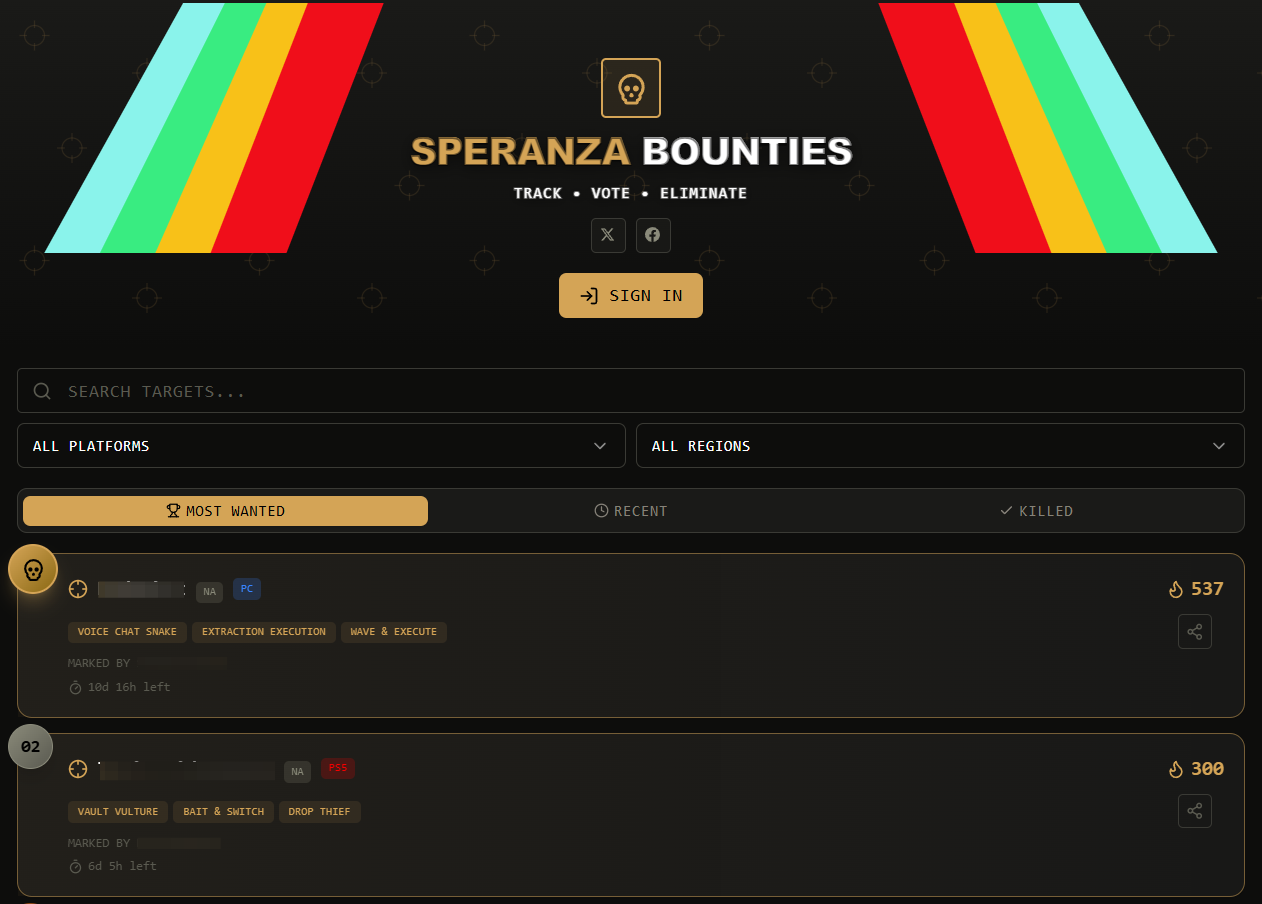
When someone files a bounty on Speranza Bounties, they provide the target’s Embark ID and select up to three behaviors that prompted the submission. The options are phrased like in‑universe incident reports, describing common scenarios such as:
- “Sounded chill, led to ambush” – someone roleplays friendliness in voice chat, then lures you into an attack.
- “Grabbed loot and ran” – a supposed ally takes high‑value items and disappears.
- “Shot at extract after teamwork” – a squad that cooperated in the raid turns hostile at the last second.
- “Hides near extract, attacks on arrival” – classic extraction camping.
- “Pretended AFK, wiped the squad” – a player feigns being away, then cleans up once guards are down.
- “Snipes players heading to extract” – long‑range ambushes focused on exfil routes.
Each bounty remains active for 30 days. During that period, anyone who encounters the named player in live matches can try to eliminate them. To claim the bounty, the hunter uploads screenshot proof of the kill. Repeatedly confirming kills unlocks titles on the site, and the team behind it has floated the idea of offering rare weapons or blueprints as prizes for players who secure the highest‑value targets each week.

The design plays directly into Arc Raiders’ fiction. In‑game, Speranza is the underground hub that relies on Raiders to bring back salvaged goods from “Topside,” and the official story already acknowledges that some Raiders prey on each other instead of cooperating. The fansite essentially imagines what Speranza’s backroom gossip board might look like if players could run it themselves.
Streamers at the top of the wanted lists
On Speranza Bounties, the bounties with the most votes tend to be on high‑visibility players rather than random griefers. Popular streamers such as TheBurntPeanut, HutchMF, Nadeshot, Cloakzy, and Symfuhny appear prominently, reflecting how much of Arc Raiders’ social meta now runs through Twitch and other platforms.
In one example, TheBurntPeanut, a VTuber who leads an informal “Bungulator” faction of viewers and followers, was marked with a bounty submitted by HutchMF, another creator engaged in an in‑game rivalry. The listing is less about protecting the average player from a single betrayal and more about giving that rivalry a public scoreboard: viewers can see who’s “won” the feud most recently, and unrelated players can join the hunt for fun.
 Pallav Pathak
This also explains why some players joke about the site turning the game into a kind of paperwork simulator, where everyone screenshots every kill just in case it turns out to be worth a bounty later. When the targets are widely recognized personalities, a single screenshot can double as proof for the site and as a social media trophy.
How posting and claiming bounties works
The exact interface differs between sites, but the core loop is consistent.
Step 1: A player has a bad encounter in Arc Raiders: a betrayal after calling “friendly,” repeated ambushes at extract, or some other behavior they view as toxic. After the match, they note the opponent’s Embark ID from the post‑game report.
Step 2: They visit the bounty site in a browser and create a new bounty entry. This usually involves entering the Embark ID, describing or tagging the incident, and sometimes assigning a notional value or voting the bounty up.
Step 3: Other players browse or search the bounty lists. On Speranza Bounties, entries stay live for 30 days, so the list gradually fills with active targets, recently claimed ones, and expired entries.
Step 4: During regular play, anyone who runs into a listed Raider can attempt to kill them. To claim credit, the hunter captures a screenshot of the kill feed or downed enemy screen that clearly shows the target’s name.
Step 5: The hunter uploads the screenshot back to the bounty site and, if accepted, receives credit for the elimination. Over time, repeat hunters unlock titles tied to the number and value of bounties they have claimed.
At this stage, there is no in‑game integration. The tracking, verification, and rewards all live on the web. That separation is important: if a claim fails, it only affects a player’s standing on the fan site, not their actual Arc Raiders account or progression.
Why these sites exist when Arc Raiders already allows PvP

Arc Raiders’ design already centers on risk: every trip Topside can end in a machine ambush, a rival squad, or a last‑second disaster at the extract point. Betrayals are not bugs, they are one of the intended drivers of tension. So why build extra‑game systems to punish behavior that the game allows?
There are a few motivations:
- Revenge at a distance. The odds of matching into the same lobby with a specific Raider again are low. A bounty site creates the sense that someone, somewhere, might avenge you, even if you never see it yourself.
- Social storytelling. Public lists of “criminals” turn anonymous encounters into ongoing narratives. Streamer feuds, notorious extract campers, and legendary betrayals become shared reference points instead of isolated memories.
- Soft community norms. Even without formal power, a board that names bad actors can encourage some players to think twice before scamming strangers, if only because they dislike the idea of being publicly labeled.
There is also a design conversation running alongside the websites. On the official Steam discussion boards, players regularly propose in‑client bounty systems that would automatically flag certain behaviors, ping “rogue” Raiders on the map, and reward others for hunting them down. That debate reveals how divided the community is about whether structured revenge tools would improve the game or undermine its tension.
Community debate and the problem of abuse
Bounty websites are controversial from the outset. Many players immediately raise concerns about harassment and witch hunts: once there is a public list of “toxic” users, nothing stops someone from submitting names out of spite, or for ordinary PvP encounters instead of actual betrayals.
Comments in Arc Raiders community spaces outline several recurring worries:
- Verification is weak. Outside of a manual review of screenshots or event descriptions, organizers have limited ability to confirm that an alleged betrayal really happened as described.
- Anyone can be listed. A simple system where you only need an Embark ID and a short form lowers the barrier to entry, but also makes it easy to misuse the site as a blacklist or “manifesto” of people someone dislikes.
- Privacy and security questions. At least one commenter reported that an early version of a bounty site leaked email addresses, underlining the risks of tying game IDs to external accounts on unvetted fan infrastructure.
Others argue that the concept overcomplicates a game built on snap decisions. Checking a website to see whether a random voice in a dark corridor is trustworthy makes little sense in a title with fast firefights and no persistent matchmaking identities on screen. As one player put it bluntly, with hundreds of thousands of players, the chance that the person in front of you is on a bounty list at all is tiny.
Still, there is a subset of Raiders that likes the idea of a semi‑formal underworld. For them, being marked is a badge of honor, especially if they play as dedicated extract campers or ambushers. Some even talk about deliberately farming betrayals just to see their names rise on the wanted boards.
How this differs from in‑game bounty proposals
On the Steam forums, one long post lays out a detailed concept for an official bounty system inside Arc Raiders itself. That proposal shows how different a developer‑run mechanic would have to be from a browser‑based fan tool.
The suggested system would:
- Automatically flag a Raider as “Rogue” if they down more than a set number of players across a certain number of raids.
- Ping that Rogue’s position on the map for everyone else at regular intervals while they remain Topside.
- Grant a separate reward track for Rogues, giving PvP‑focused players loot for sustaining high‑risk kill streaks.
- Reward those who kill Rogues with medals or dog tags redeemable at a special vendor.
Critics immediately point out that such a system could be abused, would be hard to tune around time‑limited matches, and might shift the entire game toward PvP farming at the expense of cooperative play and PvE objectives. Others argue that the tension of not knowing who will betray you is the whole point; formalizing “bad actors” with global pings and reward ladders risks undermining that dynamic.
The fan bounty websites sidestep that entire design problem by staying outside the client. They don’t have levers for map pings, matchmaking groups, or loot tables. All they can do is name people and track screenshots. That keeps them from destabilizing the mechanical balance of Arc Raiders, but it also limits their power to address toxic behavior in a reliable way.
Bounty websites sit in an odd space between playful role‑play and potential harassment infrastructure. They capture something true about Arc Raiders: the stories people tell each other about betrayal can be as memorable as any firefight with a machine. Whether they become a lasting part of the game’s culture or fade as a short‑lived novelty depends less on clever “crime” tags or reward tiers and more on how the community chooses to use—or ignore—them.