

Dark Knight armor is the top-tier heavy set in Roblox’s The Forge. It sits above standard Knight gear, trading mobility for very high health scaling and strong defensive traits. Each piece is crafted like any other armor, but it comes from the rare end of the Heavy armor pool, so you need the right ores and recipes to see it consistently.
Dark Knight armor stats and why it matters
Heavy armor in The Forge covers two set families: Knight and Dark Knight. Both share the same slot structure (helmet, chestplate, leggings) and base prices, but Dark Knight rolls higher HP bonuses and is treated as the chase variant inside the Heavy tier.
| Armor piece | Set | Boost to base HP (%) | Chance | Base sell price ($) |
|---|---|---|---|---|
| Helmet | Knight | 12.5 | 1/1 | 1,020 |
| Helmet | Dark Knight | 18.75 | 1/2 (within Heavy pool) | 1,020 |
| Chestplate | Knight | 16.25 | 1/1 | 1,355 |
| Chestplate | Dark Knight | 25 | 1/2 (within Heavy pool) | 1,355 |
| Leggings | Knight | 13.75 | 1/1 | 1,200 |
| Leggings | Dark Knight | 21.875 | 1/2 (within Heavy pool) | 1,200 |
A full Dark Knight set gives a much larger HP multiplier than standard Knight armor and is treated as S‑tier for tank play, especially in deeper caves and late-game combat. The trade-off is the ore cost: Heavy pieces generally consume 30–40 ores for a single craft when you are pushing for high multipliers.

How armor crafting works in The Forge
Armor comes only from forging. There are no direct drops or vendors for Dark Knight pieces; everything starts at the crucible.
Step 1: Find the forge in Stonewake’s Cross, near the potion seller. Interact with the large crucible to open the crafting interface.
Step 2: Switch to the Armor tab. This tells the crucible you are crafting armor instead of weapons.
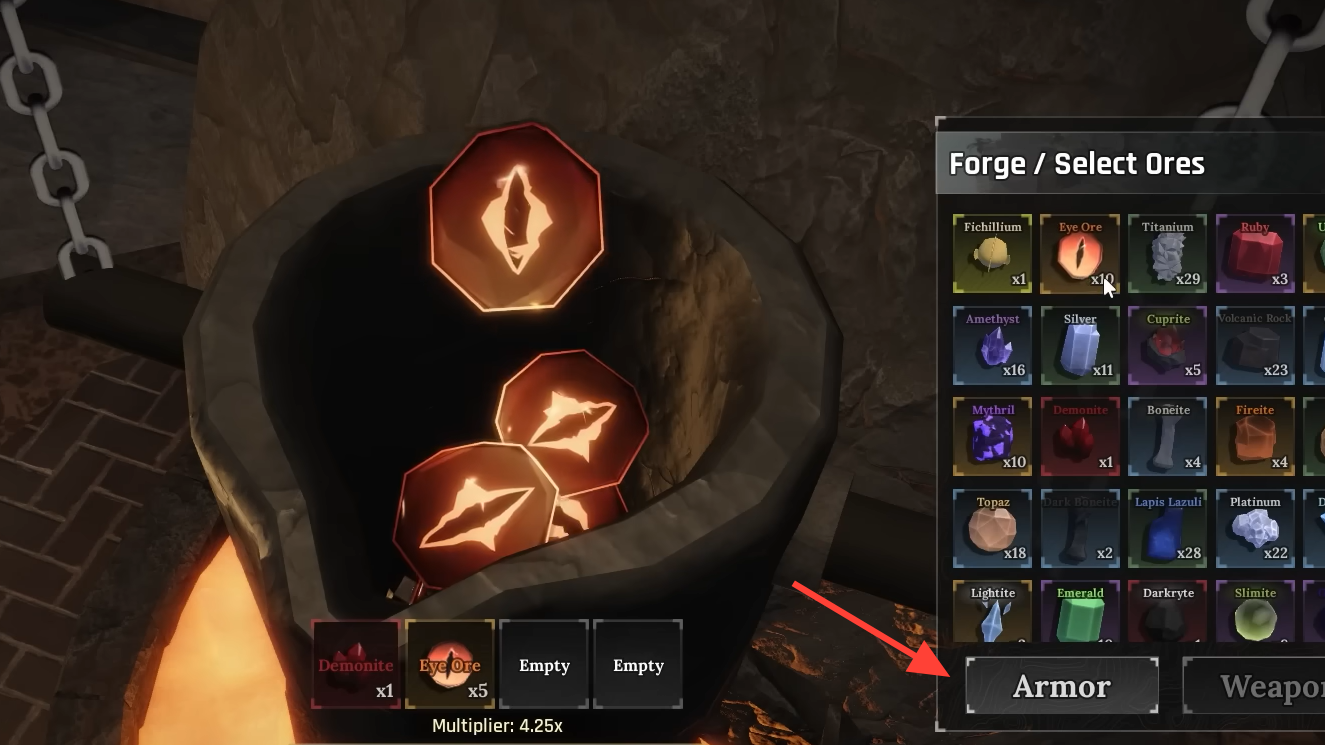
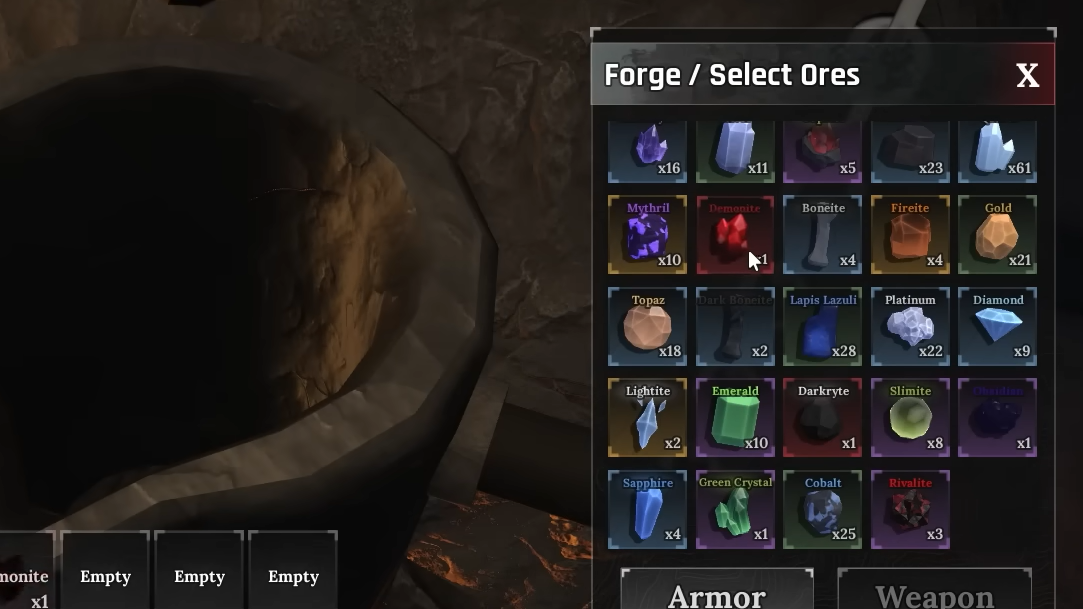
Step 3: Drag in at least three ores. The total ore count and the rarity of each ore determine two things: whether you hit Light, Medium, or Heavy armor, and the stat multiplier/trait count on the result.
- Light armor: roughly 3–10 ores of any type.
- Medium armor: roughly 10–30 ores, usually with mid-tier ores.
- Heavy armor: roughly 30–40 ores, leaning on rare ores.
Rare ores such as Obsidian, Uranium, Mythril, Demonite, Lightite, and Darkryte increase the multiplier dramatically, up to the 4x range when used in high-end recipes.
Step 4: Complete the forging mini-game. The sequence generally includes bellows, pouring, hammering, and quenching. Hitting perfect timings raises the quality bar towards 100%, which can unlock better traits and higher defense on the resulting piece.
Within the Heavy pool, the slot that drops is probability-based. For many high-end chestplate-focused recipes, there is roughly a 75% chance of a chestplate, 20% for leggings, and 4–5% for a helmet, with a small chance to fall back to a Medium piece. Dark Knight variants then share that Heavy result table, usually at around a 50% share versus regular Knight for the same slot.
Ore planning for Dark Knight recipes
For Dark Knight specifically, the game leans on late-game ores. These ores both push you firmly into the Heavy tier and carry strong multipliers for HP and traits:
- Obsidian
- Uranium
- Mythril
- Demonite
- Eye ore
- Lightite (Legendary only)
- Darkryte (Legendary only)
Heavier recipes combine these in tens to reach multipliers above 3x, sometimes above 4x. Those same recipes are used for general Heavy armor, but they are where Dark Knight shows up most often and with the best stats.

Baseline Heavy armor recipes that can roll Dark Knight
Any properly configured Heavy recipe can land either a Knight or Dark Knight piece. For players who want a simple, resource-efficient starting point before moving into extreme Legendary recipes, the following layouts are useful. They are built around the Cobalt–Diamond–Titanium–Lapis Lazuli core, which pushes you consistently into Heavy:
| Target armor | Ore 1 | Ore 2 | Ore 3 | Ore 4 |
|---|---|---|---|---|
| Knight / Dark Knight Helmet | Diamond (11) | Cobalt (9) | Titanium (3) | Lapis Lazuli (7) |
| Knight / Dark Knight Chestplate | Cobalt (9) | Diamond (11) | Titanium (6) | Lapis Lazuli (7) |
| Knight / Dark Knight Leggings | Cobalt (9) | Diamond (11) | Titanium (6) | Lapis Lazuli (4) |
These recipes are tuned for slot chances (helmet vs chest vs leggings), not for maximum multiplier. Once you want Dark Knight with top-end traits instead of just “any Dark Knight”, you move to rarer ore combinations.
Example Dark Knight-focused Heavy recipes
High-rarity armor recipes are organized around a few “packages” of Epic and Legendary ore layouts. They control both the multiplier and the number of random traits your armor can roll.
| Recipe | Multiplier | Traits | Notable trait effects | Armor slot chances |
|---|---|---|---|---|
| 10 Obsidian, 10 Mythril, 10 Uranium, 10 Eye | 3.21x | 5 | Large vitality boosts, HP-based AoE damage, weapon damage boost, minor HP penalty | 75% Heavy Chestplate, 20% Heavy Leggings, 4% Heavy Helmet, 1% Medium Chestplate |
| 10 Lightite, 10 Mythril, 10 Obsidian | 3.48x | 3 | Movement speed and large vitality increases | 49% Heavy Leggings, 28% Heavy Helmet, 13% Heavy Chestplate, 8% Medium Chestplate, 1% Medium Leggings |
| 10 Lightite, 10 Mythril, 10 Obsidian, 10 Darkryte | 4.19x | 4 | Movement speed, stacked vitality, chance to dodge incoming damage | 75% Heavy Chestplate, 20% Heavy Leggings, 4% Heavy Helmet, 1% Medium Chestplate |
All of these produce Heavy armor pieces that can be either Knight or Dark Knight. Because Dark Knight is the top half of the Heavy pool, these recipes are effectively your “on-ramp” to high-trait Dark Knight chestplates and leggings without having to guess random ore piles.
For players who want concrete slot-and-set targeting, it also helps to use set-oriented templates built around Obsidian, Uranium, Mythril, Demonite, and Eye:
| Dark Knight piece | Example ore pattern | Notes |
|---|---|---|
| Dark Knight Helmet | 6 Obsidian, 6 Uranium, 3 Eye, 3 Mythril, 2 Demonite (plus filler to 20–35 ores) | Heavily weighted towards helmet outcomes in the Heavy tier. |
| Dark Knight Chestplate | 8 Obsidian, 8 Uranium, 8 Mythril, 8 Demonite, 5 Eye (27–46 total with filler) | Chestplate-leaning Heavy recipe with a strong HP multiplier. |
| Dark Knight Leggings | 9 Obsidian, 9 Uranium, 8 Mythril, 10 Demonite, 2 Eye (30–46 total) | Legging-slot bias inside the Heavy pool. |
The filler in these cases is usually more of the same high-rarity ores or mid-tier ores that do not dilute the Heavy weighting. Keep the total inside the standard Heavy range (about 30–40 ores) so the game does not slip into unusual behavior.

Midgame Dark Knight recipes using “only rare” ores
Epic and Legendary ores are limited, especially if you are still in midgame. One practical approach is to target Dark Knight armor using only “rare” ores such as Sapphire, Amemes (Amethyst), Topaz, and generous amounts of Quartz as filler. That way, you save Lightite, Darkryte, and higher-end materials for later.
A common pattern here is a three-way ratio recipe with Quartz filling out the count:
- Helmet and leggings: 6 Sapphire, 6 Amemes, 6 Topaz, then enough Quartz to reach Heavy ore count.
- Chestplate: slightly more of each rare ore (for example 7 Amemes, 7 Diamond or Sapphire, 7 Topaz) plus Quartz filler.
This type of recipe still sits in the Heavy pool and can roll Knight or Dark Knight. The raw multiplier is lower than Lightite/Darkryte builds, but it is enough to beat basic Quartz-only Knight gear while keeping your best ores untouched.
How to steer into specific Dark Knight slots
Heavy crafting recipes always have a chance to “miss” the slot you want. That is built into the system, but careful ore planning lets you stack the odds in your favor:
- To chase helmets, use Heavy recipes with fewer total ores and a layout tuned for the helmet slot (such as Diamond‑heavy ratios).
- To chase chestplates, favor the Epic and Legendary multipliers that list 75% chestplate odds and keep total ore count in the upper Heavy range.
- To chase leggings, use leg-oriented versions of the same recipes, or rare‑ore patterns where the game lists around 49–50% leggings chance.
Once you are in the correct Heavy slot, Dark Knight vs Knight is handled by the internal rarity split, typically around 50:50 for medium-to-high rarity inputs. That means you are rarely more than a few crafts away from the Dark Knight version if you stick to good recipes.
Enhancing Dark Knight armor
Freshly forged Dark Knight pieces are already strong, but they also scale with enhancement. Upgrading armor uses essences and gold at the Enhancer NPC.
Step 1: Find an Enhancer NPC in your current region. These are present in all regions, usually in main hubs.
Step 2: Start an enhancement session and choose the Dark Knight piece you want to upgrade (helmet, chestplate, or leggings).
Step 3: Feed essences and pay the gold fee. Tiny, Small, and Medium Essences drop from regular enemies, while larger essences come from tougher foes and late-game content.
Enhancement raises stats and, at higher levels, opens rune-style options that stack with your original traits. On a high-multiplier Dark Knight chestplate, this can push survivability by several extra tiers without needing a new craft.
Dark Knight armor in The Forge is less about a single secret recipe and more about understanding how ore rarity, total count, and slot weighting work together. By committing to Heavy-tier ore layouts built around Obsidian, Uranium, Mythril, Demonite, and the Lightite/Darkryte packages—and then finishing with high-quality mini-game runs—you can turn the Heavy pool into a consistent Dark Knight factory instead of a coin flip. Once you have a full set rolled and enhanced, it becomes the natural endpoint of the game’s tank progression.