

Kirby’s latest mainline adventure is less about saving Dream Land again and more about what happens when Dream Land is ripped away.
Core setup: a pink sphere in a ruined world
The premise is simple and sharp. A swarm of star-shaped vortexes tears through Dream Land, lifting Kirby, Bandana Waddle Dee, and a population of unsuspecting Waddle Dees into the sky. Kirby wakes up alone on a beach in a “new world” where malls, highways, and theme parks are half-swallowed by nature. The native Beast Pack is rounding up Waddle Dees in cages; a small blue creature, Elfilin, narrowly escapes and becomes Kirby’s guide and partner.
From there, the structure is classic Kirby, rebuilt around 3D movement. World maps string together discrete stages. Each stage ends at a cluster of captured Waddle Dees that pop free once Kirby reaches the goal. Rescuing Waddle Dees is the backbone of progression: they repopulate Waddle Dee Town, unlock facilities, and open boss arenas at the end of each world.
Platforms, editions, and what changes on Nintendo Switch 2
| Version | Platform | Key features | Release | Approx. file size |
|---|---|---|---|---|
| Kirby and the Forgotten Land | Nintendo Switch | Base game, 3D platforming campaign, Waddle Dee Town hub, co-op, amiibo support | March 25, 2022 | 5.8 GB |
| Kirby and the Forgotten Land – Nintendo Switch 2 Edition + Star-Crossed World | Nintendo Switch 2 | Base game, higher resolution and frame rate, new Star-Crossed World campaign, new Mouthful Modes and stages | August 28, 2025 | 16.7 GB |
The original release runs on Nintendo Switch as a 3D action-platformer built around short, focused stages and light exploration. The upgraded Nintendo Switch 2 Edition builds on that foundation with sharper image quality, smoother performance, and a second story campaign called Star-Crossed World, set after the main events. That expanded version is sold as a standalone Switch 2 SKU and as an upgrade pack that converts an existing Switch copy into the enhanced edition on Nintendo Switch 2.
How 3D Kirby actually plays
The most important shift is perspective. Instead of side-scrolling levels with occasional depth layers, Kirby roams through fully 3D environments: city streets overgrown with vines, frozen boulevards, rusted industrial plants, and amusement parks in permanent twilight. The camera is mostly guided but still gives enough freedom to nudge and peek around corners, which matters because stages hide a lot of optional objectives.
Kirby’s basic move set is familiar: jump, hover, slide, guard, and inhale. In 3D, those tools are re-tuned to keep input complexity low while making combat feel more deliberate. There is a single main attack button; each Copy Ability fans out into different attacks based on movement, charging, and midair states rather than separate buttons.
Dodging is where the design leans into spectacle. Guarding and then tilting a direction triggers a dodge roll with generous distance. Time slows briefly if Kirby dodges just before an attack connects, exposing enemies to a powered-up counter. That slowdown is as much a teaching tool as it is a flourish: it makes boss patterns readable without turning fights into quick-time events.
There is no life system. Running out of health simply costs Star Coins and restarts from a nearby checkpoint. That change fits the game’s emphasis on experimentation over punishment; Kirby is encouraged to try risky routes or different abilities without worrying about a traditional game-over screen.
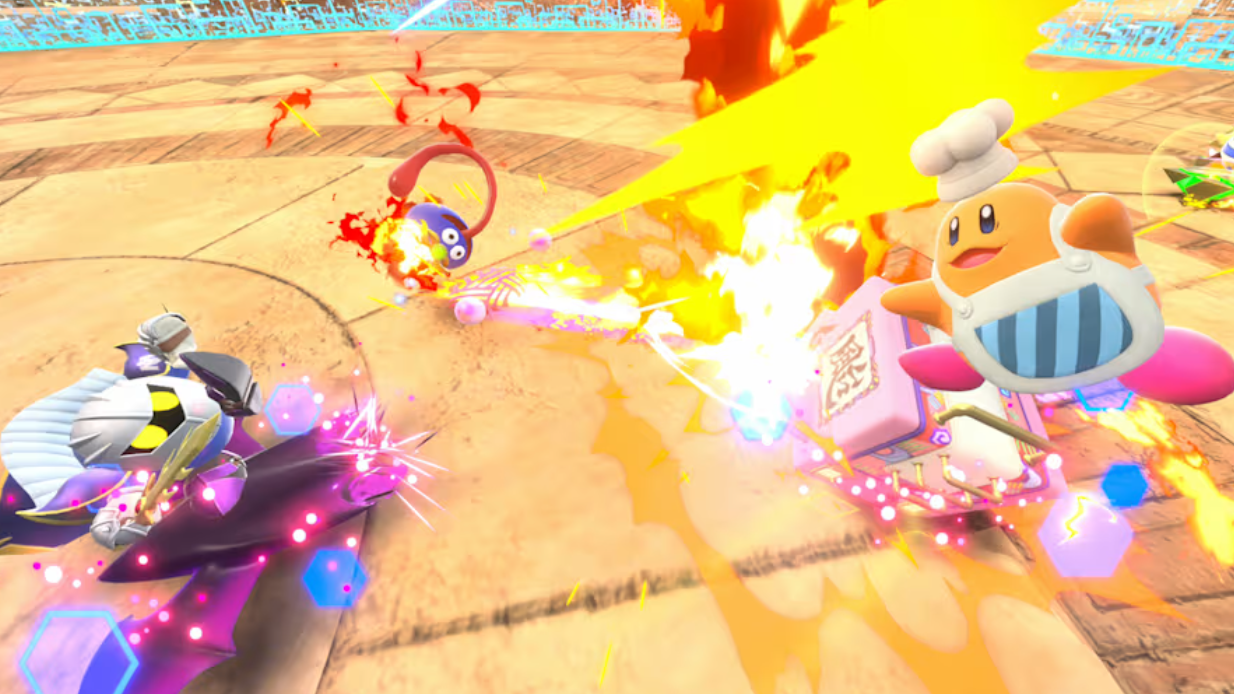
Copy Abilities and why the upgrade path matters
Copy Abilities are still the heart of the series, but here they are built to support a full 3D move set and a light progression system. There are 12 standard abilities, including returning staples like Sword, Fire, Ice, Bomb, Needle, Cutter, Hammer, Tornado, Crash, Sleep, and newer entries Drill and Ranger.
| Base ability | Role in play | Sample evolutions |
|---|---|---|
| Sword | Close-range, all-purpose combat | Gigant Sword, Meta Knight Sword, Morpho Knight Sword |
| Fire | Damage over time, hazard manipulation (lighting fuses, burning barriers) | Volcano Fire, Dragon Fire |
| Drill | Burrowing under terrain, reaching hidden platforms | Pencil Drill, Twin Drill |
| Ranger | Long-range aiming and charged shots | Noble Ranger, Space Ranger |
| Bomb | Area control, traps, and chained explosions | Chain Bomb, Homing Bomb |
| Sleep | Self-healing with some risk | Deep Sleep |
Blueprints scattered through stages and boss rewards unlock Evolved Copy Abilities at Waddle Dee’s Weapons Shop in town. Upgrading costs Star Coins and Rare Stones, the latter earned mainly in Treasure Road challenges. Each evolution modifies attack patterns and raw damage: Dragon Fire leaves combustion trails, Chain Bomb links explosives into webs, and Meta Knight Sword reshapes Kirby’s neutral sword into a more aggressive, combo-heavy kit.
After the main story, abilities can be strengthened again, boosting their base power rather than changing their form. That late-game tuning is aimed at the optional boss gauntlets and post-game content, where damage races and survival windows get much tighter.
Mouthful Mode: Kirby meets infrastructure
Mouthful Mode is the game’s answer to traditional power-ups, but wrapped in a very literal sight gag. When Kirby inhales certain large objects—things like cars, traffic cones, ring-shaped vents, or vending machines—he stretches over them instead of swallowing them. That transformation grants a new mini-move-set that exists alongside his current Copy Ability.
| Mouthful form | Object | Primary use |
|---|---|---|
| Car Mouth | Run-down car | Boosting through walls, time trials, jumping gaps |
| Vending Mouth | Vending machine | Firing cans as projectiles, pressing distant switches, breaking debris |
| Cone Mouth | Traffic cone | Spiking into weak tiles, opening vertical shafts, puncturing bosses |
| Arch Mouth | Curved archway | Gliding sequences with air currents and ring pickups |
| Light-Bulb Mouth | Light bulb | Illuminating dark mazes, revealing hidden hazards |
| Stairs Mouth | Concrete stairs | Creating temporary platforms, crushing enemies below |
| Big-Rig Mouth | Semi-truck | Final chase and climactic boss sequence |
Stages are built around short Mouthful Mode setpieces: racing a crumbling highway in Car Mouth, lining up concrete steps as movable platforms, or threading through a haunted house where Light-Bulb Mouth is the only way to see safe ground. Crucially, Kirby keeps his current Copy Ability in reserve while in these forms, making Mouthful sections feel like situational tools rather than replacements for the core combat kits.
The Switch 2 Edition adds at least one more Mouthful Mode on top of the base roster, tied into the Star-Crossed World campaign and its crystal-heavy environments.
Waddle Dee Town: a hub that slowly remembers itself
Rescued Waddle Dees rebuild a town that doubles as a menu, museum, and mini-game plaza. As the population grows, new buildings appear:
- Waddle Dee Cinema replays unlocked cutscenes.
- Waddle Dee’s Weapons Shop handles Copy Ability evolution and upgrades.
- Waddle Dee-liveries redeems Present Codes for in-game items.
- Waddle Dee Café sells healing food and hides a time-management mini-game behind the counter.
- Waddle Dee’s Item Shop stocks temporary buffs like Life Up, Attack Boost, and Speed Boost that stack with Kirby’s health bar.
- Gotcha Machine Alley turns coins into collectible figures with lore blurbs for bosses, abilities, and objects.
- Fishing Pond offers a simple timing-based fishing game that escalates into absurdly large catches.
- Tilt-and-Roll Kirby brings back a wooden maze board that leans on tilt controls.
- Colosseum hosts multi-round boss cups, including post-game and Switch 2-only variants.
- Kirby’s House acts as a small museum and rest spot, complete with a bed and display shelves.
Wise Waddle Dee stands in the town square and surfaces aggregated stats such as global clear rates and popular abilities when connected online, and Waddle Dee Town itself becomes a way to track how much of the game’s optional content you have actually seen.
Co-op structure and difficulty options
Forgotten Land supports two players on a single system. Player 1 is always Kirby, and Player 2 is Bandana Waddle Dee. Bandana Dee’s spear-based kit is fixed, but its effectiveness scales with Kirby’s current Copy Ability evolution level, so upgrading weapons benefits both players indirectly.
The camera always tracks Kirby, which keeps things simple but can be disorienting in boss arenas if Player 1 sprints around constantly. When Bandana Dee falls, they respawn after a short delay rather than burning a shared life counter. Co-op extends to several town mini-games and boss cups, but Bandana Dee cannot copy abilities or use Mouthful Mode himself; instead, he can interact with certain Mouthful sequences as support, such as throwing spears during on-rails glides.
Two difficulty settings frame the whole experience:
- Spring-Breeze Mode raises Kirby’s maximum health and softens enemies, leaning into exploration and spectacle.
- Wild Mode reduces health, makes enemies hit harder, and pays out an extra 50 Star Coins per stage or challenge clear.
Both modes keep stage layouts identical, and you can swap between them without losing progress, so difficulty here is more about pacing than locking content in or out.
Stage structure, missions, and Treasure Road
Each world is built around a theme—grassy outskirts, coastlines, a derelict theme park, snowbound streets, deserts turned to skeletons of cities, volcanic industrial zones—and each stage inside those worlds layers several objectives on top of a direct path to the goal. Every level hides a set of captured Waddle Dees in side rooms or behind specific interactions; it also tracks a handful of stage-specific missions, such as finding all hidden tulips, eating particular food, or defeating a boss without taking damage.
Completing missions unlocks more Waddle Dees at the end of a clear, and the game surfaces completed and missed goals on a stage card so you can see exactly what remains without spoiling the specifics.
On the world map, shimmering points lead to Treasure Road challenges. These are compact time trials built around a single ability, evolved ability, or Mouthful Mode. Each clear rewards a Rare Stone the first time and bonus Star Coins for beating a target time. Some Treasure Road stages remain locked until the corresponding evolved ability has been crafted at the Weapons Shop.
Story beats, post-game, and why the tone feels darker
The campaign leans on a surprisingly heavy piece of sci-fi. Deep under the Beast Pack’s volcano, Kirby discovers Lab Discovera, a tourist-facing research facility housing ID-F86, an “ultimate life-form” that once tried to consume the new world. The people who built the lab used the creature’s warp abilities to leave their planet behind for “a land of dreams,” then froze the original specimen in a capsule and poked at its abilities for decades.
That research split ID-F86 in two: Fecto Forgo, the mass of psychic sludge in stasis, and Elfilin, the smaller, more sympathetic half that escaped. The Beast Pack is essentially a cult that formed around Fecto Forgo’s influence; King Dedede’s rampage is the result of that psychic control funneled through a warthog mask. The final act escalates through Fecto Forgo’s escape, a chase through collapsing lab corridors, and a merger into Fecto Elfilis, a towering alien that tries to fuse Planet Popstar into the new world through a massive rift.
The resolution is pure Kirby: inhale a semi-truck, scale an impossible highway through space, and ram the would-be god hard enough to break their spell. Elfilin seals the rift at the last second, seemingly sacrificing himself, then quietly returns through a smaller tear as credits roll. It’s absurd and strangely melancholic at the same time.
Post-game, the tone gets dreamlike and more hostile. The Isolated Isles: Forgo Dreams remix earlier environments into stitched-together gauntlets where you collect fragments of Leongar’s soul. Phantom versions of each boss—amplified, recolored, and with new attack patterns—guard the ends of these runs. Finishing Forgo Dreams unlocks one last sequence: Soul Forgo’s rebirth, Morpho Knight’s surprise arrival, and a final boss in Chaos Elfilis, framed as the chaotic remains of the life-form Kirby has been dismantling all along. That fight sits at the top of the difficulty curve, pairing tight damage windows with dense, screen-filling attacks.
Star-Crossed World: What the Switch 2 campaign adds
The Star-Crossed World campaign in the Nintendo Switch 2 Edition shifts the threat from labs and gods to the falling sky. A meteor—the Star of Darkness—breaks apart as it enters the atmosphere, spawning crystalline growths across familiar regions and punching a volcanic island, Fallen-Star Volcano, out of the ocean. Astronomer Waddle Dee frames the stakes: the meteor houses a sealed catastrophe, and only collecting the light-infused Starries—small star-like beings inside the meteor fragments—can restore the seal.
Each world gains new “Starry stages” where meteor fragments have warped the layout, creating new routes, hazards, and crystal structures. Finding Starries turns them into pieces of a Sealing Crystal around the Star of Darkness. Once enough are gathered, the seal reforms, cracks immediately, and the entity inside reveals itself as Genwel Meteonelfilis, elder sibling to Fecto Elfilis.
The late-game fights here lean into scale. Genwel absorbs power from the entire crystal island, becomes gigantic, and forces Kirby to fight on a shrinking patch of safe ground. After a multi-phase battle—culminating in Kirby breaking through a crystal shell around Genwel’s core—the Starries reseal the now-dormant threat and depart into space. Elfilin recognizes echoes of his own past in their light, underscoring that Kirby’s new allies are part of a broader cosmic ecosystem built around containing beings like the Elfilis line.
That is not quite the end. Fecto Forgo’s soul, having absorbed both Morpho Knight’s power and residual energy from the Starries, regroups once more in an optional Switch 2-only Colosseum cup. Kirby revisits phantom bosses, including illusions of Meta Knight, Forgo Dedede, Leongar, Morpho Knight, and even Genwel, before facing Chaos Elfilis again under a distorted sky above Lab Discovera’s roof. The final remnant of the chaotic soul chooses to merge peacefully with Elfilin, closing the loop on a story that constantly pairs consumption with connection.

What starts as a pink mascot wandering through overgrown malls quietly becomes a dense tour of everything the series can do in 3D: precise combat, breezy co-op, collectible lore, surreal cosmic horror, and a town that grows more lived-in the longer you spend there. The Nintendo Switch 2 Edition’s sharper output and new campaign do not rewrite that core, but they give it a longer tail—and a clear signal that Kirby is not retreating from 3D anytime soon.