

Madiao in Where Winds Meet looks complicated, but it’s basically a digital version of Bluff / Cheat / “Bullshit” with numbered cards and drinking penalties. Once you understand that you are declaring how many copies of one number you’re putting down — not adding values together — the whole thing clicks.
Madiao basics: deck, yellow cards, and win conditions
Madiao uses a fixed, simple deck:
- 40 numbered cards: numbers 1 to 10, with four copies of each number.
- 12 yellow “golden” cards: wild cards that can count as any number from 1–10 when you declare.
You win a Madiao match in one of two ways:
- Empty your hand: play all your cards legally (truthful or unchallenged lies) until you have none left.
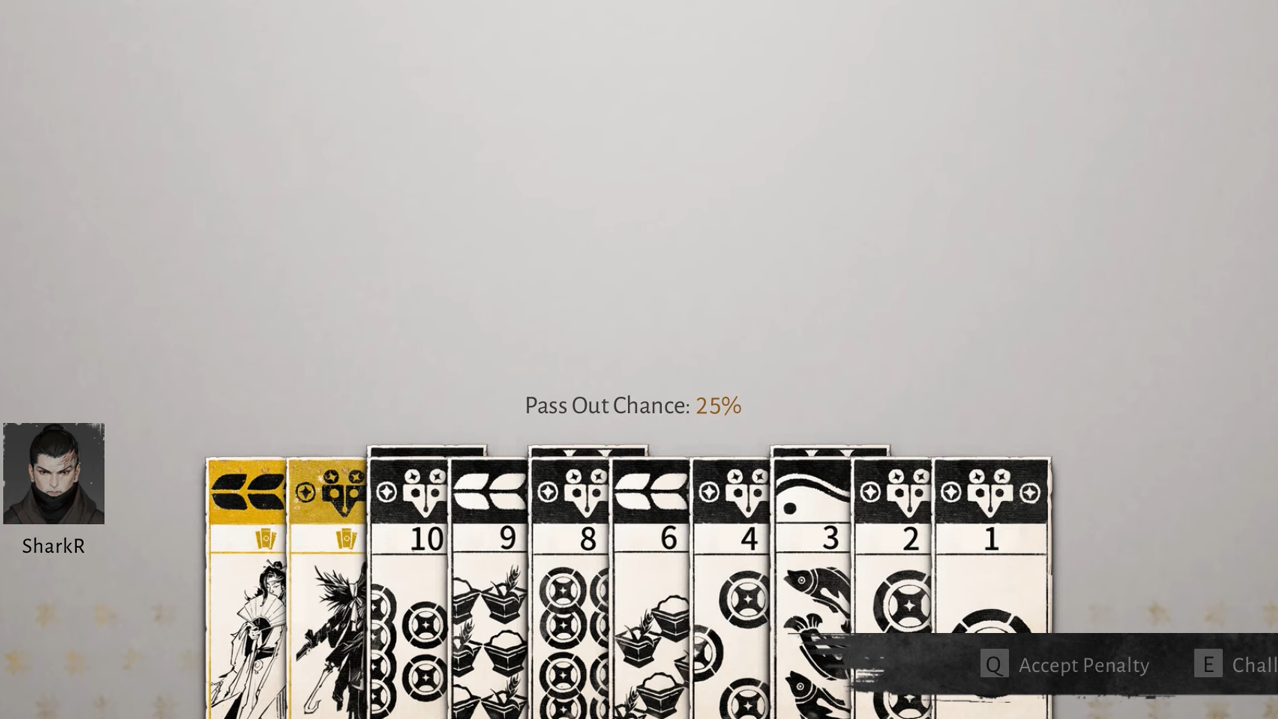
- Make everyone else pass out: each time someone loses a challenge or accepts a penalty, their “drunk” meter fills, and their pass-out chance goes up. When they either reach 100% on the meter or hit a bad roll on their pass-out chance, they’re eliminated.
Two things happen when a player loses a round (by being caught lying or failing a challenge):
- Their alcohol meter increases by the percentage shown in the pot in the middle of the table.
- Their pass-out chance increases in 25% steps: it starts at 25%, then 50%, 75%, and 100% with each loss.
That means anyone can be knocked out instantly on a bad roll, even at low meter, once their pass-out chance rises.
How a Madiao round flows
Madiao is played in a sequence of rounds. Within each round, everyone pretends to play the same number.
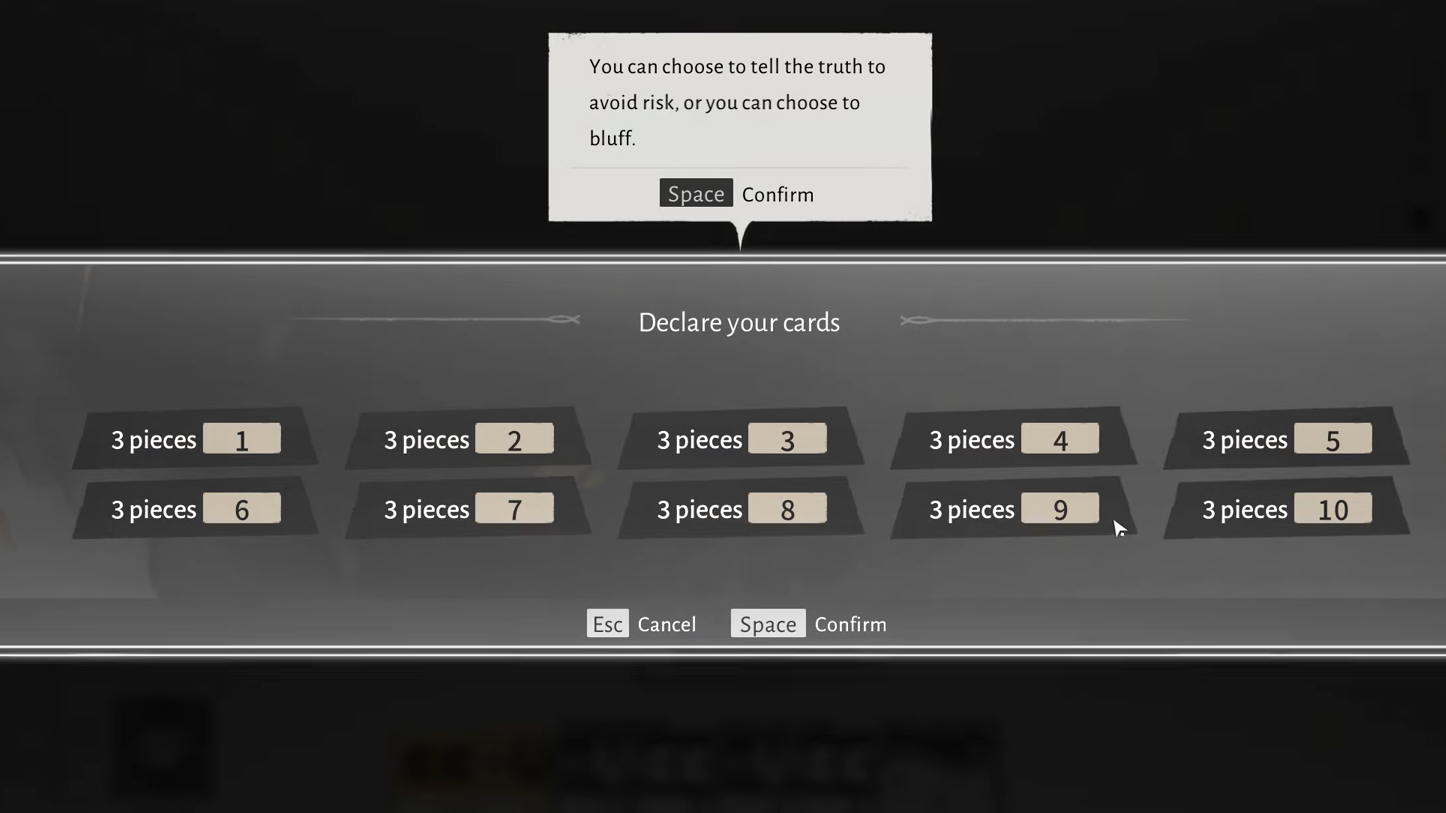
Step 1: One player holds the starting coin and leads the round. This player chooses a number from 1–10 and declares how many copies of that number they are putting down. For example: “three 9s”. They place that many cards face down. Those can be real 9s, wild cards, or lies.
Step 2: The Turn order continues around the table. Each player must now also “play” that same number. On their turn, they choose:
- How many cards to place face down, and
- Declare them as that number (for example, “two 9s”), even if the physical cards are something else.
On your turn, you usually have three options:
- Tell the truth: play that number (and optionally wild cards).
- Lie: put down other numbers and claim they match the called number.
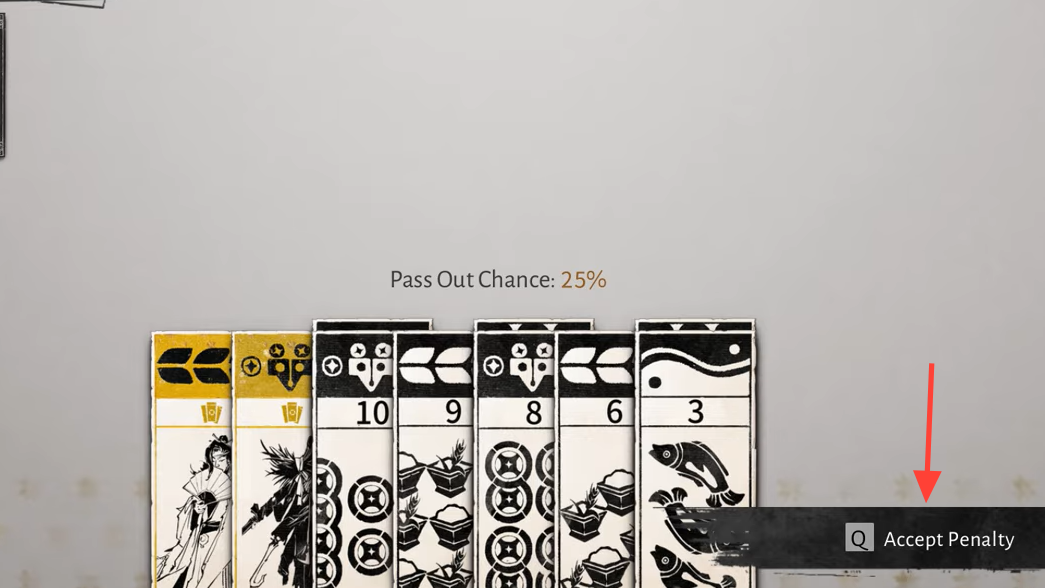
- Accept the penalty: admit you can’t or won’t play this number, take whatever penalty % is currently in the pot, and end your participation in that round.
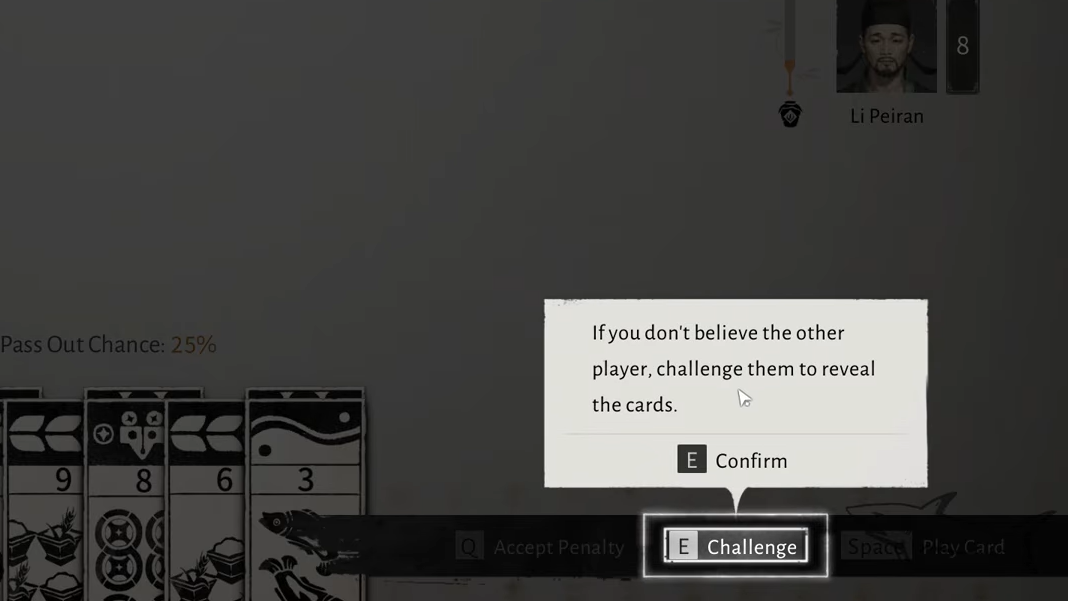
Step 3: At any time, when the last player has put cards down, someone at the table can hit Challenge to call the bluff on that last declaration.
Step 4: If a challenge is declared, the last player flips their cards, and one of two things happens:
- They were lying (their cards don’t match their claim): they lose the round, drink (take the pot penalty plus pass-out roll), and take all cards in the middle back into their hand.
- They were truthful (enough real + wild cards to match): the challenger loses the round instead, drinks, and takes the whole middle pile.
The player who wins the challenge (either by catching a lie or surviving a false accusation) takes the coin and will choose the number for the next round.
The match continues with fresh rounds until only one player is left conscious or someone successfully plays their last card.
What your declaration really means
A key point that confuses a lot of players: when you declare, you’re not doing math with card values. You are claiming “this many copies of the same number”.
Example: The called number for this round is 9, and you declare “three 9s”. To be telling the truth, your face-down cards must contain three cards that count as 9 in-game:
- Any mix of real 9s, plus
- Any number of yellow wild cards, each of which can represent a 9.
You could truthfully declare “three 9s” with:
9, 9, 99, 9, yellow9, yellow, yellow
If you put down 6, 3, yellow and declare them as “three 9s,” that is a lie, even though 6 + 3 = 9. Only the card identity and wilds matter; sums never do.
How yellow wild cards work
Yellow (golden) cards are simple but powerful:
- Each yellow card can count as any chosen number when you declare for that round.
- When you declare “two 7s” and you put down
yellow, yellow, you are completely safe: you really do have two 7s in the logic of the game. - Wilds are usually best saved for late rounds to guarantee safe declarations when people are desperate to challenge you.
Because there are only 12 wilds across everyone’s hands, big declarations that would require many wilds are usually suspicious.

Understanding the drinking and pass-out system
Each player has two overlapping ways to lose:
- Meter damage: the pot in the middle shows a percentage. That percent is added to the loser’s meter when they drink.
- Pass-out chance: starts at 25% and increases by 25% every time that player loses a round (50%, 75%, then 100%).
Whenever you lose a round (caught lying or losing a challenge) or accept the penalty, you:
- Fill your meter by the pot %, and
- Roll against your current pass-out chance — if it hits, you are knocked out immediately.
Because of this, a player who has already lost two or three times is extremely fragile, even at a modest meter value. Keeping your pass-out chance low is as important as keeping your meter low.

Core strategy: how to win Madiao consistently
1. Always think in counts, not card values
The entire game revolves around tracking how many copies of a number are realistically left in circulation.
- There are 4 copies of any numbered card.
- There are 12 wilds total.
If the round number is 9 and you personally hold three 9s, only one real 9 exists elsewhere. So if someone later declares “six 9s,” that hand, if truthful, would need:
- Their one 9 (if they even have it), plus
- Five wild cards.
Given that you probably also have some wilds, that scenario is usually impossible. That’s your cue to challenge.
2. Play small, safe stacks (2–3 cards) on your turns
Big plays attract challenges. Against NPCs in particular:
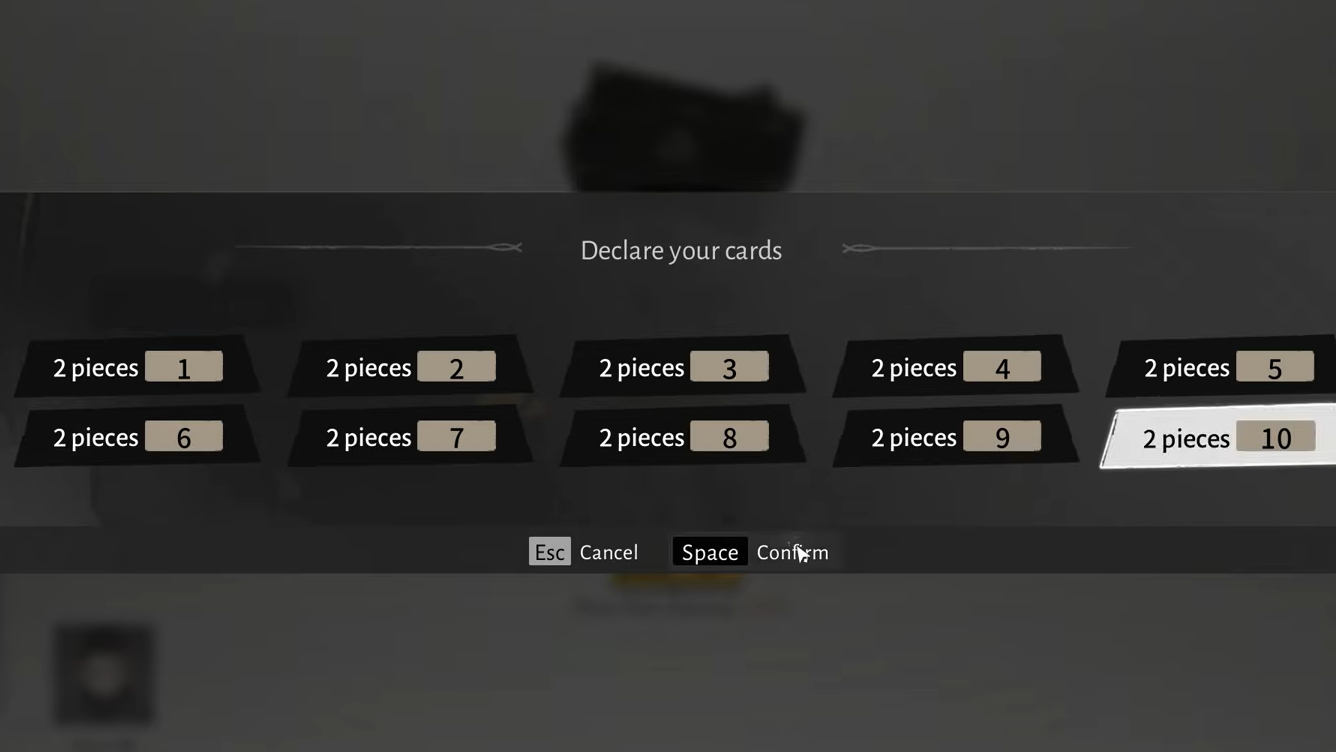
- Keep most of your truthful plays to two or three cards at a time.
- Avoid dropping five or six cards unless you are absolutely certain you won’t be challenged, or you are making a calculated bluff.
Small declarations steadily shrink your hand without painting a huge target on you.
3. Call out big, greedy declarations
Nobody is counting perfectly every round, but a simple heuristic works very well:
- Hands of five or more cards are very often lies, especially in the mid-to-late game.
- Hands of four cards can go either way; look at how many of that number you already know are out of play and how many wilds have appeared.
When an opponent claims something like “seven 1s” or “six 9s,” quickly run the mental math:
- Four real copies exist of that number.
- Any extras must be wilds.
- If you are holding several wilds, their claim becomes nearly impossible.
In those spots, challenge aggressively. Even if you misjudge occasionally, you’ll usually catch far more lies than you lose.
4. Tell the truth more often than you lie (especially vs NPCs)
Against the AI, the safest long-term plan is surprisingly simple:
- Mostly tell the truth on your turns, especially early in the match.
- Focus on challenging when NPCs get greedy with huge stacks.
NPCs routinely overextend with big lies. If your own declarations are genuine, you rarely get punished when they challenge you, and every successful call you make shoves more cards back into their hands while pushing up their pass-out chance.

5. Use yellow wilds as late-game insurance
Wilds are your best tools for closing out a match:
- Keep a few wilds in reserve rather than burning them on early safe plays.
- In late rounds, when everyone is desperate to stop you from emptying your hand, use wilds to make your final declarations fully truthful. Even if opponents challenge, they lose.
Because other players assume you’re bluffing near the finish line, having two or three wilds at the end often guarantees victory.
6. Choose good numbers when you win the lead
Whenever you win a challenge — whether by catching a lie or surviving a false accusation — you gain the right to choose the number for the next round.
Two simple approaches work well:
- Stick with the previous number: other players have likely already spent their copies of that number in the last round, while the loser just picked up the whole pile full of mismatched junk. It’s often hard for them to play honestly on that same number again.
- Call a number you’re rich in: if you have three or four copies (plus wilds), you can safely make slightly larger but still truthful declarations, dragging others into awkward lies.
Either way, the goal is to push opponents into lying or accepting penalties while you continue playing mostly genuine hands.
7. When to accept the penalty instead of lying
Accepting the penalty means:
- You immediately lose the round.
- You take the current pot % as meter damage and roll against your pass-out chance.
- You avoid putting down a very obvious lie that others will easily challenge.
Accept the penalty when:
- The pot is small (for example, early in a round with only a few cards in the middle), and
- Any lie you could tell would be extremely obvious because you have none of the called number and few or no wilds.
It’s still a risk — you can pass out on the spot — but in some cases, it is less damaging than handing a huge pile of cards back into your own hand by being caught in an obvious bluff.
Common misunderstandings that cause instant losses
Several design choices and UI quirks trip players up. A few things to watch for:
- The game sometimes “auto-declares” for you. If you are not the one who started the round, your declaration is locked to the number the leader called. You choose how many cards to put down, but the number itself is fixed for the round.
- You cannot change the round number on your turn unless you are starting a new round. Only the player with the coin at the beginning of a round picks the number.
- Number of cards, not their sum. When someone declares “three 10s,” they are claiming three cards that all count as 10, not a mix like 6+4 or 7+3+0.
- AI can feel unfair offline. NPCs challenge very aggressively and often seem to “know” when you’re lying. That’s another reason to keep your own declarations mostly truthful and let them hang themselves with overblown lies.
Once you treat Madiao as a pure bluffing game about counts — four copies per number, twelve wilds, and a rising drunk meter — the minigame stops being opaque and becomes a predictable, almost mechanical way to earn wins. Keep your stacks small, challenge big hands, hoard your yellow cards for the end, and let everyone else drink themselves under the table.