

Cooking in Slay the Spire 2 is tied to a single relic: Meat Cleaver. Once you have it, Rest Sites gain a new cooking option, and that option becomes part of your route planning in the same way Smith, Rest, Dig, and Lift already do for other relic-driven builds.
Meat Cleaver trigger
Quick answer: Get Meat Cleaver, then enter a Rest Site. The Cooking option appears there, which confirms the mechanic is active.
Cooking is not a base system that every run can use from the start. It is a relic-gated mechanic. The same pattern already exists elsewhere in the relic pool. Girya adds Lift at Rest Sites, Shovel adds Dig, and Miniature Tent lets you choose any number of Rest Site options. Meat Cleaver fits that same design language and turns campfires into a resource conversion point.
The success check is simple. If Meat Cleaver is in your relic bar, the next Rest Site should show the Cooking action. If it does not, the mechanic is not active for that run.
What Cooking changes at Rest Sites
Cooking matters because Rest Sites are one of the most limited resources on the map. Every time you stop at one, you are usually giving up something else. A normal choice is already tense: heal now or upgrade now. Meat Cleaver adds a third axis to that decision.
That has two immediate consequences. First, route value changes. A path with more Rest Sites becomes stronger than it would be in a run without Meat Cleaver. Second, any relic that expands Rest Site actions becomes more valuable because it reduces the opportunity cost of using Cooking.
| Relic | Rest Site effect | Why it matters with Meat Cleaver |
|---|---|---|
| Meat Cleaver | Adds Cooking | Enables the mechanic |
| Miniature Tent | You may choose any number of options | Lets you combine Cooking with Rest, Smith, Dig, or Lift |
| Girya | Adds Lift | Creates another strong campfire action competing with Cooking |
| Shovel | Adds Dig | Raises the value of multi-option campfires even more |
| Regal Pillow | Rest heals an additional 15 HP | Makes full healing turns stronger if Cooking does not solve survivability alone |
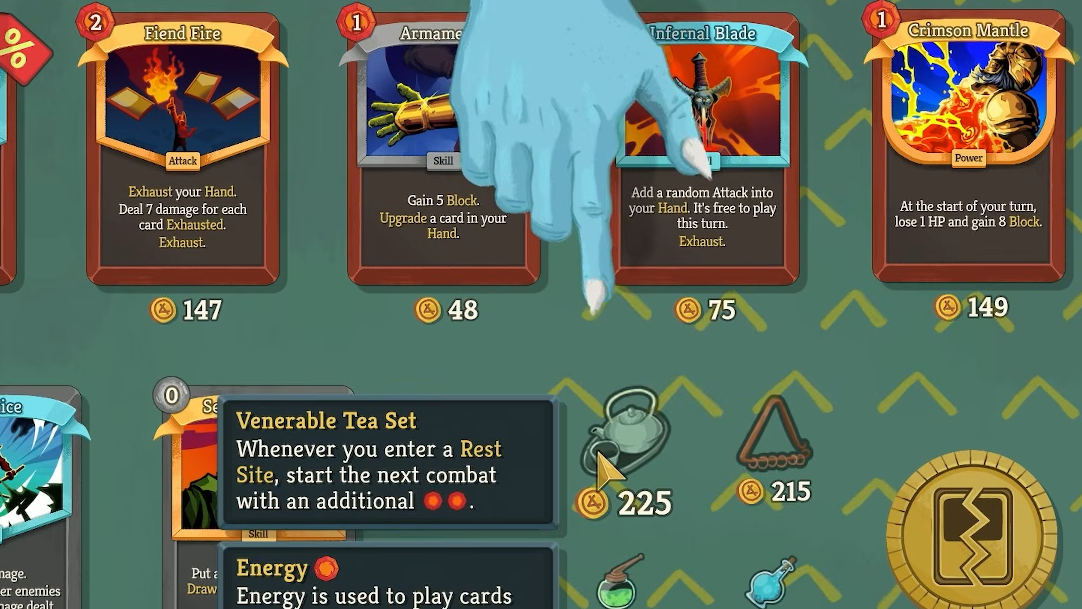
| Venerable Tea Set | After entering a Rest Site, the next combat starts with 2 additional Energy | Improves the floor value of every campfire stop |
How to use Meat Cleaver effectively
The core rule is simple. Treat Meat Cleaver as a reason to value Rest Sites more highly, not as a reason to stop upgrading cards entirely. Cooking is strongest when it replaces a weak campfire turn, not when it crowds out a crucial Smith that would have fixed your deck.
If your deck already blocks well and closes fights cleanly, Smith often remains the better choice. If your run is unstable, Cooking can be the safer use of the campfire because it gives you immediate value without needing another fight to pay it back.
The relic becomes much stronger when your route has repeated campfires. It also becomes stronger when you already have enough upgraded core cards and no single Smith target is run-defining. In that spot, Cooking is easier to justify because the upgrade you are skipping is marginal, while the campfire value from Meat Cleaver is immediate.
When Meat Cleaver is strongest
Meat Cleaver performs best in runs where Rest Sites are plentiful, and your deck’s essentials are already online. That usually means you have solved your first layer of consistency and are now trying to stretch survivability, deck quality, or both across the rest of the act.
It also gets better when you can stack campfire utility. Miniature Tent is the obvious high-roll partner because it removes the usual one-choice limit at Rest Sites. When those relics overlap, campfires stop being a tradeoff and start acting like full build checkpoints.
By contrast, Meat Cleaver is less impressive when your deck is desperate for upgrades, your best cards still need to be Smith’d, or your route offers very few Rest Sites. In those runs, the relic is still active, but the number of times you can exploit it is much lower.
What to verify after you get Meat Cleaver
The mechanic is working if the Cooking action appears at the next Rest Site. That is the only confirmation you need. You do not need a separate unlock menu, class-specific condition, or external progression check tied to the relic itself.
If you are planning around Meat Cleaver, verify three things before committing to a path:
- How many Rest Sites are still ahead in the act
- Whether you still need key upgrades more than the campfire utility
- Whether you have relics that make campfires more efficient, especially the Miniature Tent
Common mistakes with Meat Cleaver
The most common error is overvaluing Cooking the moment the relic appears. Meat Cleaver is powerful because it gives Rest Sites another use, but that does not erase the value of Smith. If a specific upgrade fixes your energy curve, improves scaling, or solves a bad matchup, skipping it for Cooking can be a net loss.
The second mistake is undervaluing route shape. Meat Cleaver is not equally strong on every map. A relic that adds a campfire option gets paid only when you actually reach campfires. If your chosen path is rich in elites, shops, and events but light on Rest Sites, the relic’s impact drops sharply.
The third mistake is missing synergy with other campfire relics. Miniature Tent is especially important because it changes Cooking from an either-or decision into additive value. When that happens, Meat Cleaver stops competing with your best campfire options and starts joining them.
Meat Cleaver in the broader relic economy
Slay the Spire 2 splits relics into starter, common, uncommon, rare, and shop categories on its official relic lists at Slay the Spire 2’s relic page. Many relics are simple passive bonuses, but a smaller group changes the rules of the map or adds new actions. Meat Cleaver belongs in that second category.
That distinction matters. A stat relic like Vajra or Oddly Smooth Stone improves every combat in a predictable way. A system relic changes how you value rooms and decisions. Meat Cleaver is stronger than it first looks for exactly that reason. It does not merely add power. It changes what a Rest Site can do for your run.
If Meat Cleaver shows up, the right question is not whether Cooking is “good” in the abstract. The real question is how many Rest Sites remain, how badly your deck still needs upgrades, and whether any other relics let you stack campfire actions. When those pieces line up, Meat Cleaver can turn an ordinary route into one of the most efficient paths on the map.