

Data Points sit at the center of progression in StarRupture. They unlock crafting recipes, advanced production stations, building upgrades, and raise Corporation reputation, and late-game milestones can demand thousands of them. The upside is that the game offers several reliable ways to generate large amounts of Data Points once you know where to look and how to time your runs.
What Data Points are used for
Data Points act as a universal research currency rather than a traditional crafting resource. They are created by analyzing items or by completing corporate deliveries, and then spent in two main places:
- Corporate Terminal – transferring Data Points to Corporations advances Milestones and raises Faction levels, which in turn unlocks new recipes and systems.
- Recipe Station – spending Data Points here unlocks extra functionality and upgrades for buildings.
Some Milestones can consume anything from a few dozen to tens of thousands of Data Points. Delivering Data Points to Corporations also replaces the need to ship physical Material Commissions via Orbital Launcher Stations for those milestones, which is why efficient farming dramatically smooths mid- and late-game progression.

How to turn in and spend Data Points
Once you start generating Data Points, you need to know where to convert them into progression.
Step 1: Access a Corporate Terminal in your base and interact with it. Your current Data Point total appears in the upper-right corner of the terminal UI, alongside a progress bar for your active milestone or Faction level.
Step 2: Click the button near the Data Point readout or directly on the Data Point count. This applies your stored Data Points to the current milestone, raising your Corporation level. In the tutorial, this is the “level up” control that lets you push to the required level when the text says to “get to level 4 using data points.”
Step 3: After leveling up Corporations, visit the unlock menus tied to that Corporation and the Recipe Station to purchase new building functions, recipes, and upgrades using additional Data Points.
Method 1: Analyze Ignitium after Rupture events
The Rupture is StarRupture’s signature system: a planet-wide event that wipes the map, reshapes terrain, and bombards Arcadia-7 with meteorites. That destruction is also one of the most efficient Data Point engines in the game.
After a Rupture, meteorites and minerals rain down across the landscape. Among them is Ignitium, a glowing orange resource that serves as both a valuable crafting material and a high-yield analysis target for Data Points.
A bundle of 5 Ignitium analyzed at an Analysis Station is worth about 2,000 Data Points, which makes focused post-Rupture farming a quick way to stockpile research currency.

How to find and safely harvest Ignitium
Step 1: As soon as a Rupture ends, leave your base and scan the horizon. Ignitium meteorites reveal themselves with an orange glow in the distance and visible smoke plumes rising from fresh impact sites.
Step 2: Move toward these visual markers and mine or loot the Ignitium deposits around each impact. Prioritize speed over thoroughness; Ignitium is highly unstable.
Step 3: Return to your base quickly. At your Analysis Station, feed stacks of Ignitium into the analyzer to convert them directly into Data Points. Repeat the loop with nearby impact sites until Ignitium stops spawning.
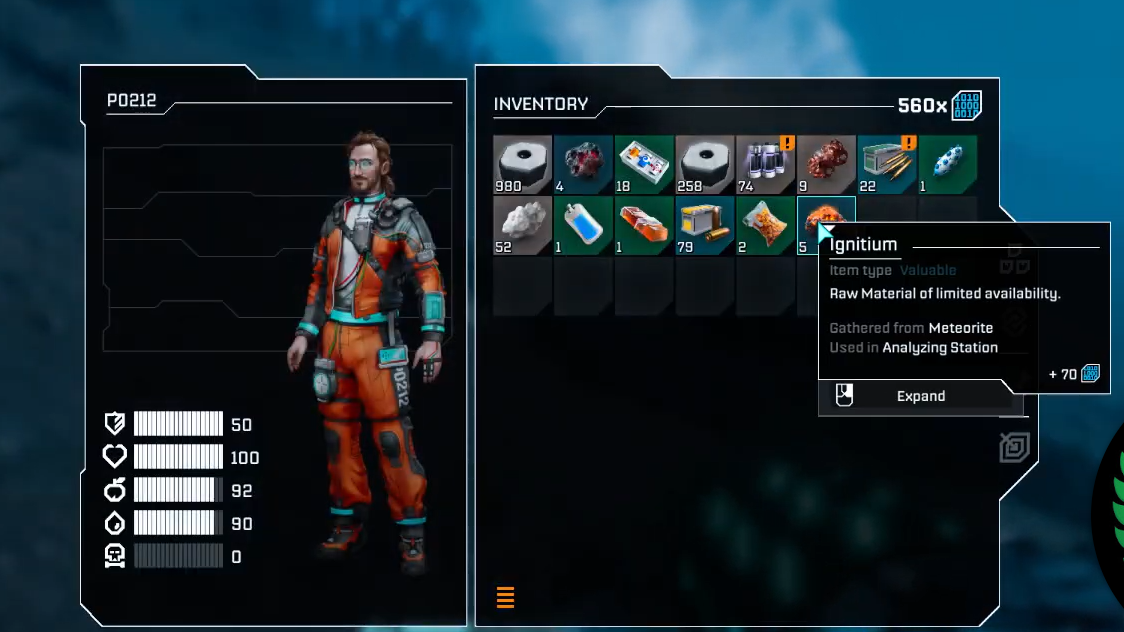
Ignitium has two hard constraints. It only appears in the early hours after a Rupture, and it disintegrates quickly if left in the world. Treat every Rupture as a timed window: grab what you can, cash it in, and accept that chasing one more meteor might mean losing earlier spawns.
Method 2: Analyze combat and exploration drops
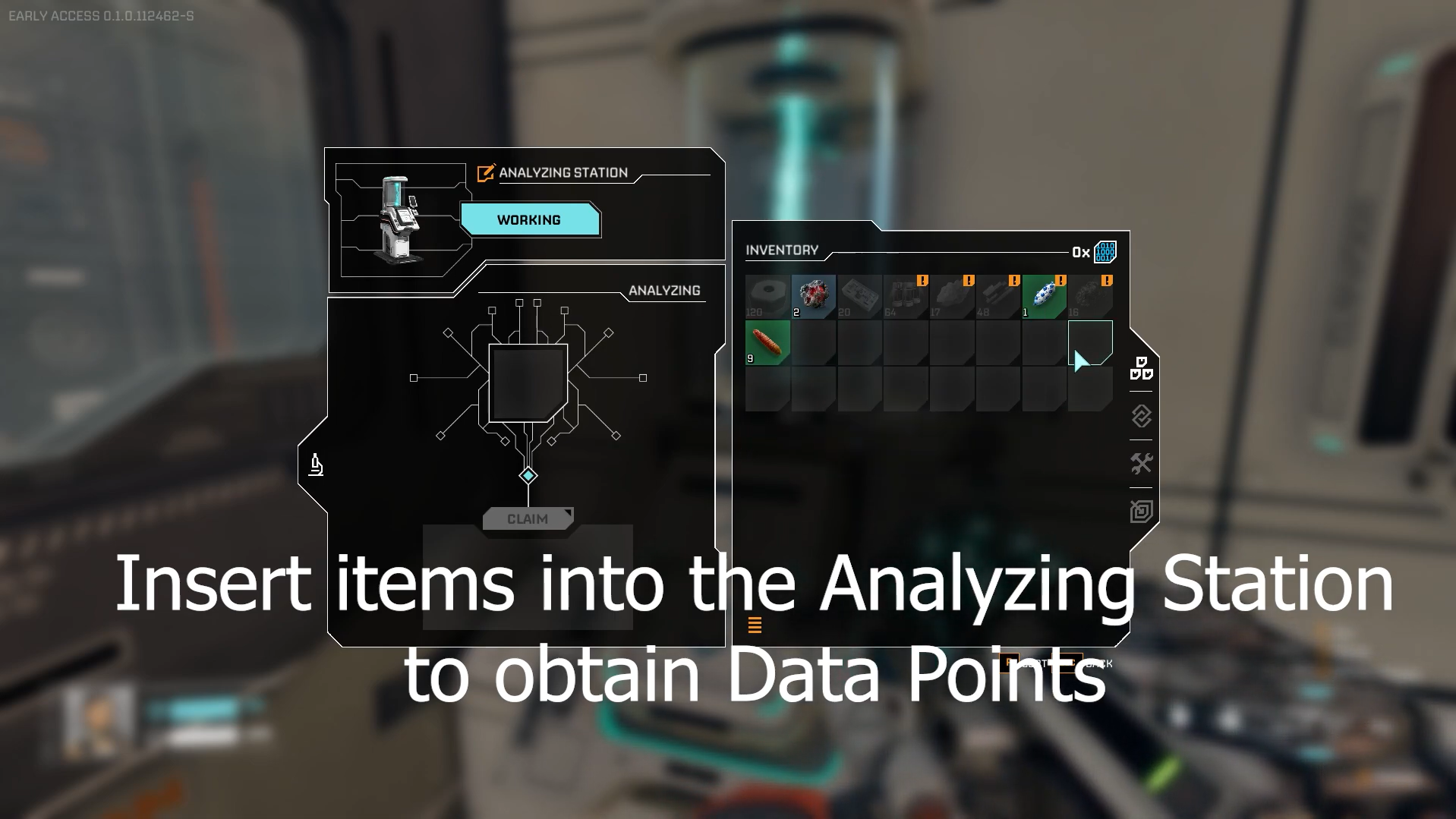
Between Ruptures, the game still gives you steady ways to convert field work into Data Points. The Analysis Station accepts a wide range of items, but some categories offer better returns than others.
Vermin and other biological samples
Vermin are small arachnid enemies scattered across Arcadia-7. They are more than just a nuisance: they drop valuable biological samples that can be analyzed for research currency.
Step 1: While exploring during normal cycles (when the Rupture is inactive), clear out Vermin nests and patrol routes as you encounter them. Focus on areas you already traverse for resources rather than going out of your way solely for Vermin.
Step 2: After each fight, manually collect the biological sample loot. These drops are easy to miss during chaotic encounters, so sweep the area before moving on.
Step 3: Back at your base, deposit the collected samples into the Analysis Station to convert them into Data Points. The yield is smaller than Ignitium, but this method runs continuously and pairs well with resource gathering or questing.
Organic materials, Meteor Hearts, and other analyzable items
The Analysis Station also accepts a variety of world drops, which makes exploration intrinsically valuable:
- Organic materials appear on tree trunks and branches across the map. They usually glow, so they stand out even at night. These can be analyzed for modest but frequent Data Point gains.
- Meteor Hearts drop from meteorites much like Ignitium. They convert into Data Points at the Analysis Station, but also serve other purposes, so burning them for research is a tradeoff rather than an automatic choice.
- Plant Samples and Meteorite Cores can be analyzed as well, but they are typically more valuable for crafting and other systems than for their relatively low Data Point return.
Over time, combining creature drops, organic materials, and post-Rupture spoils through the Analysis Station forms a baseline income that keeps your tech tree moving forward even before your factories are fully automated.

Method 3: Salvage Broken Pieces of Technology
The highest-value single items for analysis come from the remains of previous activity on Arcadia-7. These runs are riskier and more involved than chasing meteorites, but their payouts can rival several Ignitium hauls.
When exploring, keep an eye out for:
- Fallen Drones – downed machines scattered across the landscape.
- Former Colonist bodies – human remains often accompanied by gear or containers.
- Ruined ClayWood Corporation survey sites – remnants of earlier expeditions with crates, equipment racks, and structural debris.
These locations can contain Broken Pieces of Technology in various forms and sizes. Once brought back and analyzed, these fragments yield roughly 400 to 2,000 Data Points each, depending on their quality tier.
Step 1: Plan expeditions toward known ruin clusters, drone crash zones, or corporate survey remnants while you are also pursuing other objectives, to amortize the travel time.
Step 2: Thoroughly loot each site for any item labeled as a Broken Piece of Technology or visually identifiable as tech scrap or modules.
Step 3: Return to base and load these pieces into the Analysis Station. Prioritize higher-tier fragments if inventory space is tight; their Data Point return is significantly higher.
This route is less consistent than meteorite runs but offers the best individual-item yields, especially once you are already pushing deep into the map for other content.

Method 4: Launch materials via the Orbital Cargo Launcher
Once your production lines are stable, the most scalable way to generate Data Points is to turn manufactured goods into orbital deliveries. Corporations post material commissions, and fulfilling those via the Orbital Cargo Launcher pays out directly in Data Points.
Step 1: At a Corporate Terminal, check which items each Corporation is currently requesting. Each request lists both the quantity and the Data Points you will earn for delivering that item.
Step 2: In your factory setup, ensure you can mass-produce at least one or two of the requested items without manual babysitting. This method shines when belts and assemblers can run unattended.
Step 3: At an Orbital Cargo Launcher, load the requested materials into the cargo bay. Before firing, review the interface again; it shows the exact Data Point reward per item, which helps avoid accidentally sacrificing rare, more valuable materials.
Step 4: Launch the cargo. Once the delivery completes, the corresponding Data Points are added to your total almost instantly, ready to be spent at the Corporate Terminal or Recipe Station.
This loop is especially potent in the mid- to late-game when your base can output large volumes of mid-tier components. At that point, Data Points effectively become a byproduct of your manufacturing scale.

Method 5: Analyze-only progression early on
Long before heavy automation, the Orbital Cargo Launcher path is limited by your ability to spare materials. Early bases often struggle to keep up with basic demands, so feeding those same items into orbit can feel punishing.
In that phase, it is more efficient to treat the Analysis Station as your main research engine:
- Use every Rupture window to scoop up Ignitium and occasional Meteor Hearts.
- Collect Vermin samples, organic materials, and other easy world drops while exploring.
- Analyze Broken Pieces of Technology whenever you find them, rather than hoarding them.
This approach front-loads your tech progression so that by the time you can sustain constant production, your Corporations and building tech are already several tiers ahead, and Data Points from cargo launches become a bonus instead of a bottleneck.
Which items you should avoid analyzing
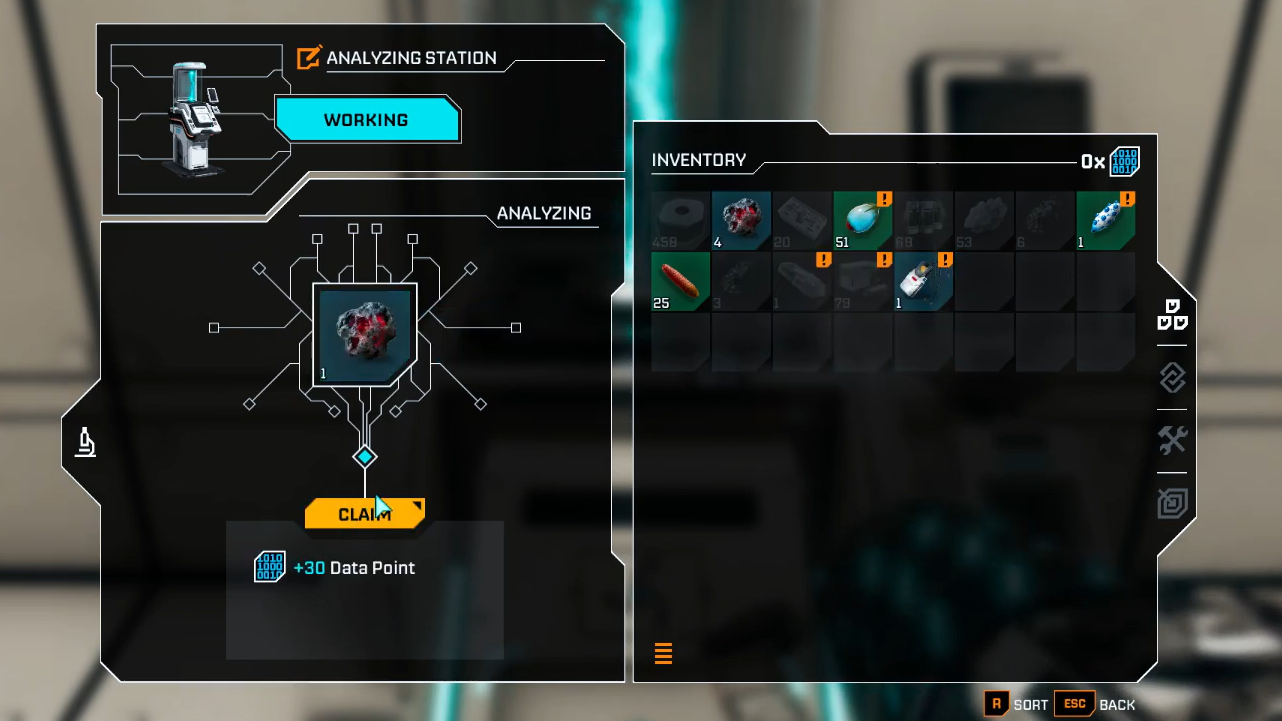
Not every analyzable resource should be turned into Data Points. Some items carry more value in crafting than they do as research fodder.
- Plant Samples and Meteorite Cores technically generate Data Points at the Analysis Station, but their payouts are relatively small compared to their importance in other systems. Treat these as last-resort sacrifices if you are blocked by a specific milestone.
- Meteor Hearts provide good Data Points but also support other uses, so it is usually better to prioritize Ignitium and lower-value samples before feeding Meteor Hearts into the analyzer.
A good rule of thumb: if an item is central to weapon upgrades, advanced construction, or quest chains, keep it; if it exists primarily as a “valuable” or as biological/organic scrap, it is a strong candidate for analysis.
Choosing the right Data Point strategy for your stage
The most efficient approach changes as your world develops:
- Very early game: lean heavily on Ignitium from Rupture events and whatever small drops you can feed into the Analysis Station. Save most refined materials for building your base.
- Early–mid game: add Vermin farming, organic gathering, and tech salvage runs to your routine. Use Data Points to unlock key base systems and early building upgrades.
- Mid–late game: once factories are stable, let the Orbital Cargo Launcher do most of the heavy lifting. Keep using Rupture windows and salvage expeditions as burst income to hit expensive milestones faster.
Mixing methods is the core of efficient play. Meteor-based bursts, steady analysis of exploration loot, and large-scale corporate launches complement each other, turning Data Points from a frustrating cap into a predictable, controllable resource that keeps your Corporations and infrastructure advancing.