

The Brainrot Dealer in Steal A Brainrot was designed to feel less like a casual NPC shop and more like a global flash sale. For one week in November 2025, it became the main way to grab some of the strongest Brainrots in the game — if you could beat everyone else to them.
Brainrot Dealer location and availability
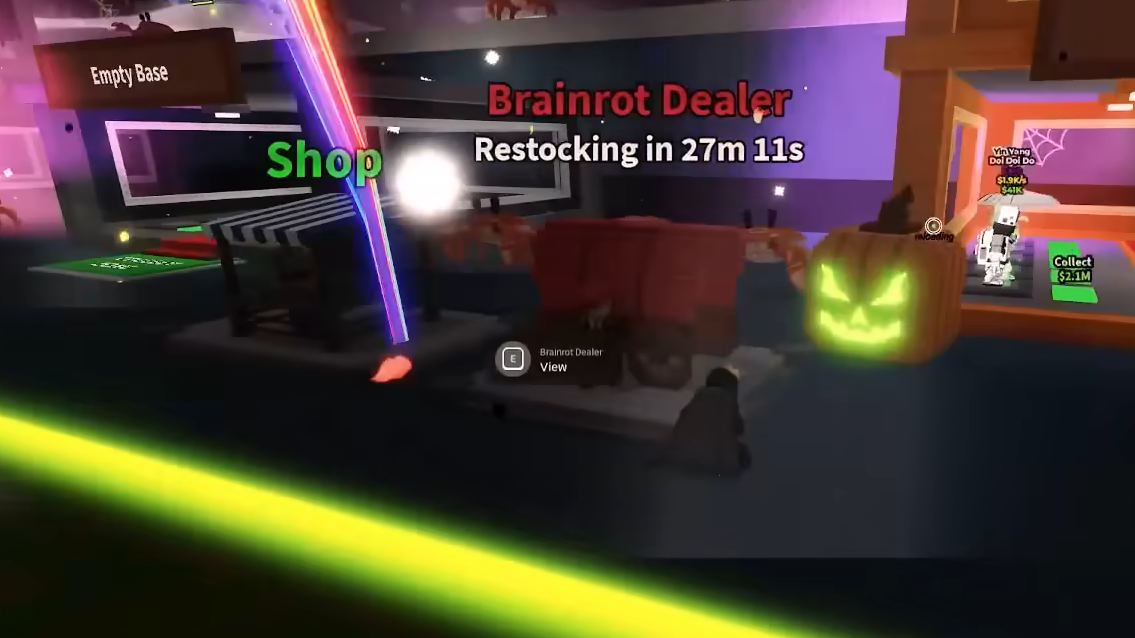
The Dealer’s setup was deliberately hard to miss. He stood on a raised platform right next to the regular Shop in the center of the map, with a large wagon behind him covered in bright signage. That wagon doubled as a UI element: it showed two key things at a glance — how many of each Brainrot were left, and when the next restock would hit.
From any spawn point, you could simply head toward the central Shop area to find him. During the event window, the Dealer stayed active and did not despawn between rounds. The system ran from November 8 to November 15, 2025, replacing the Witch Fuse machine during that period before being shut down after strong pushback from players.
How the global stock system worked
The Brainrot Dealer used a single, shared inventory across the entire game. That design choice is what turned a simple vendor into a competitive market.
| System feature | What it meant in practice |
|---|---|
| Global inventory | Every visible stock number was shared across all servers and players. |
| Shared stock pool | Buying 1 copy of a Brainrot reduced the remaining count for everyone else by 1. |
| Timed restocks | New stock appeared on a fixed 30-minute cycle; some in-game UIs also surfaced it as “restocks every hour”. |
| Rarity-based quantities | Secret Brainrots appeared in very small batches; lower rarities spawned in much larger numbers. |
| Real-time updates | Stock decreased immediately after any purchase, no matter which server it came from. |
If you saw “50 Noo La Polizia” in stock, those 50 copies were being fought over by the entire active player base, not just your server. A single purchase anywhere pushed the number down to 49 for everyone.
This design meant hesitation often cost you the item. It also produced a lot of “empty” purchases: you would click buy, only to see an “Unexpected Server Error” because the Brainrot had sold out a fraction of a second earlier, and your client hadn’t refreshed yet.
Brainrot Dealer stock: full item list and performance
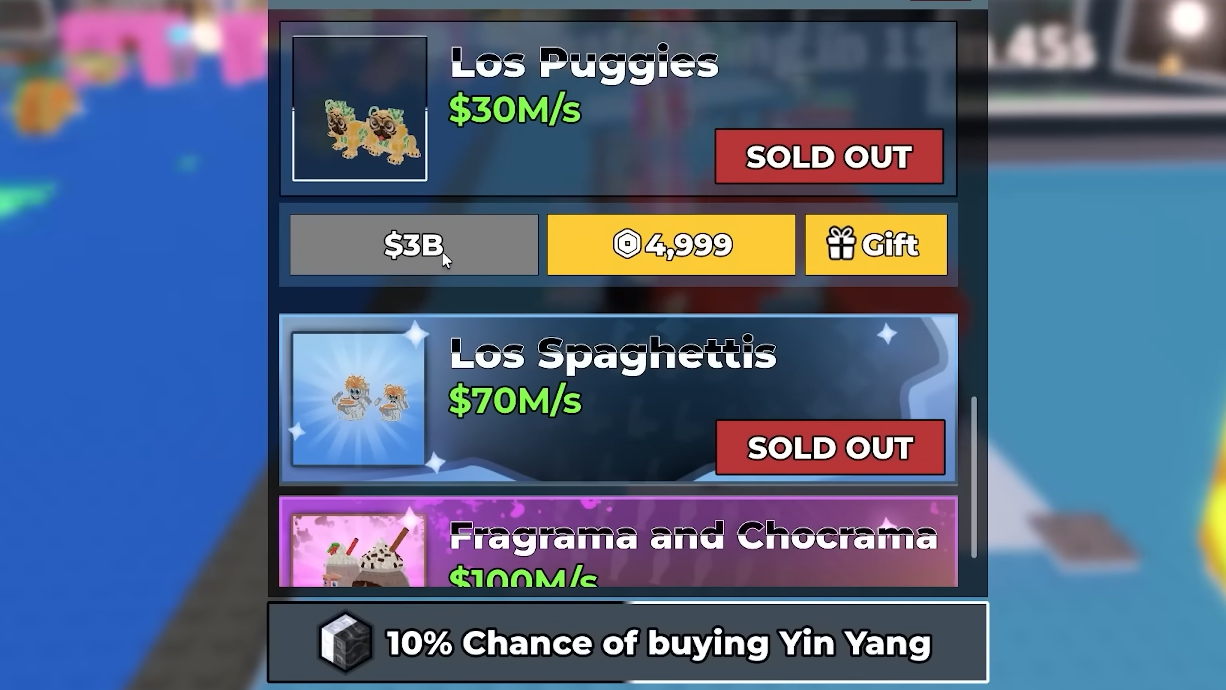
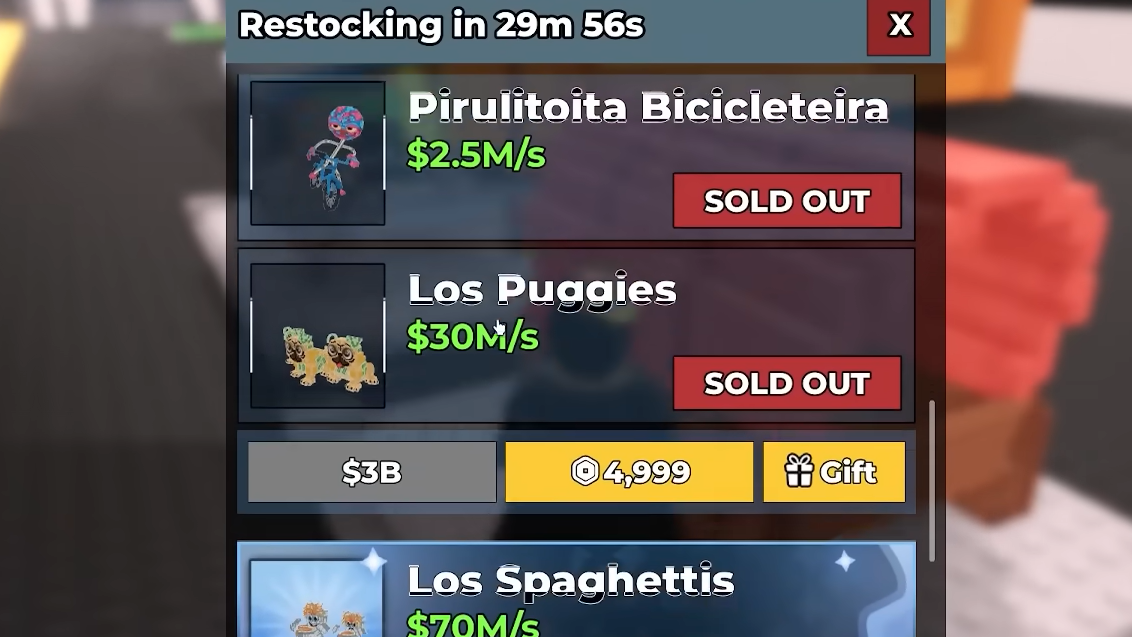
The Dealer carried a fixed lineup of 10 Brainrots, covering the full spectrum from Rare to Secret. Each came with a steep upfront cost but a dramatically higher income than most regular units.
| Brainrot name | Rarity | Cost (cash) | Income per second |
|---|---|---|---|
| Fragrama and Chocrama | Secret | $40,000,000,000 | $100,000,000 |
| Los Spaghettis | Secret | $40,000,000,000 | $70,000,000 |
| Los Puggies | Secret | $3,000,000,000 | $30,000,000 |
| Pirulitoita Bicicleteira | Secret | $600,000,000 | $2,500,000 |
| Noo La Polizia | Brainrot God | $67,000,000 | $280,000 |
| Money Money Man | Brainrot God | $17,500,000 | $65,000 |
| Stoppo Luminino | Mythic | $3,000,000 | $8,000 |
| Clickerino Crabo | Legendary | $250,000 | $1,000 |
| Doi Doi Do | Epic | $41,000 | $260 |
| Cupcake Koala | Rare | $8,000 | $60 |
On raw income, Fragrama and Chocrama sat at the top with $100M per second, with Los Spaghettis following at $70M/s. Even the “cheap” end of the list — Cupcake Koala and Doi Doi Do — outpaced early-game units and gave newer players a way to quickly step up their earnings if they could win the purchase race.
For many players, these numbers felt less like a progression curve and more like a dividing line between those who could spend heavily and those who couldn’t, which fed directly into the backlash.
Restock timing and why the window felt so tight
Restocks happened on a fixed 30-minute cycle for the Dealer’s global inventory. The wagon behind the NPC displayed a countdown timer so you knew exactly when the next set of items would land. In some in-game surfaces, this was described more loosely as a restock “every hour”, but in practice, players treated 30-minute ticks as the real cadence.
At restock, each Brainrot rolled a new stock quantity. Two design choices shaped how those drops felt:
- Secret Brainrots (Fragrama and Chocrama, Los Spaghettis, Los Puggies, Pirulitoita Bicicleteira) appeared in tiny numbers — sometimes only a handful of units globally.
- Lower-rarity Brainrots like Cupcake Koala and Doi Doi Do showed up in the hundreds, enough that most players who were prepared at the timer could grab at least one.
That imbalance created a split experience. Casual players could generally snag Rares or Epics without too much drama. High-end hunters sat on the timer, opened the Dealer UI seconds before restock, and spammed purchase on a specific Secret, hoping to win what was effectively a ping and click-speed contest.
Dealing with failed purchases and “Unexpected Server Error”
The event’s global-first design made it easy to run into a specific failure message: an “Unexpected Server Error” when you tried to buy a Brainrot that had technically already sold out.
In practice, it meant the stock number you were seeing was stale by a fraction of a second. Someone else had already bought the last unit, but your client hadn’t received the update yet. The fix was basic but essential:
- Close and reopen the Dealer shop to force a refresh of the stock numbers.
- Check what is still actually available rather than relying on the old list.
- Swap to a backup target if your first choice is gone instead of repeatedly clicking the same empty slot.
- Wait for the next 30-minute restock cycle if everything worth buying has been wiped out.
Purchase priorities and money targets
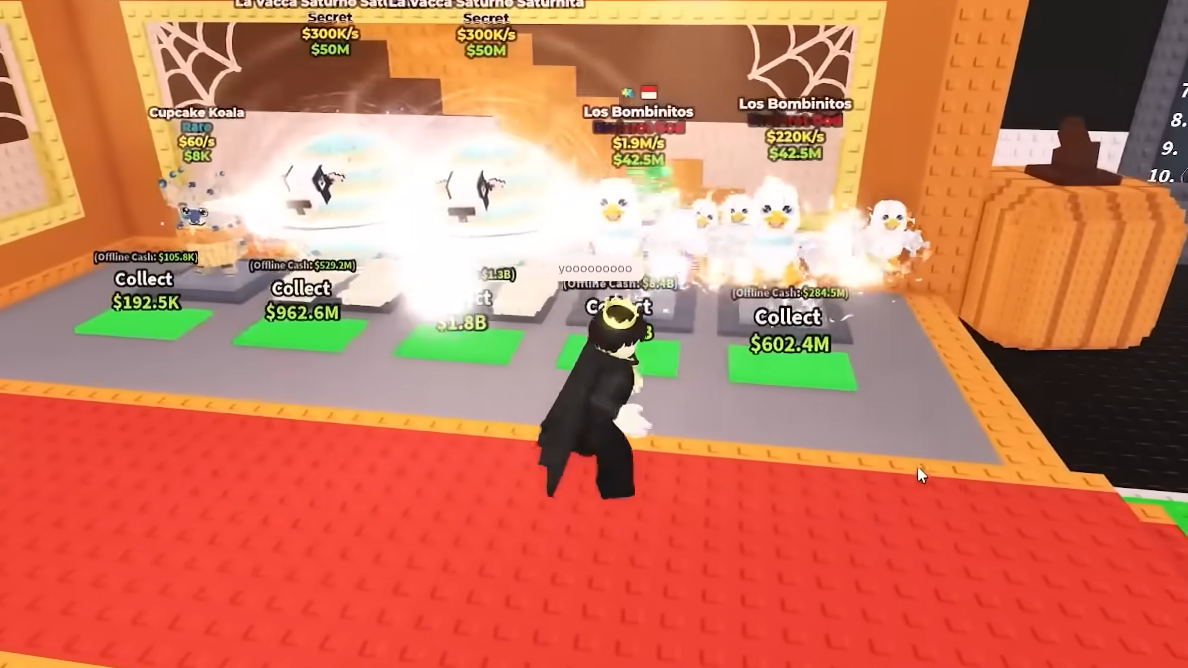
Given how rare some of the stock was, treating the Dealer like a normal shop didn’t work. You had to decide in advance what was worth burning your balance on and how much you needed to farm before the event.
| Priority band | Brainrots | Who should target them |
|---|---|---|
| Top-tier Secret | Fragrama and Chocrama, Los Spaghettis | Players already holding tens of billions; chasing maximum income per slot. |
| High-value Secret | Los Puggies, Pirulitoita Bicicleteira | Players who can hit the hundreds of millions to low billions and want a huge jump in earnings. |
| Late-game core | Noo La Polizia, Money Money Man | Mid- to late-game players scaling up from millions into tens of millions per second. |
| Starter upgrades | Stoppo Luminino, Clickerino Crabo, Doi Doi Do, Cupcake Koala | Newer players looking for efficient early-game boosts with relatively low buy-ins. |
Fragrama and Chocrama was the clear “best in slot” for pure cash generation, but its $40B price tag and tiny stock made it something you prepared for days in advance. Los Spaghettis, at the same price and slightly lower income, still landed among the top earners and became a popular chase target in its own right — especially for players aiming for later traits and mutations.
Why the Brainrot Dealer was pulled early
On paper, the Dealer was a high-stakes experiment: global supply, hard scarcity, and a visible countdown that drew players into the center of the map every 30 minutes. In practice, it exposed several pressure points in Steal A Brainrot’s economy.
Two themes dominated player feedback:
- Perceived pay-to-win tilt. The sheer cost of top-tier Brainrots meant that players who could either grind heavily or spend Robux had a much easier time buying up the best items and locking in income advantages over everyone else.
- Automation and exploits. With global stock and fixed restocks, autoclickers and scripted purchases became incredibly effective. Some players were able to instantly drain stock as soon as it appeared, leaving regular users staring at “Sold Out” messages even when they were on time.
The event was initially positioned to last until December, but the combination of community frustration and exploit-heavy restocks pushed the developers to cut the lifetime back to a single week, ending on November 15, 2025. A rework was announced that would shift the Dealer into more of a trader role: instead of paying cash against a global pool, players would exchange existing Brainrots for the Dealer’s exclusives, with trade offers refreshing every 30 minutes.
What happens to Dealer Brainrots after the event
When the Dealer left the map, the Brainrots themselves did not vanish from the game. They remained part of the overall roster, but access shifted back to other systems that players were already using:
- Conveyor belt spawns. Some Dealer Brainrots could appear randomly on the central ramp, letting anyone in the lobby sprint for them.
- Craft Machine. Certain units became reachable through recipes that combined existing Brainrots or materials.
- Fuse Machine. Others slotted into fusion chains as high-end outcomes for players willing to sacrifice multiple lower-tier units.
The Dealer event essentially acted as an early shortcut and a stress test for a new kind of marketplace rather than a permanent gate. If similar global vendors return later, the same lessons will stay relevant: know your target, farm the exact amount of cash you need ahead of time, and position yourself at the wagon when the restock timer ticks down.