

Ores sit at the center of The Forge. They decide how hard your weapons hit, how tanky your armor feels, and how much gold you pull out of a mining run. The game packs more than 50 different ores into three main areas and a handful of enemy drops, and each one comes with its own rarity, drop chance, forging multiplier, and sometimes a powerful trait.
How ores work in The Forge
Every ore in The Forge has a small set of stats that always matter:
- Rarity – Common, Uncommon, Rare, Epic, Legendary, Mythical, Relic, or Divine. Higher rarity usually means lower drop chance and better forging potential.
- Chance – Shown as a fraction such as
1/5. The bigger the number on the right, the rarer the ore. - Multiplier – A “forging boost” value like
2.5xthat scales weapon and armor stats when the ore is part of the recipe. - Price – How much gold you get for selling a single ore.
- Trait – Extra passive bonuses on weapons or armor when enough of that ore is in the mix.
- Dropped by / Rocks – Which rock types or enemies can drop the ore, and in which area.
For mining, the important pieces are where an ore drops and how rare it is. For crafting, multiplier and traits matter more than raw sell price.
Stonewake’s Cross ores (starter cave)
Stonewake’s Cross is the starting area and home base. Here you mine three rock types – Pebbles, Rocks, and Boulders – with even the starter pickaxe. These early ores are mostly about filling your wallet and pushing up base multipliers so your first weapons and armor don’t feel paper thin.
| Ore | Rarity | Chance | Multiplier | Sell price | Dropped by | Trait |
|---|---|---|---|---|---|---|
| Stone | Common | 1/1 | 0.2x | $3 | Pebble | None |
| Sand Stone | Common | 1/2 | 0.25x | $3.75 | Pebble, Rock | None |
| Copper | Common | 1/3 | 0.3x | $4.5 | Pebble, Rock, Boulder | None |
| Iron | Common | 1/5 | 0.35x | $5.25 | Pebble, Rock, Boulder | None |
| Tin | Uncommon | 1/7 | 0.425x | $6.38 | Rock, Boulder | None |
| Silver | Uncommon | 1/12 | 0.5x | $7.5 | Rock, Boulder | None |
| Gold | Uncommon | 1/16 | 0.65x | $19.5 | Boulder | None |
| Mushroomite | Rare | 1/22 | 0.8x | $12 | Rock, Boulder | None |
| Platinum | Rare | 1/28 | 0.8x | $12 | Boulder | None |
| Bananite / Banananite | Uncommon | 1/30 | 0.85x | $12.75 | Rock, Boulder | None |
| Cardboardite | Common | 1/31 | 0.7x | $10.5 | Rock, Boulder | None |
| Aite | Epic | 1/44 | 1.0x–1.1x | $16.5 | Boulder | None |
| Poopite | Epic | 1/131 | 1.2x | $18 | Pebble, Rock, Boulder | 15% poison for 5s when below 35% HP (armor) |
In practice, Stonewake’s Cross is where you bulk up on Copper, Iron, Tin, and Silver, then slowly stack rarer finds like Aite and Poopite to raise your forging multipliers. Poopite deserves special mention: it’s the first traited ore and adds a poison effect when you’re low on health if enough of it ends up in your armor.
Forgotten Kingdom ores (mid-game basalt zone)
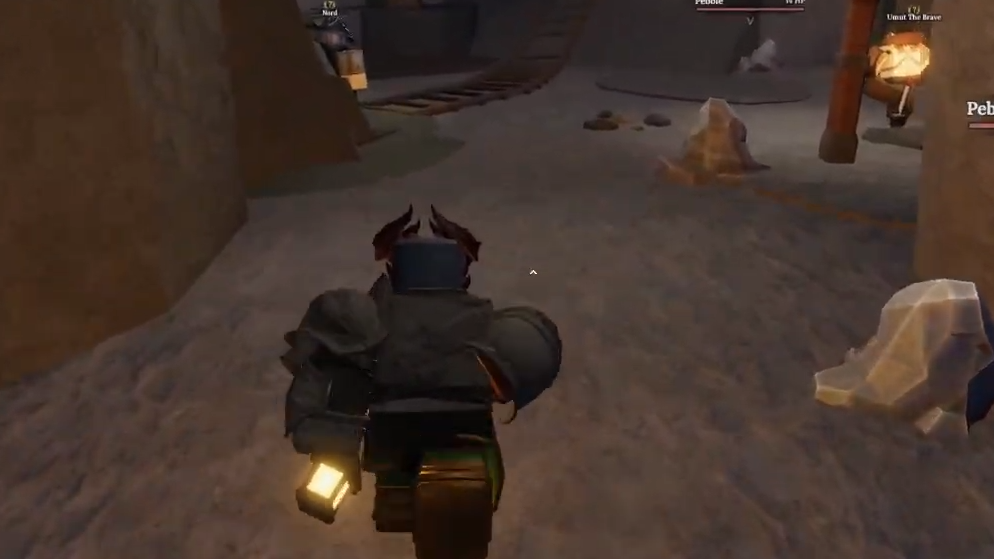
The Forgotten Kingdom sits behind progression gates and expects at least an Iron pickaxe. Here you mine four rock types – Basalt Rock, Basalt Core, Basalt Vein, and Volcanic Rock – and start seeing serious multipliers and many of the game’s key armor and weapon traits.
| Ore | Rarity | Chance | Multiplier | Sell price | Rocks | Main trait effect |
|---|---|---|---|---|---|---|
| Cobalt | Uncommon | 1/37 | 1.0x | $15 | Basalt Rock, Basalt Core | None |
| Titanium | Uncommon | 1/50 | 1.15x | $17.25 | Basalt Rock, Basalt Core | None |
| Lapis Lazuli | Uncommon | 1/73 | ≈1.3x | $19.5–$22.5 | Basalt Rock, Basalt Core | None |
| Volcanic Rock (ore) | Rare | 1/55 | 1.55x | $23.25 | Volcanic Rock | None |
| Quartz | Rare | 1/90 | 1.5x | $22.5 | Basalt Core, Basalt Vein | None |
| Amethyst | Rare | 1/115 | 1.65x | $24.75 | Basalt Core, Basalt Vein | None |
| Topaz | Rare | 1/143 | 1.75x | $26.25 | Basalt Core, Basalt Vein, Volcanic Rock | None |
| Diamond | Rare | 1/192 | 2.0x | $30 | Basalt Core, Basalt Vein | None |
| Sapphire | Rare | 1/247 | 2.25x | $33.75 | Basalt Core, Basalt Vein | None |
| Cuprite | Epic | 1/303 | 2.43x | $36.45 | Basalt Core, Basalt Vein, Volcanic Rock | None |
| Obsidian | Epic | 1/333 | 2.35x | $35.25 | Volcanic Rock | +15–30% armor defense, depending on listing |
| Emerald | Epic | 1/363 | 2.55x | $38.25 | Basalt Core, Basalt Vein | None |
| Ruby | Epic | 1/487 | 2.95x | $44.25 | Basalt Vein | None |
| Rivalite | Epic | 1/569 | 3.33x | $49.95–$66 | Basalt Vein, Volcanic Rock | +20% crit chance on weapons |
| Uranium | Legendary | 1/777 | 3.0x | $48–$66 | Basalt Vein | 5% max HP AOE damage on armor |
| Mythril | Legendary | 1/813 | 3.5x | $52.5 | Basalt Vein | 15% extra defense on armor |
| Eye Ore | Legendary | 1/1333 | 4.0x | $37.5–$60 | All Basalt & Volcanic rocks | -10% HP, +15% damage on weapons/armor |
| Fireite | Legendary | 1/2187 | 4.5x | $67.5 | Volcanic Rock | 20% burn chance on weapons |
| Magmaite | Legendary | 1/3003 | 5.0x | $75 | Volcanic Rock | 50% AOE explosion on weapons |
| Lightite | Legendary | 1/3333 | 4.6x | $69 | Basalt Vein | 15% extra movement speed on armor |
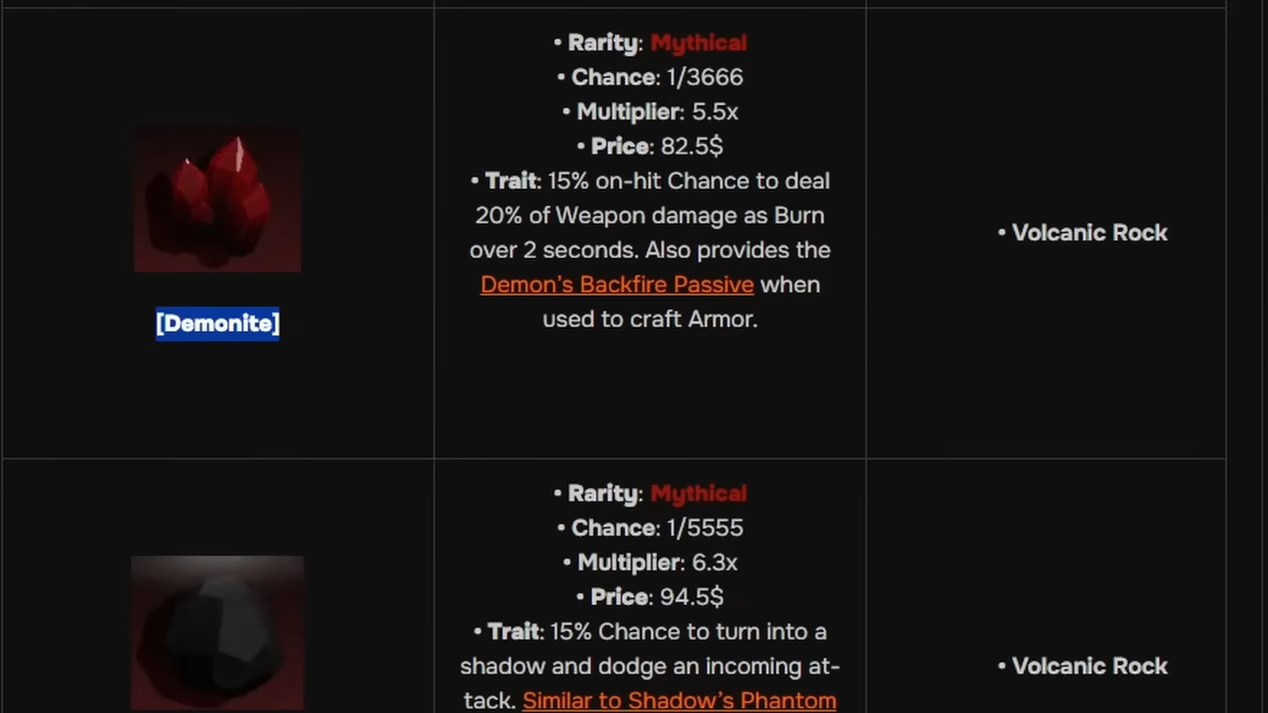
| Demonite | Mythical | 1/3666 | 5.5x | $82.5 | Volcanic Rock | Burn & Demon’s Backfire passive |
| Darkryte | Mythical | 1/5555 | 6.3x | $94.5 | Volcanic Rock | Shadow’s Phantom Step passive |
| Fichillium | Relic | 1/1 (from Lucky Block) | 0x | $0 | Lucky Block | None |
This area is where you start designing actual builds around ore traits:
- Obsidian stacks raw defense on armor, making it the easiest way to push survivability early in Forgotten Kingdom.
- Rivalite is a core ingredient for crit-focused weapons, thanks to its +20% crit chance trait.
- Uranium and Mythril both lean into armor passives: Uranium for HP-based AOE damage, Mythril for extra defense.
- Eye Ore is a flexible but risky pick for both weapons and armor, trading 10% max HP for +15% damage.
- Fireite and Magmaite define burn and explosion-centric weapon builds respectively.
- Demonite and Darkryte add high-end passives tied to burn and dodging.
Volcanic Rock nodes are especially valuable because they can drop Volcanic Rock ore itself plus Obsidian, Rivalite, Fireite, Magmaite, Demonite, and Darkryte. Basalt Veins focus more on gems and armor-focused legendaries like Mythril and Lightite.
Goblin Cave ores (crystal rocks)
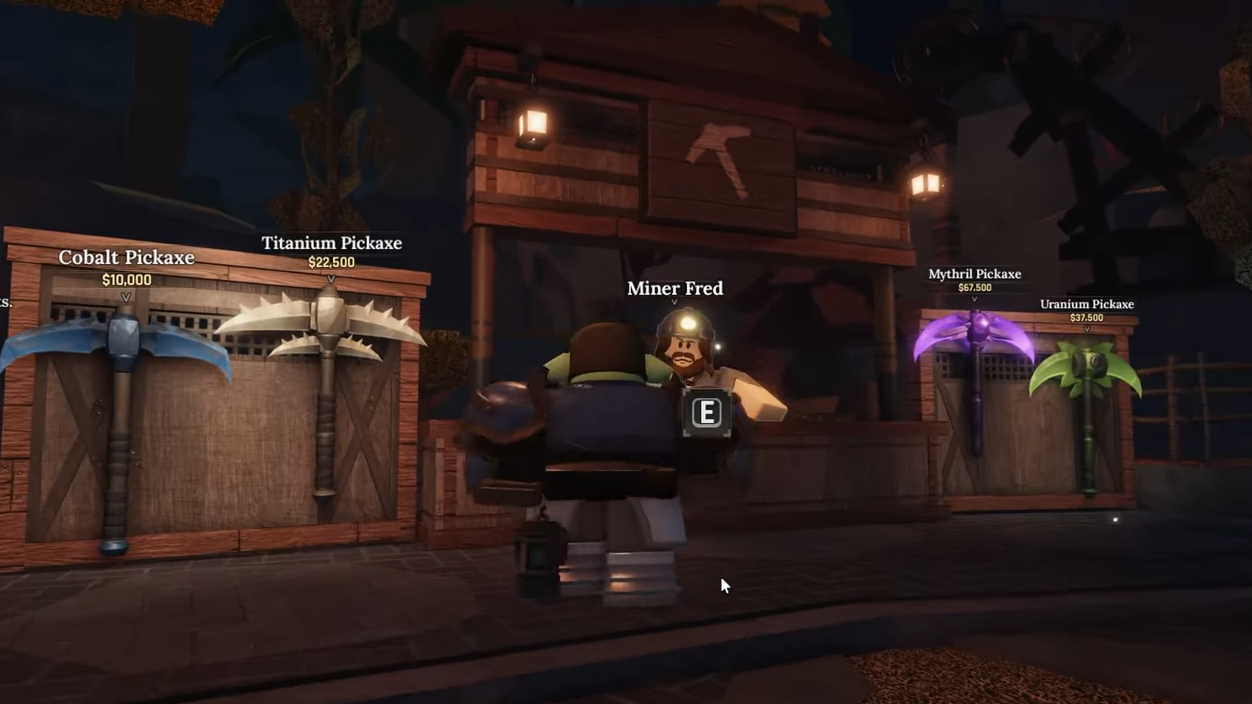
Goblin Cave swaps basalt for color-coded crystal rocks: Crimson Crystal, Cyan Crystal, Earth Crystal, and Light Crystal. These don’t drop the usual metals at all. Instead, each color can yield a shared pool of crystal ores with very high multipliers and long odds.
| Ore | Rarity | Chance | Multiplier | Sell price | Rocks | Trait |
|---|---|---|---|---|---|---|
| Magenta Crystal Ore | Epic | 1/255 | 3.1x–2.5x depending on listing | $37.55–$46.5 | All color Crystal Rocks | None |
| Crimson Crystal Ore | Epic | 1/255 | 3.3x–2.5x | $37.55–$49.5 | All color Crystal Rocks | None |
| Green Crystal Ore | Epic | 1/255 | 3.2x–2.5x | $37.55–$48 | All color Crystal Rocks | None |
| Orange Crystal Ore | Epic | 1/255 | 3.0x–2.5x | $37.55–$45 | All color Crystal Rocks | None |
| Blue Crystal Ore | Epic | 1/255 | 3.4x–2.5x | $37.55–$51 | All color Crystal Rocks | None |
| Rainbow Crystal Ore | Legendary | 1/5000 | 5.25x | $78.75 | All Crystal Rocks | None |
| Arcane Crystal Ore | Epic | 1/100000 | 7.2x–7.5x | $112.5 | All color Crystal Rocks | None |
Crystal ores don’t bring unique passives, but they do bring extremely high multipliers. That makes them ideal for rolling very high raw stats on both weapons and armor once you already have trait coverage from Forgotten Kingdom metals.
Enemy-only ores and ultra-rare drops
Not every ore comes out of a rock. A few sit in enemy loot tables or in special interactables:
- Boneite – Rare, 1/222 chance from skeleton enemies such as Skeleton Rogue, Axe Skeleton, and Deathaxe Skeleton; 1.2x multiplier and $18 sell price.
- Dark Boneite – Rare, 1/555 from Elite Skeleton Rogue, Reaper, and Elite Deathaxe Skeleton; 2.25x multiplier and $33.75 sell price.
- Slimite – Epic, around 1/247 from Slime and Burning Slime; 2.25x multiplier and $37.55 sell price.
- Fichillium – Relic ore obtained from Lucky Blocks; 0x multiplier and $0 sell price, used more as a collectible or for specific interactions than for forging power.
- Galaxite – Divine ore with a 1/1,000,000 chance, 11.5x multiplier, and no normal price or drop source listed yet; functionally an ultra-rare prestige material.
- Vooite – Listed with no stats or drop source; reserved for future content.
These ores are mostly about spicing up late-game builds or filling the index. Their multipliers sit between mid-tier basalt gems and high-end legendaries, but they bring novelty and, in the case of Galaxite, bragging rights.
How to get ores efficiently
Ores come from a few predictable sources:
- Rocks, pebbles, cores, veins, and crystals – Mine them with pickaxes in Stonewake’s Cross, Forgotten Kingdom, and Goblin Cave. Higher-tier pickaxes chew through harder rocks faster.
- Enemies – Farm skeletons and slimes for Boneite, Dark Boneite, and Slimite.
- Lucky Blocks – Break these to pull Fichillium.
Drop rates are fixed per ore, but you still control three levers:
- Location – Each ore only appears on certain rocks or enemies, so farming in the wrong area wastes time.
- Pickaxe tier – Stronger pickaxes clear more rocks per minute, multiplying the number of drop rolls you generate.
- Character and item bonuses – Mining-focused races, potions, and totems can boost luck and mining speed.
Which ores to prioritize for forging
With so many ores on the table, it helps to group them by role rather than by rarity logo alone.
- Baseline stat ores – Stone, Sand Stone, Copper, Iron, Tin, Silver, Cobalt, Titanium, common gems. These raise multipliers without changing how your build behaves. Use them to “pad” recipes around rarer traited ores.
- Defensive armor ores – Obsidian, Mythril, Lightite, Uranium. These are the backbone of tanky armor: more defense, movement speed, and HP-based AOE.
- Offensive weapon ores – Rivalite, Fireite, Magmaite, Eye Ore, Demonite, Darkryte. These define crit, burn, explosion, and dodge-centric playstyles.
- Hybrid risk–reward ores – Eye Ore and Uranium in particular trade HP for damage or AOE effects; they pay off if you’re confident about dodging hits.
- Pure multiplier ores – Diamond, Sapphire, and all crystal ores. These exist to push raw stat ceilings when you already have the traits you want.
When you stand at the forge, you’re not just dumping your rarest finds. You’re choosing which traits and multipliers you want to appear on the finished item, then filling any leftover slots with solid baseline ores that don’t conflict with that plan.
Once you know where each ore comes from and what it does, the caves in The Forge stop being random stone walls and turn into targeted resource nodes for the exact build you had in mind.