

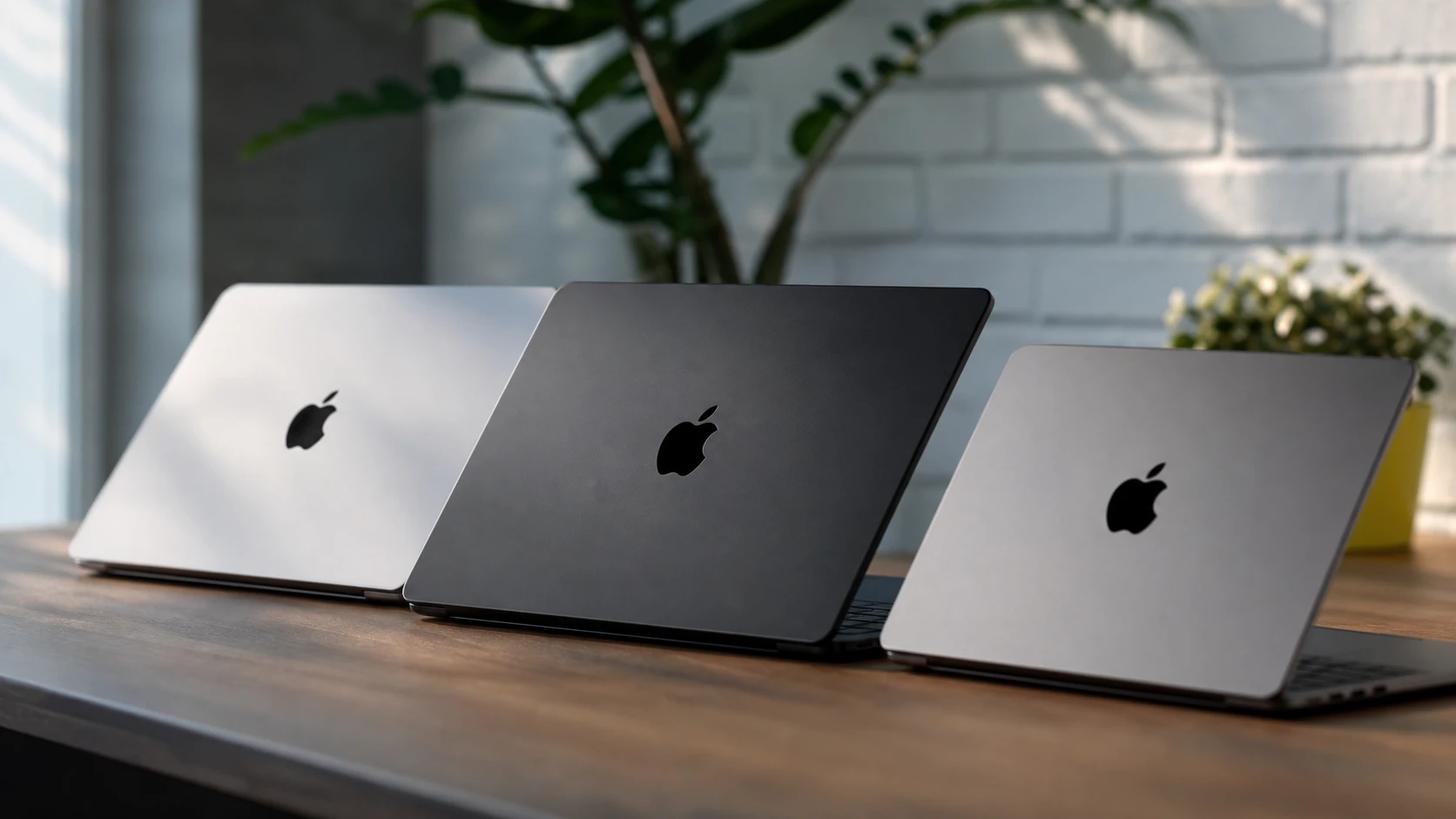
Apple is preparing its first Mac with a touchscreen, and it is arriving inside a heavily redesigned high-end MacBook Pro built around the M6 generation of chips. The plan pairs an OLED display with finger input, a Dynamic Island in place of the notch, a thinner body, and built-in cellular. It would be the biggest change to the professional MacBook Pro since the 2021 redesign.
Quick answer: The touchscreen MacBook Pro is expected to launch in late 2026 or early 2027. A global memory chip shortage has pushed the most likely window toward the end of that range, meaning the 14-inch and 16-inch models could arrive by the end of January 2027. No official date has been confirmed by Apple.
Touchscreen MacBook Pro release date (late 2026 or early 2027)
Two launch windows have been in play. The earlier target was the back half of 2026, which would line up with Apple’s usual fall MacBook Pro timing around October. The fallback is early 2027, and that has become the safer bet because of the memory chip shortage now affecting Apple’s Mac roadmap.
The display side of the project is moving forward. Samsung Display has been ramping up its Gen 8.6 OLED line, with reported yields above 90 percent and some individual stages hitting around 95 percent, the level the industry treats as production-ready. Panels could ship to assembly partners in the second half of 2026, which keeps a late-2026 launch technically possible even if the full release slides into the new year.
For context on the wider lineup, a refreshed Mac Studio with M5 Max and M5 Ultra chips is expected around October 2026, also delayed by the same shortage. The touchscreen MacBook Pro follows that desktop update.
Which MacBook gets the touchscreen first
Touch input is set to debut on the high-end 14-inch and 16-inch MacBook Pro, powered by M6 Pro and M6 Max chips. These become the first Macs to accept direct finger input alongside the keyboard and trackpad.
The entry-level 14-inch MacBook Pro with the standard M6 chip is not expected to receive most of the redesign. Reports point to the base model using an LCD panel, with the OLED screen reserved for the Pro and Max configurations. The MacBook Air and the cheaper MacBook Neo are not expected to gain touch in the near term, though the Air is seen as the most likely candidate for a later touchscreen upgrade, possibly around 2028 or 2029.
M6 chip: 2nm process and performance
The M6 family is expected to be Apple’s first Mac silicon built on TSMC’s 2nm (N2) process, a full node shrink from the 3nm used for M5. A smaller node packs more transistors into the same die area, draws less power per task, and runs cooler, which makes the thinner chassis possible.
Estimated gains over M5 from the die shrink alone fall in the ranges below. Any architectural changes Apple adds on top would push these higher.
| Area | Estimated gain over M5 |
|---|---|
| CPU (single and multi-core) | ~15–20% |
| GPU | ~20–25% |
| Power efficiency | ~30% |
| Neural Engine (AI inference) | ~40–50% |
The M6 chip itself may not appear first in this laptop. The M4 generation debuted in the iPad Pro before any Mac, and the same pattern could repeat, with an M6 iPad Pro, Mac Studio, or Mac mini arriving ahead of the full MacBook Pro redesign. The complete touchscreen package, with OLED, Dynamic Island, and cellular, still lines up with the late-2026 to early-2027 window.
Tandem OLED display
The current MacBook Pro uses a mini-LED backlit LCD. The redesigned Pro and Max models move to tandem OLED, the same broad approach Apple introduced with the M4 iPad Pro, which stacks two OLED layers to reach higher brightness while staying efficient.
- Deeper blacks and higher contrast, since OLED pixels switch off completely
- Stronger HDR performance with higher peak brightness
- A thinner lid, because there is no backlight layer
- Better efficiency on dark content
Touch is expected to use on-cell technology, which builds the touch sensors into the display rather than adding a separate layer. That keeps the panel thin while supporting multi-touch.
Design: thinner body, hole-punch camera, Dynamic Island
The redesigned MacBook Pro is described as thinner and lighter, helped by the backlight-free OLED panel and the efficiency of the 2nm chips. It keeps the familiar laptop shape with a full keyboard and large trackpad rather than turning into a tablet hybrid.
The notch is set to go. In its place, a smaller hole-punch camera cutout sits at the top center of the screen, wrapped in software that brings the iPhone’s Dynamic Island to the Mac. On a MacBook, that area would surface Live Activities, music controls, call and screen-share status, and notifications. A reinforced hinge is part of the plan, so the display resists wobble when you push on it.
macOS 27 touch support: touch-friendly, not touch-first
Apple is not turning macOS into iPadOS. The system is being tuned so the interface can shift between touch and point-and-click. When you reach for the screen, controls such as menus and buttons can scale up to make tapping easier. When you go back to the trackpad or mouse, the familiar desktop layout returns.
Standard gestures like tapping, scrolling, and pinch-to-zoom are expected to work natively, and touch, trackpad, and mouse input can be used interchangeably. macOS 27 Golden Gate already hints at the direction, since its Sidecar feature now lets you tap and interact with Mac interface elements directly using a finger on an iPad.
Note: This is a notable reversal. Apple long argued a vertical touchscreen causes arm fatigue, a point Steve Jobs made in 2010 and that hardware chief John Ternus echoed in 2021 when he said the Mac was optimized for indirect input.
5G cellular comes to the Mac
Apple has never shipped a Mac with built-in cellular. That changes with this MacBook Pro. The timing tracks Apple’s own modem work, moving from the C1 in the iPhone 16e to the C1X and then the C2, which adds faster 5G and is expected to be ready for late-2026 hardware.
- Always-on internet without tethering to a phone hotspot
- eSIM, so no physical SIM tray
- A carrier plan is required, adding to running cost
Cellular is expected to be optional or limited to higher-tier Pro and Max configurations at first, rather than standard on every model.
Branding and price
The redesigned laptop might carry MacBook Ultra branding to separate it from the MacBook Air and the entry-level MacBook Neo. Whatever the name, the move to OLED and the wider redesign are likely to raise the starting price. When the iPad Pro switched to tandem OLED, Apple added $200, so a similar premium on the MacBook Pro is plausible.
For reference, current M4 MacBook Pro configurations start at $1,599 for the 14-inch base model and $2,499 for the 16-inch with M4 Pro. Those numbers are a baseline, not a forecast, and supply-chain costs around OLED could push the new lineup higher.
Should you wait for M6 or buy M5 now
The M5 MacBook Air and MacBook Pro arrived in March 2026 and remain strong machines with excellent mini-LED screens. The decision comes down to whether the OLED touchscreen, 5G, and new design are worth waiting until late 2026 at the earliest.
| Factor | M5 (now) | M6 (later) |
|---|---|---|
| Availability | Available now | Late 2026 at earliest |
| Display | Mini-LED | Tandem OLED |
| Touchscreen | No | Yes |
| 5G cellular | No | Optional |
| Process node | 3nm | 2nm, ~20% faster CPU |
| Design | 2021 design | Full redesign |
| Price | Current pricing | Likely higher |
Buy the M5 now if you need a laptop today, do not specifically want touch, and the current display meets your needs. Wait for the M6 if you can hold out into late 2026 or early 2027 and want the OLED panel, touch input, 5G, or the thinner redesign, especially for color-critical work where the OLED upgrade matters most.
None of this is official until Apple announces it, and the memory chip shortage means the exact timing can still shift. The direction, though, is clear. After years of insisting touch did not belong on a laptop, Apple’s flagship MacBook Pro is being rebuilt around it, and the pieces, from OLED panels to the C2 modem, are lining up for a launch on either side of the 2026-to-2027 boundary.