Rogue is a turn-based dungeon crawler built around a single goal. You guide an adventurer down through the levels of an unmapped dungeon, reach the lowest floor to grab the Amulet of Yendor, then climb back to the surface alive. Michael Toy and Glenn Wichman created it around 1980 for Unix systems, with later work from Ken Arnold, and its mix of random dungeons and permanent death gave the roguelike genre its name.
Quick answer: Win Rogue by descending every dungeon level, retrieving the Amulet of Yendor from the bottom floor, then returning to the surface without dying. You cannot revisit earlier levels until you hold the Amulet.
The goal: reach the Amulet of Yendor and escape
The game starts at the top level of the dungeon and pushes you downward. The Amulet of Yendor sits on the lowest floor. Its name is “Rodney” spelled backwards, a nod to the wizard tied to it. Until you pick up the Amulet, you cannot return to levels you have already cleared, so the descent is one direction only.
Monsters grow steadily tougher as you go deeper. Each floor adds harder encounters, so survival depends on the gear and items you collect on the way down. The run is not finished when you grab the Amulet. You still have to make the trip back up to the surface, which means surviving the dungeon a second time with everything you have left.
Permadeath: why a single death ends the run
Rogue uses permadeath as a core design choice. If your character loses all health through combat or any other cause, that character is gone for good. There is no respawn and no reloading a dead character back to life. You start over with a brand new adventurer.
Toy wanted to move players away from simply memorizing the correct sequence of steps, which was common in adventure games of the era. The aim was to make every move matter in the moment, forcing you to find the right action to avoid death right then. Wichman later described this idea as “consequence persistence.”
Saving exists, but only to pause a run across sessions. Early on, a game had to be finished in one sitting, and the save feature was added by playtester demand. When players began reloading from saves to dodge bad outcomes, a practice known as “save scumming,” the design was changed so the save file is erased when you reload. That keeps a character’s death meaningful.
Procedural generation: every run is a new dungeon
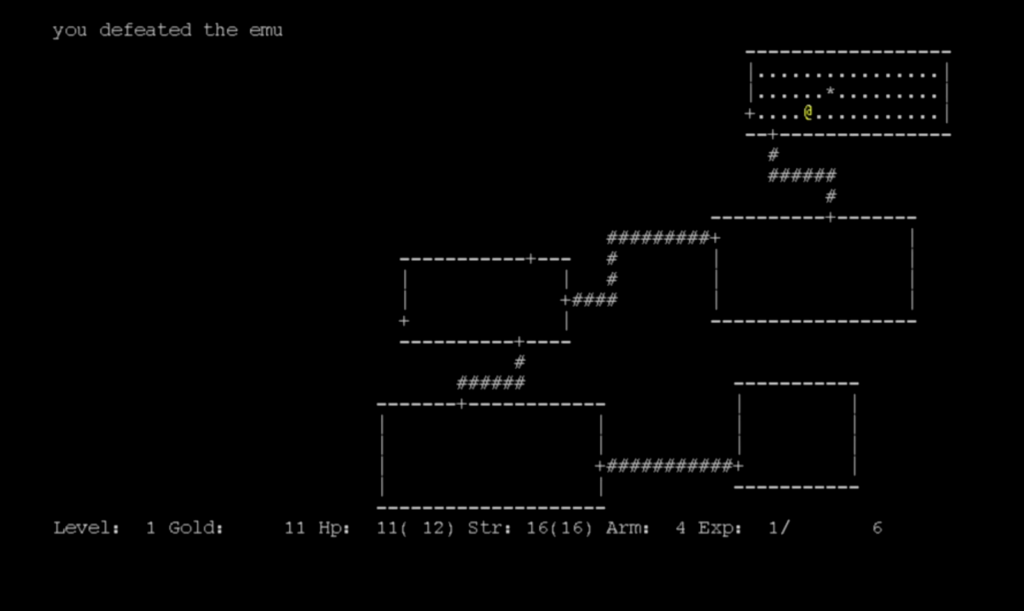
No two games of Rogue are the same. The dungeon layout, monster placement, and treasures are randomly generated for each playthrough. This was the answer to a problem Toy and Wichman saw in other adventure games, where the world never changed and replaying felt pointless.
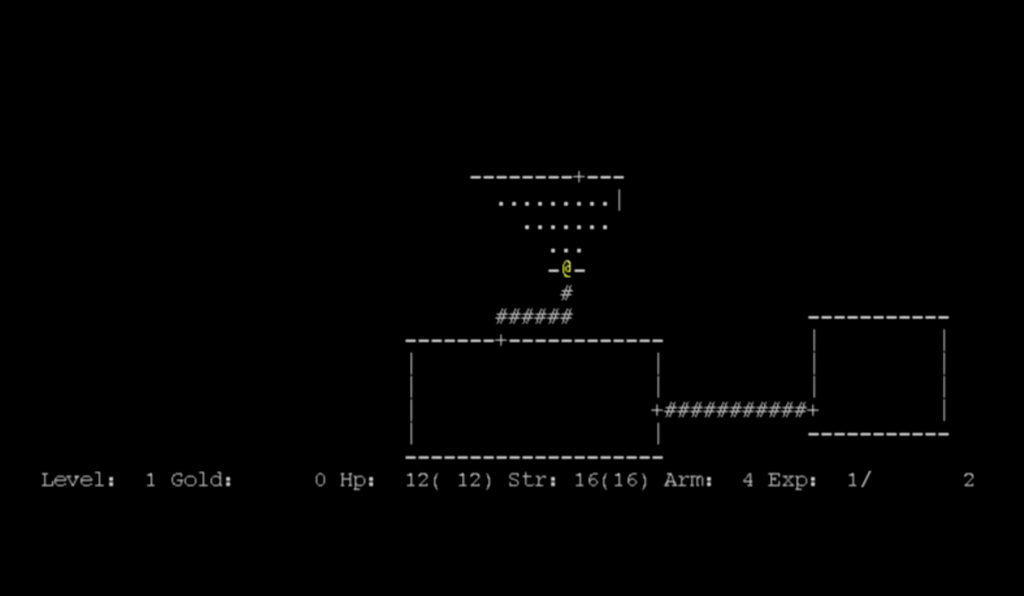
Each level is built on a three-by-three grid, like a tic-tac-toe board, with a room of varying size placed in each cell and hallways connecting them. Dead-end corridors, T-forks, and bending passages can appear where a room might otherwise be, and deeper floors can swap a room for a maze. The grid approach solved an early problem with pure random generation, where a stairway could end up in a room players could never reach.
Items add their own mystery. Magic items first appear only by a descriptor such as a color, and you learn the true name and effect only after experimenting or identifying them another way. That uncertainty changes every run.
How the ASCII display works
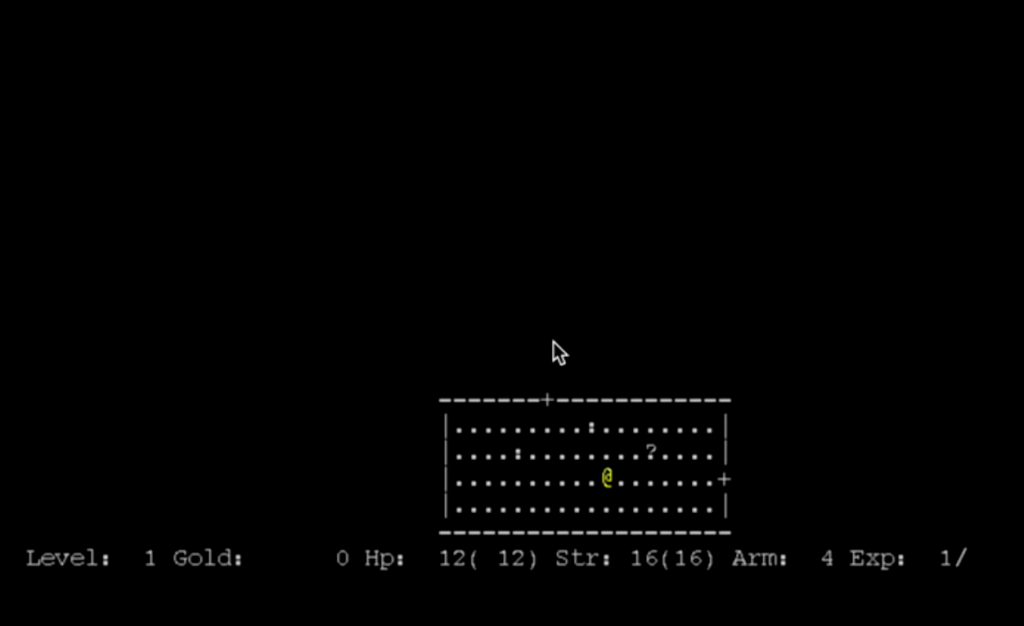
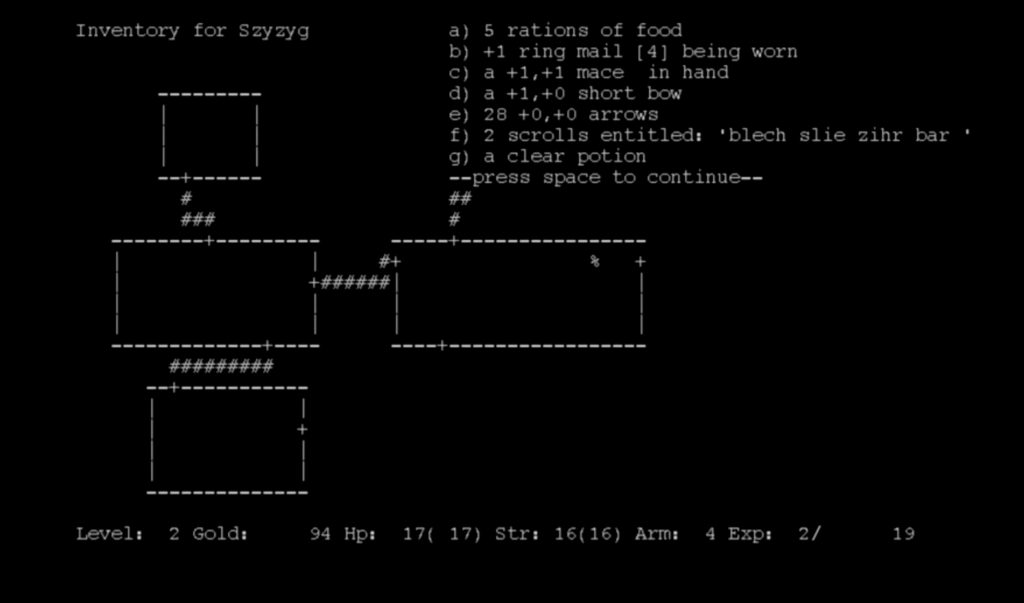
In the original text versions, the dungeon, your character, and the monsters are all drawn with letters and symbols from the ASCII character set. This made it work on plain, non-graphical terminals. The display was made possible by the curses programming library written by Ken Arnold, which let a program place characters anywhere on a terminal screen.
| Symbol | What it represents |
|---|---|
@ | The player character, showing where you are |
. | Empty floor space |
+ | A door |
| and - | Walls of the dungeon |
Capital letters (e.g. Z) | Monsters, with up to twenty-six varieties such as Z for zombie |
Later ports keep this text interface but add extended character sets, and some replace it entirely with graphical tiles.
Rogue controls and key commands
Movement borrows the cursor keys from the vi editor, and most actions use a single keystroke. The MS-DOS version differs slightly, using the cursor keys for movement and the scroll lock key for fast movement instead of the capital-letter keys.
| Key | Action |
|---|---|
h | Move left |
j | Move down |
k | Move up |
l | Move right |
H, J, K, L | Fast move in that direction |
q | Quaff a potion |
w | Wield a weapon |
e | Eat some food |
Because the game is turn-based on a square grid, you have time to weigh each move before committing to it.
Where Rogue came from
Toy and Wichman were students at the University of California, Santa Cruz, and both were already writing their own adventure games when they met. Toy was the stronger programmer and led development in the C language, while Wichman, who came to the school to study game design, drove much of the design. They drew on text games such as the 1971 Star Trek game and Colossal Cave Adventure from 1976, plus the high-fantasy feel of Dungeons & Dragons.
Wichman named the game Rogue. The idea was that, unlike the party-based play of Dungeons & Dragons, the character goes into the dungeon alone. The name was also kept short so it was quick to type on a command line. Toy later worked at UC Berkeley, where he met Arnold, who helped optimize the code and add features. Commercial ports later came together through A.I. Design, the company Toy, Wichman, and Jon Lane formed, with backing from the publisher Epyx.
Why Rogue named a genre
Rogue spread widely in the 1980s, especially among college students and computer-savvy users, helped by its inclusion in the fourth release of the Berkeley Software Distribution. Its popularity inspired programmers to build similar titles such as Hack (1982/1984) and Moria (1983).
At that time the source code had not been released, so those new games built their own variations on top of Rogue’s ideas rather than copying its code. A long line of games grew from that lineage. Rogue was not the first game to combine procedural generation with permadeath, but it became the title the entire roguelike genre is named after.
How to play Rogue today
The game has been ported to modern systems using its now open-source code. A freeware DOS version of Rogue runs in the browser through an emulator, so you can try the original without installing anything.
Whichever version you load, the loop stays the same. Read the symbols, weigh every turn, fight your way down to the Amulet of Yendor, and try to carry it back up before a single mistake ends the run for good.