ARC Raiders sorts players into lobbies partly based on how they tend to treat other Raiders, and Embark Studios just adjusted two parts of that calculation. Defending yourself no longer counts the same as picking a fight, and quick rounds where you barely do anything carry less weight in your long-term playstyle profile. Both changes are already live.
What the matchmaking system is doing
Lobby formation in ARC Raiders is built around two goals: matching players with a similar chance of succeeding in a round, and matching players likely to enjoy the round together. In practice, that means prioritizing equal squad sizes where possible and grouping people by playstyle, while still respecting matchmaking time and latency constraints.
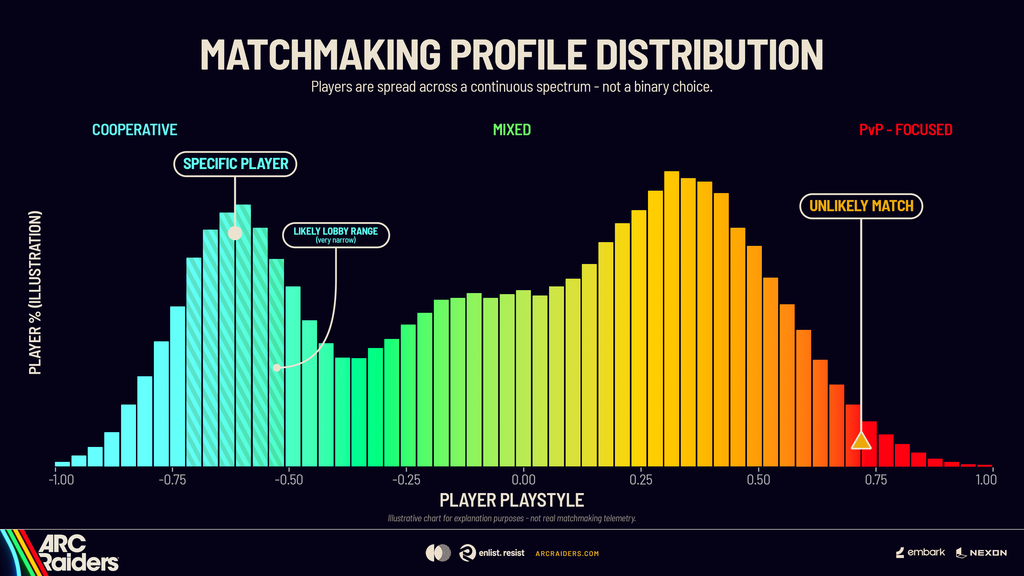
Playstyle is treated as a continuous scale rather than a binary tag. A Raider who is almost always cooperative sits at one end; someone who is heavily focused on PvP sits at the other. Most players land somewhere in the middle, and the system tries to place you with others nearby on that scale without locking in any specific outcome.
Two rules govern how that works in practice:
- Similarity is more likely, not guaranteed. You have a higher probability of meeting Raiders with a comparable history, and a lower probability of meeting very different ones.
- Your behavior gradually reshapes your future lobbies. Change how you play, and the kinds of Raiders you encounter shift over time. There is no single round that flips a switch.

What changed in the latest update
Embark identified two weaknesses in how playstyle used to be estimated and addressed both:
| Change | Old behavior | New behavior |
|---|---|---|
| Self-defense vs. initiating a fight | Returning fire was weighted similarly to starting a fight, which pushed cautious players toward more PvP-heavy lobbies than they wanted. | Starting an engagement and responding to one are now scored separately, so reactive players are no longer treated as aggressors. |
| Low-activity rounds | Short sessions, including spawning in and surrendering, influenced playstyle estimates more than intended and could be used to game the system. | These rounds carry reduced weight, so the profile better reflects how you play when you’re actually engaging with the world. |
Embark has said it will keep tuning these values as it watches how they play out.
Common myths Embark cleared up
Alongside the change, the studio addressed several widespread assumptions about how lobbies are assembled. Some of these have been circulating for months in community discussions.
| Claim | Reality |
|---|---|
| There are only “friendly” and “aggressive” lobbies | It’s a continuous scale, not two buckets. |
| One kill puts you in a PvP-only lobby | The system reacts to patterns over time, not single moments. |
| PvE-only lobbies exist | They don’t. Topside always carries some risk of player conflict. |
| End-of-round surveys affect your next lobby | They inform design decisions, not lobby assembly. |
| Loadout cost or gear tier affects matchmaking | It doesn’t. Lobby difficulty is not scaled to your kit. |
| Patches reset your matchmaking profile | Playstyle history persists across patches. Rougher matches right after an update are due to a small initial player pool. |
| Looting downed Raiders affects your profile | Only your engagement behavior matters, not what you do with their loot. |
| Squad matchmaking is based on the leader | Every squad member contributes equally to the squad profile. |
| Crossplay toggling changes lobby tone | It only changes who is in the pool, which affects queue time, not aggression levels. |

How to shift your own profile
If you want different lobbies, the lever is consistent behavior over many rounds rather than any single trick. Players who tend to cooperate and only fire when fired upon should now see that reflected more accurately, because reactive shots no longer push the profile toward PvP. Players who hunt other Raiders will continue to be matched with others who do the same.
A few practical implications of the new logic:
- You won’t be punished for defending an extraction or returning fire after being shot at.
- Spawning in only to surrender will barely move your profile, so it isn’t a useful way to reset your lobbies.
- Changes happen gradually. Expect a stretch of rounds before your matches noticeably shift.

How to tell it’s working
There isn’t a visible rating or UI element that exposes your playstyle number. The way you confirm the system is reflecting your play is by paying attention to the tone of your lobbies over a series of rounds, not a single match. If your encounters trend toward Raiders who behave similarly to you over time, the profile is tracking as intended. Short-term swings, especially right after a patch, are expected while the player pool refills.
For the full developer breakdown, Embark’s post is on the official site: Notes on The Matchmaking System.