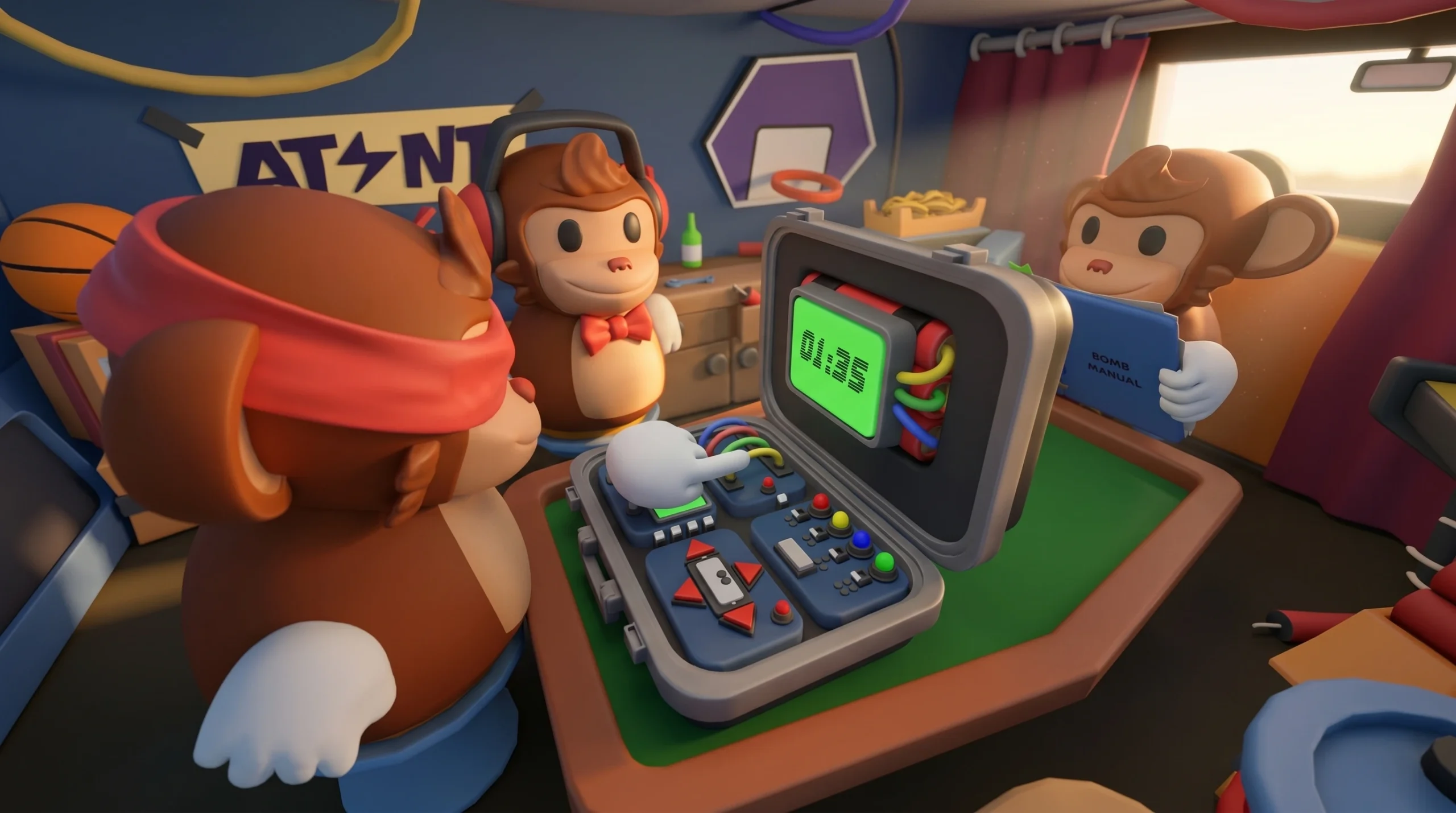
BOMBANANA! turns a bomb into a communication test. The game from Lefto Studio drops three players into a mobile bomb workshop, where one monkey can touch the bomb, one holds the manual, and one watches the screen, and none of them share the same senses. Defusing the puzzle modules is rarely the hard part. Getting what one player sees over to the player with their hands on the wires is where most new teams fail.
Quick answer: Bring exactly three players, assign Blind, Mute, and Deaf Monkey before the timer starts, agree on emotes for wait, yes, and wrong, and run every module in one fixed order: module name, position, the details that module needs, the manual answer, a repeat-back, a confirm, then the input.
The three monkey roles and their limits
Every session needs one player in each sensory-limited role. The whole game is built so that no single player can solve a module alone, so the first thing to memorize is what each role can and cannot do.
| Role | What they handle | The limitation |
|---|---|---|
| Blind Monkey | Locates and touches the bomb, interacts with modules, and reads Braille-style dots by feel. | Limited visual information, so they depend on teammates for instructions. |
| Mute Monkey | Owns the defusal manual and signals the answer. | Cannot speak, so all answers come through emotes and gestures. |
| Deaf Monkey | Reads the bomb aloud to Blind Monkey and interprets Mute Monkey’s gestures. | Cannot hear teammates, so they rely on what they can see. |
Pick roles based on what each person is comfortable doing, and talk it out before you commit. Mute Monkey is usually the hardest beginner seat, and Deaf Monkey burns out fast if the same person is stuck reading the bomb every round, so plan to rotate.
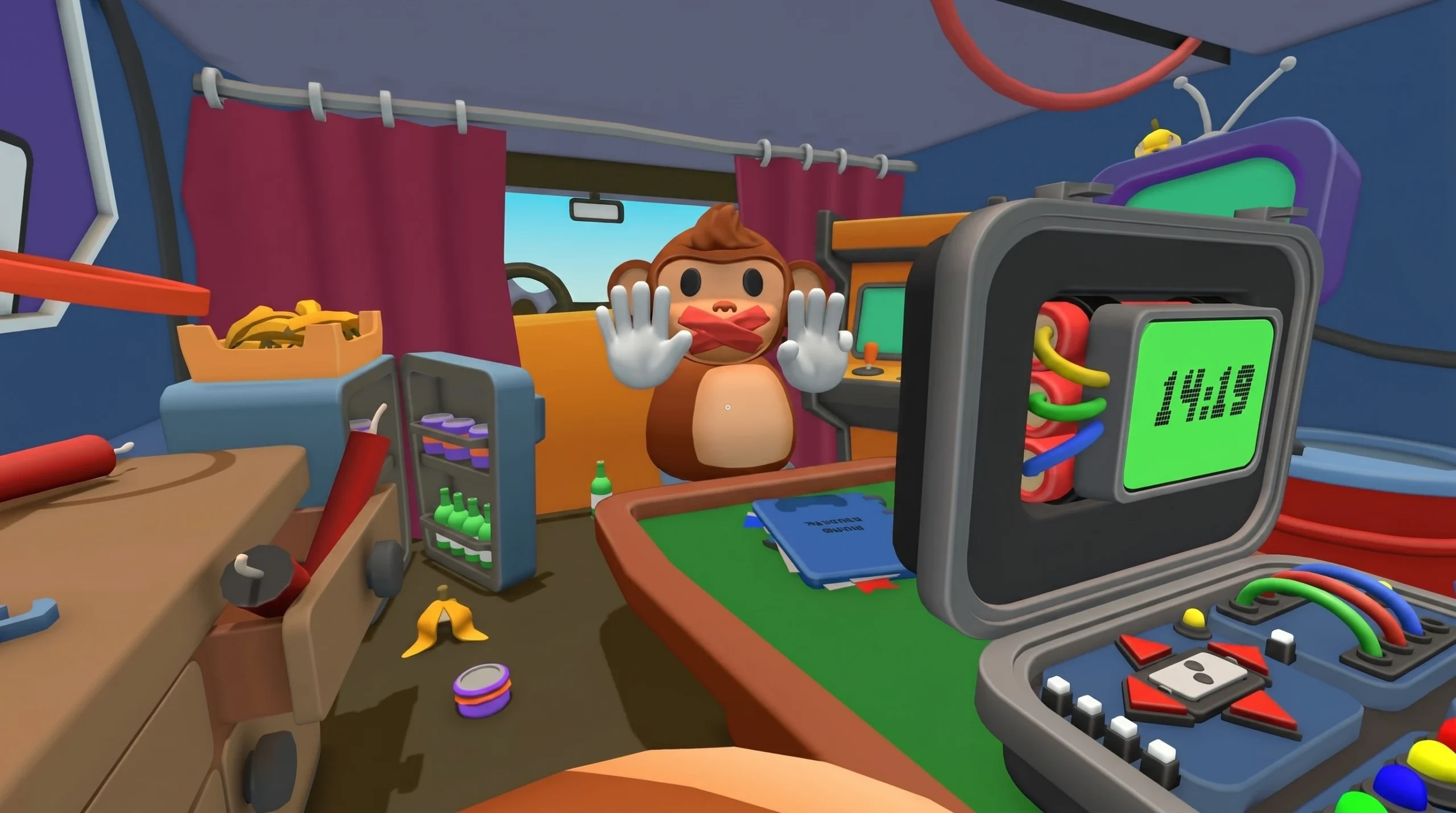
Set up the lobby before the timer starts
A first run can fall apart before the bomb even matters. The free demo is on Steam, and you need all three players installed and in the same room before you touch a module.
Use one callout structure for every module
Information in BOMBANANA! moves in one direction. Mute Monkey reads the manual and signals, Deaf Monkey speaks the instruction to Blind Monkey, and Blind Monkey acts. Reverse that order and you get explosions. Deaf Monkey is the bottleneck, because they have to watch the bomb screen and Mute Monkey’s gestures at the same time.
Learn this single callout shape and use it every time: module name, then position, then the details that module needs, then the manual answer, then a repeat-back, then a confirm, and only then the input. Beginners skip the module name and position, which is the most important part, because Mute Monkey cannot find the right manual page without knowing which module you mean. A good team sounds boring and robotic when it is working.
Tip: Make it a hard rule that nobody cuts, presses, types, or flips a switch until the instruction has been repeated back once. A slow confirmed input beats a fast guess.
How to read each puzzle module
Each bomb mixes different modules with their own rules. The details change, but the opening move never does, which is to call the module name and position first. The table below covers what to read out for the modules a new team meets first.
| Module | Call this out | Common mistake |
|---|---|---|
| Wires | Wire count first, then colors left to right, then the LED color. | Assuming every module has four wires; three and four can use different rules. |
| D-pad | Active LED color, the center number or Braille value, using Blind Monkey’s left and right. | Pressing the right answer from the wrong direction. |
| Numpad / Math | The full expression solved aloud, odd or even, greater-than or less-than where it matters, and the LED color. | Treating the math result as the final key; the keypad is jumbled, so press the number itself wherever it appears. |
| Switch panel | Top light-color order, the full digit string, and each switch up or down in turn. | Pressing enter before every switch state is confirmed. |
A clean wire callout sounds like this: “Wires, top right. Four wires. Left to right: green, blue, red, yellow. Red LED. Waiting for the cut.” On the numpad, watch for the priority trap, where a result can be both odd and greater than five at once. Mute Monkey, holding the manual and the LED color, decides which condition wins. Blind Monkey just reports the full state and waits.
Braille modules are a common wall. Only Blind Monkey can feel the dots, so the other roles must wait for tactile reports instead of inventing numbers. Work one digit at a time, and re-read whenever the light color shifts, because that often changes which manual row applies.
Mistake limits and how to recover
Campaign levels track failed inputs (wrong wire cuts, bad keypad digits, incorrect switch flips) before the bomb detonates. The first stage is unforgiving, so a single wrong input can end an early run. Later stages allow a few mistakes, but three sloppy guesses still blow up most bombs.
When something goes wrong, stop. Panic inputs stack errors faster than calm retries. Call a full stop, then re-read the whole module from scratch, because a wrong input can change the LED, the number, or the stage you are on. The answer that was correct ten seconds ago may not be anymore.
You know a module is done when its state clears, so announce each clear aloud before anyone assumes the next panel is safe to touch. When a bomb stacks wires, Braille, and switches on one timer, finish the active module before describing the next one. Talking about module three while Blind Monkey is still on module one causes double inputs and instant fails.
Practice in Free Mode and rotate roles
The demo includes campaign progression and a Free Mode where your group can design custom bombs. Treat the campaign as a structured tutorial that adds new module types as you climb, and use Free Mode to drill one module type at a time, wires only, then Braille only, then switches only, without public-lobby pressure.
The most common beginner errors are easy to avoid once you name them:
- Starting with only two players; the game needs exactly three monkeys every session.
- Blind Monkey touching the bomb before Deaf Monkey finishes reading the module state.
- Mute Monkey miming complex numbers without pointing to the manual page first.
- Other roles guessing Braille values instead of waiting for Blind Monkey’s touch report.
- Quitting after one failed bomb instead of spending a minute debriefing what broke.
After each explosion, name one fix rather than blaming a role. Was the wrong manual row chosen, was an emote ambiguous, did Deaf Monkey speak before Mute Monkey confirmed? Rotate seats every few rounds so everyone learns each sensory limit, and your group will get faster than any team that treats every beep as a race. BOMBANANA! is designed around misunderstanding, and the teams that improve fastest are the ones that slow the communication down and keep it boring.