

Crimson Desert launches on March 19, 2026, on PlayStation 5, Xbox Series X|S, and PC, and one of the biggest talking points ahead of release is the sheer scale of its open world. The continent of Pywel is a seamless landmass spanning five major regions, each with its own political structure, ecosystem, and visual identity. Developer Pearl Abyss has been careful to frame the conversation around density rather than raw square footage — but the raw square footage is still impressive.
Quick answer: Pywel's playable area is estimated at roughly 80–110 km² (30–42 mi²), making it at least twice the size of Skyrim and larger than Red Dead Redemption 2. Crossing the full map on horseback takes approximately two hours.
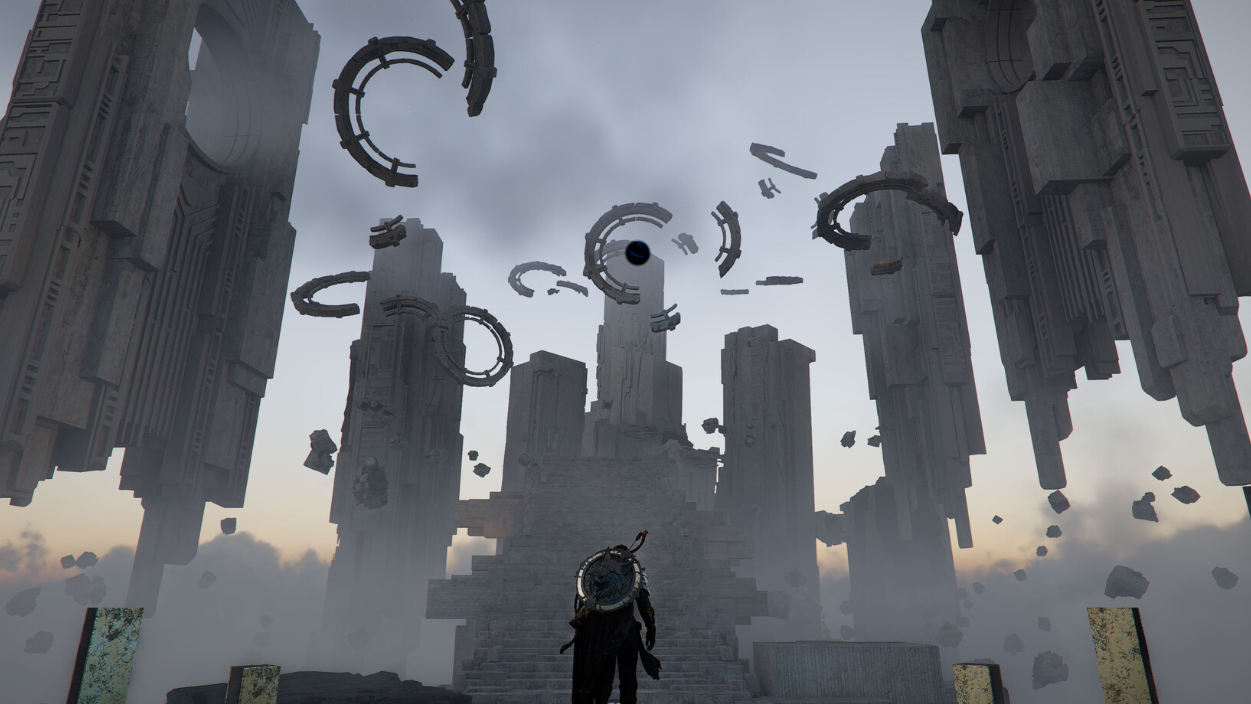
Crimson Desert Map Size Compared to Skyrim and Red Dead Redemption 2
Will Powers, Pearl Abyss's PR and marketing director, stated in an interview with Gaming Interviews that the world is "at least twice as big as the open world, the playable area, of Skyrim" and "larger than the map of Red Dead Redemption 2." He also stressed that numbers alone don't capture the experience, because the studio's priority is what it calls the "density of interactivity."
Translating those comparisons into hard numbers gives a useful frame of reference. Skyrim's overworld sits at roughly 37 km² (excluding interior cells), while Red Dead Redemption 2 covers approximately 75 km². Doubling Skyrim and exceeding RDR2 places Pywel in the 80–110 km² range, though Pearl Abyss has not published an exact figure.
| Game | Estimated Playable Area |
|---|---|
| The Elder Scrolls V: Skyrim | ~37 km² (14 mi²) |
| Red Dead Redemption 2 | ~75 km² (29 mi²) |
| Elden Ring | ~79 km² |
| Crimson Desert (estimated) | 80–110 km² (30–42 mi²) |
| The Witcher 3 (including water) | ~135 km² |
Worth noting: these comparisons only capture horizontal area. Pywel also extends vertically, with underground caverns, elevated terrain, and floating sky islands adding explorable space that doesn't show up in a flat km² measurement. Instanced locations like dungeons and caves further expand the effective playable volume beyond the overworld footprint.
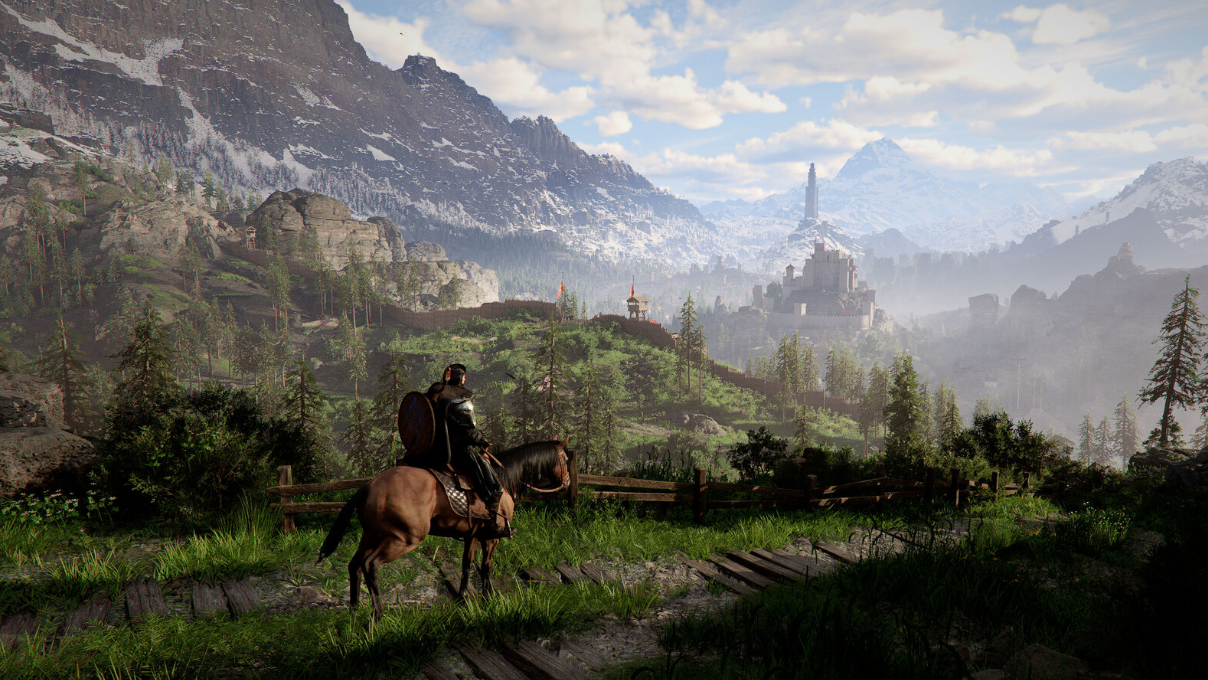
The Five Major Regions of Pywel
Pywel is divided into five regions, each functioning as a distinct biome with its own faction politics, quest lines, and environmental hazards. The world is fully seamless — no loading screens separate one region from the next.
| Region | Environment | Key Characteristics |
|---|---|---|
| Hernand | Forests, mountains, fertile plains | The starting area. Dense with cities and lush greenery. Heavy medieval-style political intrigue and power struggles. |
| Pailune | Deep snow, harsh mountain ranges | The homeland of protagonist Kliff and the Greymane mercenary band. Survival-oriented terrain that is difficult to traverse. |
| Demeniss | Military strongholds, fortified settlements | The political and military seat of power on the continent. A major staging ground for large-scale conflicts. |
| Delesyia | Technologically advanced cities | The continent's center of science and engineering. Features mechanical creatures and Dwarven-tech constructs. |
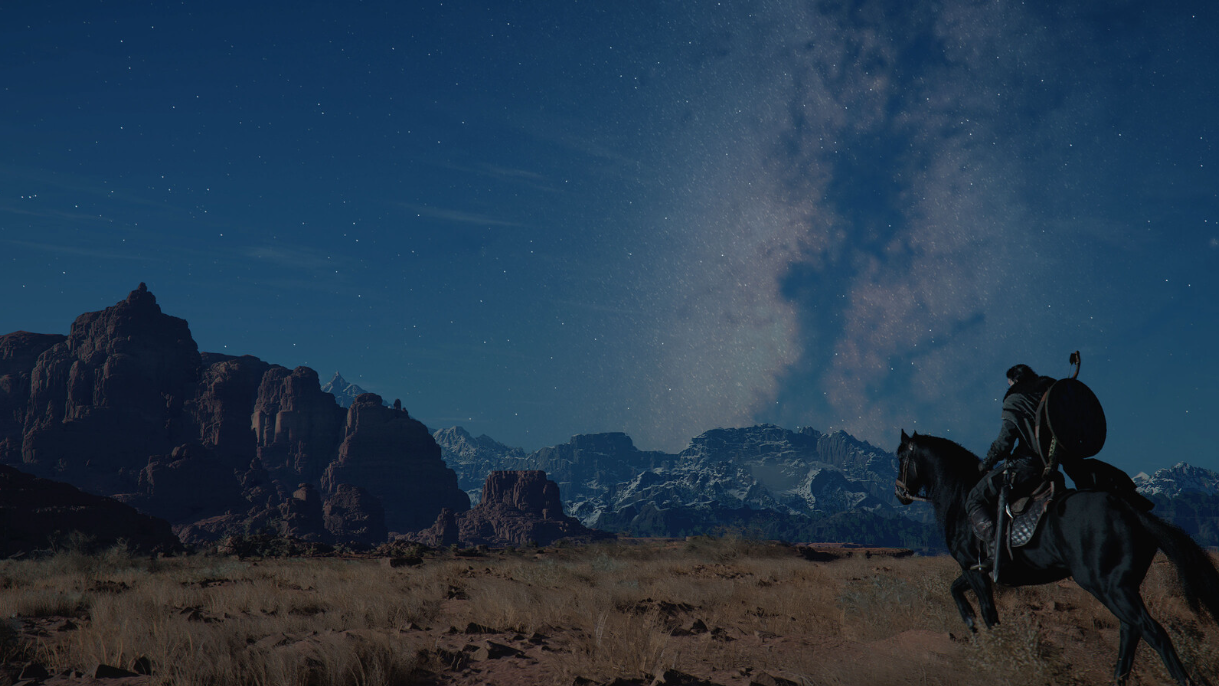
| The Crimson Desert | Arid red-sand wasteland | The namesake zone. A lawless expanse filled with unpredictable encounters and high-risk exploration. |
Beyond these five named regions, the game's codex reveals a staggering 573 territories spread across the continent. These appear to function as smaller control zones or faction areas — potentially capturable locations — rather than standalone biomes. The exact relationship between territories and broader regions will become clearer at launch.
World Content by the Numbers
Press preview sessions have surfaced specific content counts from the in-game codex. While the exact nature of some categories remains ambiguous, the numbers paint a picture of a world that's been packed with things to find and do.
| Category | Count |
|---|---|
| Unique voice-acted characters | 467 |
| Factions | 110 |
| Territories / sub-regions | 573 |
| Unique creature types | 401 |
| Confirmed bosses | 76 |
| Mounts | 29 |
| Adventures (quests or encounters) | 430 |
| Gatherables | 150 |
| Collectibles | 94 |
| Crafting manuals | 355+ |
The "adventures" category likely encompasses side quests, encounters, or mission-style activities, though Pearl Abyss hasn't clarified the exact definition. If you combine territories, adventures, and collectibles as potential points of interest, the total approaches or exceeds 1,000 discrete content nodes — which, spread across an 80–110 km² map, would put Pywel's density on par with or above Skyrim's roughly 350 map markers across 37 km².
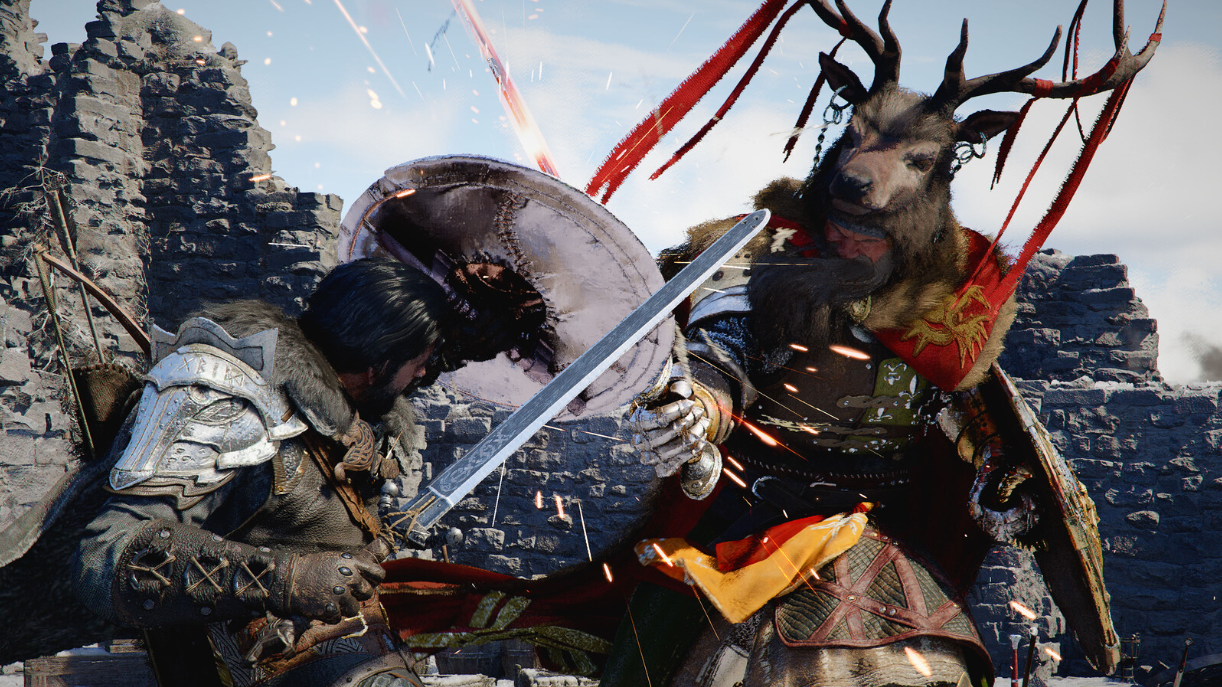
Traversal and Mounts
A world this large needs varied ways to move through it, and Crimson Desert delivers several distinct traversal systems that go well beyond standard horseback riding.
Ground mounts include horses, bears, lizards, and raptor-like creatures, and Dwarven mechs. There are 29 confirmed mounts in total, and mounted combat is possible on many of them.
Aerial travel takes the form of dragon riding, which appears to be a later-game unlock that lets you cover large distances quickly. The playable character Damiane also has a unique glide mechanic using an umbrella-like device that lets her float and propel herself through the air.
Character-specific movement adds further variety. Kliff can perform a smoky dash-glide called the Black Crow, essentially a shadow-step that transforms him into a wisp-like form for rapid repositioning. He also has access to a grappling hook for vertical surfaces.
Climbing works on nearly any vertical surface in the game, which opens up significant vertical exploration routes that flat map measurements don't capture.
Fast travel points exist throughout the map and unlock as you discover them. Your Greymane camp serves as one such anchor point.
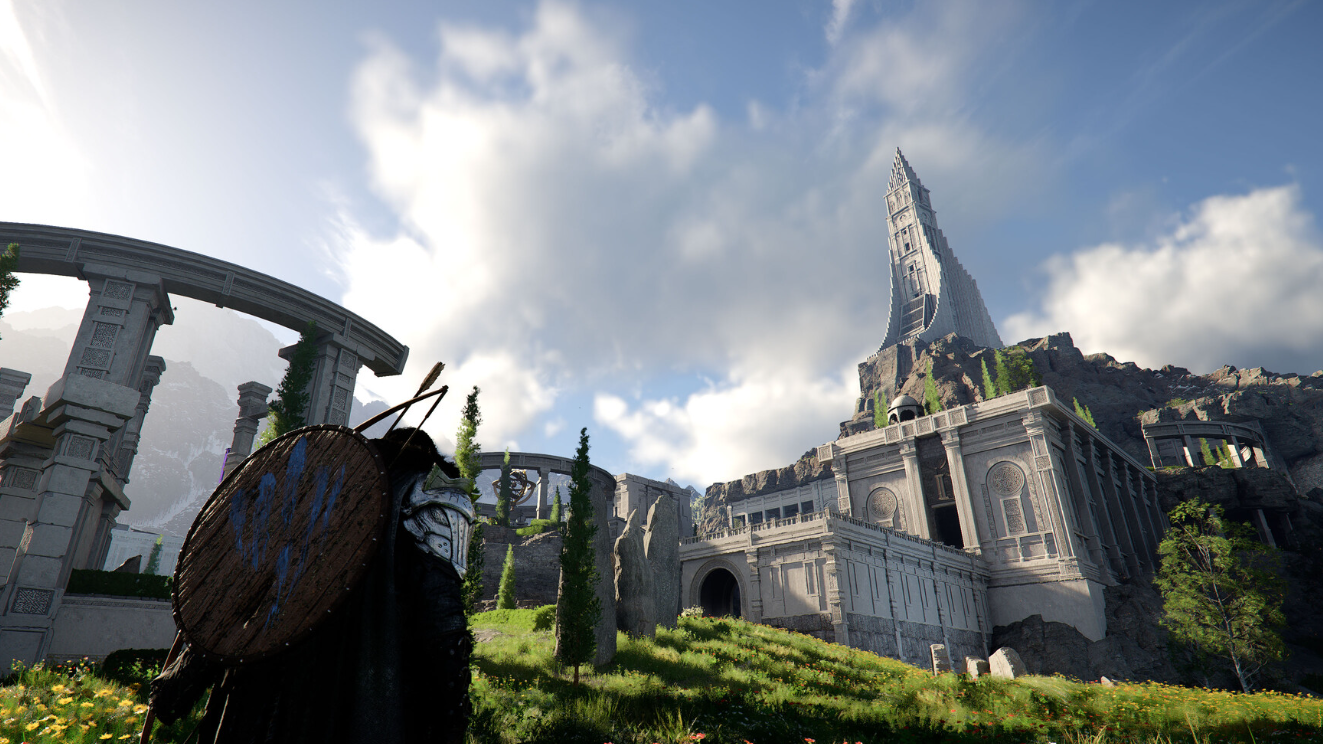
The BlackSpace Engine and Dynamic World Systems
Crimson Desert runs on Pearl Abyss's proprietary BlackSpace Engine, which the studio built specifically because off-the-shelf engines couldn't support the level of world interactivity they wanted. Will Powers has noted that even BlackSpace itself had to be "majorly updated" during development to handle the density of systems the team was building.
The result is what Pearl Abyss calls a "systemic" world. NPCs follow daily routines and react to changes in their environment. If you liberate a town from an attack or destroy a bridge leading to a settlement, those actions have lasting consequences. New NPCs may move into a freed town. Trade routes can open or close. The world state shifts in response to what you do, rather than resetting to a default.
Dynamic weather systems — snowstorms, heavy rain, sandstorms — also affect visibility and movement, influencing both combat and navigation depending on which region you're in.
Side content fills out the spaces between major story beats. Fishing, delivery tasks, environmental puzzles with physics-based interactions, and smaller settlement quests all contribute to making even remote corners of the map feel active. The Abyss regions function as dungeon-like spaces that exist outside the standard map geometry, adding another layer of explorable content beyond the overworld.
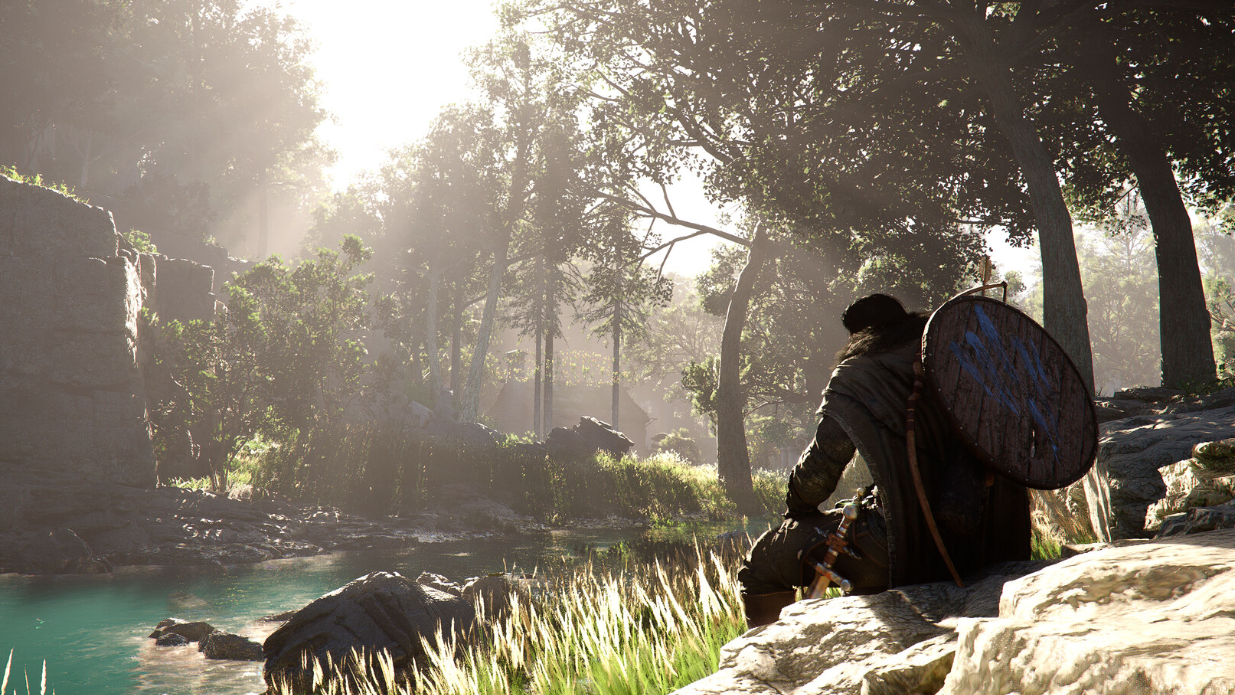
Exploration Philosophy — Density Over Distance
Pearl Abyss has consistently pushed back on the idea that Crimson Desert's appeal is simply its size. The studio's messaging centers on what happens within that space rather than how many square kilometers it covers. Combat, for instance, is designed around observation and learning — encountering an enemy performing a special grappling move or magical ability can eventually teach you to replicate that technique, meaning exploration directly feeds character progression in ways beyond traditional XP accumulation.
The 573 territories, 430 adventures, and 76 bosses scattered across Pywel suggest a world where you're rarely far from something to engage with. Whether that density holds up across the full map — especially in the more barren Crimson Desert region — remains to be seen when the game launches on March 19, 2026. But the structural foundation Pearl Abyss has laid is among the most ambitious in the modern open-world RPG space, sitting alongside The Witcher 3 and Kingdom Come: Deliverance 2 as a game trying to push the genre's boundaries rather than simply expanding its acreage.