

Terraria 1.4.5 folds a full mini–arsenal from Dead Cells into its item pool, spanning every damage class plus vanity, mobility, and world interaction tools. Each of these crossover items is a discrete Terraria item with its own damage type, use pattern, and supporting mechanics.
Quick answer: Terraria 1.4.5 includes five Dead Cells weapons (Flint, Barrel Launcher, Killing Deck, Mushroom Staff, Barnacle, plus the Swarm grenade), one Beheaded vanity outfit, Ram Rune, Wings of the Crow, a Health Fountain furniture buff station, hanging item flasks, an Aether Pylon variant, and assorted Dead Cells–themed display items. They are obtained and used like normal Terraria gear: weapons are found, crafted, or dropped and then function as melee, ranged, magic, summon, or sentry tools, while Ram Rune, Wings, Health Fountain, and flasks act as mobility, buff, and display objects.
Dead Cells weapons in Terraria 1.4.5 (types and roles)
The crossover adds one weapon for every primary damage archetype along with a grenade-style utility. Each keeps the core identity of its Dead Cells counterpart while obeying Terraria’s combat rules.
| Item | Role in Terraria | Damage category | Key mechanic |
|---|---|---|---|
| Flint | Melee weapon | Melee | Close-range swing with Dead Cells–style impact timing. |
| Barrel Launcher | Projectile launcher | Ranged | Fires explosive barrels as a ranged weapon. |
| Killing Deck | Thrown weapon | Ranged / magic–style projectile | Launches a deck of damaging cards. |
| Mushroom Staff | Summon staff | Summon (minion) | Summons Mushroom Boi as a persistent minion. |
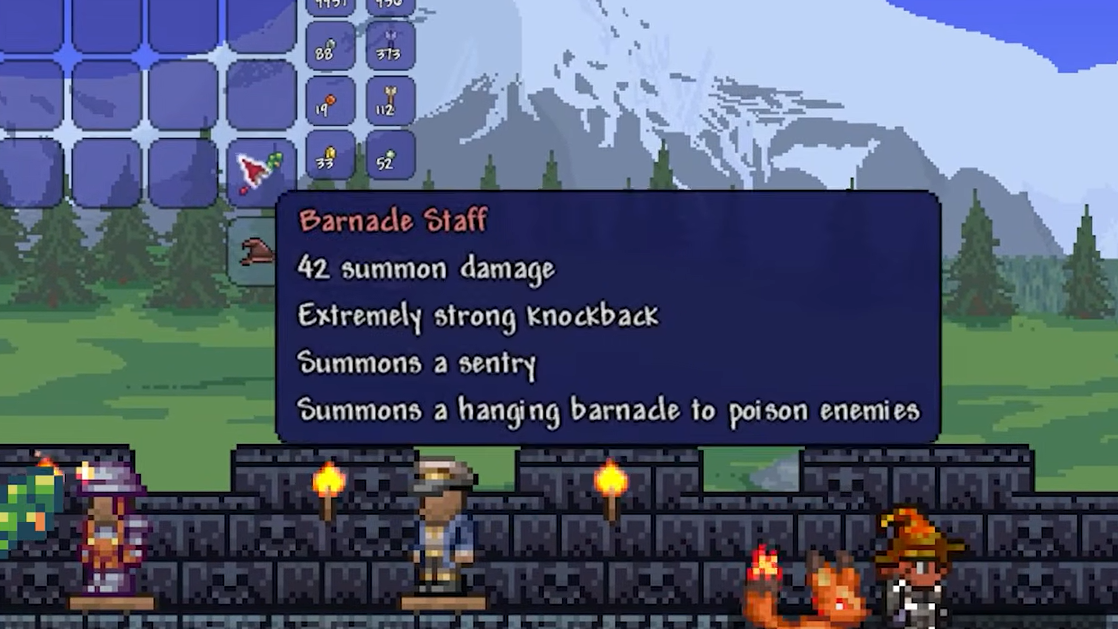
| Barnacle | Deployable turret | Summon (sentry) | Acts as a sentry that attacks nearby enemies. |
| Swarm grenade | Grenade–style weapon | Summon / magic hybrid | Releases a swarm of damaging entities. |

The Flint is a straight melee weapon. It is classified as a melee weapon in Terraria’s item system, benefiting from melee bonuses and interacting with melee-only modifiers and accessories. Its behavior is that of a swung weapon rather than a projectile, which means use time, knockback, and hitbox follow standard melee rules.
The Barrel Launcher is explicitly marked as a ranged weapon. It fits into the game’s ranged ecosystem, using ranged modifiers and scaling with ranged armor bonuses. It fires barrel projectiles that behave like other explosive shots, triggering contact or timed detonations based on the projectile’s design; enemy immunity frames and terrain collision follow the same rules used by other explosive ranged weapons.
Killing Deck is a card-throwing weapon that fills the “Dead Cells deck” slot. Internally it behaves like a projectile launcher, tossing multiple card projectiles that travel independently. Hit registration, pierce count, and projectile lifetime determine how effective it is against groups compared to single targets.
The Mushroom Staff is a summoner weapon that creates a permanent minion, Mushroom Boi. The game tracks this under the standard minion count, and the summon obeys minion targeting rules. When summoned, Mushroom Boi follows the player, attacks enemies in range, and its presence contributes to the minion counter visible beneath the buff icon. Its glowing eyes remain visible in darkness, but that visual trait does not change its combat logic.
Barnacle functions as a sentry summon rather than a roaming minion. When deployed, it anchors to a surface or supported attachment like balloons and automatically fires at enemies entering its detection radius. It respects the sentry limit (only a fixed number of active sentries per player) and disappears when its duration expires or when replaced by new sentries.
The Swarm grenade appears as the Swarm Grenade from Dead Cells, reimplemented as a Terraria item. When used, it spawns a swarm that moves toward enemies and inflicts damage until its duration ends or targets are eliminated. The swarm’s entities count as projectiles or summoned attackers under the hood, so they interact with projectile collision and enemy immunity windows in the same way as other multi-hit swarm effects.

Dead Cells vanity, buff, and traversal items
Beyond weapons, the crossover introduces a small kit of utility items that change how you move, buff, or display gear in the world.
| Item | Category | Primary effect |
|---|---|---|
| Beheaded vanity outfit | Vanity armor | Cosmetically turns the player into the Beheaded, no stats. |
| Ram Rune | Utility / movement | Provides a ram-style movement capability connected to world traversal. |
| Wings of the Crow | Wings | Grants flight and glide following Terraria’s wing rules. |
| Health Fountain | Furniture buff station | Applies a temporary buff when interacted with. |
| Hanging flasks | Display furniture | Display items visually, similar to Item Frames. |
| Ash/Aether Pylon with flasks | Teleportation pylon | Functions as a pylon inside Dead Cells–themed flask displays. |
The Beheaded vanity outfit is a full vanity armor set. Equipping it in social armor slots replaces the visual of your character with the Beheaded’s look while keeping the stats and set bonuses of your real armor. It has no direct gameplay impact and does not alter hitboxes, movement, or defense values.
Ram Rune appears as the rune unlock from Dead Cells, reflected in Terraria as a movement or traversal aide. It acts as a dedicated item with its own slot or usage behavior and is used to perform ram-like actions that can break or bypass obstacles designated to react to that ability. Only blocks or objects flagged for Ram Rune interaction respond; normal terrain remains unaffected.

Wings of the Crow are a standard wing item in Terraria’s equipment system. When equipped in a wing slot or accessory slot that supports flight, they grant aerial movement governed by the same mechanics as other wings: a fixed flight time, horizontal speed cap, and fall-slowing behavior when glide is engaged. Buffs and debuffs that affect generic wings also apply.
The Health Fountain is placed as furniture. Interacting with it applies a buff to the player. That buff appears in the buff bar with its own icon and duration, and it follows the same stacking and replacement rules as other buff-granting furniture, such as campfires or sharpening stations. Once placed, the fountain is triggered per-use rather than providing a constant aura, so you must interact again to refresh the effect after it expires.
Hanging flasks are decorative yet functional display blocks. You place them like other wall-mounted furniture, then assign items to be shown inside. They display item sprites much like Item Frames, but inside Dead Cells–style flask graphics. Removing the flask or changing the displayed item returns the stored item to your inventory or drops it as a world item, following the same safety rules as other display containers.
Some Dead Cells content, such as the pylon shown inside a flask, behaves like other pylons in the NPC happiness network while being visually framed in the crossover art. The pylon’s teleport network logic is unchanged by its representation inside a flask.

How Dead Cells summoner content integrates with Terraria’s summon system
Several crossover items explicitly target summoner gameplay, using Terraria’s summon mechanics rather than improvised workarounds. The key distinction is between minions and sentries, and Dead Cells items cleanly map onto those roles.
The Mushroom Staff produces a minion. Every cast consumes one minion slot up to your current maximum, and the Mushroom Boi behaves like any other minion for targeting and persistence. It follows the player, teleports when off-screen, and continues attacking until unsummoned or replaced by another minion when you hit your cap.
The Barnacle is a sentry. Sentries are stationary and bound by a separate cap from minions. When you place a Barnacle, it snaps to a valid surface or permitted anchor and starts scanning for enemies. If you try to place more sentries than your current limit allows, the oldest or least recently placed sentry is removed to make room, just as with other summoner turrets.
The Swarm grenade acts as a hybrid, but mechanically, its swarm behaves like multi-hit projectiles or temporary summons rather than persistent minions or sentries. It does not occupy a minion slot; instead, it follows projectile lifespan rules and disappears after a fixed time or number of hits. This keeps summoner slot accounting clear while still providing Dead Cells–style swarm behavior.
All of these items benefit from general summon bonuses such as increased summon damage, additional minion slots, and improved sentry capacity. They also interact with the new summon-specific modifiers such as Eager, Focused, Loyal, Worthy, Rabid, Ballistic, and Fabled, which are applied at the reforging stage like other modifiers.
Display and crossover integration in the Dead Cells “flask room”
One of the most visible manifestations of the crossover is the recreated Dead Cells flask room inside Terraria. Functionally, this is built using the new hanging flask items and Dead Cells crossover content arranged into a room.
Each hanging flask is a wall object capable of holding a single item for display. You assign a weapon, utility item, or other object to a flask, and its sprite is rendered inside the glass, suspended as if in Dead Cells’ iconic collector room. Items shown this way are not duplicated; the flask stores them in-place, and removing them returns the original item with its stats and modifiers unchanged.
Within such setups, items like the Health Fountain, Ram Rune, Wings of the Crow, and the crossover weapons can be both functionally usable and visually showcased. The interaction rules do not change; a Health Fountain placed in a display-heavy room still applies a buff when used, and equipping Ram Rune or Wings of the Crow still requires moving them to the correct inventory or equipment slots.
All Dead Cells crossover items in Terraria 1.4.5 follow existing item category rules, modifier systems, and world interaction logic. Once obtained, they slot directly into established melee, ranged, magic, and summoner builds while introducing Dead Cells flavor through visuals, movement tools like Ram Rune and Wings of the Crow, and furniture such as the Health Fountain and hanging flasks.