

Brewing turns some of Minecraft’s strangest items into some of its strongest tools. With the 1.21 update, the system now covers classic combat buffs, utility effects, and a new set of mob-focused status potions built around Trial Chambers.
Core brewing equipment and fuel
Every potion starts at a brewing stand. To use it efficiently you need four things: the stand itself, Blaze Powder as fuel, glass bottles, and a water source.
Brewing Stand. This block runs the entire brewing process. It holds up to three bottles in the bottom row and one ingredient in the top slot. A Blaze Rod plus three blocks of cobblestone in a crafting table creates one brewing stand.
Blaze Powder. The stand consumes Blaze Powder as fuel. One unit supplies around 20 brews, so a single Blaze Rod converted into powder keeps multiple brewing sessions running.
Water source and bottles. Glass bottles filled from any water source block or cauldron become water bottles and form the base of almost every potion. Water sources do not deplete, while a full cauldron can fill three bottles.
Awkward potions and base brews
Nearly every usable potion in Minecraft starts from an Awkward Potion. This base determines whether an ingredient will create a real effect or just waste materials.
| Base potion | How to brew (from Water Bottle) | Purpose |
|---|---|---|
| Awkward Potion | Nether Wart | Required base for all standard effect potions |
| Mundane Potion | Redstone Dust (or some effect items directly) | No direct use in survival |
| Thick Potion | Glowstone Dust | No direct use in survival |
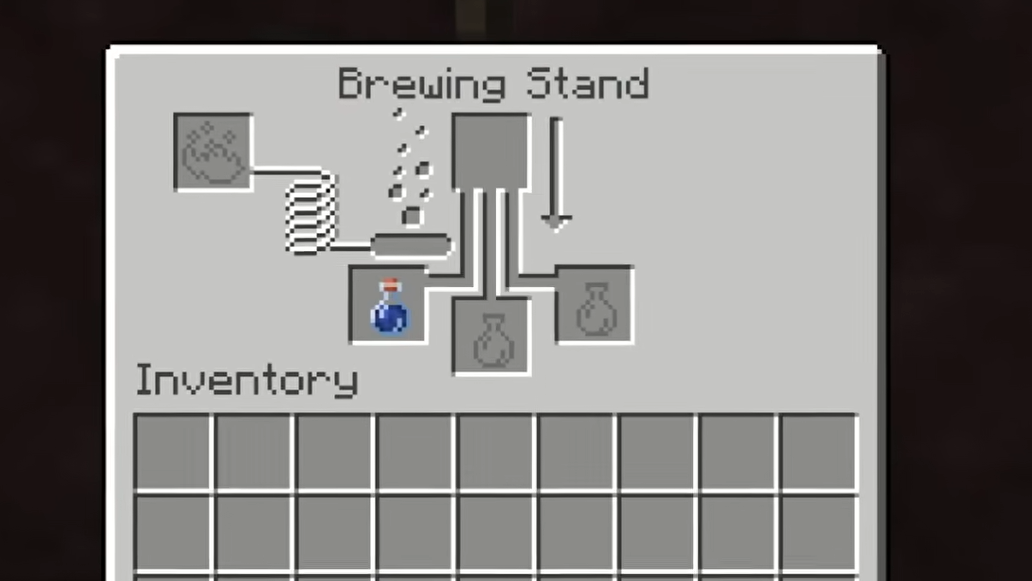
Step 1: Place Blaze Powder in the left fuel slot of the brewing stand to power it.
Step 2: Put up to three water bottles in the bottom slots.
Step 3: Add Nether Wart in the top ingredient slot and wait for the brew to finish. The bottles become Awkward Potions.
There is one exception: Potion of Weakness can be brewed directly from a water bottle using a Fermented Spider Eye, skipping Awkward Potions entirely.
Modifier items: duration, strength, splash, and lingering
Once a base effect exists, modifier ingredients reshape how the potion behaves without changing its core status effect.
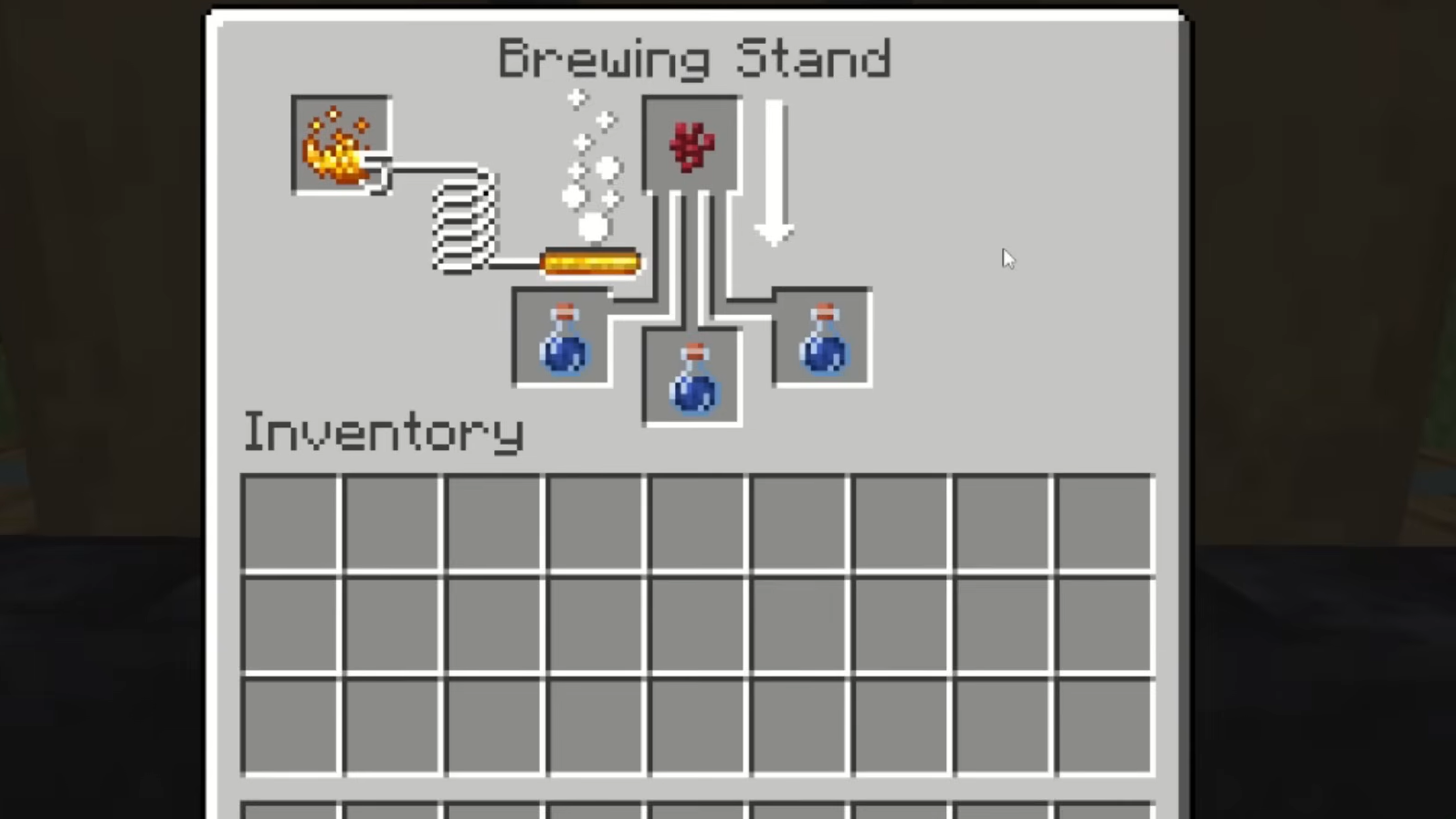
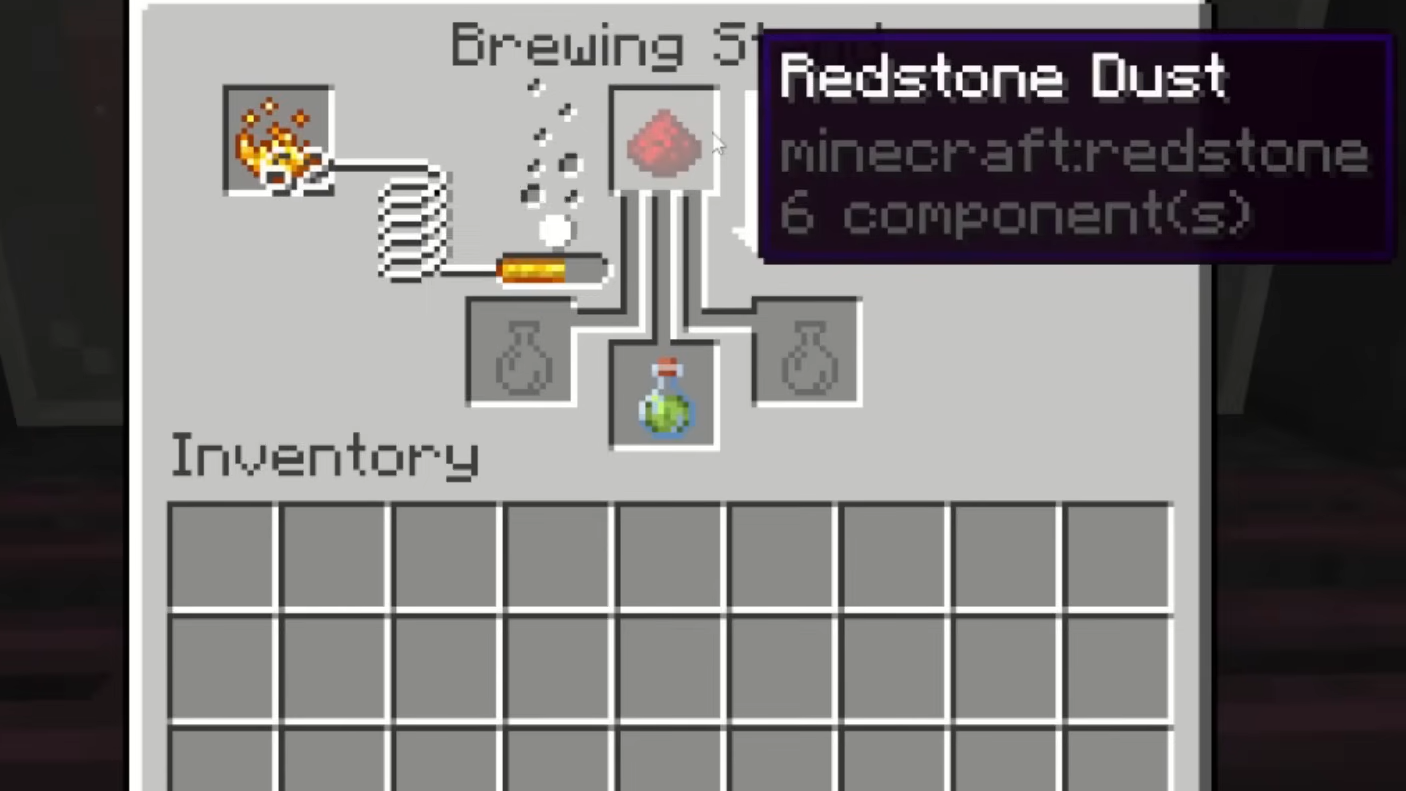
- Redstone Dust extends duration on potions that have a time limit. A 3:00 effect usually becomes 8:00, and shorter effects gain a similar proportional increase.
- Glowstone Dust increases the level of many effects, producing “II” versions such as Strength II or Swiftness II, with stronger effects but shorter total duration.
- Fermented Spider Eye corrupts certain potions, flipping them into negative or inverted effects such as Swiftness into Slowness, Healing into Harming, or Night Vision into Invisibility.
- Gunpowder converts any drinkable potion into a splash potion, which is thrown instead of drunk and applies its effect in a small area on impact.
- Dragon’s Breath converts a splash potion into a lingering potion, which leaves a cloud on the ground that applies a weakened effect to any entity that passes through.
In Java Edition, drinkable and splash potions have the same duration. Lingering versions are shorter, typically a quarter of the drinkable length. In current Bedrock builds, splash and drinkable forms now share durations as well.
Some combinations are deliberately blocked. Glowstone and redstone cannot be stacked on the same potion, and specific corrupted combinations (such as Harming from certain bases) use fixed rules rather than stacking upgrades.
All positive effect potions in 1.21
Positive potions improve combat, travel, or survivability. All of these use an Awkward Potion as the base unless noted.
| Potion | Effect ingredient | Key effect | Typical upgrades |
|---|---|---|---|
| Potion of Healing | Glistering Melon Slice | Instant Health, restores 4 health (2 hearts) | Glowstone: Instant Health II (8 health) |
| Potion of Regeneration | Ghast Tear | Gradual health regeneration over time | Redstone for longer regen, Glowstone for faster but shorter regen |
| Potion of Fire Resistance | Magma Cream | Immunity to fire, lava, magma blocks, and blaze fireballs | Redstone for extended 8:00 duration |
| Potion of Swiftness | Sugar | Speed, longer sprint distance and jump length | Redstone for 8:00 duration, Glowstone for Speed II |
| Potion of Strength | Blaze Powder | Boosted melee attack damage | Redstone for 8:00 Strength, Glowstone for Strength II |
| Potion of Leaping | Rabbit’s Foot | Jump Boost, higher jumps and slightly reduced fall damage | Redstone for longer duration, Glowstone for Jump Boost II |
| Potion of Water Breathing | Pufferfish | Prevents air loss underwater | Redstone for long ocean exploration runs |
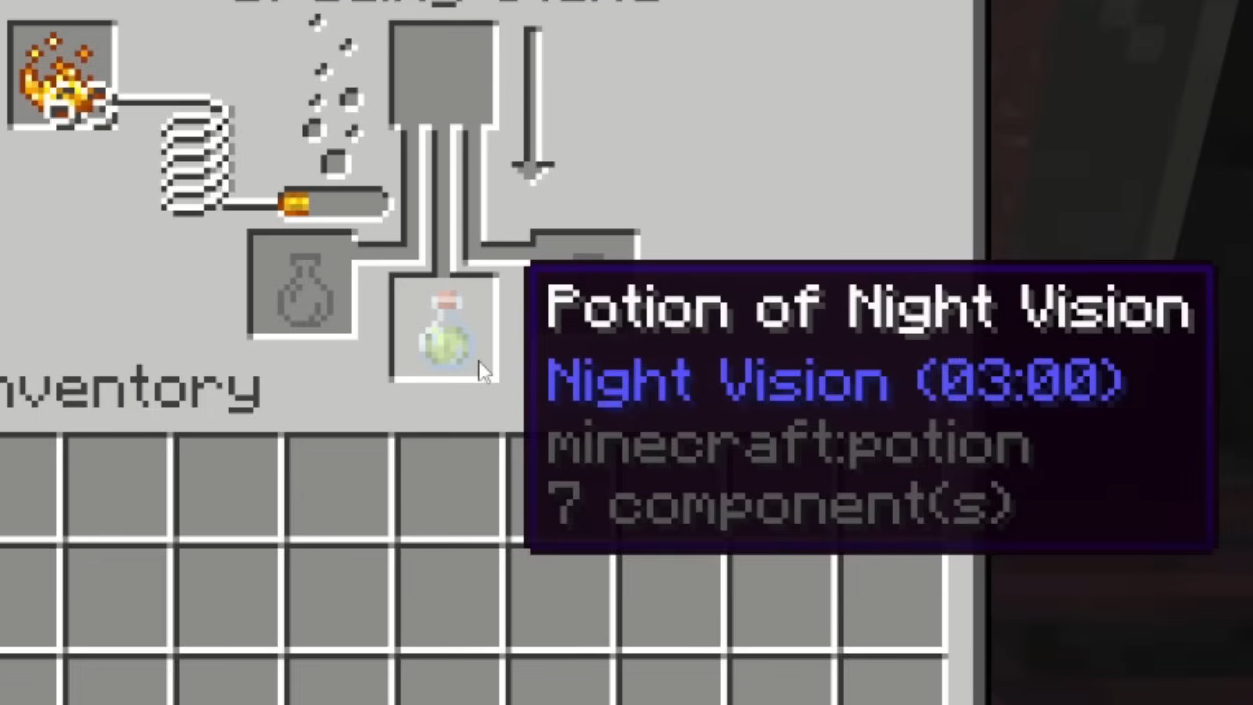
| Potion of Night Vision | Golden Carrot | Makes the world appear fully lit, even underwater or in caves | Redstone for 8:00 duration |
| Potion of Invisibility | Corrupt Night Vision with Fermented Spider Eye | Turns the player invisible; held and worn items stay visible | Redstone for longer sneaking windows |
| Potion of Slow Falling | Phantom Membrane | Greatly reduced fall speed, no fall damage | Redstone to extend from 1:30 to around 4:00 |
| Potion of the Turtle Master | Turtle Shell | High damage resistance with heavy movement slowdown | Redstone for longer tanking, Glowstone for stronger resistance and slowness |
On undead mobs, effects interact differently. Healing and Harming swap roles: Healing damages undead, while Harming restores their health. Regeneration and Poison have no effect on undead targets.
Negative and debuff potions
Negative potions are usually thrown as splash or lingering versions during combat or PvP.
| Potion | How to brew | Effect | Common variants |
|---|---|---|---|
| Potion of Weakness | Water Bottle + Fermented Spider Eye (no Nether Wart needed) | Reduces melee attack damage by 4 | Redstone for longer debuff, splash/lingering for area use |
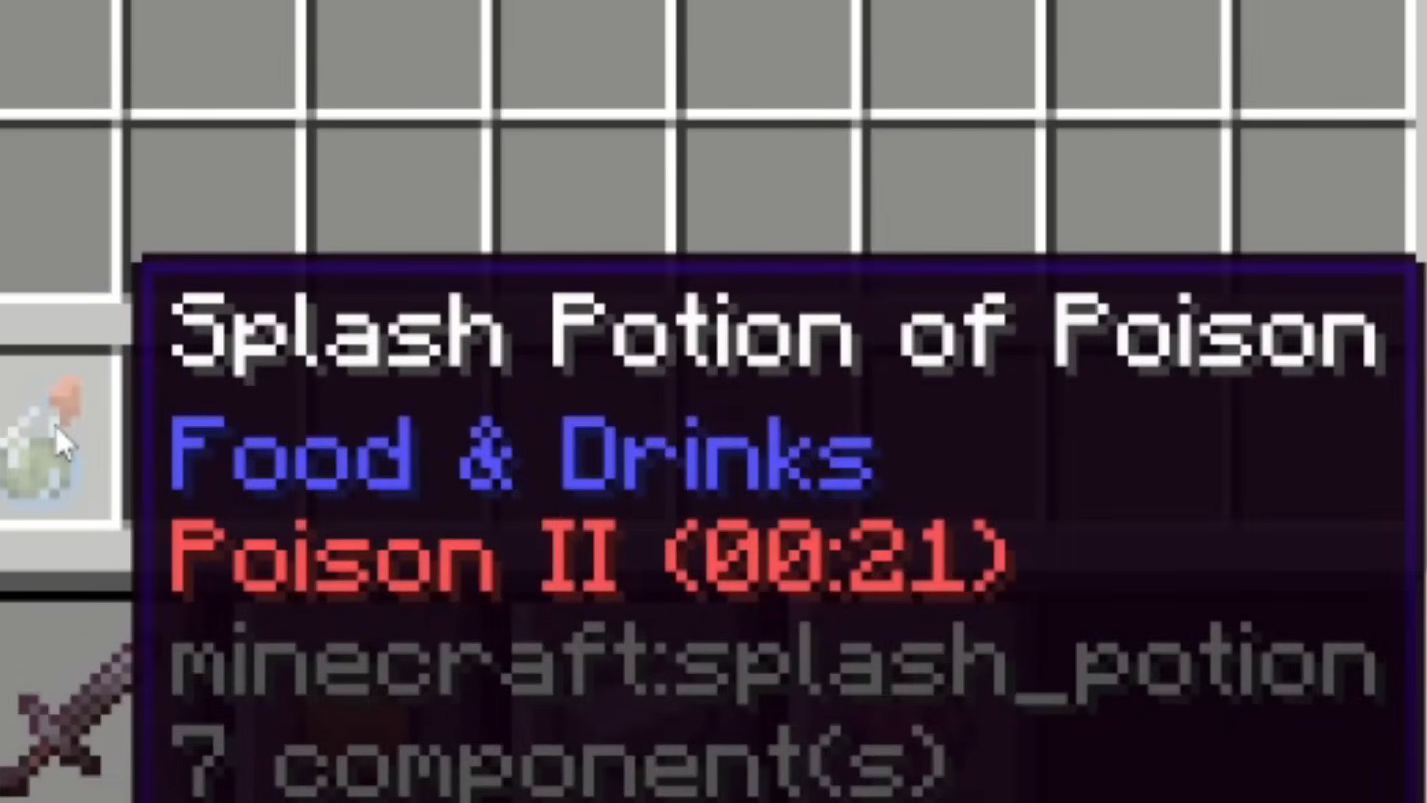
| Potion of Poison | Awkward Potion + Spider Eye | Gradual damage over time, down to half a heart but not fatal | Redstone for extended poison, Glowstone for Poison II (faster damage) |
| Potion of Slowness | Corrupt Swiftness or Leaping with Fermented Spider Eye | Reduces movement speed | Redstone for long slowness, Glowstone for Slowness IV |
| Potion of Harming | Corrupt Healing or Poison with Fermented Spider Eye | Instant Damage, hits immediately on contact | Glowstone for Instant Damage II |
These negative brews are particularly effective in splash form, where they can soften large groups of mobs or swing PvP fights when timed well.
Mob-effect potions added in Minecraft 1.21
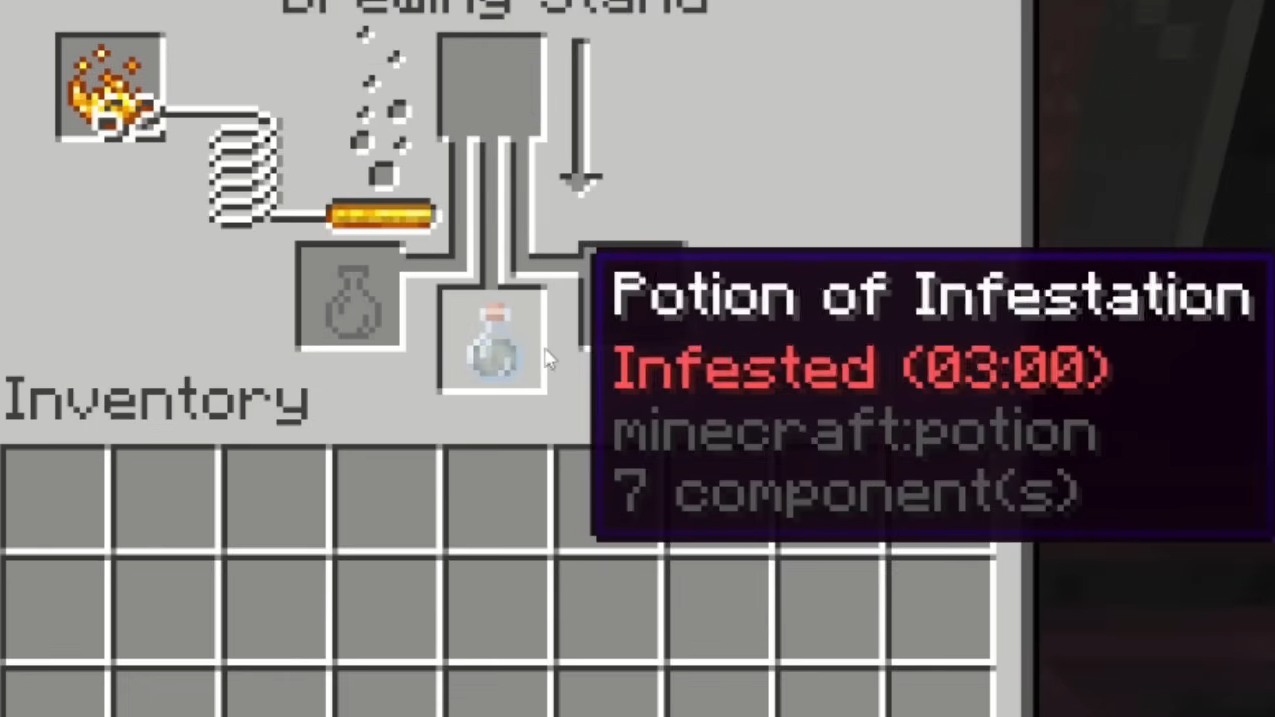
Minecraft 1.21 introduces four new status effects tied to Trial Chambers and mob behavior: Infestation, Oozing, Weaving, and Wind Charging. All four use Awkward Potions as the base and are best understood as death-triggered effects.
| Potion | Effect ingredient | Status effect | What happens |
|---|---|---|---|
| Potion of Infestation | Stone | Infested | When the affected entity takes damage, there is a small chance to spawn silverfish nearby. |
| Potion of Oozing | Slime Block | Oozing | When the affected entity dies, two medium slimes spawn at the death location. |
| Potion of Weaving | Cobweb | Weaving | When the affected entity dies, two or three cobweb blocks appear around the corpse. |
| Potion of Wind Charging | Breeze Rod | Wind Charged | On death, the affected entity emits a wind burst similar to a Wind Charge. |
These brews are designed for traps, farms, and pranks rather than traditional buffs. For example, Oozing on a disposable mob can constantly restock a slime farm, while Infestation and Weaving lend themselves to chaos-heavy traps and PvP arenas.
Splash and lingering variants
Any potion with a base effect can be turned into an area-of-effect tool.
Step 1: Brew the desired drinkable potion in the brewing stand.
Step 2: Place the finished potion bottles back into the stand and put Gunpowder in the top slot. The bottles become splash potions.
Step 3: To create lingering versions, place splash potions in the bottom slots and add Dragon’s Breath in the top slot.
Splash potions are ideal when you want to affect a group all at once. Lingering potions create a persistent field that can layer effects on anyone who steps through, and they are also used to craft tipped arrows.
Education-only cures and unbrewable potions
With the Education features enabled in Bedrock or in Minecraft Education, a separate set of “cure” potions exists. These use chemical elements instead of the usual Nether ingredients and remove specific negative effects rather than granting buffs.
| Cure potion | Removes |
|---|---|
| Antidote | Poison |
| Elixir | Weakness |
| Eye Drops | Blindness |
| Tonic | Nausea |
Cure potions cannot be extended, strengthened, or turned into splash or lingering versions.
Separately, some potions are intentionally unbrewable in survival. Luck and Decay fall into this category and are only available through commands or specific loot structures, depending on edition.
Putting it together: a practical brewing workflow
Once the relationships between bases, effects, and modifiers are clear, brewing becomes a repeatable loop rather than guesswork.
Step 1: Stockpile core ingredients: Nether Wart, Blaze Powder, glass, and access to water. Without these, brewing stalls immediately.
Step 2: Decide on a base role for your potions, such as “boss fight,” “Nether exploration,” or “Trial Chamber farming.”
Step 3: Brew a batch of Awkward Potions, then convert them into the effect you need using the relevant ingredient (for example, Ghast Tears for Regeneration, Magma Cream for Fire Resistance).
Step 4: Apply either Redstone or Glowstone, not both, choosing between longer duration or higher impact.
Step 5: Finish with Gunpowder or Dragon’s Breath if you need area coverage or lingering traps instead of personal buffs.
Handled this way, the brewing system in Minecraft 1.21 exposes a compact but powerful set of recipes that cover fast healing, sustained protection, movement tricks, and more experimental mob-based interactions. Once the base patterns are memorized, expanding into newer potions like Infestation or Oozing becomes a matter of swapping in different effect ingredients rather than relearning the entire system.