

Redstone is Minecraft's version of electrical wiring, and it changes the game from a block-building sandbox into something closer to an engineering playground. The problem is that getting started feels overwhelming. Repeaters, comparators, observers, monostable circuits — the vocabulary alone can scare off newcomers. The good news is that most practical redstone builds rely on the same handful of components wired in straightforward patterns, and you can learn those patterns by building things you'll actually use in survival.
Quick answer: The easiest redstone builds to start with are a 2×2 piston door, an automatic lighting system, and a simple sugarcane farm. Each one uses only basic components — redstone dust, repeaters, pistons, and observers — and teaches a core concept you'll reuse in every future project.
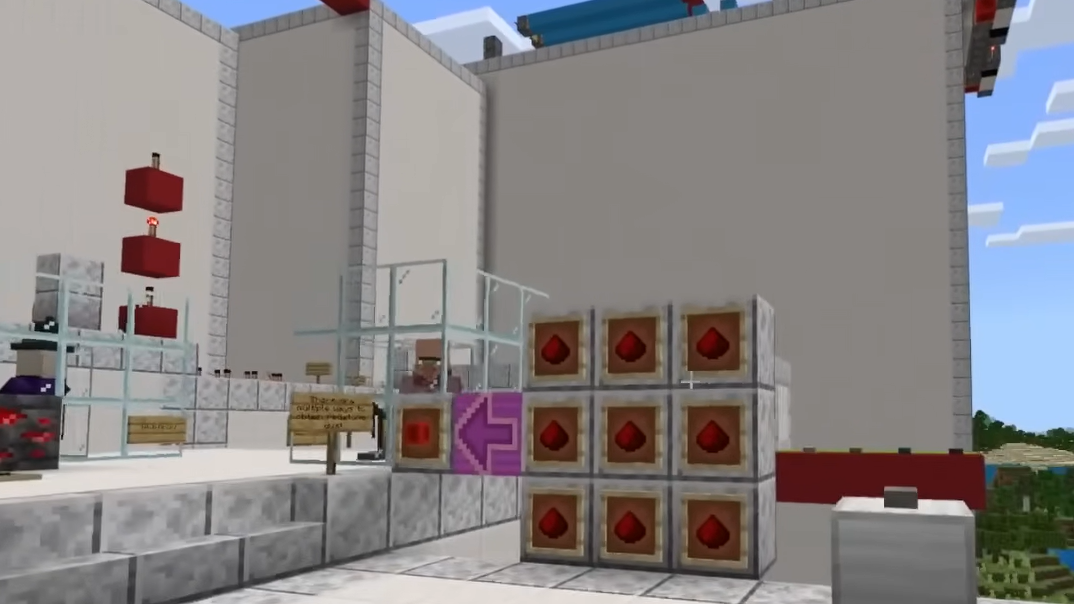
Core Redstone Components Every Beginner Needs
Before diving into builds, it helps to know what each piece actually does. You don't need to memorize everything — just understand the roles well enough to follow a wiring layout.
| Component | What It Does | Key Detail |
|---|---|---|
| Redstone Dust | Transmits a signal between blocks | Signal weakens over 15 blocks, then dies |
| Redstone Torch | Provides a constant signal; inverts input | Useful for logic gates and toggle systems |
| Repeater | Extends signal range and adds delay | Each repeater adds 1–4 ticks of delay |
| Comparator | Measures and compares signal strength | Essential for item sorters and detecting container fill levels |
| Piston | Pushes the block in front of it | Cannot pull blocks back on retraction |
| Sticky Piston | Pushes and pulls the block in front of it | Critical for hidden doors and retractable structures |
| Observer | Detects block changes and emits a pulse | Fires on both placement and removal of adjacent blocks |
| Hopper | Moves items between containers | Pulls from above, pushes into the container it points toward |
A redstone signal travels a maximum of 15 blocks through dust before fading out completely. Repeaters solve this by refreshing the signal to full strength while also letting you introduce precise timing delays — a mechanic that matters enormously once you start chaining pistons together.
Survival Base Builds
These three projects are ideal first builds because they're small, immediately useful, and teach you how signals flow through dust, pistons, and switches.
2×2 Piston Door. This is the classic starter project. Place four sticky pistons behind a wall so they face inward, wire them to a lever or pressure plate with redstone dust running underneath the floor, and you've got a hidden entrance that retracts into the walls when activated. The pistons extend to seal the doorway when the signal stops, so the blocks blend with the surrounding wall. It's a small build — roughly a 5×5 footprint behind the wall —, and it immediately makes any base feel more polished.
Automatic Lighting System. Instead of scattering torches everywhere, you can wire redstone lamps to pressure plates at room entrances. Step on the plate, the lamps light up. Step off, they go dark. The wiring is just dust running from the plate to each lamp, with repeaters if the distance exceeds 15 blocks. Beyond looking clean, this setup prevents mob spawning in dark corners of your base without permanent torch clutter.
Hidden Staircase. Sticky pistons pull blocks away from a staircase entrance when you press a button, revealing steps that lead underground. Release the button, and the blocks slide back, hiding the stairs completely. The circuit is almost identical to the piston door — a signal source, dust, and sticky pistons — just oriented vertically instead of horizontally. It's a great way to protect underground storage rooms on multiplayer servers.
Automated Farms
Farms are where redstone pays for itself in survival. Each of these designs runs with minimal player interaction once built, generating resources passively while you do other things.
Automatic Sugarcane Farm. Plant sugarcane on dirt blocks adjacent to water. Place observers behind the second-level sugarcane blocks so they detect growth. When the cane reaches the target height, the observer fires a signal to pistons that snap the cane off. The broken pieces fall into a water stream that funnels them through hoppers into a chest. Paper from sugarcane feeds book crafting and librarian villager trades, making this one of the most valuable early farms.
Simple Chicken Cooker. Chickens are confined in a glass enclosure above a dispenser. When they lay eggs, the eggs collect in the dispenser via hoppers. A comparator detects when the dispenser has eggs and triggers it to fire them into a chamber below. Hatched chicks grow into adults, at which point lava kills them, and the cooked chicken drops through a hopper into a chest. It sounds grim, but it's a completely hands-off food source.
Semi-Automatic Wheat Farm. This design uses a farmer villager to do the harvesting. Plant wheat on tilled soil, place a composter nearby so the villager recognizes its job, and run minecarts with hoppers beneath the farmland. The villager harvests mature wheat and replants seeds automatically. Harvested wheat drops into the minecarts, which deliver it to a collection chest. You only need to occasionally check the chest.
Wool Farm with Observers. Pen sheep inside a small enclosure with an observer watching each one. When a sheep regrows its wool, the observer detects the change and signals a dispenser loaded with shears. The dispenser shears the sheep, and the wool drops through a hopper into a chest. Dye the sheep different colors beforehand, and you'll have a steady supply of colored wool for building projects.
Melon and Pumpkin Farm. These crops grow a fruit block on an adjacent dirt or grass block rather than on the stem itself. Place observers facing the blocks where fruit appears. When a melon or pumpkin spawns, the observer triggers a piston that breaks it. The drops fall into a water stream leading to hoppers and a chest. Because the stem stays intact, the cycle repeats indefinitely.
Storage and Sorting Contraptions
Once your farms start producing, you'll need a way to manage the flood of items. These builds handle that problem.
Automatic Item Sorter. The standard design uses a column of hoppers, each locked by a redstone torch. Inside each hopper, you place the item type you want sorted (with a specific number of filler items to set the signal strength). When the correct item enters, the comparator reads the change in signal, unlocks the hopper below, and the item drops into its designated chest. It requires hoppers, comparators, repeaters, redstone torches, and chests. The system is tileable, meaning you can extend it sideways for as many item categories as you need.
Auto Smelting Array. Multiple furnaces connected by hoppers and minecarts with hoppers distribute raw materials evenly across all available furnaces. Drop ores or raw food into an input chest, pull a lever, and the minecart distributes items to each furnace in sequence. Finished products collect in an output chest. This dramatically cuts smelting time compared to using a single furnace, and the design works on both Java and Bedrock editions.
Hidden Chest Minecart Unloader. If you use minecart rail systems to transport items across your world, this contraption automatically empties a chest minecart when it arrives at a station. Hoppers beneath the rail extract items and feed them into storage chests. Once the minecart is empty, a comparator detects the change and triggers a piston mechanism that releases the cart back onto the track. It's a clean way to build a logistics network between distant bases.
Fun and Novelty Redstone Projects
Not everything needs to be about efficiency. These builds are entertaining, teach useful timing concepts, and give you something to show off.
Simple Water Elevator. A column of water with soul sand at the bottom pushes you upward in a bubble stream. Swap the soul sand for a magma block, and the stream pulls you down. The redstone component comes from wiring a button at the top to a sticky piston that swaps between soul sand and magma, giving you a two-way elevator controlled from either end. You'll need observers, repeaters, and redstone torches to handle the signal routing.
AFK Fishing Farm. This build lets you catch fish, enchanted books, and treasure while idle. The core mechanic uses a tripwire or note block to detect when a fish bites, then automatically recasts the line. You hold down the use button, and the farm handles the rest. Loot funnels through hoppers into a chest. It's one of the most rewarding passive farms in survival, especially early on when enchanted books are hard to come by.
Pop-Up Armor Equipper. A sticky piston with a slime block holds an armor stand beneath the floor. Press a button or step on a pressure plate, and the piston fires upward, popping the armor stand into view. It's a small build — just a piston, slime block, redstone torch, and a button — but it feels satisfying every time. Place it near your base entrance so you can grab gear on the way out.
TNT Cannon. Line up TNT blocks in a water-filled channel made of blast-resistant blocks like obsidian. Place one TNT block at the open end without water protection. Wire everything to a button through repeaters with staggered delays. When fired, the submerged TNT detonates without destroying the cannon, and the blast launches the exposed TNT block across enormous distances. It's impractical for survival but endlessly entertaining on multiplayer servers.
Java vs. Bedrock Redstone Differences
One thing that trips up beginners is that redstone does not behave identically across Minecraft's two main editions. Java Edition has quasi-connectivity, a quirk where pistons can be powered by signals intended for the block above them. Bedrock Edition lacks this behavior entirely, which means certain Java designs — particularly compact piston doors and flying machines — won't work on Bedrock without modification.
Bedrock also handles piston timing differently. Signal delays are a consistent 2 game ticks on Bedrock, but the lack of quasi-connectivity and some randomness in update order can make complex circuits unreliable. The beginner builds covered here — farms, doors, sorters, and simple contraptions — generally work on both editions without changes. Once you move into advanced piston extenders or flush doors, though, you'll want to verify the design was built for your specific edition.
Redstone mastery is cumulative. Every build on this list teaches at least one transferable concept — signal transmission, piston timing, observer detection, or hopper mechanics — that feeds directly into more ambitious projects. Start with a piston door, move to a sugarcane farm, and before long you'll be designing your own contraptions from scratch.