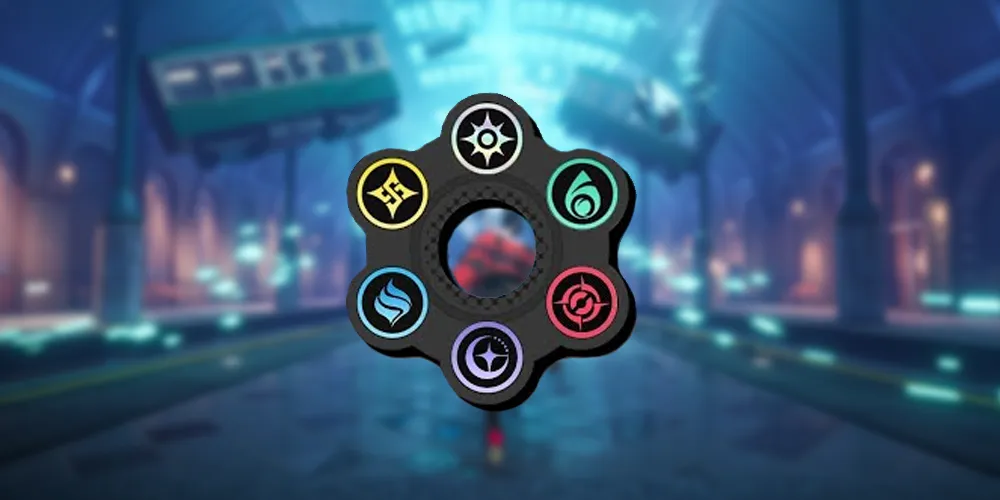
Combat in Neverness to Everness runs on a six-element wheel called the Esper Cycle. Every playable character belongs to one of six attributes, and the way you swap between them decides whether fights end in a tidy combo or a long slog. The system rewards adjacent-element pairings with reactions, extra damage, and faster meter gain, so team building is less about stacking the same element and more about building a rotation around the wheel.
The six attributes (Esper types)
An attribute, or Esper type, defines what kind of damage a character deals. Hitting an enemy’s weakness with the matching attribute eats through their Break gauge faster, which is the main path to staggering tougher anomalies and bosses. There are no built-in burn or freeze ailments tied to elements; everything flows through reactions, weakness damage, and gear that scales a specific Esper type.
| Attribute | Adjacent attributes (Esper Cycle pair) |
|---|---|
| Cosmos | Lakshana, Anima |
| Anima | Cosmos, Incantation |
| Incantation | Anima, Chaos |
| Chaos | Incantation, Psyche |
| Psyche | Chaos, Lakshana |
| Lakshana | Psyche, Cosmos |
Gear matters here. Arcs and Consoles often roll a “[Type] DMG Up” line, and those bonuses only work if the equipped piece matches the character’s own Esper type. Mixing attributes on a single character’s gear wastes most of the affix.
How the Esper Meter charges
Each character carries an Esper Meter alongside their HP and ultimate gauge. When it fills, that character’s portrait glows, and swapping to them triggers an Esper Attack that can chain into a Cycle reaction. Four actions feed the meter, and the speed depends on the character’s Cycle Rate stat.
| Action | Meter gain |
|---|---|
| Normal attacks on field | Slow, steady fill |
| Skill use | Moderate burst (scales with Cycle Rate) |
| Successful parry | Instantly fills the meter |
| Taking damage | Small passive gain |
Characters with a 100 Cycle Rate skill can effectively top up their meter on every cast, which is why some units feel like they’re constantly ready to swap in. For slower units, parrying is the shortcut. Time the parry as the inner circle aligns with the outer ring and the meter snaps to full.
Esper Cycle reactions
Pairing two adjacent attributes on the same enemy produces a duo reaction. Six exist, one for each side of the wheel, and each carries a different tactical job, ranging from damage over time to defense shred and crowd control.
| Reaction | Pair | Effect |
|---|---|---|
| Blossom | Cosmos + Anima | Spawns a turret that fires at enemies in a small area. |
| Hexed | Anima + Incantation | Triggers extra Unison damage based on recent elemental damage taken. |
| Scorch | Incantation + Chaos | Damage over time for around 15 seconds. |
| Nova | Chaos + Psyche | Marks the target; a large burst of Cognito damage detonates after about 5 seconds. |
| Stain | Psyche + Lakshana | Target takes roughly 50% more Psyche and Lakshana damage for about 12 seconds. |
| Remora | Lakshana + Cosmos | Marks the target and slows movement and attack speed. |
Two trio reactions sit on top of those duos. They don’t need a third element so much as they need two duo effects active on the same enemy at the same time.
- Charge — A target marked by Remora (Cosmos + Lakshana) gets struck by a Blossom (Cosmos + Anima). Each Blossom hit then feeds large amounts of ultimate energy to whoever you’re controlling.
- Discord — A target carries Scorch (Incantation + Chaos) and Nova (Chaos + Psyche) at the same time. Their Break meter takes a heavy chunk of damage, accelerating the stagger.
Esper Cycle passives stack across the team
Almost every character has a Support Skill that buffs a specific reaction, and that passive stays active as long as the character sits in the squad, even when they never step on the field. This is what makes single-element teams viable: you don’t need three different elements to trigger the reaction yourself if your bench is amplifying it for you.
Blossom is the cleanest example. A team running Jiuyuan, Nanally, and Mint stacks three different passive effects onto the same Cosmos + Anima reaction. Jiuyuan adds an extra Blossom and raises the cap to six. Nanally tacks on additional small hits per Blossom and increases their attack rate. Mint widens the area each Blossom covers. Only one of them needs to actually trigger the pairing.
Building a rotation
The cleanest way to think about a rotation is to identify your slowest meter-builder and assign them the parry job, since parries fill the meter instantly. Faster characters fill through skills and on-field attacks. Once two or three meters are ready, you swap through them in order to land the duo or trio reaction you want.
Combat habits that compound
A few smaller mechanics decide how often your rotation actually closes the loop:
- Lock on before dodging. Perfect dodges feed the enemy’s stun meter much faster than normal attacks and briefly slow time. Spamming dodge without a target wastes the i-frames.
- Watch the white Break bar. Hitting weakness attributes drains it quickly. Once it empties, the enemy is staggered and takes amplified damage from anything you throw at them.
- Don’t break shielded enemies with raw attacks. The stun meter fills slower while a shield is up. Pop the shield first, then commit to the stagger window.
- Hold dashes for combat. You get three dashes that regenerate over time, but you can’t dash mid-air. Sprinting is unlimited, so save the dashes for dodge timing.
Gearing toward your reactions
Arcs and Consoles handle stat distribution. Match every Crescent to the character’s element to unlock the basic bonuses, then complete 2-piece or 4-piece sets with Tetris-style pieces to activate Sonata Effects. Two-piece bonuses tend to add flat damage to a specific Esper type. Four-piece bonuses do heavier work, like ignoring a portion of enemy resistance during reaction windows.
Substats are visible before you commit upgrade resources, so check crit rate, attack, and HP rolls before pouring materials into a piece. For reaction-focused builds, prioritize Cycle Rate on supports who need to set up the meter, and damage stats on the DPS who actually closes the rotation.
Once the wheel clicks, combat starts to feel less like swapping on cooldown and more like setting up a board. Pick two adjacent attributes, decide which reaction you want to lean on, then bring a third character whose passive amplifies that exact effect. Everything else, including parries, ultimates, and gear, exists to feed that loop a little faster.