

The three companies that make almost all of the world’s RAM are now defendants in a US antitrust case. Samsung, SK Hynix, and Micron were sued in California federal court by a group of consumers and small businesses who say the trio deliberately held back supply of standard computer memory to keep prices high during the ongoing memory crunch.
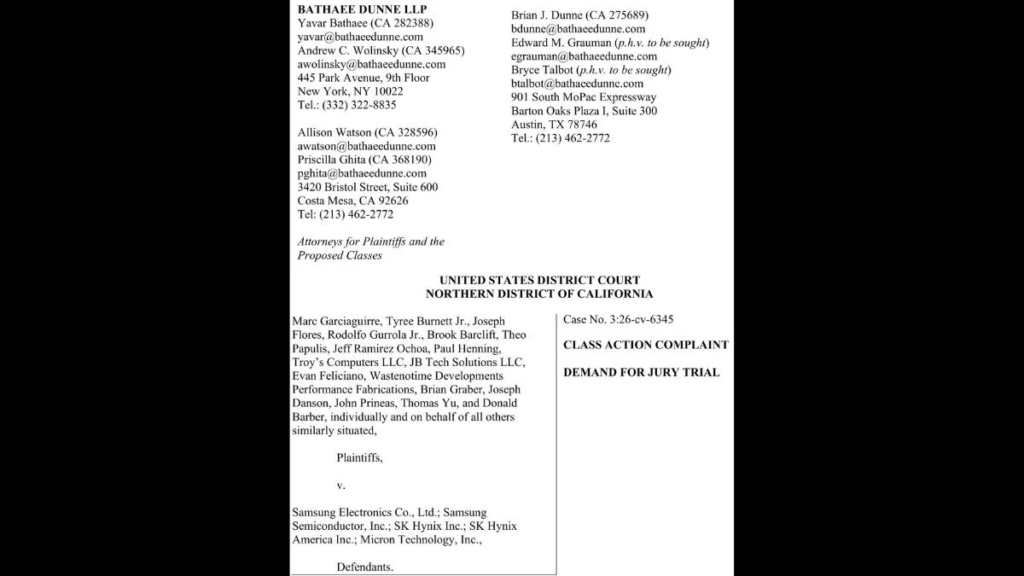
Quick answer: A proposed class-action antitrust complaint (case 3:26-cv-06345) was filed on June 25, 2026, in the US District Court for the Northern District of California, accusing Samsung, SK Hynix, and Micron of conspiring to restrict conventional DRAM supply and fix prices. The companies have not been found liable, and no trial date is set.
What Samsung, SK Hynix, and Micron are accused of
The core claim is straightforward. The three firms together account for nearly the entire global market for dynamic random access memory (DRAM), the memory used in phones, laptops, PCs, and AI servers. The plaintiffs say that starting in 2022, when demand was low, the companies began coordinating their supply and pricing decisions rather than competing. The result, they argue, was a price increase of about 700 percent over four years.
In a normal commodity market, when prices spike that hard, at least one producer usually ramps up output to grab customers and undercut rivals. The complaint says that never happened here. As the plaintiffs put it, “None of the three used the others’ retreat to expand and win customers. All three pulled back together.”
The complaint also frames the behavior in blunt terms, describing the defendants as “DRAM oligopolists” who “simultaneously cut production, coordinated a pivot to HBM and exit from DDR3 and DDR4, and otherwise decreased and locked up conventional DRAM supply while prices charged up with mind-blowing scale and rapidity.”
Key facts of the DRAM class action
| Case number | 3:26-cv-06345 |
| Type | Antitrust, proposed class action |
| Filed | June 25, 2026 |
| Court | US District Court, Northern District of California |
| Judge | Noel Wise |
| Defendants | Samsung Electronics, SK Hynix, Micron Technology |
| Plaintiffs’ counsel | Bathaee Dunne LLP |
| Trial date | None set |
Who filed the complaint
The suit was brought by 14 individual consumers and three small businesses, including PC retailers and repair shops. Named parties include Marc Garciaguirre, Theo Papulis, Thomas Yu, Tyree Burnett Jr., Thomas Barber, Brian Graber, Paul Henning, Evan Feliciano, Rudolfo Gurrola Jr., Jeff Ramirez Ochoa, John Prineas, Joseph Flores, Joseph Danson, and Brook Barclift, alongside businesses such as WNTD Fab LLC, JB Tech Solutions LLC (My Florida PC), and Troy’s Computers LLC.
They are represented by Bathaee Dunne LLP, the antitrust firm that previously prevailed in a case alleging collusion in Google’s digital advertising business. The firm is seeking to certify a class covering all consumers and businesses that bought products containing DRAM during the price surge.
The HBM shift and the DDR3/DDR4 cutoff
A central part of the argument is how the three makers handled high-bandwidth memory (HBM), the type of memory packed into AI data center accelerators. AI buyers are willing to pay enormous sums for HBM, so the makers had a strong incentive to redirect capacity toward it. The plaintiffs allege the trio used that “pivot” as cover to wind down conventional DRAM, including older DDR3 and DDR4 modules, and to keep overall supply tight.
The complaint points to Micron shutting down its consumer memory brand, Crucial, as evidence, noting it did so “at the most profitable price point in its history.” Micron has also signed multiple long-term agreements with strategic customers running through 2030, which the plaintiffs say further squeezes the standard consumer market.
The filing arrives just as device prices climb. Apple recently raised prices on several products and cited rising memory costs, and the complaint treats those increases as a trigger for the case. Phone makers including OnePlus and Nothing have also lifted prices in recent months.
Why the plaintiffs say no rival can step in to undercut prices
The complaint argues the DRAM market is effectively closed to newcomers, which is what makes coordinated supply cuts so damaging. A single fabrication plant can cost between $15 billion and $20 billion and take years to build. The manufacturing processes are protected by decades of trade secrets, and US export controls block China’s producers from getting current-generation equipment.
On top of that, finished chips must pass 12 to 18 months of customer qualification before major buyers will use them. The plaintiffs sum up the effect this way: “The practical consequence is that when the three firms restrict supply, no outsider can expand output to undercut them.”
The earlier DRAM price-fixing cases
This is not the first time these companies have faced this kind of accusation. In the early 2000s, the US Department of Justice pursued a criminal DRAM price-fixing conspiracy, and Samsung and SK Hynix pleaded guilty. The 2005 DOJ settlement brought a $300 million criminal fine for Samsung, fines for the other firms, and prison sentences for several executives. SK Hynix paid roughly $185 million in its part of the case, while Micron avoided a fine by reporting the conspiracy and cooperating with prosecutors.
The complaint also points to a separate run of price increases between 2016 and 2018 that prompted a US class action and an investigation by Chinese authorities. The plaintiffs describe the current situation as “the third such cycle in the same market, among the same firms,” and allege the companies rehired and rewarded executives who had previously gone to prison for the same conduct.
The earlier criminal case and today’s complaint are not identical situations. There is a genuine memory shortage now, driven heavily by AI demand, and the makers say they are building new fabs and production lines to expand supply. The current claims are allegations and have not been proven in court.
What the plaintiffs are seeking
The consumers and businesses want the court to stop what they call ongoing anticompetitive conduct and to compensate buyers who overpaid. Their requests include injunctive relief to address the effects of the alleged conduct, treble damages (three times the proven losses), and recovery of litigation costs and legal fees. Treble damages are a standard remedy in US antitrust cases, which is why a successful class action could carry a very large price tag.
For now, the case is small and early. Samsung, SK Hynix, and Micron have not publicly responded, the class has not been certified, and no trial date exists. If the court certifies the class, the scope could widen dramatically to cover anyone who bought a DRAM-equipped product during the surge. None of that changes the immediate picture for buyers, though. Prices remain at record highs, supply is still short, and analysts expect memory costs to keep climbing before any relief arrives.