
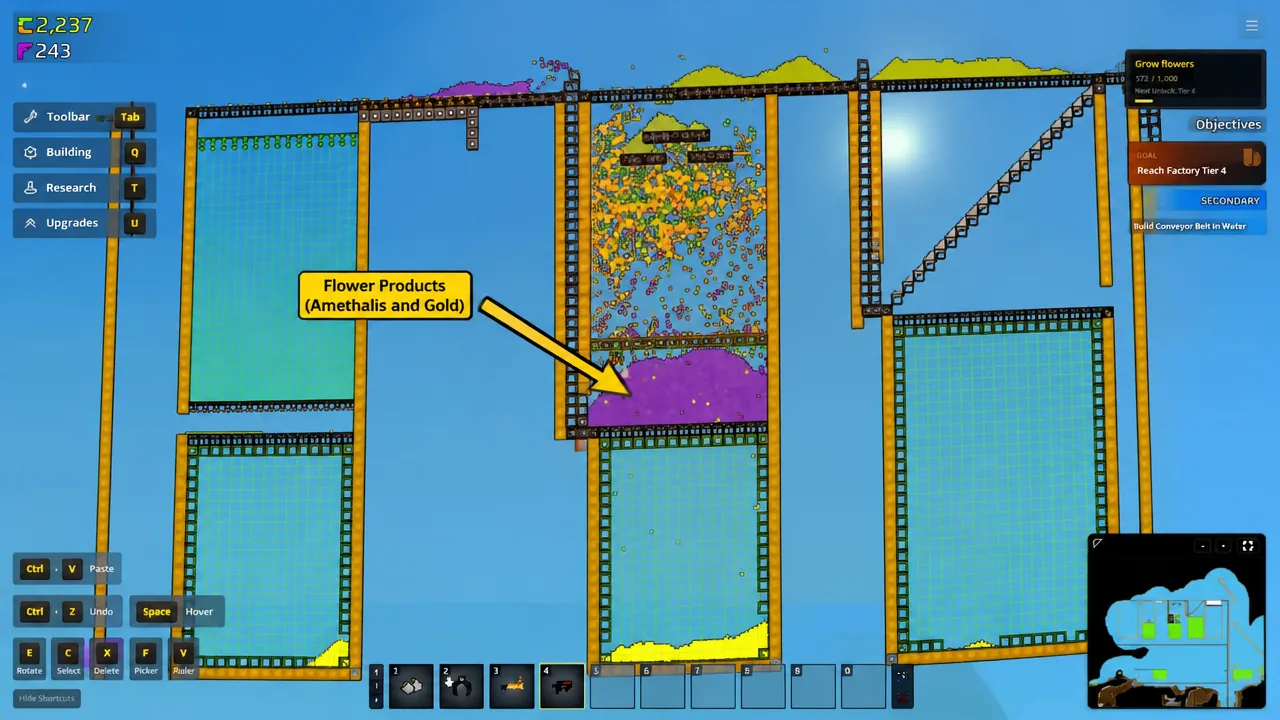
Flowers are one of the first plants you can farm in Sandustry, and they hand you two useful things at once. Each one is built from a Moss stem topped by a flower head, and that head carries 4 Amethelis and 1 Gold. The catch is that Flowers grow by spreading, so an unmanaged patch can creep straight into the rest of your factory before you notice.
Quick answer: Mix a Spore with Water to make a Wet Spore, drop it on a Planter Box to create a Seed, and let that Seed spread Moss until it forms a Flower. Destroy the finished flower head with a weapon or fire to drop 4 Amethelis and 1 Gold. To stop spread, stop adding Seeds, let everything already growing bloom fully, then burn the finished flowers.
What a Flower is and what it drops
A Flower has exactly two parts. The stem is Moss, and the head holds 4 Amethelis and 1 Gold. Flowers are burnable but they cannot be wetted or launched, so fire and weapons are your only harvest tools. Hovering over the head before you destroy it just shows a “?” tooltip, so you will not get a preview of the exact contents in the interface.
Amethelis is the part that keeps working after the harvest. Mix it with Redsand at a 1:1 ratio and you get 2 Voidbloom, which feeds into higher-tier processing. Because a single flower yields four petals at a time, it is easy to end up with a large Amethelis stockpile long before your Redsand mining can keep up.
How to grow a Flower
Growing runs through a short chain, and you unlock the Planter Box itself under the Refining 3 research tier, which costs 2,000 research.

One detail saves setup space. You do not have to keep the Planter Box in place after the Seed forms. Once the Seed exists, it keeps growing even if you remove the box, so the Planter is only needed for the conversion step.
How to harvest without stalling the plant
Harvesting sounds simple. You hit the flower head with a weapon or burn it with fire, and the Amethelis and Gold drop. The mistake that trips people up is timing.
If you burn only the stem while the plant is still growing, you interrupt the vine before it can finish the flower. An unfinished flower never actually uses up its Seed, so the plant simply tries to grow back. For a clean harvest, wait until the plant fully blooms into a flower head, then destroy that head. Destroying the finished head is the only thing that ends the growth cycle.
You will know it worked when the head breaks apart and drops 4 Amethelis and 1 Gold, and the tile does not regrow Moss afterward. If Moss keeps returning to the same spot, the plant was never fully bloomed when you burned it.
How to stop Flowers from spreading
Runaway spread is the problem most players hit, especially early on. The reliable fixes come down to containing the grow area and cutting off new input.
| Method | What it does |
|---|---|
| Box it in with solid blocks | Surrounds the grow area so Seeds cannot spread into the rest of your factory. |
| Use lights as a barrier | Seeds behave inconsistently around filters, but lights reliably block them from spreading. Use lights, not filters. |
| Stop feeding Seeds early | A single “growing seed” tile can secretly hold thousands of Spores piled up before you noticed. Adding more Wet Spores only grows that pile. |
| Let it finish, then burn it | Since torching the stem stalls the cycle, stop adding Seeds, let everything bloom fully, then destroy the finished flowers. Repeat until nothing regrows. |
Note: The reason “stop feeding” matters so much is that the visible tile hides the real backlog. You cannot burn your way out of an overfed patch while more Wet Spores keep arriving, so the input line has to be closed before the cleanup will actually finish.
Building an automated Flower farm
The dependable automated designs all share one principle. Keep the space where Seeds grow separate from the belt that feeds them in, so a new batch never sneaks in while the current one is still blooming.

Keep in mind that embers are a hazard as well as a tool. They can ignite Moss and Flowers, which means a stray burn lane or Lava overflow path near your greenhouse can wipe out a row you spent research gold to build. Separate the burn area from the grow platforms, and keep the Amethelis on its own route so it does not get buried in a mixed pile you have to dig back out later.