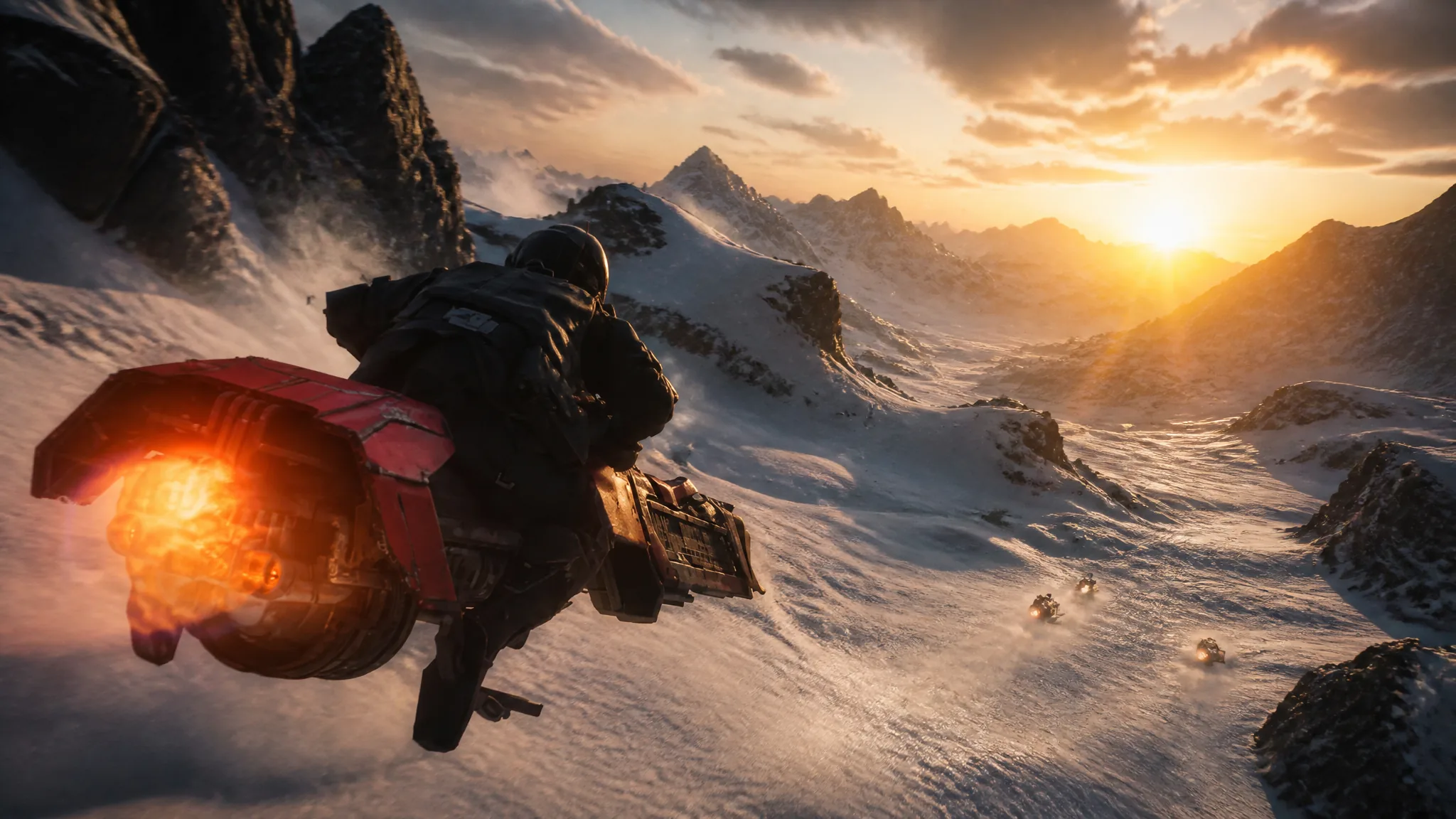
Star Wars: Galactic Racer is a high-speed arcade racer set in the New Republic era, just after the fall of the Empire in Return of the Jedi. There’s no Force and no Jedi prophecy here. You play as Shade, a masked loner chasing a grudge through the Galactic League, an unsanctioned circuit running wild across the lawless Outer Rim. It comes from Fuse Games, a Guildford studio stacked with Criterion veterans behind Burnout and Need for Speed, and it carries that destructive, slam-into-the-wall DNA straight into the Star Wars universe.
Quick answer: Star Wars: Galactic Racer launches October 6, 2026 on PlayStation 5, Xbox Series X/S, and PC. The standard edition is $59.99 and the Deluxe Edition is $79.99, with a $160 physical collector’s edition also confirmed.
Release date, platforms, and editions
The game was revealed in December 2025 at The Game Awards and locked to a single launch date across every platform. It runs on Unreal Engine 5, with Fuse Games developing and Secret Mode publishing under license from Lucasfilm Games.
| Detail | Confirmed |
|---|---|
| Release date | October 6, 2026 |
| Platforms | PlayStation 5, Xbox Series X/S, Windows PC |
| Genre | Racing with adventure elements |
| Modes | Single-player, online multiplayer |
| Developer / Publisher | Fuse Games / Secret Mode |
Three buying tiers are available. The standard edition covers the base game, while the Deluxe Edition adds three Kor Sarun vehicles (the Ciza T speeder bike, Darc X landspeeder, and Rak S skim speeder), a livery inspired by the Naboo N-1 starfighter, three exclusive Arcade events, a deluxe player banner, and a digital art book. Pre-ordering any digital edition includes a bonus repulsorcraft livery and a multiplayer player banner.
| Edition | Price | Highlights |
|---|---|---|
| Standard | $59.99 | Base game plus pre-order livery and banner |
| Deluxe | $79.99 | Three Kor Sarun vehicles, N-1 livery, three Arcade events, deluxe banner, digital art book |
| Physical collector’s | $160 | Physical extras (boxed collector’s edition) |
The Galactic League setting and story
With the Empire broken, speed becomes the galaxy’s new obsession. Out of the chaos comes the Galactic League, an underground circuit where syndicates bankroll pilots and fortunes change hands in seconds. The framing draws a direct line to the postwar Hot Rod scene, where former soldiers and mechanics from both Rebel and Imperial ranks repurpose their skills to build and race speeders.
You step into the helmet of Shade, who enters the League’s tournaments to dethrone its dominant champion, the aristocratic Kestar Bool. The campaign leans hard into cinematic storytelling, with voice-acted vignettes and paddock conversations that play out between races. Familiar faces return too. Sebulba reappears with a significant role, joined in the Arcade lineup by classic podracers such as Gasgano, Ebe E. Endocott, and Ben Quadinaros.
How the runs-based campaign works
The single-player campaign is built as a runs-based, roguelike-style structure across three acts. Each Galactic Tour is randomized and laid out as a branching map of nodes. You choose a path through Races, Eliminators, Field Tests, and Mystery Encounters, with each route handing out different rewards you can spend on your speeder.
To start a Tour you need a League Entry Token. The token is the catch. Crash out too many times or fail to finish in the top three of an event, and the token is revoked, ending your run and sending you back to race qualifiers to earn another one. Galactic Credits and some cosmetic progress carry over, so a wipeout is a setback rather than a full reset, and it does not undo your overall progress toward Kestar Bool.
Between races you spend earnings on upgrades, with higher finishes unlocking more improvements. Upgrade categories include Afterburner, Battery, Cornering, and Ramjet, plus each chassis’s unique trait. You can also leave your ship and walk the paddock in third person to talk to rival racers, take on side challenges, and buy unique parts from vendors using Galactic Credits.
Vehicle classes and boost systems
Four vehicle types are confirmed, three of which anchor the campaign. The skim speeder is brand new to the Star Wars universe, introduced with this game. Each chassis handles differently and carries its own signature trait.
| Class | Handling profile | Trait |
|---|---|---|
| Landspeeder | Heavy and stable, strong drifting and endurance | Drift |
| Speeder bike | Top straight-line speed, harder to corner | Kinetic Burst |
| Skim speeder | Built for hard banking turns, hardest to control | Knife Edge |
| Podracer | Extreme speed and fragility (mainly Arcade) | — |
Two boost systems sit on top of the handling. The Afterburner gives a mild speed bump and recharges on its own during a race. The Ramjet is the risk play, delivering a much stronger boost that’s useful for ramming rivals off the track, but it overheats your engine if you hold it too long. Push it past the limit and the results are catastrophic. Other modifiers include an ion pulse that disables an opponent’s abilities on a hard hit.
Note: Because crashes count against your run, vehicle choice and boost discipline matter more than usual. A tight, high-speed course is a poor pick when you’re low on lives, even if its rewards look tempting.
Planets and tracks
Races span six distinct worlds, each with multiple tracks and its own environmental hazards that feed back into the racing. The tracks are wide and three-dimensional, with big drops and climbs that let you chart your own line rather than follow a single ideal racing path.
| Planet | Setting / hazard |
|---|---|
| Tatooine | The Mos Espa desert circuit, recreated from The Phantom Menace |
| Jakku | Battle-scarred sandy wastes |
| Lantaana | Tropical forests and lava caves that alter jet performance |
| Ando Prime | Frozen mines where intense cold can freeze vehicles |
| Sentinel One | Confirmed League location |
Environmental effects are part of the strategy. Cold can force you toward heat sources to keep moving, corrosive rivers call for shields, and well-timed lava-field runs and shortcuts shave precious seconds.
Game modes and multiplayer
Beyond the campaign, the game ships with several ways to race. Arcade mode delivers curated time trials and casual races, and it’s where podracing lives, including Sebulba on the Tatooine track. Scenarios offers bespoke, story-based challenges with special rules, while Versus handles online play.
| Mode | What it offers |
|---|---|
| Campaign | Runs-based story across three acts as Shade |
| Arcade | Time trials and curated races, including podracing |
| Scenarios | Story-based challenges with unique conditions |
| Multiplayer (Versus) | Online PvP, up to 12 racers (eight for podracing) |
Multiplayer supports up to 12 players per race, with a ranking system planned. Crossplay is listed among the game’s features, and the vehicle physics run at a fixed 60Hz tick rate for a stable networked experience.
PC system requirements (minimum)
| Component | Minimum |
|---|---|
| OS | Windows 10 |
| Processor | Intel Core i5-8400 / AMD Ryzen 5 2600 |
| Memory | 12 GB RAM |
| Graphics | Nvidia RTX 2060 / Intel Arc A580 / AMD Radeon RX 5600 XT 6GB |
| Storage | 50 GB available space (SSD required) |
On consoles, the base PS5 targets a locked 60fps with dynamic resolution roughly between 1440p and 1690p, and there is no 30fps quality mode. PS5 Pro uses Sony’s PSSR upscaling with denser effects, while the Xbox Series S swaps hardware Lumen for lightmass probes to hold 60fps. The PC version is set to support DLSS 4.5, Intel XeSS, and AMD FSR 4, plus handhelds like the Steam Deck and ROG Xbox Ally, possibly at 30fps.
This is the fourth Star Wars racing game, following Star Wars Episode I: Racer (1999), Star Wars: Super Bombad Racing (2001), and Star Wars Racer Revenge (2002), and the first to give the genre a full story-driven campaign with this much depth. With Criterion’s crash-and-takedown spectacle layered onto a roguelike-style League and a setting that finally drops the Force in favor of pure speed, Galactic Racer arrives October 6, 2026.