

Ores sit at the center of Roblox’s The Forge. They decide how fast you earn gold, how strong your crafted gear becomes, and which special traits your weapons and armor pick up. Once you understand where each ore comes from and how its stats work, the grind stops being random and starts feeling calculated.
How ore stats work in The Forge
Each ore is defined by a small set of stats that affect both crafting and selling:
| Stat | What it affects |
|---|---|
| Rarity | How uncommon an ore is in a given rock node and region. |
| Drop Chance | The probability of getting that ore when you mine the right type of rock. |
| Rock / Node | Which rock types can drop the ore (Pebble, Rock, Boulder, Basalt Rock/Core/Vein, Volcanic Rock, Crystal nodes). |
| Multiplier | How much the ore boosts the base stats of a forged item. |
| Price | How much gold you get for selling the ore to Greedy Cey. |
| Trait | Any special passive effect granted to items crafted with that ore. |
When you forge, the game averages the multipliers of all ores you put into the recipe. More ores mainly change item size (for example, dagger to greatsword, helmet to chest piece); the power scaling comes from the average multiplier and any traits attached to individual ores.
Rock tier and pickaxe quality decide what you can actually mine. Early on, Pebbles and Rocks in World 1 are enough to find basic ores. Deeper into World 2, Basalt Cores, Basalt Veins, Volcanic Rocks, and Crystal nodes in the Goblin Cave demand higher-tier pickaxes before they even break.
World 1 ores (Stonewake’s Cross)
Stonewake’s Cross is the first hub and the entry cave for mining. The rocks here are simple: Pebble, Rock, and Boulder. You only need to remember one gating rule: Boulders require a Gold Pickaxe or better. Everything else can be cracked with lower-tier tools.
| Ore | Rarity | Drop Chance | Drops From | Multiplier | Price | Trait |
|---|---|---|---|---|---|---|
| Stone | Common | 1/1 | Pebble | 0.2x | 3 | None |
| Sand Stone | Common | 1/2 | Pebble, Rock | 0.25x | 3.75 | None |
| Copper | Common | 1/3 | Pebble, Rock, Boulder | 0.3x | 4.5 | None |
| Iron | Common | 1/5 | Pebble, Rock, Boulder | 0.35x | 5.25 | None |
| Cardboardite | Common | 1/31 | Rock, Boulder | 0.7x | 10.5 | None |
| Tin | Uncommon | 1/7 | Rock, Boulder | 0.425x | 6.38 | None |
| Silver | Uncommon | 1/12 | Rock, Boulder | 0.5x | 7.5 | None |
| Gold | Uncommon | 1/16 | Boulder | 0.65x | 19.5 | None |
| Bananite | Uncommon | 1/30 | Rock, Boulder | 0.85x | 12.75 | None |
| Mushroomite | Rare | 1/22 | Rock, Boulder | 0.8x | 12 | None |
| Platinum | Rare | 1/28 | Boulder | 0.8x | 12 | None |
| Aite | Epic | 1/44 | Boulder | 1.0x | 16.5 | None |
| Poopite | Epic | 1/131 | Pebble, Rock, Boulder | 1.2x | 18 | Bad Smell (poison AoE and fear at low HP) |
In the opening hours, these ores mostly serve two jobs: they fund your early pickaxe upgrades through Greedy Cey, and they let you experiment with forging without risking high-value materials. Poopite stands out early because its Bad Smell trait turns low health into a defensive panic button, applying poison damage around you and fearing nearby enemies on a cooldown.
World 2 ores (Forgotten Kingdom and Volcano Region)
Forgotten Kingdom changes the mining game. Regular caves swap out Pebbles and Boulders for Basalt Rock, Basalt Cores, and Basalt Veins, and a dedicated Volcano Region introduces Volcanic Rock nodes with the highest-stakes drops in the game.
Each rock type has a minimum pickaxe requirement:
| Rock node | Minimum pickaxe |
|---|---|
| Basalt Rock | Platinum Pickaxe |
| Basalt Core | Cobalt Pickaxe |
| Basalt Vein | Mythril Pickaxe |
| Volcanic Rock | Magma, Demonite, Arcane, or Lightite Pickaxe |
That tool progression is non‑negotiable: you cannot brute-force higher-tier nodes with a weaker pickaxe. The reward is a deep list of high-multiplier ores and powerful traits.
| Ore | Rarity | Drop Chance | Drops From | Multiplier | Price | Trait |
|---|---|---|---|---|---|---|
| Cobalt | Uncommon | 1/37 | Basalt Rock, Basalt Cove | 1.0x | 15 | None |
| Titanium | Uncommon | 1/50 | Basalt Rock, Basalt Core | 1.15x | 17.25 | None |
| Lapis Lazuli | Uncommon | 1/73 | Basalt Core, Basalt Rock | 1.3x | 22.5 | None |
| Volcanic Rock | Rare | 1/55 | Volcanic Rock | 1.55x | 23.25 | None |
| Quartz | Rare | 1/90 | Basalt Core, Basalt Vein | 1.5x | 22.5 | None |
| Amethyst | Rare | 1/115 | Basalt Core, Basalt Vein | 1.65x | 24.75 | None |
| Topaz | Rare | 1/143 | Basalt Core, Basalt Vein, Volcanic Rock | 1.75x | 26.25 | None |
| Diamond | Rare | 1/192 | Basalt Core, Basalt Vein | 2.0x | 30 | None |
| Sapphire | Rare | 1/247 | Basalt Core, Basalt Vein | 2.25x | 33.75 | None |
| Cuprite | Epic | 1/303 | Basalt Core, Basalt Vein, Volcanic Rock | 2.43x | 36.45 | None |
| Obsidian | Epic | 1/333 | Volcanic Rock | 2.35x | 35.25 | +30% defense on Armor |
| Emerald | Epic | 1/363 | Basalt Core, Basalt Vein | 2.55x | 38.25 | None |
| Ruby | Epic | 1/487 | Basalt Vein | 2.95x | 44.25 | None |
| Rivalite | Epic | 1/569 | Basalt Vein, Volcanic Rock | 3.33x | 49.95 | +20% critical strike chance on Weapons |
| Uranium | Legendary | 1/777 | Basalt Vein | 3.0x | 66 | 5% max HP as AoE damage on Armor while in combat |
| Mythril | Legendary | 1/813 | Basalt Vein | 3.5x | 52.5 | +15% defense on Armor |
| Eye Ore | Legendary | 1/1333 | Basalt Rock, Basalt Core, Basalt Vein, Volcanic Rock | 4.0x | 37.5 | -10% health, +15% damage on Weapons and Armor |
| Fireite | Legendary | 1/2187 | Volcanic Rock | 4.5x | 67.5 | 20% burn for 2s with 30% on-hit chance on Weapons |
| Magmaite | Legendary | 1/3003 | Volcanic Rock | 5.0x | 75 | +50% AoE explosion damage, 35% on-hit chance on Weapons |
| Lightite | Legendary | 1/3333 | Basalt Vein | 4.6x | 69 | Trait currently undisclosed |
| Demonite | Mythical | 1/3666 | Volcanic Rock | 5.5x | 82.5 | 20% burn for 2s with 15% on-hit chance, Demon’s Backfire on Armor |
| Darkryte | Mythical | 1/5555 | Volcanic Rock | 6.3x | 94.5 | Armor only: 15% chance to become a shadow and dodge an attack |
Several ores here define the late-game meta:
- Obsidian and Mythril are defensive staples on armor, stacking flat multipliers with big percentage defense buffs.
- Rivalite is the go-to crit ore for weapons, and its 3.33x multiplier keeps raw damage high.
- Uranium and Fireite both lean into damage-over-time: one as an Armor aura, the other as a high-chance burn on weapons.
- Magmaite and Demonite push hard into AoE explosions and burn, which pairs well with crowd-heavy zones.
- Eye Ore and Darkryte are classic risk–reward picks, trading health or relying on RNG to deliver huge damage or lifesaving dodges.

Goblin Cave ores (World 2 crystals)
The Goblin Cave sits off the main Forgotten Kingdom path as a gated side area. The entrance stands to the right of the Goblin King; getting in means completing a five-part gold-sink quest chain, paying him a total of 85,000 gold to receive the cave key.
Inside, standard rocks are replaced by colored crystal nodes: Crimson Crystal, Cyan Crystal, Earth Crystal, and Light Crystal. Every ore here drops from all four node types, but the odds are tightly controlled.
| Ore | Rarity | Drop Chance | Drops From | Multiplier | Price | Trait |
|---|---|---|---|---|---|---|
| Magenta Crystal Ore | Epic | 1/255 | Crimson, Cyan, Earth, Light Crystal nodes | 2.5x | 37.55 | Unknown |
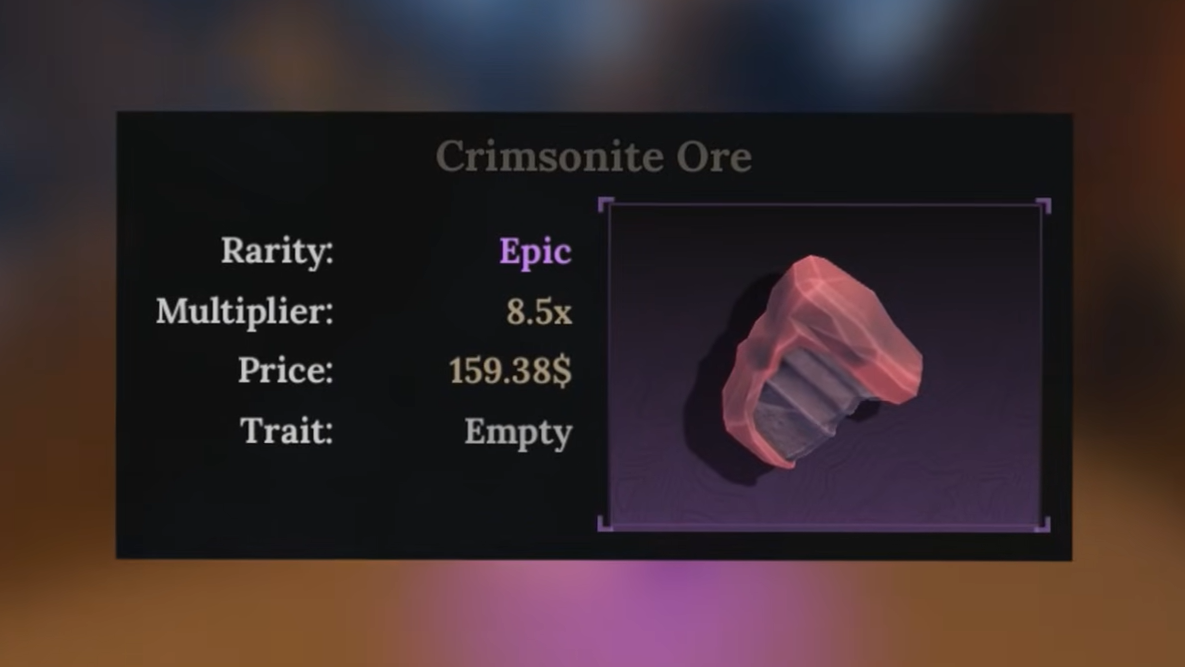
| Crimson Crystal Ore | Epic | 1/255 | Crimson, Cyan, Earth, Light Crystal nodes | 2.5x | 37.55 | Unknown |
| Green Crystal Ore | Epic | 1/255 | Crimson, Cyan, Earth, Light Crystal nodes | 2.5x | 37.55 | Unknown |
| Orange Crystal Ore | Epic | 1/255 | Crimson, Cyan, Earth, Light Crystal nodes | 2.5x | 37.55 | Unknown |
| Blue Crystal Ore | Epic | 1/255 | Crimson, Cyan, Earth, Light Crystal nodes | 2.5x | 37.55 | Unknown |
| Rainbow Crystal Ore | Legendary | 1/5000 | Crimson, Cyan, Earth, Light Crystal nodes | 5.25x | 78.75 | Unknown |
| Arcane Crystal Ore | Epic | 1/100000 | Crimson, Cyan, Earth, Light Crystal nodes | 7.5x | 112.5 | Unknown |
Even without confirmed traits, the sheer multipliers on Rainbow Crystal Ore and Arcane Crystal Ore make them some of the most coveted materials. Any item forged around a 7.5x average multiplier instantly jumps into endgame territory, which is why players tolerate the 1/100,000 odds on Arcane Crystal Ore.
Where to sell and how to build around ores
All mined ores can be offloaded at Greedy Cey’s shop in Stonewake’s Cross. Low-multiplier commons like Stone and Sand Stone are usually better as pure income to fund pickaxes, potions, and early forging experiments. Higher-multiplier rares and epics are typically worth saving for actual crafting unless you need a short-term gold spike for a big unlock, such as the Goblin Cave key.
When you start putting serious ores into your items, treat each trait as a build-defining choice:
- Stack defensive traits (Obsidian, Mythril) on armor meant for harder regions or late‑game bosses.
- Use damage traits (Rivalite, Fireite, Magmaite, Uranium, Eye Ore) on weapons when you can reliably stay alive with less defense.
- Reserve high-risk traits (Eye Ore health penalty, Demon’s Backfire, Darkryte’s shadow dodge) for characters with enough experience and comfort in the combat system to play around their downsides.
- Drop in utility traits like Poopite’s Bad Smell when you want more control tools in chaotic fights rather than pure numbers on a stat sheet.
Over time, upgrades from the Enhancing area, rune slots from the Runemaker, and passive bonuses from achievements all stack on top of whatever your ore multipliers and traits provide. Ores are only one part of the build, but they set the ceiling for how far the rest of those systems can push your gear.