The lockpicking in Gothic 1 Remake replaces the old left-right sequence with a sliding puzzle. Each lock is built from several plates, every plate holds a pin, and the lock opens only when every pin sits in the dead-center hole. The trick is that some plates are linked, so moving one shifts another, which is exactly where a solver helps.
Quick answer: Get every plate’s pin into the center hole (position 4 on a 1-7 row). A solver does the math for you once you enter three things: the number of plates, the current pin position of each plate, and which other plates move when you push a plate left. It then returns the exact order of moves to center all pins.
How the lockpicking minigame works
When you interact with a locked chest or door, the lock opens as a grid of horizontal plates. Each plate has seven holes and a single pin. You select a plate by pressing up or down (the active plate highlights), then move it left or right to slide the pin between holes. The pin pops up, turning red, only when it reaches the center hole.
The difficulty comes from links between plates. Pushing one plate can drag another plate in the same direction or the opposite direction. The wiring is different for each lock, so a plate that moves freely on one chest may be tied to two others on the next.
There is also a hard fail condition. If a pin is already at the far edge and you push it further, the lockpick strains. Strain it twice while untrained and the lockpick breaks, and the lock resets to its starting layout. The menu does not pause the game either, so an alerted guard can reach you mid-puzzle.
| Element | Detail |
|---|---|
| Plates per lock | 4 to 7, more plates on higher-tier chests |
| Holes per plate | 7, numbered 1 to 7 |
| Target hole | Center, position 4 |
| Success signal | Every pin is up and red |
| Fail signal | Lockpick strains at an edge; breaking resets the lock |
How to use a lockpicking solver
A solver treats the lock as a logic puzzle and works out a move order that never pushes a linked pin off the edge. Fan-made web tools such as Gothic Remake Lockbreaker run entirely in your browser, support 4 to 7 plate locks, and output a copyable sequence. The process is the same across these tools.
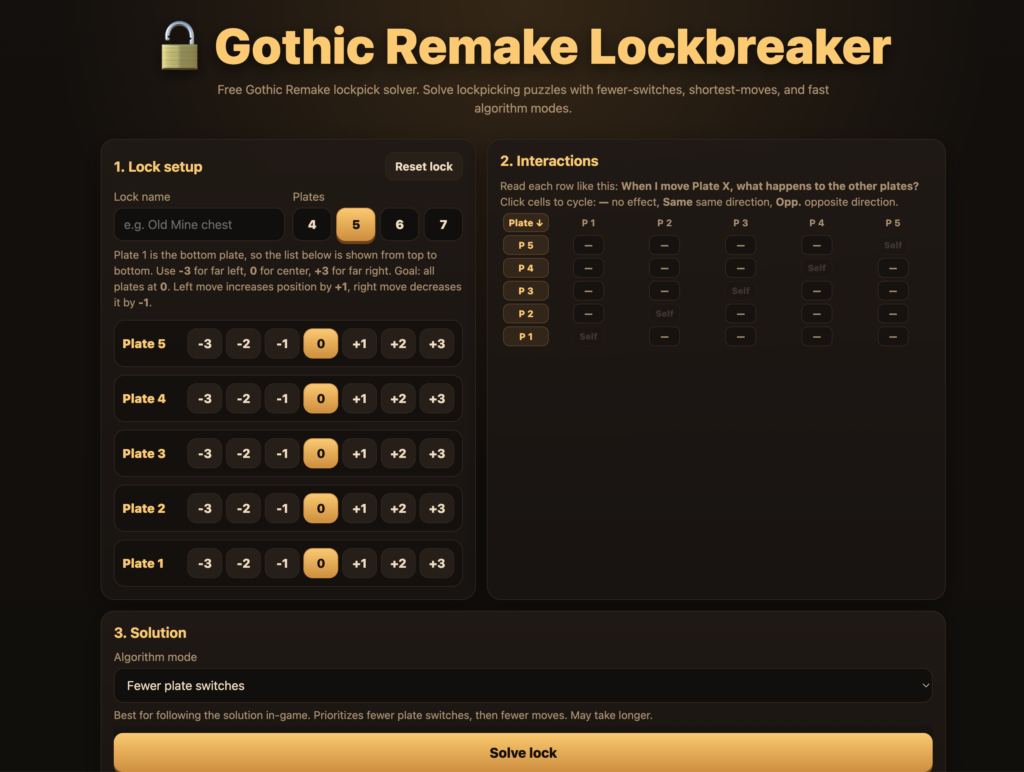
Tip: A notation of 1 means the linked plate moves one pin in the same direction, and -1 means it moves one pin in the opposite direction. Some solvers also ask which hole the lock opens on, which is the center hole in nearly every case.
Solving a lock by hand
If you would rather not use a tool, the puzzle is still beatable with a methodical order. The aim is to avoid the edge-strike that breaks your pick.
Save your game before you start. Lockpicks are limited and cost ore early on, so loading a save after a break costs nothing. You can also reset the lock at any time during the minigame without a penalty.
Lockpicking skill levels and trainers
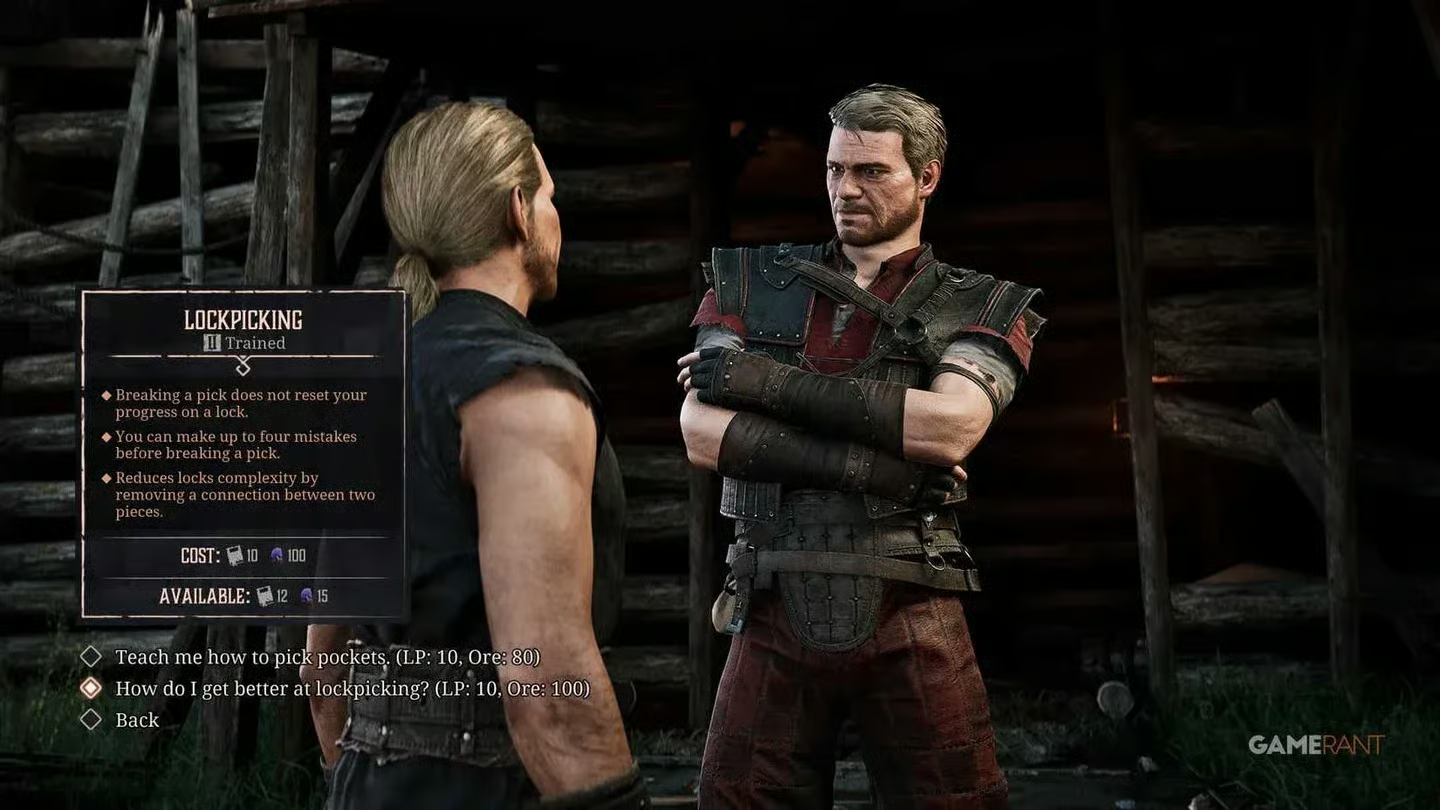
Training the lockpicking skill makes the minigame far more forgiving. You can learn it from Fingers in the Old Camp, found near the arena beside Scatty’s hut, or from Wedge in the New Camp, each for a small fee in Learning Points and ore.
| Level | Effect | Cost |
|---|---|---|
| Untrained | Pick breaks after 2 failed attempts; lock resets to its starting state | Starting level |
| Trained | Pick breaks after 4 attempts; current lock state is kept | 10 LP, 100 ore |
| Master | 6 attempts per pick; one plate connection is removed, simplifying the puzzle | 20 LP, 200 ore |
You can attempt any lock from the start of the game without training, but a hard chest is much easier to revisit once you reach Trained or Master. The removed connection at Master level cuts one of the links that makes the puzzle hard to solve in your head.
Where to get lockpicks
You need a lockpick in your inventory before a lock will open. Dexter in the Old Camp marketplace is the first merchant who sells them, at 15 ore nuggets each, which is steep in the early game. Other traders across the colony stock them too.
- Buy from merchants such as Dexter once you have a steady ore income.
- Loot world chests, including one near the locked mine across the bridge in the opening area and an abandoned campsite on the higher ground near the bridge.
- Search enemy corpses, which sometimes carry picks.
How to confirm the lock is solved
The lock opens the moment all pins are up and red in the center hole. If a move is blocked, a pin has hit the edge and the next push will strain the pick, so back that plate away from the edge before continuing. A solver only fails to help if the plate count, pin positions, or link directions were entered incorrectly, so re-check those entries against the in-game lock and run it again.