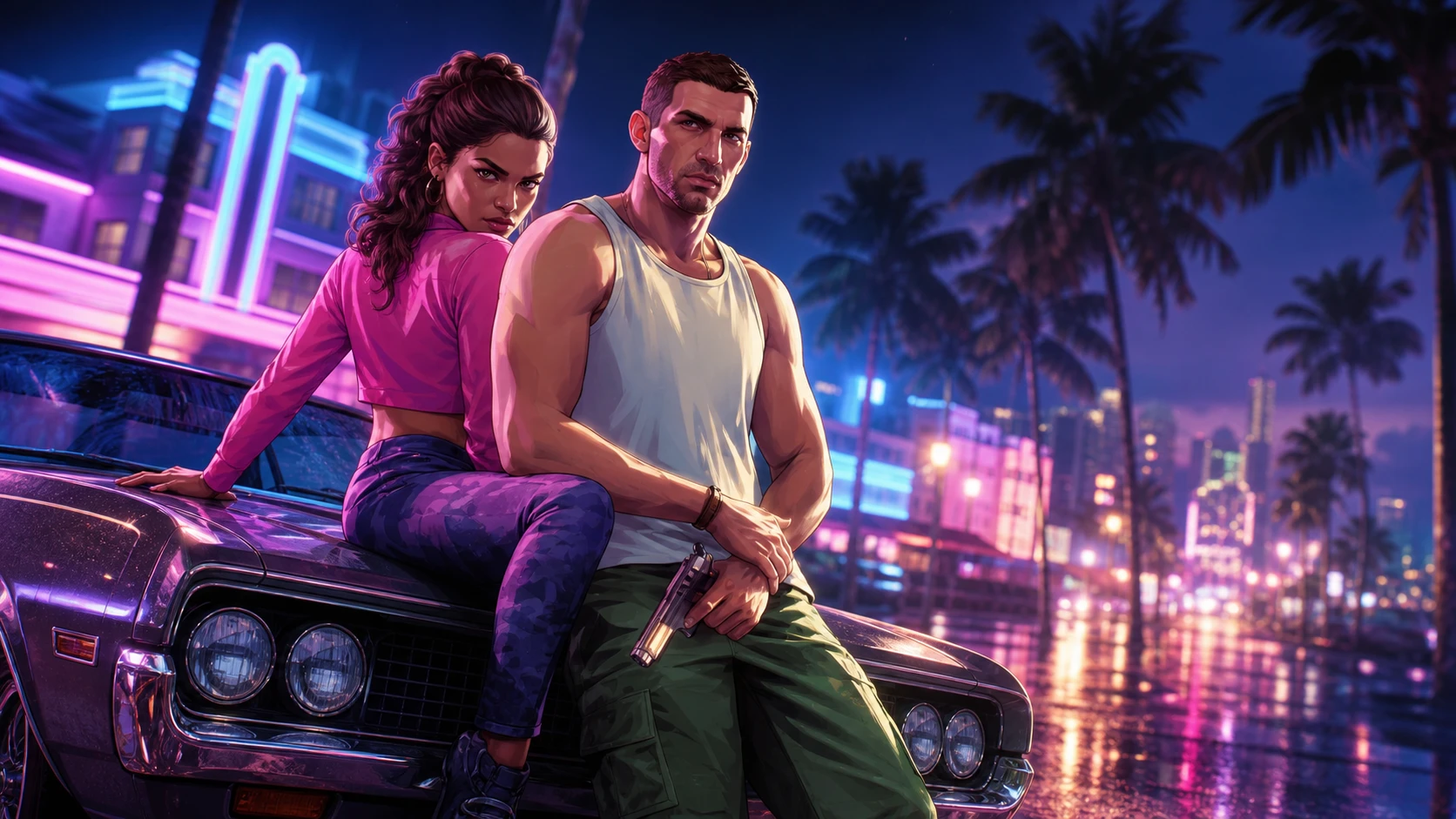
A developer who runs an AI startup is trying to build his own version of Grand Theft Auto 6 and release it before Rockstar does. The project, nicknamed GT-Caliber, is the work of Ziwen Xu, who has been posting daily progress updates since June 10, 2026. His stated aim is blunt and almost comedic in scale, which is to finish a playable open-world game in a few months using mostly AI agents, while Rockstar has spent roughly a decade on the real thing.
Quick answer: GT-Caliber is a one-person, AI-driven GTA 6 clone built by Ziwen Xu under his startup Hypercho. It began on the Godot engine, moved to Unreal Engine 5, and is coded through a loop of AI agents running on Anthropic’s Claude. The goal is to launch before GTA 6 arrives on November 19, 2026.
What GT-Caliber is and who is building it
The project comes from Ziwen Xu, who posts as @ziwenxu_ on X and runs an AI agent company called Hypercho. He frames the build as a challenge to see whether AI can produce something close to a GTA-level open-world game. There is no studio and no publisher behind it. Instead, he put out an open call for anyone who can model, code, build levels, or write music and lore to join in.
“Day 1 of building GTA 6. Still feels fake typing that out,” he wrote in his first update. He described the plan as “Ambitious, probably stupid, doing it anyway.” The inspiration traces back to a suggestion from AI entrepreneur Matt Shumer, who floated the idea of vibe coders teaming up to create an open-world game with the quality and scope of GTA 6’s trailers.
The tools and engine behind the build
The work started on Godot, a free and open game engine that carries no royalties, and relied on “vibe coding” through a loop of AI agents. The team later switched to Unreal Engine 5 to move faster. The coding itself runs on Anthropic’s Claude, with Xu saying he upgraded to the Claude Max 20x plan specifically for the project.
| Element | Detail |
|---|---|
| Developer | Ziwen Xu (Hypercho startup) |
| Start date | June 10, 2026 |
| Starting engine | Godot (free, no royalties) |
| Current engine | Unreal Engine 5 |
| AI model | Anthropic’s Claude (Claude Max 20x plan) |
| Code repository | Public on GitHub |
| Stated goal | Launch before GTA 6 (November 19, 2026) |
The source code is public, and Xu has been pushing his work to a repository where contributors can follow along and pitch in. If you want to see the project’s code directly, it lives on the GT-Caliber GitHub page.
Progress so far, from a bean on a plinth to moving cars
The early footage was rough. Day 1 showed little more than a pill-shaped default character hopping around a plain, featureless landscape inside a working sandbox. By Day 4, the build had picked up a proper character model, models for every NPC, vehicles, traffic, traffic rules, and basic driving. Xu also reported a jump in performance and a growing stack of pull requests.
The AI agents have also produced some predictable mistakes. At one point the system generated downtown Los Angeles skyscrapers, which clashes with the intended Florida setting. The visuals in the latest clips lean on standard Unreal Engine 5 looks, with flat design that, by Xu’s own framing, sits closer to a Roblox project than to Rockstar’s work.

The real cost of vibe coding a GTA clone
Even an AI-first project is not free. Xu has been burning through his usage limits at a rapid pace. He said he used about 33 percent of his weekly 20x allowance in a single day early on, and later reported spending 75 percent of the weekly limit within 24 hours. Building a game from scratch with looping AI agents eats credits quickly, especially when the goal is code that actually runs.
How GT-Caliber compares to the real GTA 6
The gap between the two projects is enormous. Grand Theft Auto 6 is set to launch on PlayStation 5 on November 19, 2026, more than 13 years after the previous mainline entry, with a PC version expected in 2027. Estimates put its development budget near $3 billion. Take-Two has also confirmed that GTA 6 uses zero generative AI and is fully handcrafted, the opposite of GT-Caliber’s approach.
| GTA 6 | GT-Caliber clone | |
|---|---|---|
| Maker | Rockstar Games | Ziwen Xu / Hypercho |
| Development time | About a decade | Started June 10, 2026 |
| Budget | Around $3 billion | AI credit costs only |
| Generative AI | None (handcrafted) | Built mostly with AI agents |
| Release target | November 19, 2026 (PS5) | Before GTA 6 |
There is also a legal cloud over the whole effort. Anything that closely resembles GTA 6 risks attention from Take-Two, which has a history of acting against projects that get too close to its properties. It would not be surprising if the project disappears quickly should it ever start to look like the real game.
How the community is reacting
Reaction has been mixed and mostly light-hearted. Some onlookers treat it as a novelty or an AI demonstration rather than a serious attempt at a finished game, and at least one reply dismissed the whole thing as “engagement bait trash.” Whether Xu is fully sincere, half-joking, or making a point about GTA 6’s long development and repeated delays is hard to pin down, but he has kept committing to the bit with daily updates.
For now, GT-Caliber is a working shape of a game rather than a real rival to anything Rockstar has shown. The interesting part is not whether it can truly beat GTA 6 to launch, which is extremely unlikely, but how quickly a single person with AI tools can stand up a moving, drivable open world in a matter of days. That, more than the finish line, is what makes the experiment worth watching.