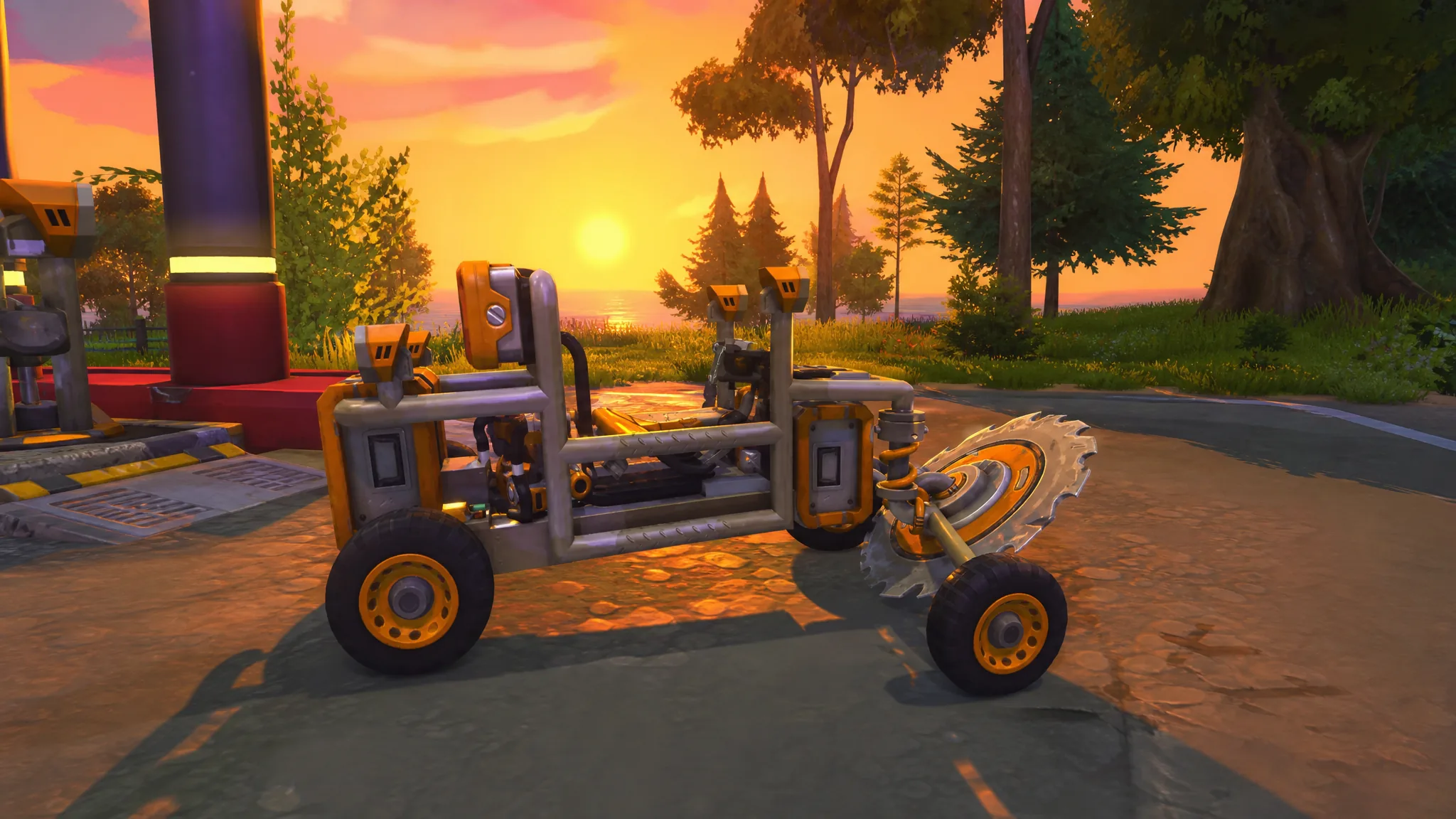
A vehicle in Scrap Mechanic is built, not found. The shortest route to a car that drives is a Driver Seat, a Gas Engine, four wheels on four Bearings, and a flat metal floor under everything. You wire the seat to the engine, the engine to the drive wheels, and the seat straight to the steering Bearings with the Connect Tool.
Quick answer: Place a floor plate, drop a Driver Seat on it, mount a Gas Engine low and central, then connect seat → engine, engine → rear wheels, and seat → front steering Bearings. If you get a max-connections message, put one Component Kit into the seat or engine instead of rebuilding.
Minimum working car parts and costs
There is no vehicle category in the Craftbot. You place blocks, attach interactive parts, and the physics engine decides whether the result rolls forward or lands on its roof. Weight and wheel contact are simulated, so a good car and a bad car can use identical parts.
| Part | Count | Notes |
|---|---|---|
| Driver Seat | 1 | Every connection routes back here. Upgrade with Component Kits for more connection points. |
| Gas Engine | 1 | Press E while looking at it to trade fuel economy for power. |
| Bearing | 4 | Two for the steering axle, two for the rear wheels. |
| Wheel | 4 | Large Wheels cost Beeswax and add a lot of weight. |
| Metal Block | ~40 | Floor plate only. Cheap Wood Blocks are fine for everything above it. |
Scrap Wood is the cheapest frame material early, and a single large tree yields a huge amount. Scrap Metal comes off broken bots and crates. Bearings run out first because steering, powered wheels, and every moving arm you build later all need them, so keep some Scrap Metal in reserve rather than dumping it all into blocks. Component Kits gate almost everything useful, including suspension, Drills, and seat or engine upgrades. Haybots and ruins are the main early supply.
Wiring the first car in Survival
The game teaches this directly. The Builder Guide sits half buried in dirt near the Crashed Maintenance Ship, and picking it up starts the Your First Car quest, which projects a hologram of each step onto a Lift. It hands you a working baseline before the Mechanic Station opens up better parts. Connections are one directional, and every one of them starts at the seat.
A cheap early suspension
Real suspension parts need Component Kits you probably do not have yet. A workaround that holds up is two suspension pieces joined by a pipe with loose Bearings on it, which gives a floating solid axle at the front. At the rear, a single Bearing carrying a straight pipe across both wheels does most of the same job for almost nothing, and it will not flip if you sit it against a chest so it cannot rotate past a point.
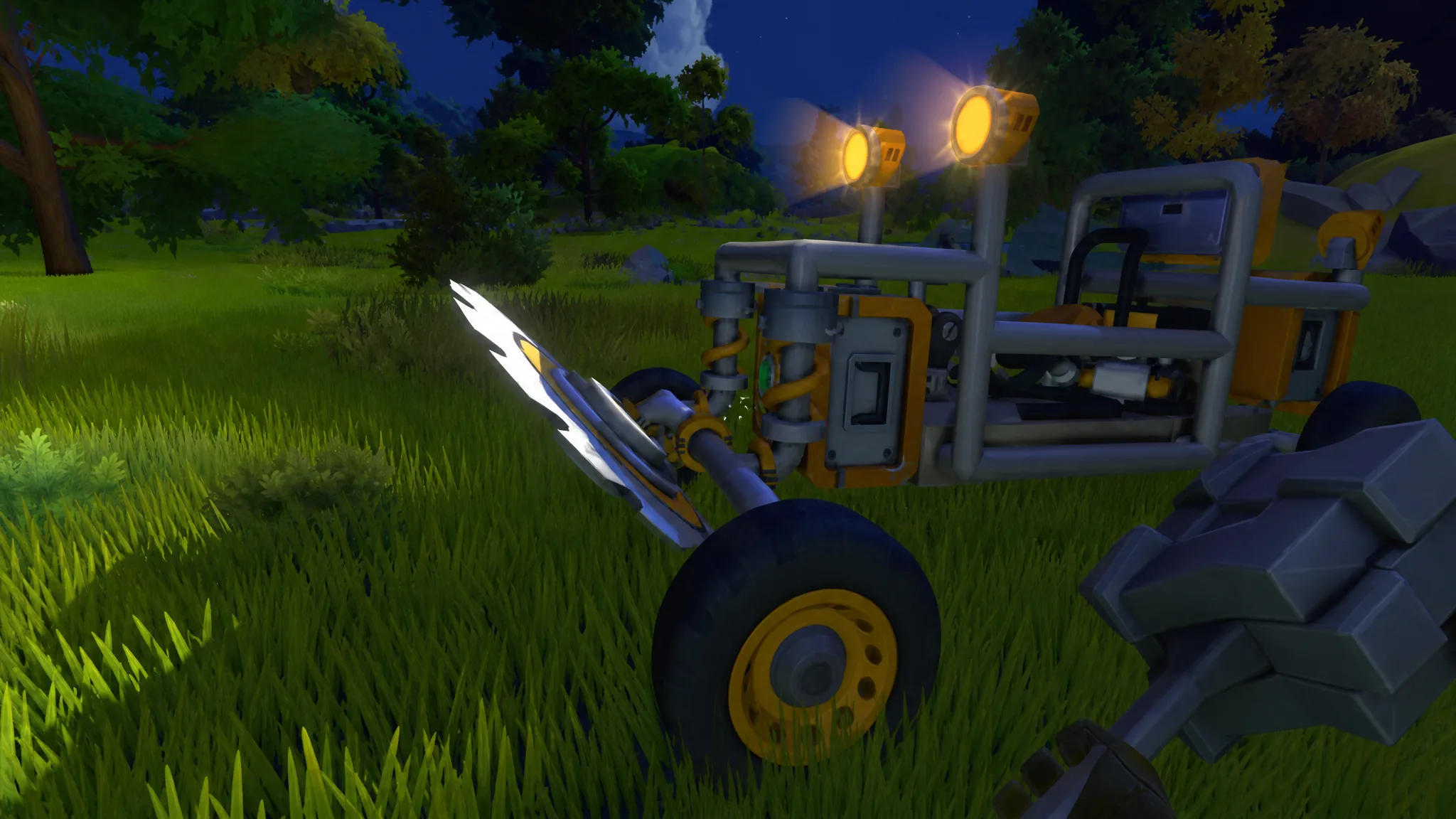
It is not elegant, but it follows the ground and costs nearly nothing. It will get you to the Mechanic Station in one piece.
What Drilling Thunder changed for vehicles
The 1.0 world rework rebuilt the ground your car drives on and added new threats aimed straight at it. Vehicle advice written before July 2026 is now partly wrong. These are the changes that actually affect a build.
| Change in 1.0 | What it means for your car |
|---|---|
| Reworked terrain, forest roads, desert biome | Ground clearance and wheel contact matter more. Roads are genuinely faster. |
| Tornadoes | Do not leave a heavy build sitting in open desert and walk away from it. |
| Fire burns blocks and parts, and spreads | Keep a Fire Extinguisher on anything you would be upset to lose. |
| Seekerbot patrols roads | Road travel becomes a real risk partway through the story. |
| Claygun shaping, and some bots dig | A clay wall around a parked car is not protection. |
| Sticky Wheels | Vehicles can dig and drive in directions that were not possible before. |
| Turret Seat | Rotates with your camera, changing both combat and mining builds. |
| Plasma Drill and Plasma Saw | Much faster on hard rock and trees than standard Drills and Saw Blades. |
| Baby Craftbot | Compact craft station meant to be bolted onto a creation. |
| Improved network responsiveness | Co-op driving is noticeably less rubbery. |
The Seekerbot deserves its own note because it catches people out. It is a large floating bot shaped like a praying mantis head. It patrols roads and sweeps a wide red beam ahead of itself. Any player or Woc caught in that beam gets locked on by heat seeking missiles, and an icon appears on your HUD when it has you. It starts spawning once you finish the first Growlab, which is the cleanest warning line in the update. Before that point, roads are the fast way to travel. After it, a big expensive vehicle parked next to a road is a target.
Drilling Thunder launched free with version 1.0 on July 24, 2026, ending Scrap Mechanic’s Early Access period. You can read the full breakdown on the Steam store page.
Build for the job, not for everything
One car cannot do all of this well. The heavy production parts are the reason. A Craftbot, a Refinebot, and a Resource Collector each weigh enough that bolting them to your explorer turns it into something slow and thirsty that handles badly the moment you need to actually go somewhere. Most players end up with one of four builds, each shaped by its job.
| Type | What it does | Design priority |
|---|---|---|
| Scout | Ruins, quests, Component Kit runs | Light, fast, cheap on fuel, two or three chests |
| Mining rig | Rock nodes and trees | Ground clearance, Drills, Refinebot and Resource Collector |
| Hauler | Produce crates, Caged Farmers | Wide flat bed, strong floor, low speed |
| Combat | Raids and road encounters | Armored front, Turret Seat, spare wheels |
Scout
Small, light, and disposable enough that losing it is annoying rather than devastating. Two chests, a Bed, a Beacon, and one headlight cover almost everything. This is the car you take into ruins hunting Component Kits.
Mining and refining rig
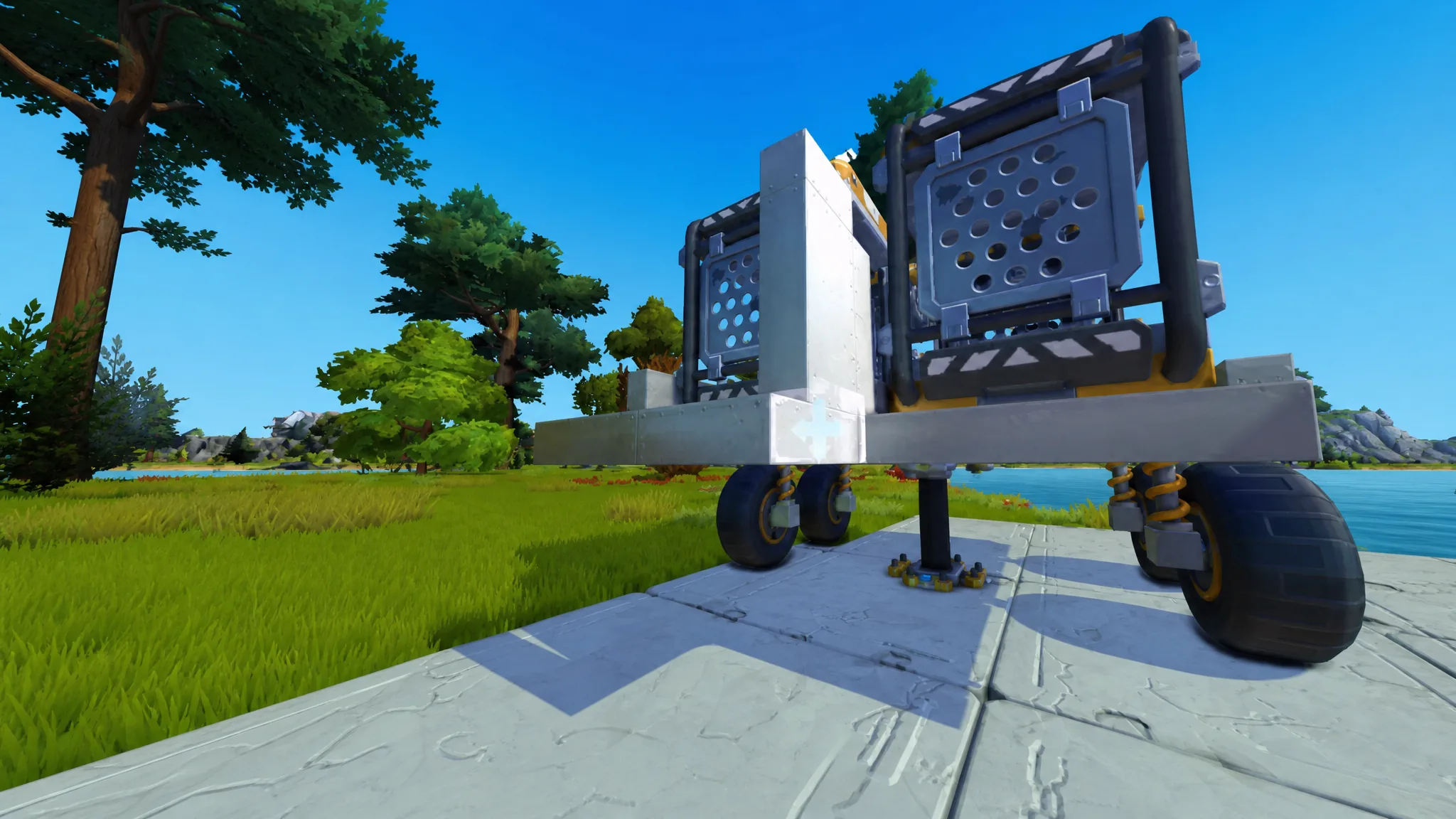
This one ends up as a box on wheels, and that is fine. Six wheels works well, with four at the back to carry the refinery weight and front wheel steering up ahead. Three Drills with two Saw Blades between them handles both rock and trees, since a tree wedges neatly between the blades.
The upgrade worth building is a Bearing joint through the middle of the chassis so the whole nose articulates. You approach a node and sweep the drill head left and right instead of repositioning the entire vehicle, and you never have to get out. The cost is understeer. Four rear wheels plus a pivot means the thing plows forward at speed and turns like a building.
Hauler
Wide, flat, and low. If you plan to carry Caged Farmers, build for a 7 block width, which means two beams with five empty blocks between them. Keep the floor solid metal, because farmers sometimes clip through a bed if you shove them in too hard.
Combat
Armor the front and mount the Turret Seat where it has a clear arc. Carry spare wheels and a Fire Extinguisher. The Red Explosive Totebot is the one to deal with first in any fight, and a burning creation loses parts fast.
Design rules that change how a car drives
Four things affect handling more than anything else you can do to a build.
Weight placement
Build the floor plate out of Metal Blocks and everything above it out of Wood. You get a low center of mass and a durable underside without dragging useless weight up top. Engines, fuel, and storage all belong as low as you can physically fit them.
Connection points
Every seat, engine, and Controller accepts a fixed number of connections at each level. The first upgrade on a Driver Seat costs a single Component Kit and buys headroom immediately. Once your engine can reach all four wheels you have all wheel drive, and the difference is not subtle.
Suspension and steering
Sport and off road suspension cost the same, and sport is enough for most builds. You cannot mount a Bearing directly on the end of a suspension piece in 1.0, so a steering axle needs a block, then a Bearing, then a block, then another Bearing. For anything heavy, a wide track and a long wheelbase beat a stiff setup. Rear wheel steering helps a long rig turn, at the cost of a few more connections you probably do not have spare.
Fuel
Weight is fuel. A refinery rig drinks gasoline at a rate that will strand you if you head out without a full Gas Container. Mount the container vertically where you can see it from the seat, so you can read the level while driving instead of climbing off to check.
How to stop losing your vehicle
Lost cars are the single most common complaint right now, and most of it is preventable.
- Put a Beacon on every vehicle the moment you can craft one. Everything else here is a distant second.
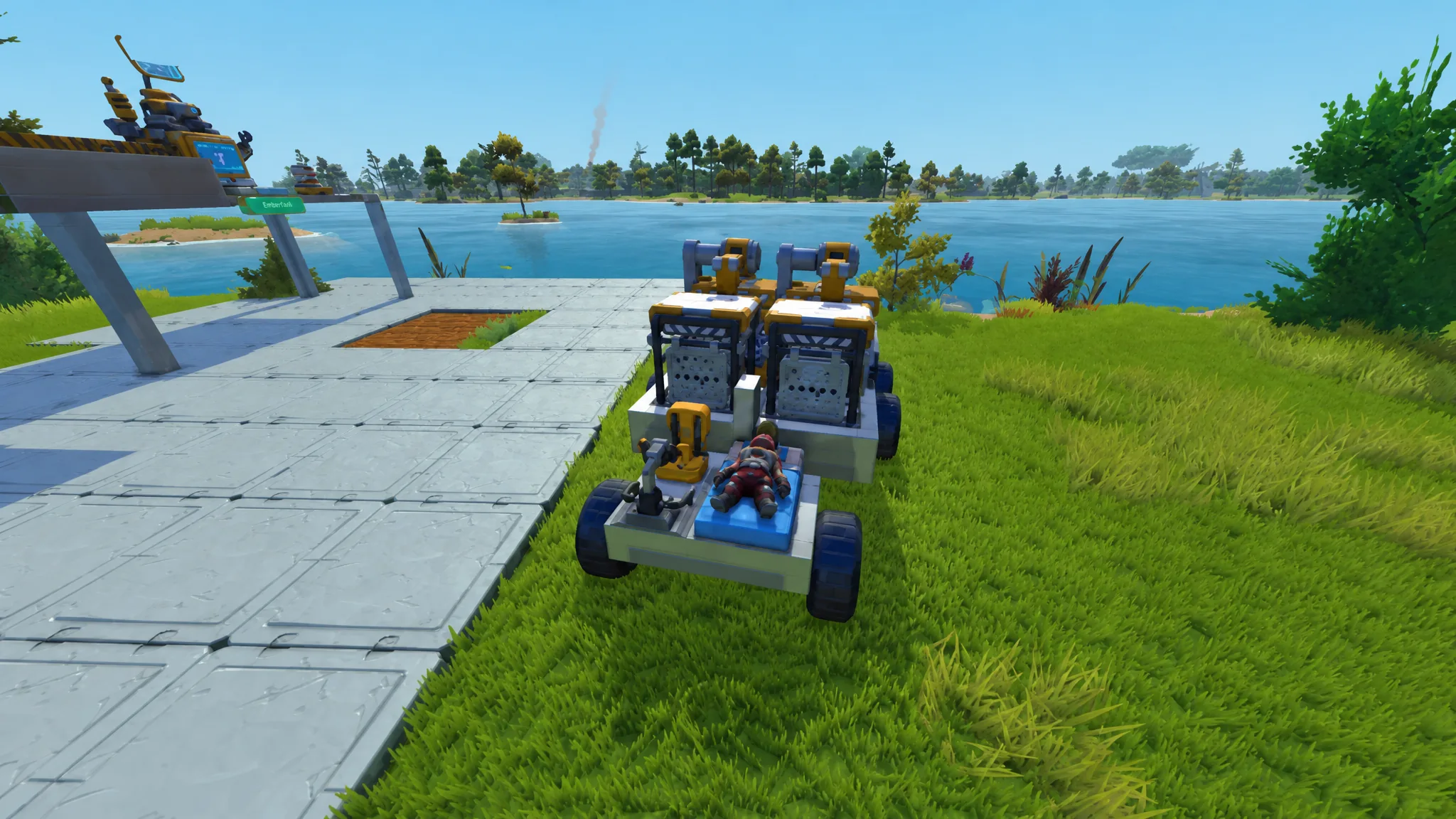
- Add a Bed so you respawn next to the car instead of a long walk away.
- Bots avoid spinning Saw Blades and Drills, so one left running on a Bearing is a decent deterrent while you loot a tower. Raising the vehicle up high is not, despite how often it gets suggested.
- Park off the road once Seekerbots are active, ideally a tile or more from the edge.
- Carry a Fire Extinguisher. Fire spreads through a creation and will take the seat, wheels, and suspension with it.
- If the game crashes and the car is gone, backtrack the way you came before you rebuild. It often ends up behind where you were standing.
Common vehicle problems and fixes
| Problem | Why it happens | Fix |
|---|---|---|
| Caged Farmer clips through the truck bed | Pressure from pistons or walls pushes it through the floor | Hold it loosely. Shorten piston length rather than switching pistons off |
| Vehicle burned down while you were away | Fire spreads through connected blocks | Keep a Fire Extinguisher on board, and do not park under an active threat |
| Vehicle destroyed with nobody near it | Seekerbot missiles do not need you present | Keep expensive builds away from road tiles |
| Refinebot fills up and stalls | It holds its output instead of pushing to a connected chest | Empty it manually before you move the chest |
| Car handles fine empty, awful loaded | Center of mass rises with cargo | Widen the chassis or drop the load lower |
| Quest reward car drives poorly | Those blueprints teach building, they are not work vehicles | Strip it for parts and build your own |
You know the build worked when the car accelerates from the seat, steers the way you point, and holds its wheels on the ground under load. If it flips, understeers, or ignores the throttle, the cause is almost always one of the six rows above rather than a broken part. Fix the connection or the weight, not the whole vehicle.