
Skeleton cyberware is the slot that keeps V standing. It has no flashy weapons or time-slowing tricks, but it decides your armor, health pool, carrying capacity, and how much incoming damage gets shaved off. On higher difficulties, these implants are the difference between surviving a Dogtown ambush and dying in the first few seconds.
Quick answer: You have two Skeleton slots by default and a third from the License to Chrome perk in Technical Ability. For most builds, start with Bionic Joints (cheap flat armor) plus Titanium Bones (carrying capacity), then swap in Epimorphic Skeleton, Para Bellum, or a build-specific piece once you have the capacity and eddies.
How Skeleton slots and tiers work
Every V starts with two Skeleton slots. A third unlocks through the License to Chrome perk in the Technical Ability tree, which is one of the stronger reasons to spend points there if you want a tanky character.
Implants sell at a tier matched to your level. Tier 1 is available from the start, Tier 2 at level 10, Tier 3 at 20, Tier 4 at 30, and Tier 5 at 40. You can also pay a Ripperdoc to upgrade chrome you already own using crafting components. Each piece carries a main effect, an attribute-attuned bonus that scales with Body, Reflexes, Technical, or Intelligence, and one or two smaller stat bonuses on top.
Capacity is the real limiter here. A single Epimorphic Skeleton costs 40 capacity at Tier 5, and Rara Avis costs 52. You cannot fit both plus a third implant without serious Technical Ability investment, so the choices in this slot matter more than the flat stat lines suggest.
Mitigation Chance and Mitigation Strength
Two Skeleton implants feed the mitigation system, and it helps to know how they differ. Mitigation Chance is your odds of a hit being reduced. Mitigation Strength is how much damage that reduced hit loses. Strength defaults to 50% and caps at 90% total.
Kinetic Frame raises the chance a hit gets mitigated. Spring Joints raises how much damage is removed when it does. They stack together and do different jobs, so pairing them gives you both more frequent and stronger mitigation. Running one without the other leaves half the combo unfinished.
Every Skeleton implant: capacity, price, and attunement
Here is the full lineup at a glance. Prices and capacity costs are for Tier 5.
| Implant | Capacity | Price (€$) | Attuned To |
|---|---|---|---|
| Titanium Bones | 6 | 3,990 | Body |
| Bionic Joints | 8 | 9,974 | Technical |
| Scarab | 14 | 50,869 | Technical |
| RAM Recoup | 14 | 50,869 | Intelligence |
| Spring Joints | 16 | 50,869 | Body |
| Kinetic Frame | 16 | 50,869 | Reflexes |
| Dense Marrow | 16 | 50,869 | Reflexes |
| Scar Coalescer | 20 | 50,869 | Body |
| Universal Booster | 25 | 84,778 | Technical |
| Para Bellum | 25 | 84,778 | Technical |
| Epimorphic Skeleton | 40 | 27,926 | Body |
| Rara Avis | 52 | 120,562 | Body |
Cheap early picks: Bionic Joints and Titanium Bones
Bionic Joints
Bionic Joints gives flat armor and nothing else. It is a straight additive armor bump with no conditions. At 8 capacity and under 10,000 eddies at Tier 5, nothing else in the slot delivers defense that cheaply. The Technical attunement adds 0.5% armor per attribute point, plus 1.3% decreased enemy vision and 1.8% reload speed.
Flat armor beats percentage armor when your base armor is low, which describes most of the early and midgame. Bionic Joints is the default pick until your armor climbs high enough for percentage bonuses to pull ahead.
Titanium Bones
Titanium Bones gives +62% carrying capacity at Tier 5, and at 3,990 eddies it is the cheapest implant in the category. The Body attunement adds 0.5 health per attribute point, 3.9 armor, and 2.6% melee damage.
Carrying capacity is quality-of-life, not raw combat power. But if you loot everything and keep walking back over-encumbered, six capacity is a small price to stop dealing with that. The small armor and melee bumps mean the slot still does something in a fight.
Armor and health implants
Epimorphic Skeleton
Epimorphic Skeleton gives +13% Max Health at Tier 5, with the Body attunement adding 0.5 health per attribute point on top. With Body maxed, the total health increase lands closer to 26%. It also adds 0.5% Mitigation Strength and 1.3% health item effect.
Forty capacity is a real commitment, worth five Bionic Joints. The case for paying it: armor has diminishing returns against big single hits, while raw health scales with everything, including your health item effectiveness and any regen you run. On a Body build already leaning on Second Heart and health items, this is the strongest defensive piece in the slot that isn’t Phantom Liberty exclusive.
Para Bellum
Para Bellum gives +12% armor, applied as a percentage of your existing armor rather than a flat number. The Technical attunement adds 0.5 armor per attribute point, plus 2.6 health and 2.1% melee damage resistance. It is available at any Ripperdoc from level 20 for 84,778 eddies and 25 capacity.
Percentage armor scales with what you already have, which flips the Bionic Joints comparison late in a run. Stack Chitin, high-armor clothing mods, and a fully kitted build, and 12% of a large number beats a small flat bonus. Early on, with thin base armor, it is the worse buy.
Scar Coalescer
Scar Coalescer gives +20% armor once you drop below 50% health. The Body attunement adds 3.9 armor and 2.1% damage over time resistance. Twenty capacity for a bonus that only shows up when you are already in trouble is a hard sell for most players.
There is one context where it earns the slot. Berserk and other builds that deliberately sit at low health for damage bonuses turn half-health into their normal state, and the conditional tag stops mattering.
Mitigation implants: Spring Joints and Kinetic Frame
Spring Joints
Spring Joints gives +16% Mitigation Strength at Tier 5. Remember the 90% total cap and the 50% default, so this pushes an already-decent number higher rather than unlocking something new. It is Body-attuned with 13 carrying capacity and 2.6% weapon handling.
Mitigation Strength only pays off if you are actually mitigating hits. Pair it with a source of Mitigation Chance or it is the weaker half of a combo you have not finished building.
Kinetic Frame
Kinetic Frame gives +16% Mitigation Chance while your stamina is above 85%. It is Reflexes-attuned, with 1.3% health regen bonus and a 2.6% headshot damage multiplier.
The stamina condition is stricter than it reads. Sprint for a couple of seconds, fire a power weapon, or swing a blade, and you drop below the threshold. It suits netrunners and pistol builds that move deliberately and rarely burn stamina, and it is the natural partner to Spring Joints since one raises how often mitigation triggers and the other raises what it is worth.
Build-specific implants
Dense Marrow (melee)
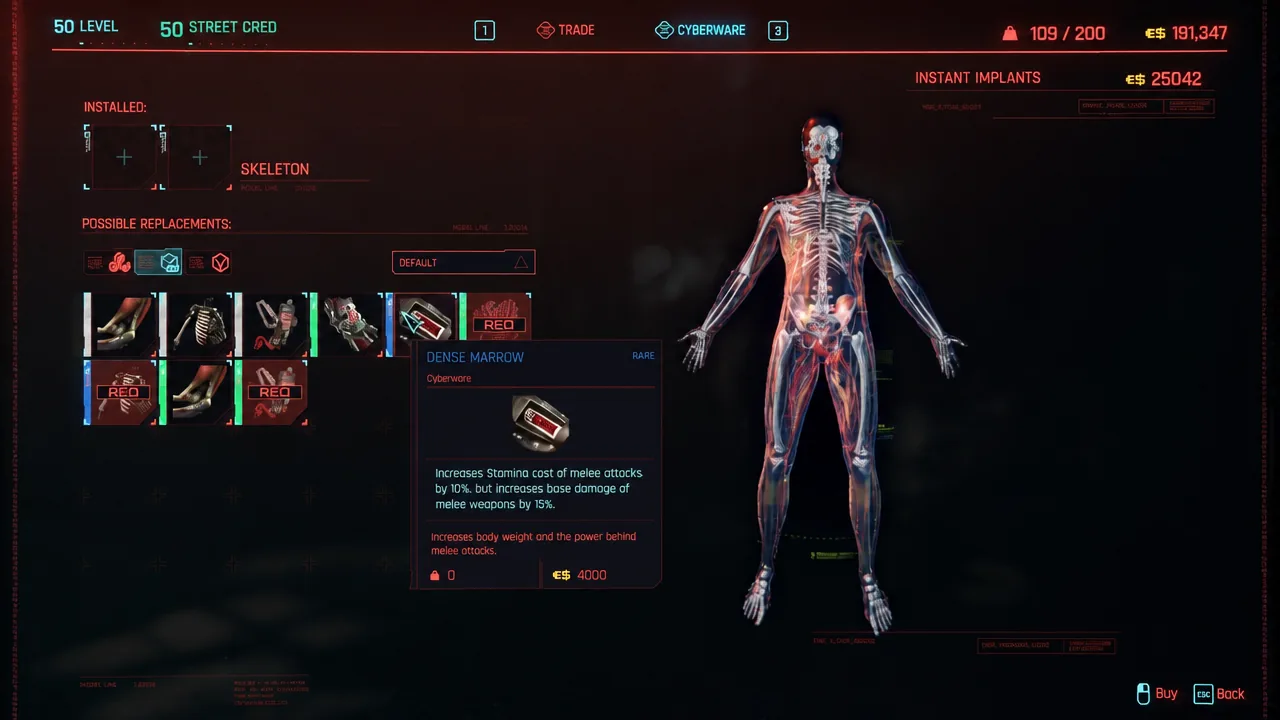
Dense Marrow gives +24% melee damage at Tier 5, with a +15% melee stamina cost. It is Reflexes-attuned, adding 3.9 armor and 5.2 bonus stealth damage. Nothing else in the slot touches melee damage, so melee builds run this regardless.
The stamina penalty is the whole conversation. More damage per swing is excellent, but you swing fewer times before you are gassed. It wants high Body, Universal Booster, or the stamina perks to offset the drain.
Scarab (crouched shooter)
Scarab grants 110 armor while crouched at Tier 5, at the cost of 20% movement speed. It is Technical-attuned, with 13 carrying capacity and 2.6% grenade recharge speed. This is a stationary-shooter implant and the backbone of the crouched LMG playstyle, where you park behind cover, layer crouch-based mitigation perks, and become very hard to shift.
Play mobile and it does nothing. Fourteen capacity for a conditional 110 armor is a great rate if the condition matches how you play, and a wasted slot if it does not.
Universal Booster (stamina and health items)
Universal Booster gives your health items a second job. Using one also grants 9% armor for 5 seconds and cuts all stamina costs by 27% for 55 seconds. The effects do not stack with themselves, so spamming injectors gains you nothing.
That 55-second stamina window is the real draw and it is easy to overlook. Stamina gates sprinting, blocking, melee swings, and power weapon fire, so a build that lives on stamina gets more out of this than the armor line suggests. At 25 capacity and nearly 85,000 eddies, it is a late-game purchase.
RAM Recoup (netrunner)
RAM Recoup restores RAM equal to 0.28% of damage received, plus 2 Max RAM. It is Intelligence-attuned, with 3.9 armor and 0.13 RAM regen from neutralizing an enemy.
Patch 2.1 multiplied this effect by roughly ten, turning it from a joke into a real netrunner tool. A tanky quickhacker under sustained fire now generates a meaningful RAM stream just by being shot at. Fourteen capacity is cheap for what it does on an Intelligence build.
Rara Avis: the Phantom Liberty iconic
Rara Avis is the category’s trophy piece and requires Phantom Liberty. It works like a scaled-up Para Bellum, granting armor in the 30–40% range depending on tier, alongside health that scales with Body.
You get it by buying it from a Dogtown Ripperdoc, or by getting lucky with a Dogtown airdrop once you have started Lucretia My Reflection. Whether it earns 52 capacity is a genuine question, since armor suffers diminishing returns against the biggest hits and that capacity could buy three or four useful implants elsewhere on your body. For an armor-stacking Body build, it is still the ceiling.
Best Skeleton picks by build
| Build | Recommended implants |
|---|---|
| Netrunner | RAM Recoup for the RAM economy, Kinetic Frame since you rarely burn stamina |
| Melee / Body | Dense Marrow for damage, Epimorphic Skeleton for health, Universal Booster if stamina is choking you |
| Gunslinger (mobile) | Bionic Joints early, Para Bellum once armor is high enough for the percentage to win |
| Gunslinger (dug in) | Scarab, and it isn’t close |
| Low eddies or capacity | Bionic Joints plus Titanium Bones (14 capacity, under 14,000 eddies) |
If you are early in a run or short on capacity, Bionic Joints and Titanium Bones together cover armor and the encumbrance problem for very little. That pairing carries you comfortably to the point where you can afford to think harder about the bigger, more specialized implants.