Mini War on Roblox looks like a war game, but the players who win servers are the ones who treat it as an economy game first. You start with one small plot, a handful of civilians, and a short tutorial that nudges you toward money. Every decision after that pulls from the same cash pool, so the order you build in matters far more than how fast you rush soldiers.
Quick answer: Build Farm Houses and basic factories for income, buy a Workshop as early as possible to add builders, increase your civilian cap through houses and research, then expand territory before you ever invest heavily in military.
Build your economy before anything else
The core loop is simple. Houses give you civilians, civilians work in factories, factories produce raw materials, and you sell those materials at the market for cash. That cash funds more buildings, research, and eventually military. Rushing troops before income is stable is the single biggest reason new players stall out.
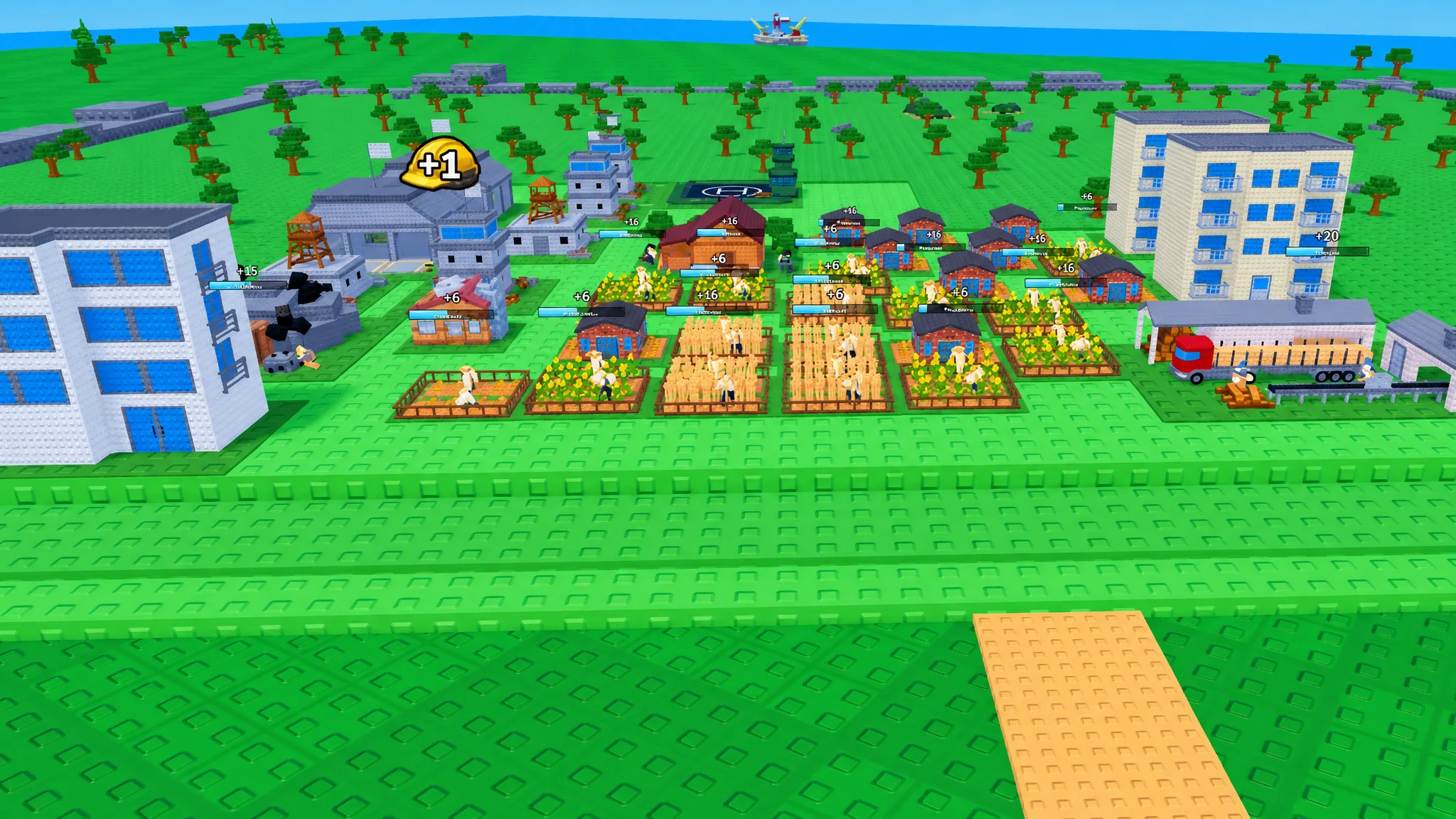
Factory progression path from early to end game
As stronger factories unlock, sell off your weakest buildings and replace them instead of stacking low-tier structures forever. A base full of basic Farm Houses will always earn less than one with upgraded factories, even with the same number of civilians. Epic, Legendary, and Mythic factories can each generate more than 1K per cycle, so they pay for themselves quickly.
| Stage | Recommended factories |
|---|---|
| Early game | Windmill → Oil Rig → Bank |
| Mid game | Research Lab → Diamond Cave |
| Late game | Nuclear Reactor → Data Center → Blackhole Generator |
| End game | Area 51 Lab (can be skipped) → Antimatter Reactor → Quantum Core Generator |
Following this order keeps your money moving into the strongest available factory and avoids dumping cash into weaker buildings that you will only tear down later. Nuclear Reactors and Data Centers are the first reliable big earners, each producing around 1K per cycle.
Civilian caps and housing efficiency
Factories do not run without civilians, so your civilian count is effectively your income ceiling. You start capped at 50 civilians and 20 military units. Once you hit those limits, you cannot place more of the same building type. The game is telling you to upgrade and raise the cap, not keep spamming.
Despite the higher price tags, bigger houses are not always more efficient. The Small House gives the best civilian count per space used, which makes it the strongest housing option for tight plots. Switch from Farm Houses to Small Houses and later Apartment Buildings as you scale.
| Setup | Maximum civilians |
|---|---|
| Free to play (max research and territories) | 260 |
| With x2 Civilian gamepass | 310 |
Research tree priorities for faster scaling
The Research Tree has 62 upgrades split across Military, Economy, and Systems branches, and each upgrade is more expensive than the last. Experienced players push the economy branch first and leave most military research until they actually plan to fight. Pick a branch before spending, since money is tight early on.
Prioritize production speed, money generation, luck, extra civilians, more builders, and more researchers. A few upgrades carry outsized value:
- Research Team adds a second active research slot so you can train two skills at once.
- 1+ Quest gives one extra quest on every refresh.
- Smart Factories raises farm production speed by 25%.
- Passive Earnings extends offline income by 30 minutes.
- Conqueror and Emperor each raise your captured base limit by one.
Grab the Alliance research early too. Allying with other players reduces the risk of being invaded while your defenses are still thin. The Researcher upgrade adds your first extra research slot before Research Team adds a second.
Territory setups that decide the mid game
Territories are the biggest power spike in the game. Each one stacks a money multiplier and adds civilians, and many also boost research speed. You can occupy up to 5 territories at first, raised to 10 through research. Early on, take whatever you can hold safely. In the early game, capturing more than two or three extra plots usually spreads your defenses too thin and leaves you open to sneak attacks.
Mid to late game, the priority shifts to controlling key points like Labs, Military Bases, and the City. Two common high-value layouts work well depending on your goal.
| Setup | Composition | Best for |
|---|---|---|
| Money meta (default) | 1 City, 6 Military Bases, 3 Labs | Balanced income, civilian cap, and research |
| Civilian scaling | 1 City, 6 Oil Rigs, 3 Labs or Military Bases | Late-game farming and AFK growth |
If your research is still in progress, keep the 3 Labs for the research speed boost. Oil Rigs scale civilian cap and income heavily over time, which makes the civilian setup ideal once you are mostly idling. Note that income from a contested territory is reduced, so commit fully to a capture or pull back rather than leaving it half-finished.
Selling at the market for maximum profit
The market board next to the Tradesman changes its prices every few minutes, so selling the instant your inventory fills is rarely the best move. Watch the percentage and wait for a favorable swing before unloading bulk materials.
- Early and mid game: sell at 30% or higher.
- Late game: sell at 40% or higher.
Capture as many territories as you can before a big sell-off, since their multipliers apply to your earnings. Market Price Boost research raises values further. For small amounts the timing barely matters, but for expensive late-game materials the difference is large.
Gems, Clone Facility, and the Black Market
Gems come from quests, Gem Mines, and daily rewards. For most players, a Gem Mine is the best first gem purchase because it generates gems passively over time. Keep in mind that Gem Mine and Clone Facility prices rise by 18.75% for each one you already own, so they get steadily more expensive.
Gems mainly buy Black Market buildings, military structures, and Clone Facilities. The Clone Facility is the standout purchase. It copies your best production farm, and in most cases that clone delivers a better income-per-civilian and income-per-space ratio than anything else you can buy. Some raid rewards are even stronger than Black Market buildings, so check those before spending.
Raid events and statue buffs
A Raid Event can appear at xx:00 and xx:30 with a 50% chance each on every server, and it lasts 15 minutes. Raids also spawn on private servers. Whoever holds the raid area the longest earns a special reward crate.
The main prize is the Worker Statue V2, an Epic statue with an 8-minute build time that grants +20% production speed across a wide radius. It is roughly twice as effective as the standard Worker Statue and can only be obtained from the normal raid. Statues do not stack, and a building gets the buff as long as at least half of it sits inside the radius.
| Statue | Effect |
|---|---|
| Worker Statue | +10% production speed |
| Worker Statue V2 | +20% production speed |
| Soldier Statue | +10% military damage |
Staying AFK to keep factories running
Idle progress is one of the strongest ways to grow, but it has a catch. If your storage fills while you are offline, production stops. Staying in-game with auto collecting, or owning the Auto Collect gamepass, keeps factories running nonstop. That matters most with end-game buildings like the Antimatter Reactor and Quantum Core Generator, which fill storage fast.
AFK time can also farm rare shop items. Open the shop, hover your cursor over the green buy button for the building you want, and turn on an autoclicker, which is allowed. Macros are not.
Which gamepasses are worth buying
If you choose to spend Robux, focus on the passes that compound your economy rather than one-time boosts.
| Gamepass | Why it helps |
|---|---|
| 2x Money | Strongest overall progression boost |
| Auto Collect | Keeps farms running for AFK farming |
| 2x Civilians | Large economy scaling, raises cap to 310 |
| 2x Building | Cuts long late-game build times |
| Private Server | Safe AFK with maximum bases captured |
Skip Auto Sell, which can dump materials at bad market percentages and waste profit. Money packs and one-off crate passes generally are not worth it and become outdated as you progress. If you use a private server, set it up properly so random players cannot join.
When to build a military
Only invest in troops once your economy can absorb the cost of replacing them. Build defense before offense. Border Towers cost just $150 and Sniper Towers at $4,000 cover key entry points along your borders. Barracks at $750 produce basic infantry.
For attacking, the Tank Base at $25,000 is the cost-efficient backbone, and a Heli Pad at $140,000 adds air pressure. Later, Missile Launchers, the General’s Base, and Air Bases with Black Hawks form a strong assault force. Always scout an enemy territory before attacking to confirm your troops can win, since each conquered base hands you a stacking money multiplier and extra civilians.
Common beginner mistakes to avoid
- Rushing military before income is stable.
- Selling materials at negative market percentages.
- Ignoring research upgrades, especially economy ones.
- Keeping outdated factories long after better ones unlock.
- Wasting plot space on inefficient layouts.
- Forgetting to raise the civilian cap.
- Ignoring territories, particularly right before a big sell.
The pattern that wins is consistent: grow income, raise your civilian cap, keep upgrading factories, expand territory control, scale late-game production, and only then pivot into a serious military. A strong economy almost always outpaces an early army, so play the long game and let your multipliers stack.