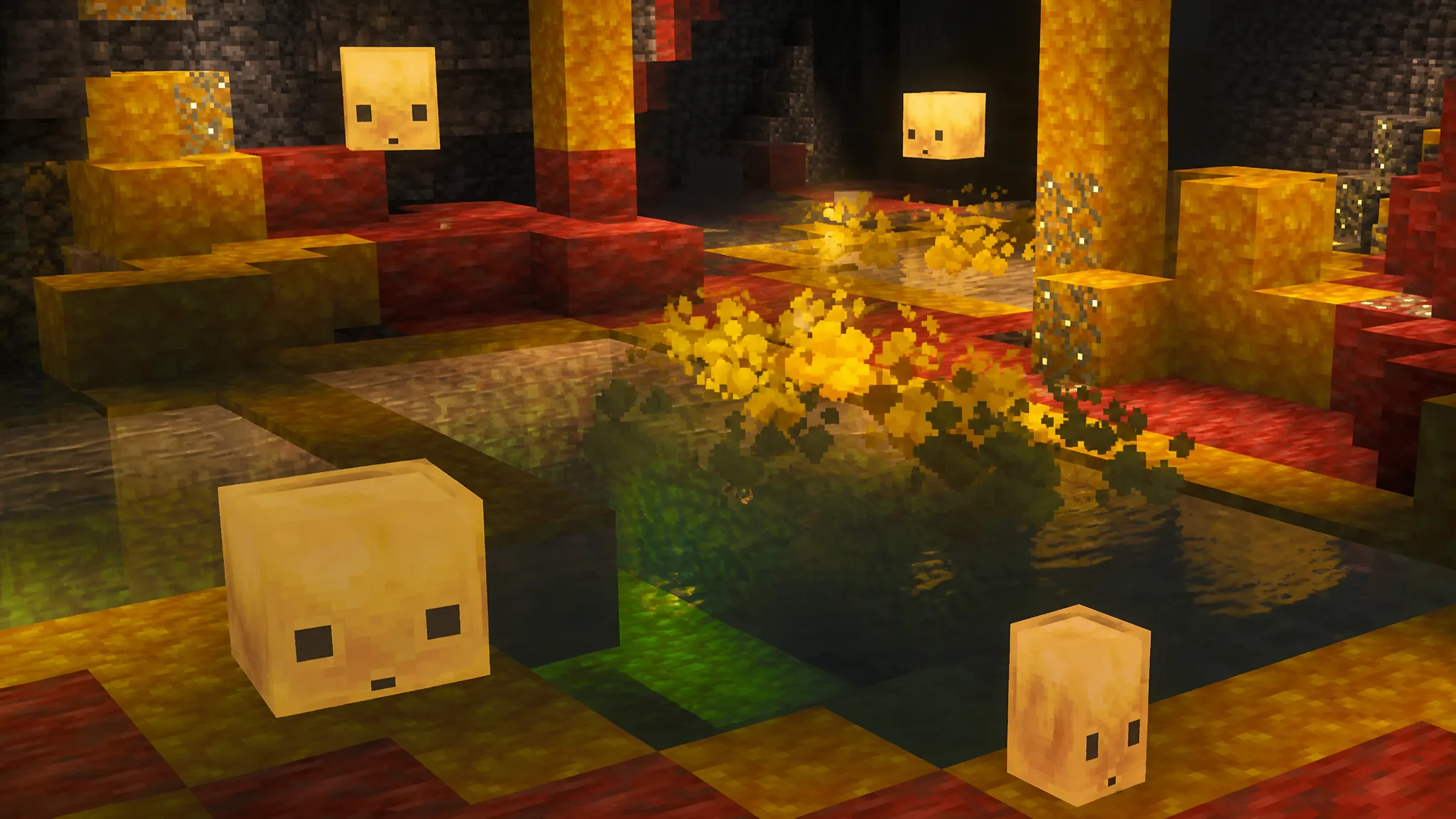
The Sulfur Cube is a passive, slime-like mob that lives in the new sulfur caves and behaves like a physical ball once it swallows a block. Feed a large cube one full-sized block and it freezes in place, becomes immune to most damage, and takes on a set of physics traits called an archetype. The block you choose decides how it bounces, how fast it slides, how heavy it feels, and whether it floats or sinks.
Quick answer: An archetype is a physics preset that activates the moment a large Sulfur Cube absorbs a block. The block type sets its knockback resistance, bounciness, ground friction, air drag, and buoyancy. There are 12 archetypes in total, including four special ones tied to specific blocks.

How Sulfur Cube block absorption works
Only large Sulfur Cubes can absorb blocks. Small ones, which spawn in pairs when a large cube dies, cannot hold anything and instead grow into large cubes after about 20 minutes. You can speed that growth up by feeding small cubes slimeballs, or stop it entirely with a golden dandelion.
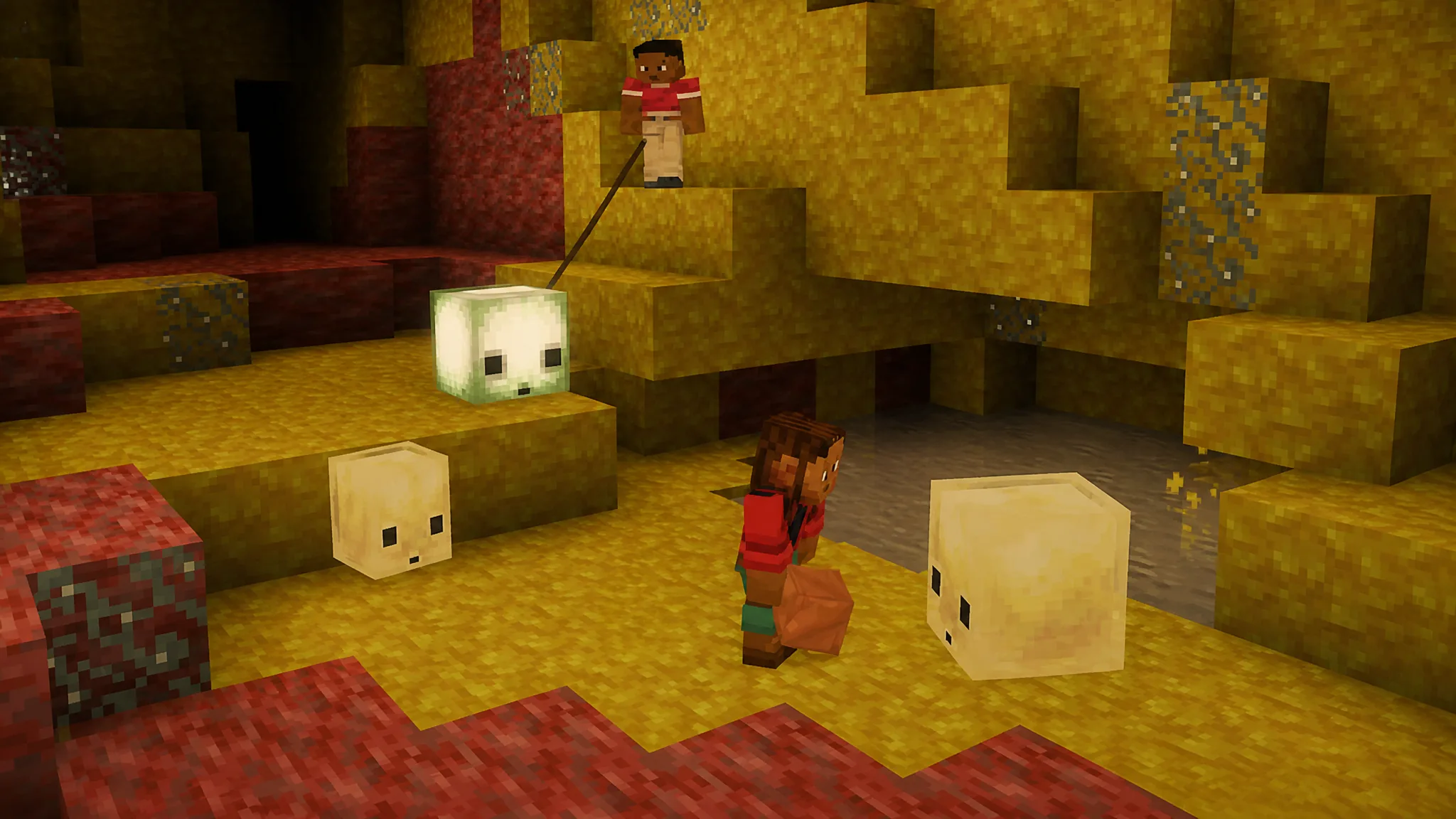
To make a large cube absorb a block, you can interact with it while holding a block in your hand, throw a block item on the ground nearby, or push a block to it with a dispenser. The cube actively moves toward block items it can use and follows players carrying a compatible block. Feeding a new block to a cube that already holds one swaps the contents and drops the old block as an item.
How you know it worked: the cube stops hopping, the absorbed block becomes visible inside its body, and it turns into a physical object you can punch and push around. Where you hit it controls the direction it travels, while the damage that would have been dealt sets how far it goes. To get the block back, use shears on the cube (a dispenser loaded with shears works too) or kill the cube, which drops the block.
While a cube holds a block, it ignores melee attacks, projectiles, falling blocks like anvils and stalactites, explosions, fall damage, freezing, and cactus or sweet berry bush damage. Fire, lava, suffocation, cramming, and the warden’s sonic boom can still kill it.
Why a block won’t be absorbed: the cube only accepts full-sized blocks. It rejects slabs, stairs, walls, and fences, along with functional blocks such as crafting tables, furnaces, pistons, observers, and chests. Transparent blocks like glass are also refused. If you hold a block the cube can’t use, it simply keeps hopping around and shows no interest.
All Sulfur Cube archetype stats
Each archetype is defined by five numbers plus its buoyancy. Lower knockback resistance means the cube flies further when hit, higher bounciness means stronger rebounds, lower friction means longer slides, and higher air drag keeps it hanging in the air. Here is how all 12 compare.
| Archetype | Knockback resist | Bounce | Friction | Air drag | Floats |
|---|---|---|---|---|---|
| Bouncy | -2.0 | 0.9 | 0.3 | 0.01 | Yes |
| Regular | -1.0 | 0.5 | 0.3 | 0.1 | Yes |
| Slow Bouncy | 0.4 | 0.6 | 0.3 | 0.05 | No |
| Fast Flat | -1.0 | 0.5 | 0.2 | 0.01 | No |
| Slow Flat | 0.5 | 0.4 | 0.4 | 0.1 | No |
| Fast Sliding | 0.5 | 0.1 | 0.05 | 0.01 | No |
| Slow Sliding | 0.8 | 0.1 | 0.05 | 0.01 | No |
| Light | -1.0 | 1.0 | 0.3 | 1.8 | Yes |
| High Resistance | 0.7 | 0.2 | 1.0 | 0.01 | No |
| Sticky | -2.0 | 0.0 | 2.0 | 0.01 | No |
| Explosive | -1.0 | 0.5 | 0.3 | 0.3 | Yes |
| Hot | -1.0 | 0.5 | 0.3 | 0.1 | Yes |
Which blocks trigger each archetype
Blocks are grouped by material, so wood produces a bouncy ball, ice makes a slider, and metal makes a heavy sinker. The table below lists the main blocks for each archetype.
| Archetype | Behavior | Blocks |
|---|---|---|
| Bouncy | Very bouncy, fast, and floats | Planks, Bamboo Mosaic, Logs, Stripped Logs, Wood, Stripped Wood, Block of Bamboo, Block of Stripped Bamboo |
| Fast Flat | Low bounce, slides quickly | Coral Blocks, Dead Coral Blocks, Sponge, Wet Sponge, Dried Kelp Block, Moss Block, Pale Moss Block, Pumpkin, Melon, Hay Bale, Carved Pumpkin, Froglights |
| Fast Sliding | No bounce, slides extremely fast | Blue Ice, Packed Ice, Snow Block |
| Slow Sliding | No bounce, slides slowly | Brown Mushroom Block, Red Mushroom Block, Mushroom Stem, Mycelium, Nether Wart Block, Warped Wart Block, Shroomlight |
| Slow Flat | Heavy, slow, sinks | Block of Iron, Block of Gold, Block of Raw Copper, Block of Raw Gold, Block of Raw Iron, Gold Ore, Nether Gold Ore, Iron Ore, Copper Ore, Block of Netherite, Block of Copper, Copper Bulb, Cut Copper, Chiseled Copper |
| Light | Low gravity, floaty | Wool (all colors) |
| Slow Bouncy | Bouncy but slow | Most stone blocks, such as Stone, Cobblestone, Andesite, Diorite, Granite, Tuff, Blackstone, Basalt, Obsidian, Bricks, Terracotta, Sulfur, and Cinnabar |
| Regular | Balanced, floats | Dirt, Coarse Dirt, Rooted Dirt, Podzol, Grass Block, Sand, Gravel, Clay, Concrete, Concrete Powder, Block of Coal, Bone Block, Block of Redstone |
| High Resistance | Hard to push, no bounce | Soul Sand, Soul Soil |
| Sticky | Cannot slide or bounce | Honeycomb Block |
| Explosive | Can be ignited and explodes | TNT |
| Hot | Damages nearby entities | Magma Block |
The Bouncy archetype turns the cube into a near-perfect rubber ball, which players have used to build pinball-style minigames and redstone contraptions.
Special archetypes: Explosive, Hot, High Resistance, and Sticky
Four archetypes behave differently from the simple ball physics of the rest. Two of them, Explosive and Hot, are dangerous and should be handled with care.
Explosive (TNT)
A cube that has absorbed TNT can be ignited. Once lit, it explodes after six seconds and dies, leaving no small cubes behind. Shears cannot remove ignited TNT, so there is no way to defuse it once it starts counting down.
Hot (Magma Block)
A cube holding a magma block damages nearby entities, dealing contact damage as it bounces around. It floats in water like the standard ball archetypes.
High Resistance (Soul Sand, Soul Soil)
Soul sand and soul soil make the cube extremely hard to push, with very high friction and no bounce. It works well as an immovable obstacle.
Sticky (Honeycomb Block)
A honeycomb block removes the cube’s ability to both slide and bounce. Its friction is set to the highest value of any archetype, so it sticks in place almost immediately after being hit.
Edition and version differences to watch
The Sulfur Cube is part of the Chaos Cubed update and is still in development, so a few block assignments differ between Java and Bedrock and across versions. The explosive, hot, and slow bouncy archetypes arrive in Bedrock with the 26.30 beta, alongside the cube spawning during normal and peaceful gameplay rather than only under the “Drop 2 of 2026” experiment.
| Block | Java Edition | Bedrock Edition |
|---|---|---|
| Block of Resin, Resin Bricks, Chiseled Resin Bricks | Fast Flat | Bouncy (changes to Fast Flat with BE 26.30) |
| Jack o’Lantern | Fast Flat | Added as Fast Flat with BE 26.30 |
| Slime Block, Honey Block, Sculk | Not listed | Fast Flat (until BE 26.30) |
| Ice | Not listed | Fast Sliding (until BE 26.30) |
| Ancient Debris | Slow Flat | Not listed |
One more nuance to keep in mind. Stone-type blocks produce the Slow Bouncy archetype in newer development builds, but inside the older “Drop 2 of 2026” experiment those same blocks give the Regular archetype instead. Because the feature is still being tested, individual block assignments and stat values may shift before the update is finished.
Once you understand how each material maps to an archetype, the Sulfur Cube becomes a flexible tool rather than just a cute cave dweller. A bucket carries a large cube anywhere with its absorbed block intact, so you can prepare a wooden bouncer or an icy puck and drop it exactly where your build needs it.