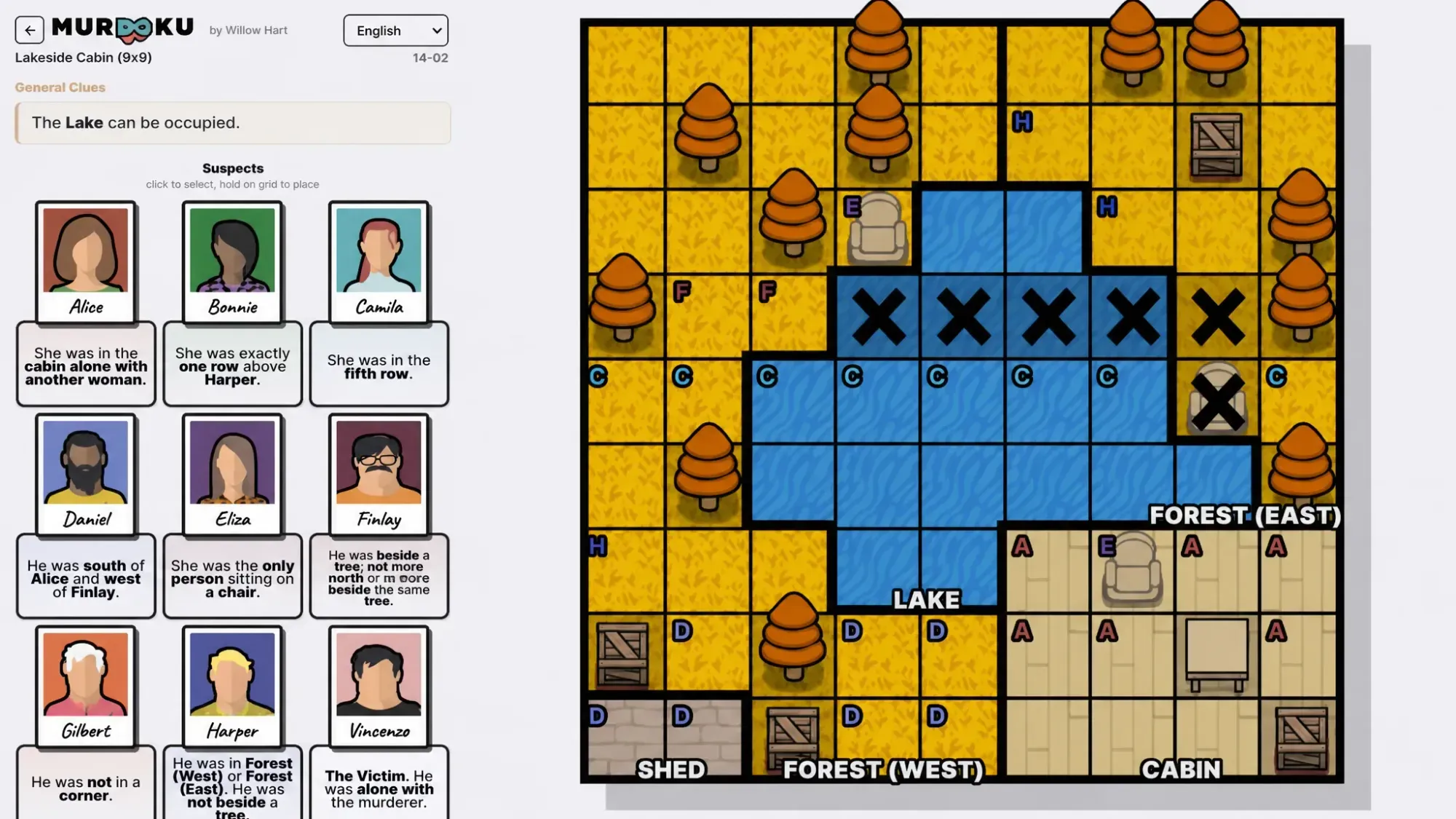
Murdoku takes the placement logic of Sudoku and wraps it inside a murder mystery. Instead of filling a grid with numbers, you place named suspects and a victim across a crime scene divided into rooms, then read each suspect’s clue to work out exactly where everyone stands. Once the board is full, the killer is whoever ends up alone with the victim in the same room.
Quick answer: Place every suspect and the victim on the grid using one person per row and one per column, follow each suspect’s clue and the furniture limits in every room, and the murderer is the person left alone with the victim in the same area.
What Murdoku is
Murdoku is a logic puzzle created by Montreal puzzlemaker Manuel Garand, whose work has appeared in the Financial Times. Each puzzle drops you into a single illustrated crime scene, such as a courtroom, a zoo, a prison, a car repair shop, or a holiday shopping village. A victim has already been killed, and your job is to find the culprit by placing every character in their correct spot.
The art matters here. Rooms are filled with furniture and objects like chairs, tables, shelves, TVs, beds, plants, water puddles, and cars. Some squares can be occupied and some cannot, and many clues depend on what a character is standing next to. That visual layer is the main thing that separates Murdoku from a plain number grid.
Core rules of every Murdoku puzzle
The base rules stay the same from case to case, even as the scenes change. Understanding these four points is enough to start solving.
| Rule | What it means |
|---|---|
| One per row and column | Each row and each column holds exactly one person, exactly like Sudoku placement. |
| Follow the clues | Every suspect has a written clue describing where they are, what they are beside, or who they are near. |
| “Beside” definition | Beside means directly left, right, above, or below something, and in the same area (room). |
| The killer | The murderer is the person who ends up alone with the victim in the same area. |
As soon as you place a person, you block their entire row and column for everyone else, which steadily narrows the open squares. Clues often reference objects (“She was beside a register”), exact positions (“He was in the last column”), relationships (“She was alone with Mara”), or directions (“He was exactly one row north of Gemma”).
How to solve a case
Difficulty and variant rules
Puzzles run from easy to expert, and harder cases layer in extra scene-specific rules on top of the standard placement logic. These twists are tied to the theme of each crime scene.
| Scene | Difficulty | Special twist |
|---|---|---|
| The Courtroom | Easy | Straightforward room and furniture clues. |
| Preppers | Medium | Box placement and hidden rooms factor into the deductions. |
| The Horse Track | Hard | Jockeys race in order, so “ahead” and “behind” set their positions. |
| The Zoo | Expert | Only zookeepers can occupy habitats, and each habitat needs at least one. |
| Solitary Confinement | Expert | Guard roles, empty cells, and corner positions all constrain the grid. |
The clutter is part of the challenge. On the toughest boards, the dense furniture and overlapping object clues are where most of the difficulty comes from, so slow, careful elimination beats guessing.
Where to play Murdoku
The fastest way in is the free web version, which rotates fresh cases twice a week. If you prefer paper, there are printable Family Murdoku sheets as well as full puzzle books.
The flagship book, Murdoku: 80 Murder Mystery Logic Puzzles by Manuel Garand, runs 208 pages and was published by Puzzlewright Press on October 28, 2025, at a list price of $18.99. It collects 80 crime scenes, from a bakery and a casino to a chess tournament, a farm, and an opera, and ramps from easy up to expert. Follow-up volumes continue the series, with Murdoku Volume 2: Back in Time out now and Murdoku Volume 3: Around the World available to preorder.
If you already enjoy variant Sudoku or classic logic grids like the Zebra Puzzle, Murdoku will feel instantly familiar but fresh. The suspects stay simple ciphers rather than fully drawn characters, yet the satisfaction comes from the same place a good Sudoku does: a single correct arrangement that locks into place once you read the room.