Game Freak has leaned on the natural world for designs since the very first generation, and monkeys have been part of the roster from the start. They span Fighting bruisers, Fire starters, elemental trios, and even a mythical jungle dad. Sorting the genuinely strong picks from the cute-but-forgettable ones is the only thing standing between you and a solid primate team.
Quick answer: Infernape and Annihilape are the strongest competitive monkeys, Zarude is the rarest, and the elemental trio of Pansage, Pansear, and Panpour are the weakest worth skipping for battle.
Mankey and Primeape: the original angry monkeys
Mankey debuted in Generation 1 as the Pig Monkey Pokémon, a Fighting-type with a temper and, oddly, a pink pig nose stuck on a monkey body. It’s one of the smaller Fighting-types in the Pokédex, but the design has lasted because the attitude reads instantly. Mankey evolves into Primeape, and in modern games Primeape can push further into Annihilape, the Ghost/Fighting final form added in Generation 9.
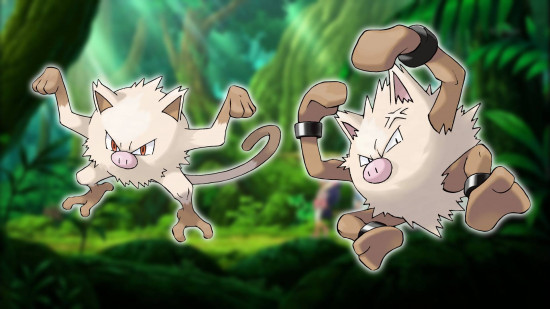
In Pokémon GO, Mankey is squarely a collector’s catch rather than a battler. It tops out at 1,317 CP at Level 50, and its best loadout is Karate Chop paired with Brick Break. Those numbers don’t carry it into raids, since its defense stat is too low to matter, but a shiny version is available, and it gets a boost in cloudy weather.
| Detail | Mankey in Pokémon GO |
|---|---|
| Type | Fighting |
| Weaknesses | Fairy, Flying, Psychic |
| Base stats | 148 ATK / 82 DEF / 120 HP |
| Max CP (Lvl 50) | 1,317 |
| Best moveset | Karate Chop / Brick Break |
| Evolutions | Primeape (50 Candy), then Annihilape (100 Candy + defeat 30 Psychic/Ghost) |
Oranguru and Passimian: the Alola apes
Strictly speaking, orangutans are apes rather than monkeys, but Oranguru earns a spot anyway. It’s a Normal/Psychic-type built around an old, wise shaman vibe, and that calm-genius personality stands out among the more chaotic primates. Passimian, its Generation 7 counterpart, is the Fighting-type team player of the pair.
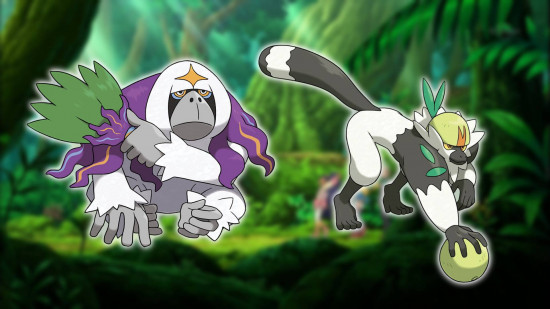
Given how many regions since Kanto have featured jungle areas, it’s a little surprising the Mankey line never picked up a regional form of its own. Oranguru and Passimian fill some of that gap by giving the jungle archetype two very different temperaments.
Aipom: the mischievous tail-hand
Aipom is the prankster of the group, a purple monkey defined by the small hand on the end of its tail. That appendage is perfect for picking fruit and pulling tricks, and its permanent grin sells the personality. It’s a simple design that still manages to stand apart from the rest.
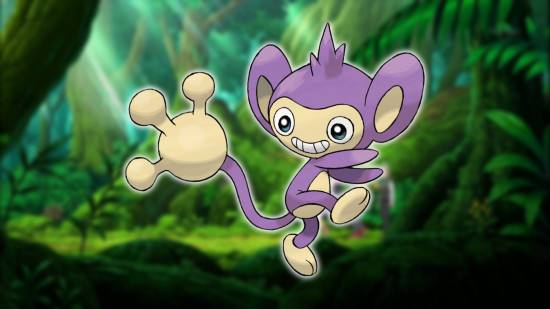
Aipom has a real home in Pokémon Diamond and Pearl and their Nintendo Switch remakes. Teach it Double Slap, and it evolves into Ambipom, trading one tail-hand for two and a sizable jump in offensive power.
Chimchar and Infernape: the best competitive monkey
Chimchar is Sinnoh’s Generation 4 Fire starter, a small monkey with a flaming tail and a matching tuft on its head. The flame only goes out when it sleeps or faints, and like real monkeys it’s a strong climber that handles Sinnoh’s mountains with ease. It was once mistaken for a ghost and nicknamed “Lantern-Tail.”
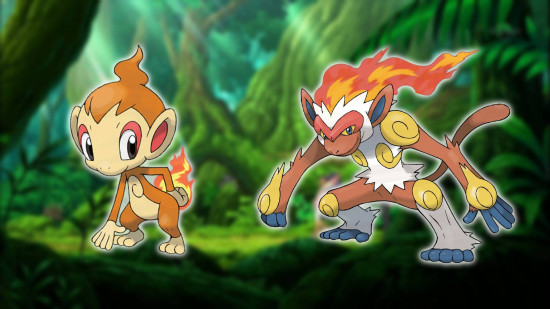
Chimchar becomes Monferno, then Infernape at Level 36, and that’s where the line peaks. Infernape is a Fire/Fighting powerhouse with gold armor-like plating and a crown of flame, drawing on both the Chinese epic Journey to the West and the Hindu Ramayana. Unlike a lot of starters, it nails its final evolution and backs the look up with a genuinely strong movepool. It’s the monkey to beat in actual battles.
Darmanitan and Galarian Darmanitan
Darmanitan is the fiery, broad-shouldered monkey of Unova, and it picked up one of the more dramatic regional forms in the series. In Pokémon Sword and Shield, Darumaka and Darmanitan got Galarian variants that swapped the Fire typing for Ice.
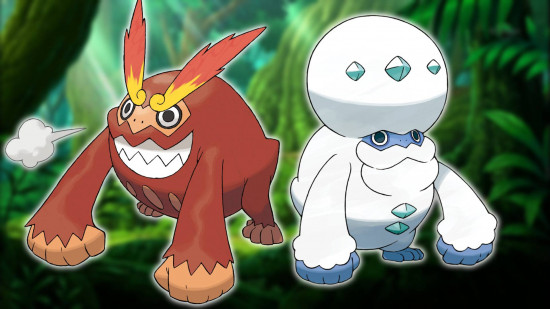
The icy makeover is more than cosmetic. When Galarian Darmanitan enters its Zen Mode, it becomes a heavy hitter that can be a real wall to break through in battle, on the same tier of nuisance as some of the series’ most stubborn opponents.
Grookey, Thwackey, and Rillaboom
Grookey is the Grass starter of Pokémon Sword and Shield, modeled on the squirrel monkey right down to its facial markings and arm coloring. It carries a special stick to drum out a beat, and because it’s a Grass-type, the music it makes can revive nearby plants and flowers. It’s a strong pick to open a Galar run.
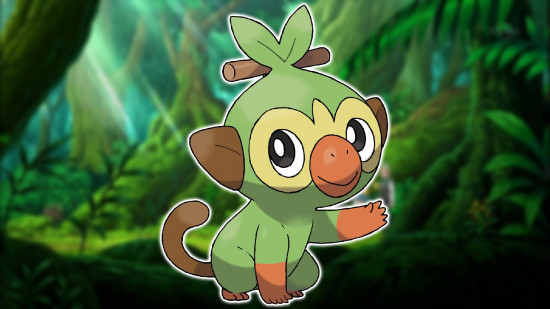
It evolves into Thwackey at Level 16, the Beat Pokémon, which keeps the drumming gimmick by thwacking the two sticks tucked in its fur. The faster it can lay down a rhythm, the more respect it earns from other Thwackey. The middle stage is as plain as most middle stages, but the line pays off with Rillaboom, a great ape that finishes the evolution strongly.
Slaking: the lazy heavyweight
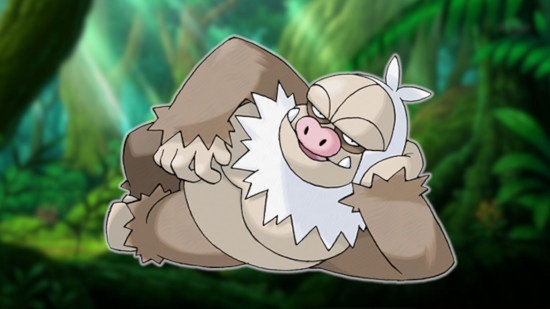
Slaking is the resident couch potato, a hulking Normal-type whose enormous stats are famously held back by its Truant ability, which forces it to loaf every other turn. The sloth comparison is fair, but the design and raw power are pure great-ape spectacle, which is enough to keep it in the conversation.
Zarude: the rarest monkey of all
Zarude is a Dark/Grass mythical first seen in the movie Secrets of the Jungle. It was distributed in Pokémon Sword and Shield through a special event, which makes it the hardest monkey to add legitimately if you missed that window.
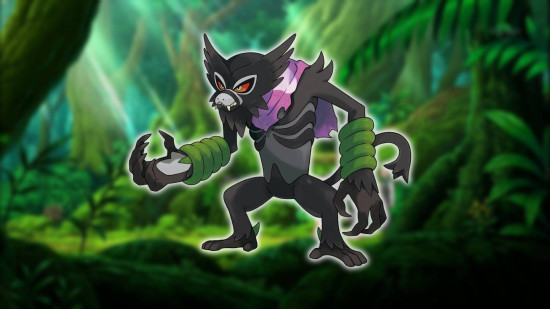
It also has a special Dada form, identical to the standard look except for a pink cape, a nod to the film where it raises a human child. Between the rare typing, the mythical status, and the limited availability, Zarude is the trophy of the monkey lineup.
The elemental trio: the monkeys to skip for battle
Pansage, Pansear, and Panpour are the elemental monkeys, each tied to a core element. Pansage is Grass, Pansear is Fire, and Panpour is Water, and they double as a reference to the three wise monkeys of “see no evil, hear no evil, speak no evil.” It’s a clever theme that doesn’t translate into combat.
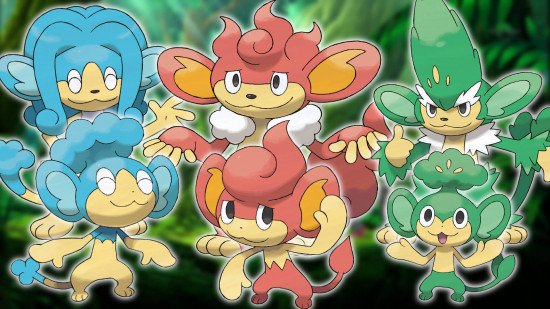
Used together, the trio and their evolutions, Simisage, Simisear, and Simipour, give you tidy type coverage across grass, fire, and water. Individually, though, their stats fall short, which lands them in the worst-monkey corner. They’re worth catching for the collection and the novelty, not for a serious roster.
If you’re building a team, lean on Infernape and the Annihilape line for power, keep Galarian Darmanitan around for its bulk, and chase Zarude if you want the rarest catch. Everything else, from Aipom’s pranks to Slaking’s naps, is more about charm than competition, which is exactly why the monkeys remain some of the most memorable designs in the series.