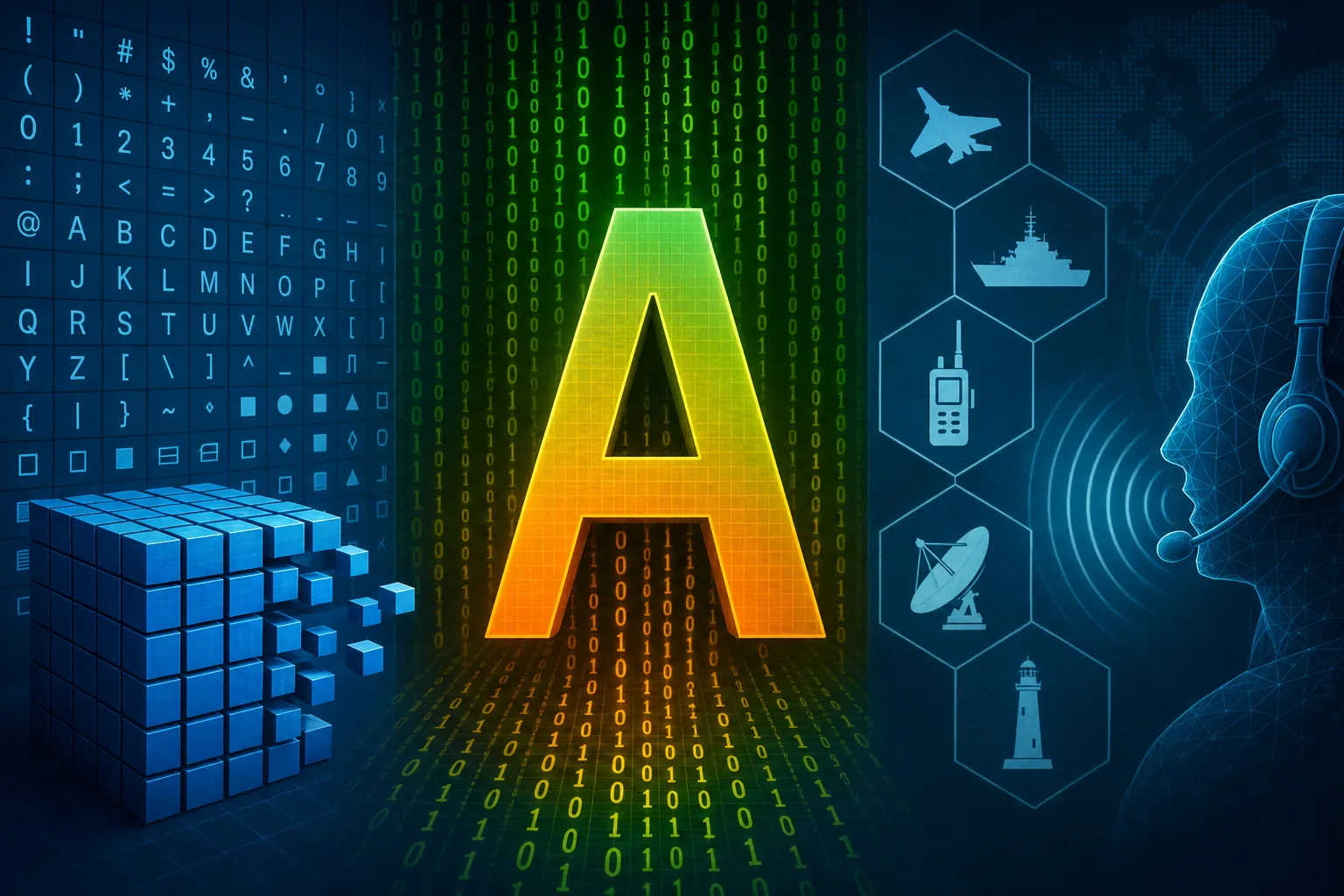
Every letter of the alphabet can be represented in more than one way once you move past plain text. Computers store letters as numeric ASCII values and binary strings, radio operators spell letters aloud using standardized code words, and classroom coding exercises often layer in Morse code, sign language, or hieroglyphic symbols. Knowing how these systems map to A through Z makes it possible to decode messages, troubleshoot character encoding, or communicate clearly over a noisy radio channel.
ASCII and binary codes for capital letters (A to Z)
Capital letters A through Z occupy ASCII decimal values 65 through 90. Each value also has a 7-bit binary equivalent, which is what a computer actually stores and processes.
| Letter | ASCII code | Binary code |
|---|---|---|
| A | 65 | 1000001 |
| B | 66 | 1000010 |
| C | 67 | 1000011 |
| D | 68 | 1000100 |
| E | 69 | 1000101 |
| F | 70 | 1000110 |
| G | 71 | 1000111 |
| H | 72 | 1001000 |
| I | 73 | 1001001 |
| J | 74 | 1001010 |
| K | 75 | 1001011 |
| L | 76 | 1001100 |
| M | 77 | 1001101 |
| N | 78 | 1001110 |
| O | 79 | 1001111 |
| P | 80 | 1010000 |
| Q | 81 | 1010001 |
| R | 82 | 1010010 |
| S | 83 | 1010011 |
| T | 84 | 1010100 |
| U | 85 | 1010101 |
| V | 86 | 1010110 |
| W | 87 | 1010111 |
| X | 88 | 1011000 |
| Y | 89 | 1011001 |
| Z | 90 | 1011010 |
ASCII and binary codes for lowercase letters (a to z)
Lowercase letters sit exactly 32 places higher than their capital counterparts on the ASCII table, starting at 97 for “a” and ending at 122 for “z”. That fixed offset of 32 is why converting between upper and lower case in code often involves adding or subtracting 32 from the ASCII value.
| Letter | ASCII code | Binary code |
|---|---|---|
| a | 97 | 1100001 |
| b | 98 | 1100010 |
| c | 99 | 1100011 |
| d | 100 | 1100100 |
| e | 101 | 1100101 |
| f | 102 | 1100110 |
| g | 103 | 1100111 |
| h | 104 | 1101000 |
| i | 105 | 1101001 |
| j | 106 | 1101010 |
| k | 107 | 1101011 |
| l | 108 | 1101100 |
| m | 109 | 1101101 |
| n | 110 | 1101110 |
| o | 111 | 1101111 |
| p | 112 | 1110000 |
| q | 113 | 1110001 |
| r | 114 | 1110010 |
| s | 115 | 1110011 |
| t | 116 | 1110100 |
| u | 117 | 1110101 |
| v | 118 | 1110110 |
| w | 119 | 1110111 |
| x | 120 | 1111000 |
| y | 121 | 1111001 |
| z | 122 | 1111010 |
Converting a letter to its ASCII or binary code
To find a letter’s code, locate it in the tables above and read across. The capital letter “A” has ASCII value 65 and binary value 1000001. The lowercase “a” has ASCII value 97 and binary value 1100001, exactly 32 more than its capital form. This 32-point gap holds true for every letter pair, so once you know a capital letter’s ASCII value, adding 32 gives you the lowercase version instantly.
Binary code puzzles typically ask you to translate a string of seven-digit binary numbers back into letters. Working through each 7-bit group against the tables above resolves the message one character at a time, since every printable capital and lowercase letter has a fixed, unique binary pattern.
NATO phonetic alphabet for spelling letters aloud
The International Radiotelephony Spelling Alphabet, commonly called the NATO phonetic alphabet, assigns a distinct code word to each letter so it can’t be confused with another over a radio or phone line. It was standardized by the International Civil Aviation Organization in 1955–1956 and remains the reference version used in aviation, emergency services, and everyday spelling over the phone.
| Letter | Code word |
|---|---|
| A | Alfa |
| B | Bravo |
| C | Charlie |
| D | Delta |
| E | Echo |
| F | Foxtrot |
| G | Golf |
| H | Hotel |
| I | India |
| J | Juliett |
| K | Kilo |
| L | Lima |
| M | Mike |
| N | November |
| O | Oscar |
| P | Papa |
| Q | Quebec |
| R | Romeo |
| S | Sierra |
| T | Tango |
| U | Uniform |
| V | Victor |
| W | Whiskey |
| X | Xray |
| Y | Yankee |
| Z | Zulu |
The spellings Alfa and Juliett are intentional. Alfa uses an “f” instead of “ph” so non-English speakers pronounce it correctly, and Juliett keeps a double “t” so French speakers don’t drop the final consonant. Numbers get the same treatment: 3, 4, 5, and 9 are pronounced “tree,” “fower,” “fife,” and “niner” to avoid being mistaken for other words or numbers on a noisy line.
Some maritime and telecom agencies use a separate set of digit code words, such as “Nadazero” for 0 and “Unaone” for 1, but the NATO/ICAO digit pronunciations above are the ones paired with the standard letter alphabet.
Other coding systems used to represent the alphabet
Classroom code-breaking exercises frequently pull in additional systems beyond ASCII, binary, and the NATO phonetic alphabet. Morse code translates each letter into a pattern of short and long signals, American Sign Language assigns a distinct handshape to every letter, and Egyptian hieroglyphic charts map letters to ancient symbols for cross-curricular history and literacy activities. These are typically used in verbal reasoning practice and cipher-style puzzles rather than in computing or radio communication.
When you’re decoding a message and unsure which system applies, check whether the code uses numbers only (likely ASCII), strings of 0s and 1s (binary), spoken words (NATO phonetic), or dots and dashes (Morse). Matching the code’s format to the right chart is the fastest way to translate it accurately.