Sublight swaps the usual survivors-like stick figure for a warship. You command a capital vessel, bolt turrets onto specific hardpoints, and grind through escalating enemy waves across sectors of contested space. It left demo status on September 15th, 2026 and is now in paid Early Access on Steam.
Quick answer: Sublight is available now in Early Access on Steam for $11.99, with 6 levels, 2 enemy factions, 9 ships, and 16+ weapon types. A free demo remains live.
Sublight price and platform
Sublight is a PC release on Steam only. Codebrew Software, a solo studio based in Nottingham, UK, both develops and publishes it, and says there are currently no plans to raise the price when the game leaves Early Access.
| Region | Price |
|---|---|
| US | $11.99 |
| UK | £9.99 |
| Europe | €10.99 |
| Japan | ¥1,400 |
Interface text is available in English, German, Spanish, Japanese, Korean, Brazilian Portuguese, Russian, and Simplified Chinese. There is no voice audio or subtitle localization listed. The build supports Steam Cloud, Steam Leaderboards, and Family Sharing, and it is single-player only.
The demo did not go away at launch. If you want to test the loop before spending anything, the Sublight demo on Steam is still downloadable.
What is in the Early Access build
This is not a skeleton launch. The version that went live carries six finished levels with multiple bosses each, and weekly rotating level modifiers that change the conditions of a run.
| Content | Included at launch |
|---|---|
| Levels | 6, fully finished |
| Enemy factions | 2 |
| Playable ships | 9 |
| Weapon types | 16+ |
| Bosses | Multiple per level |
| Modifiers | Weekly rotating |
Every hull ships with its own integrated weapon systems and abilities, plus alternative loadouts, so the nine ships are not simply stat variations of one another. More ships, weapons, and upgrades unlock through in-game challenges.
The Armory: ships, captains, equipment, and weapons
All persistent progression lives in the Armory, reached from the main terminal alongside Play and Options. It is split into tabs for ships, captains, equipment, items, and weapons, and credits earned during runs are spent here through a Research mechanic.
Ships and hull research
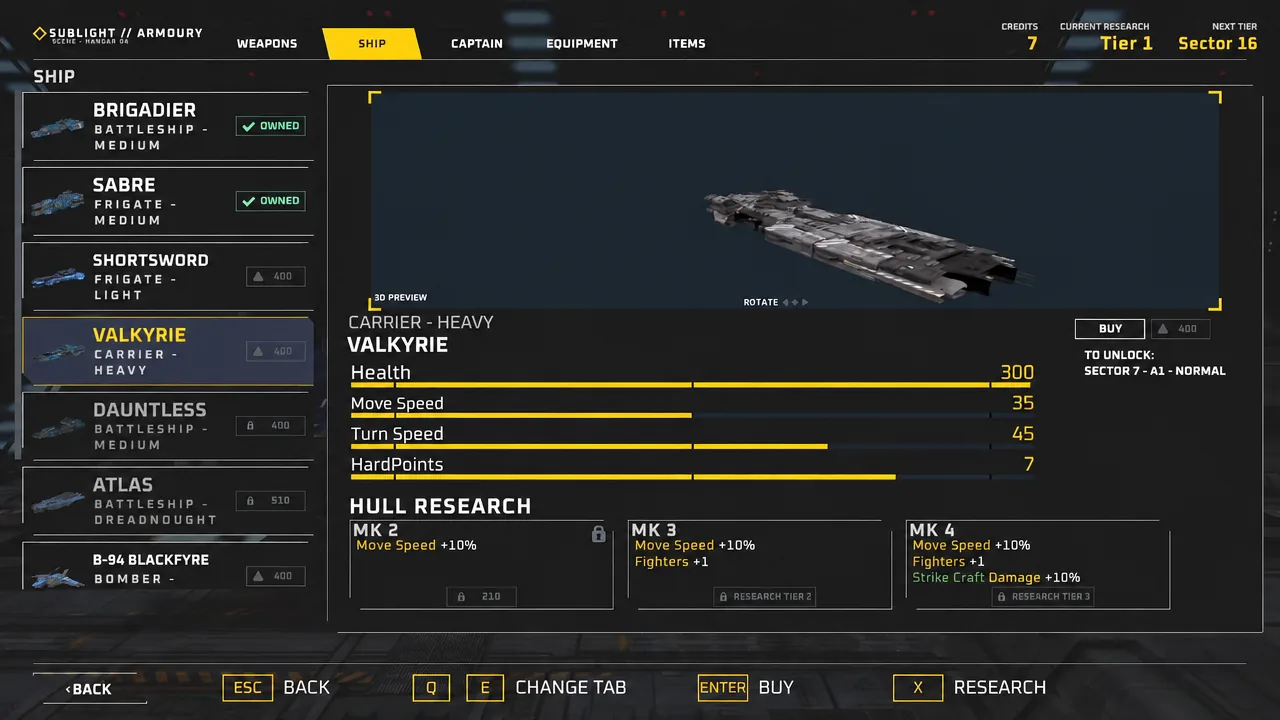
The Ship tab covers a spread of hull classes, including the medium battleship Brigadier, the medium frigate Sabre, the Valkyrie carrier, the Atlas dreadnought, and the B-94 Blackfyre bomber. Each lists Health, Move Speed, Turn Speed, and Hardpoints, and each has its own hardpoint requirements and firing arcs. Hull Research spends credits to push a ship up through upgrade tiers.
Captains
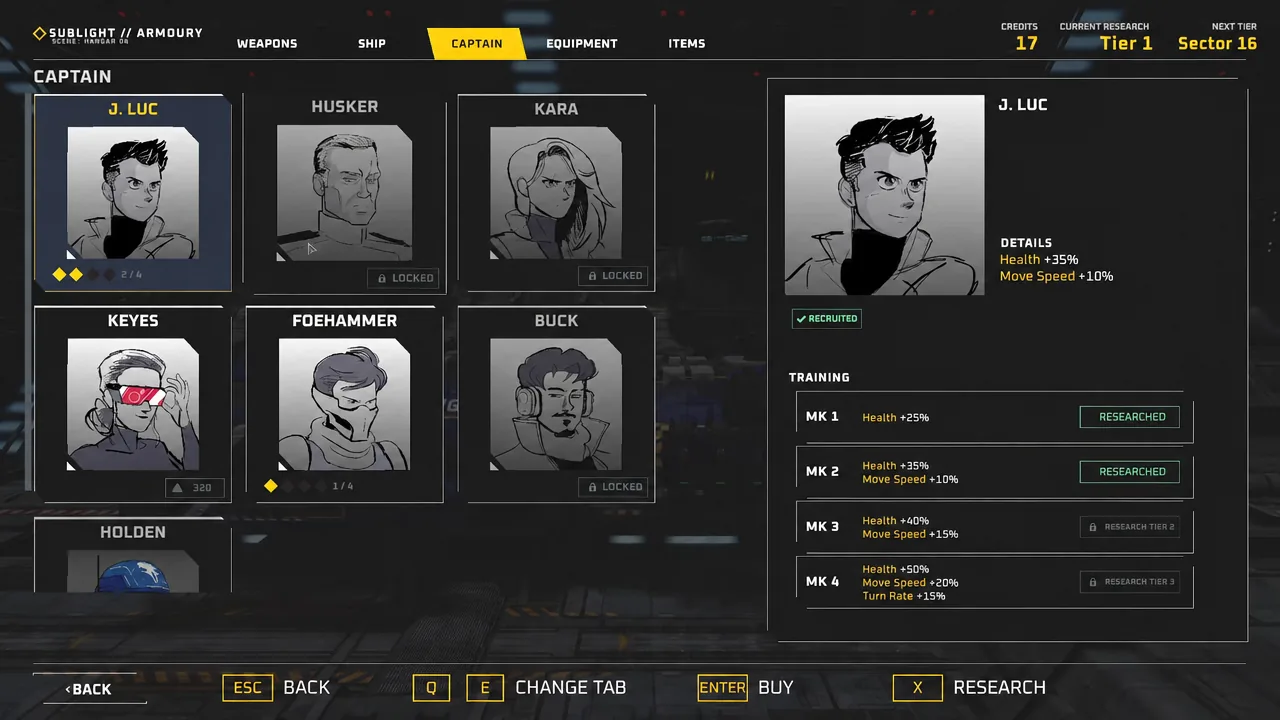
Captains are a second progression layer on top of the hull. The roster includes J. Luc, Husker, Kara, Keyes, Foehammer, Buck, and Holden, each with its own stat profile and Training tiers running from MK 1 to MK 4. The picks matter because they lean into specific playstyles, such as kinetic damage, ramming resistance, longer status effect duration, or strike craft bonuses.
Equipment and passive items
Equipment covers the active abilities you trigger mid-run, each on its own cooldown, and some are gated behind sector unlock requirements. Passive items are the stat backbone and can be researched from MK 1 up to MK 4 using credits.
- Active equipment: Thruster Overdrive, Barrage Core, Tactical Jump, Pyrotech Kit, Missile Launchers
- More equipment: Shield Boost, Emergency Repair, Fleet Support
- Passive items: Ablative Armor, Afterburner Fuel, Autoloaders
- More passives: Deflector Plates, Heavy Rounds, Shield Emitters
Weapon categories
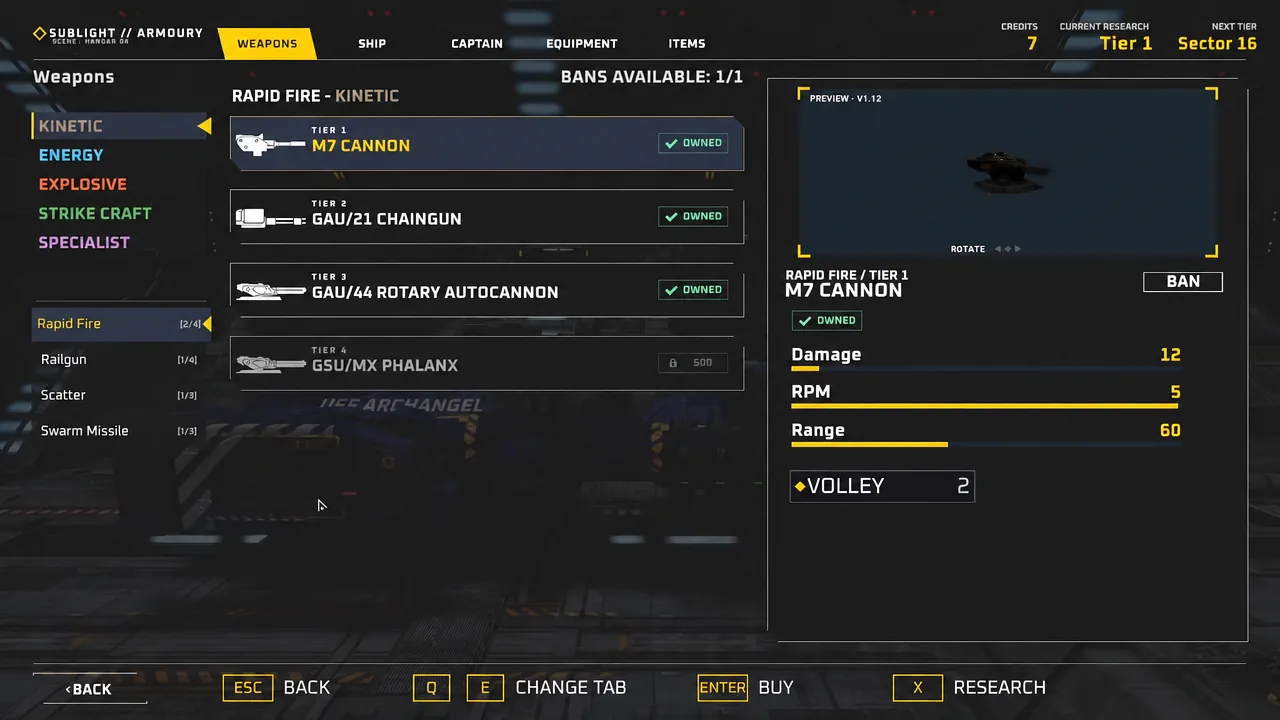
Weapons are grouped into Kinetic, Energy, Explosive, Strike Craft, and Specialist families, with sub-variants such as Rapid Fire, Railgun, Scatter, Swarm Missile, Plasma, Pulse, Beam, Autocannons, Escorts, and Pyrotechnic. Because weapons come in tiers, part of the meta is stacking synergies rather than just bolting on the highest number you can afford.
How a Sublight run plays out
Before deploying, you set a loadout of ship, captain, weapons, and one equipment ability, then pick a primary color, secondary color, and livery decal. The Deploy screen shows an act mission map with individual sectors and three difficulty options, and it lists the unlockable rewards attached to objectives such as destroying the ISF Citadel.
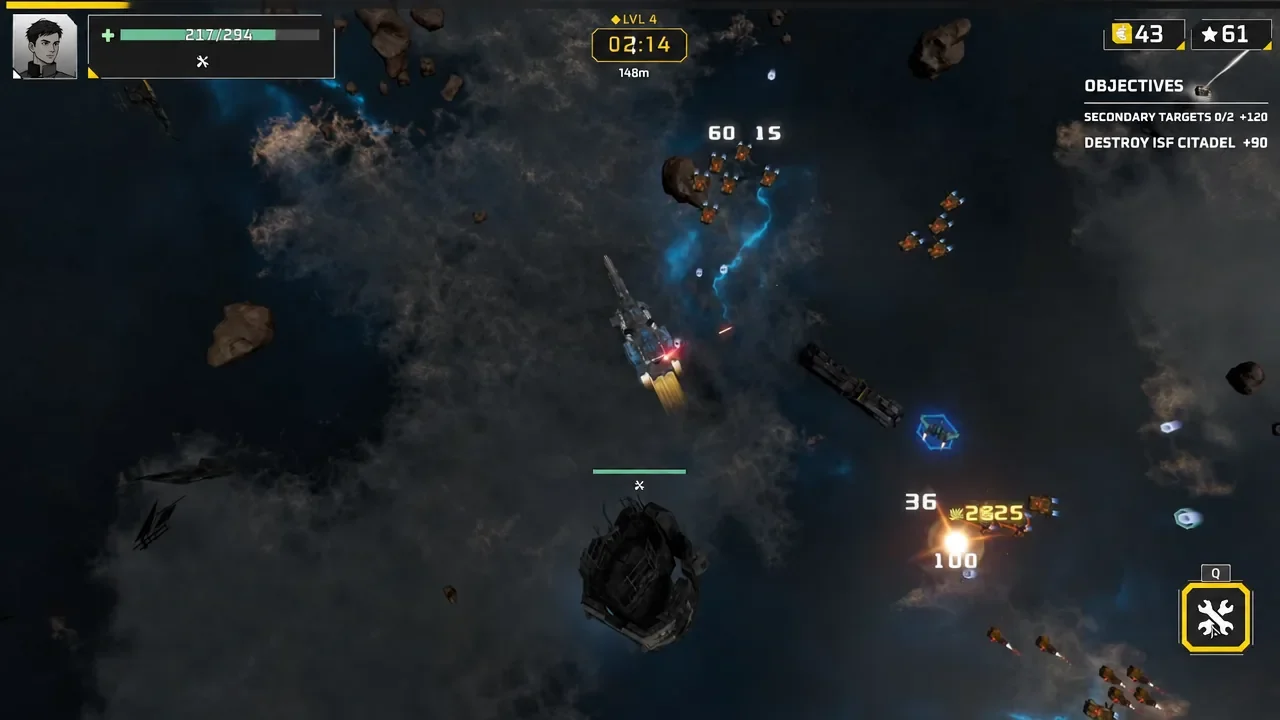
Once you drop in, the loop is familiar to anyone who has played a bullet heaven. You fly through asteroid fields and enemy fighter waves, kills drop EXP and credits, and a magnetic tractor effect pulls pickups toward the hull.
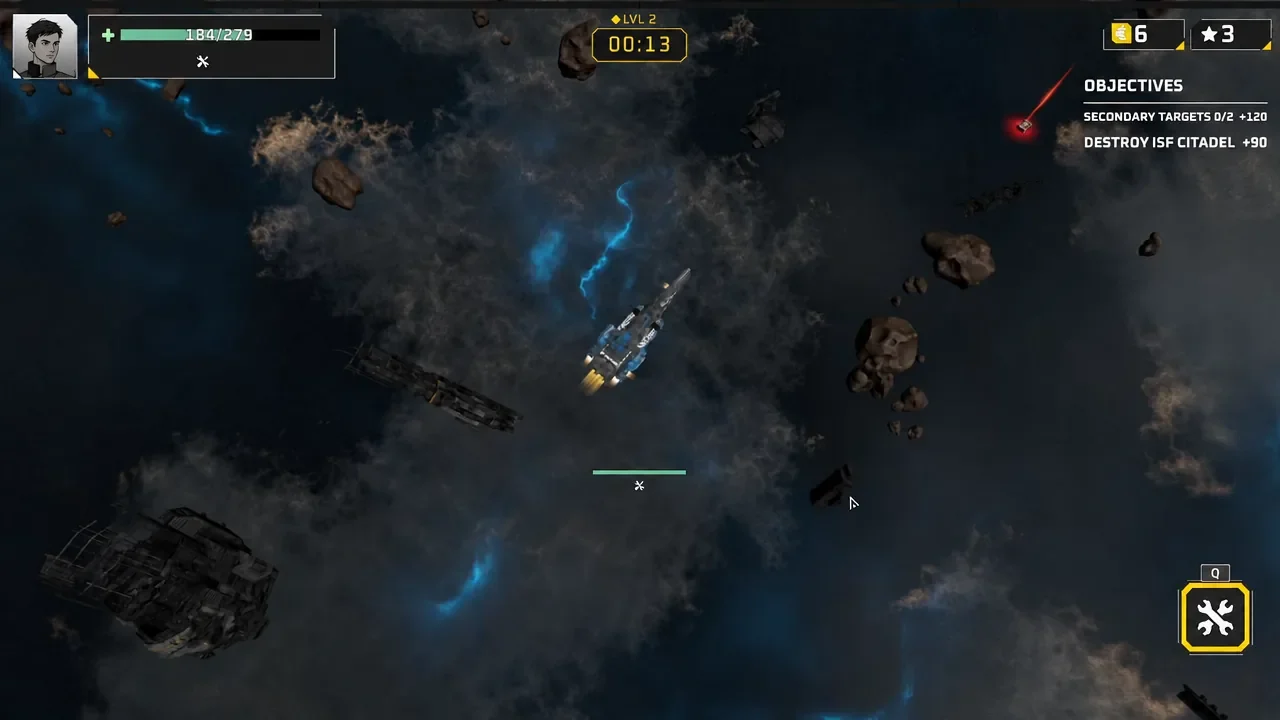
The wrinkle is placement. Level-ups offer weapons like the M7 Cannon, the MS16 Missile Launcher, or Cryonic Rounds, and you choose which hardpoint slot each one goes into. Every mount has a firing cone, so a badly positioned turret will waste most of its output. The pause menu lets you reorganize mounted arcs mid-run.
Firing arcs are the part of Sublight that separates it from the genre standard. Turrets do not auto-cover every angle, and a heavy hull that cannot turn quickly will leave gaps.
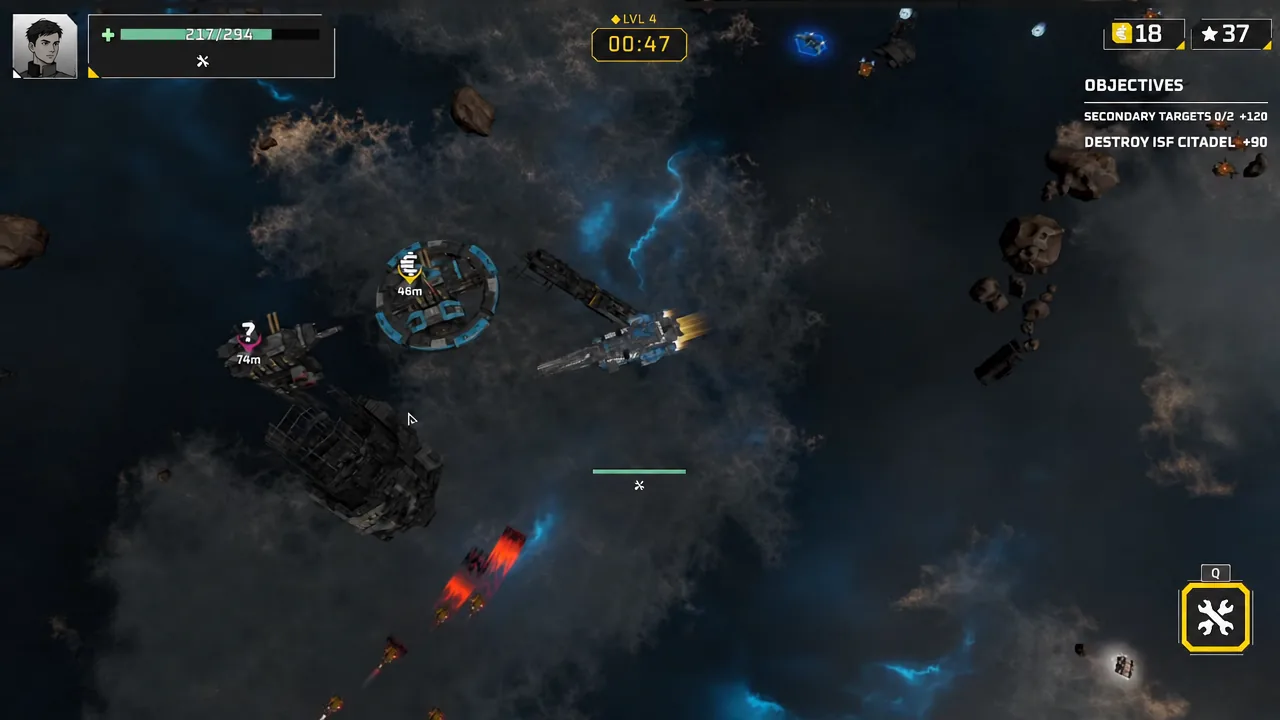
Runs also break up the shooting with side activities. Circular Beacon Defense zones award caches for holding position, and in-space Market stations let you spend credits on repairs, weapon upgrades, and hull modifications. Later on, a Large Signature Detected warning signals the arrival of a mini-boss such as the ISF Scuttler, which drops a reward when destroyed.
System requirements
| Component | Minimum | Recommended |
|---|---|---|
| OS | Windows 10 21H1 | Windows 10 21H1 |
| CPU | Core i3 (4th gen) | Core i7 (4th gen) |
| RAM | 4 GB | 8 GB |
| GPU | DX10/11/12 or Vulkan | DX10/11/12 or Vulkan |
| Storage | 6 GB | 6 GB |
There is a SteamOS and Linux build as well. It asks for SteamOS 3.0 or Ubuntu 20.04 at minimum with a Core i5-4430 or Ryzen 3 1200, 4 GB of RAM, and a Vulkan-capable GTX 960 or RX 470. The recommended Linux spec moves up to SteamOS 3.6+ or Ubuntu 22.04, a Core i7-7700 or Ryzen 5 2600, 8 GB of RAM, and a GTX 1060 6GB or RX 5500 XT.
Early Access roadmap and how long it will run
Codebrew expects Sublight to stay in Early Access for at least six months, with regular updates, fast bug fixes, and content drops on a set cadence. The published plan runs through 2027.
| Window | Planned content |
|---|---|
| Q4 2026 | New enemy faction, new ships and weapons, more builds, balance changes |
| Q1 2027 | Boss drop weapons, enemy flagship hunts, new mission types |
| Q2 2027 | Refreshed campaign on an XCOM-style threat map, expanded factions, more research |
| Q3 2027 | Community-voted ships and weapons, mod support, achievements |
All of that is subject to change, as Early Access plans usually are. The stated reason for shipping unfinished is collaboration: the developer is active daily in the game’s Discord and checks the Steam forums, and says ship designs, weapons, balance changes, and core features have already been shaped by player requests.
Where to get Sublight
Sublight is sold directly through Steam, and the purchase unlocks the full Early Access build immediately. User reception so far is positive across a small review count, which is worth weighing against how young the release is.
For anyone on the fence, the sensible order is to run the demo first, check that the firing arc system clicks for you, and then decide. The systems on display in Early Access are already deep enough to reward experimenting, and the price does not move when 1.0 arrives.