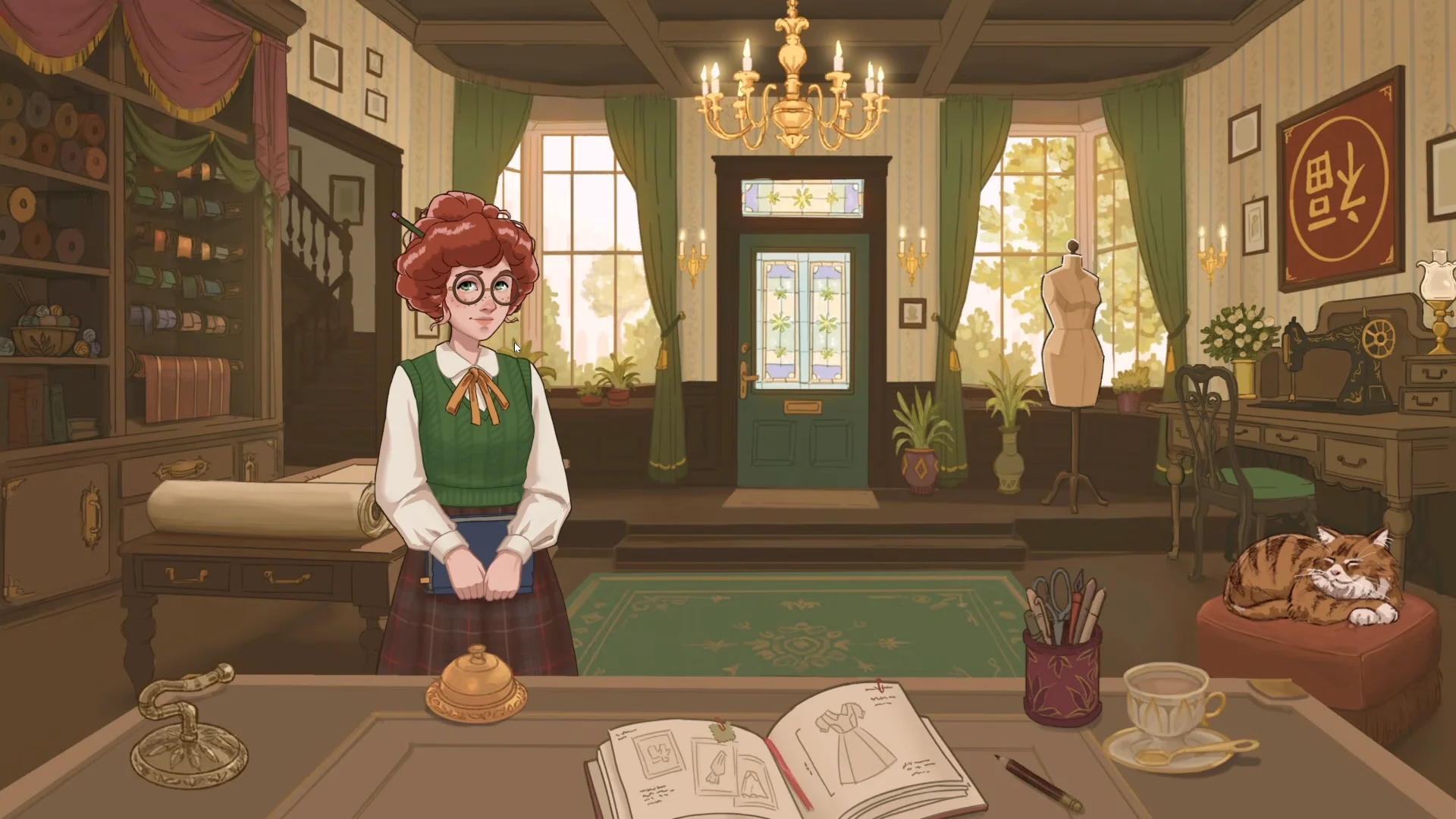
Dressmaker is a cozy simulation game about actually making clothes, not just picking them off a menu. Customers walk into your shop with an occasion, a style preference, and a budget, and you handle every stage of the garment yourself — measuring, designing, buying cloth, cutting panels, sewing seams, and pinning on trim. It is closer to a job sim than a fashion dress-up game, and the rules underneath it are strict enough that a sloppy cut will follow you all the way to the final score.
Quick answer: Every commission runs the same chain — measure the client, design to their style targets in the sketchbook, buy tagged fabric, cut on the grain, sew the seams, decorate, photograph, and deliver.
The commission loop, step by step
There is no timer on any of this. You can spend ten minutes or an hour on a single dress, and the order of operations never changes.
Fabric types, tags, and budget limits
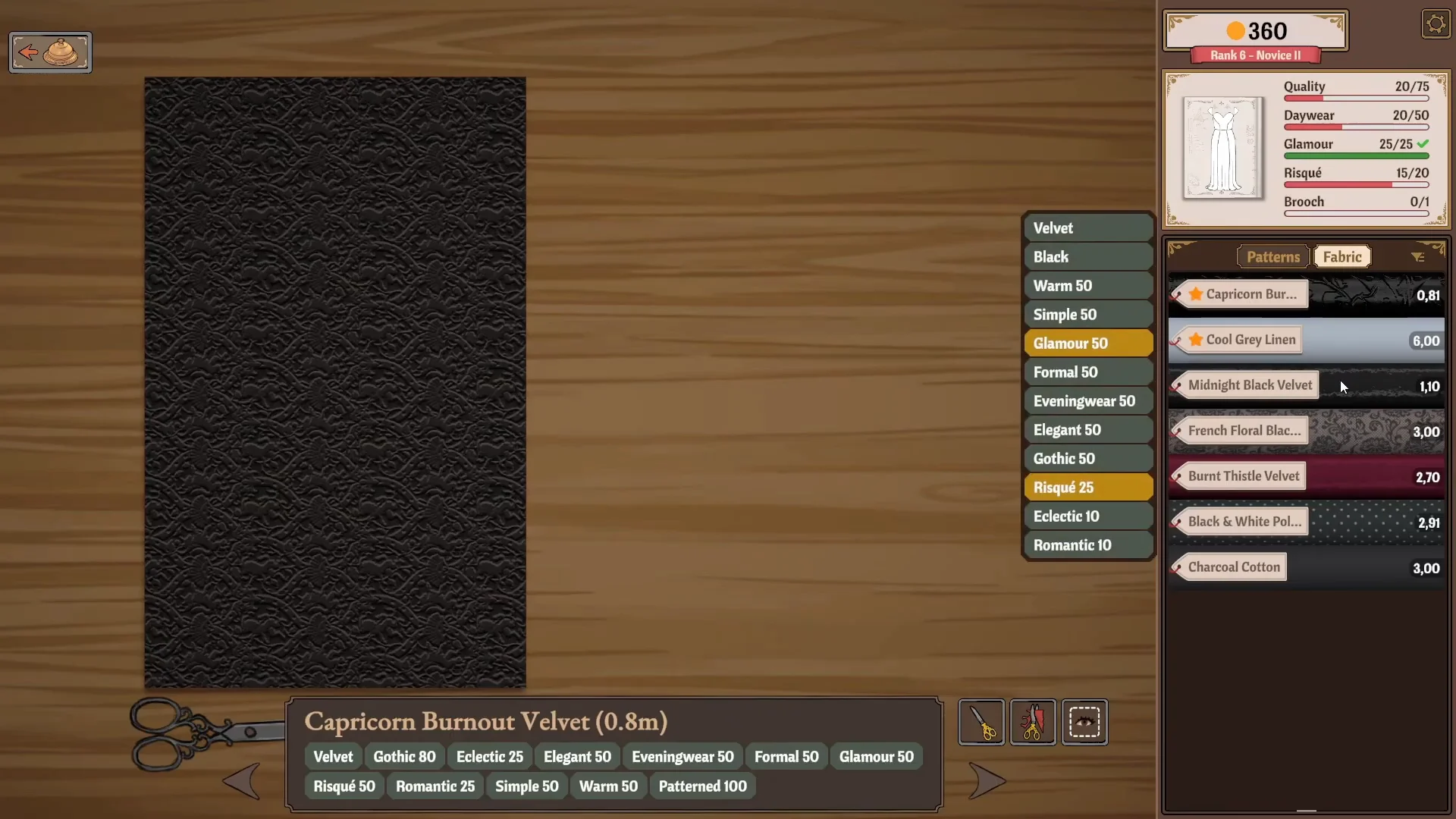
Five material families make up the shop’s stock, and each one leans toward a different kind of commission. The tag filters in the Emporium are the fastest way to find something that matches the brief.
| Fabric | Suits | Look |
|---|---|---|
| Cotton | Casual, workwear | Matte, sturdy |
| Linen | Relaxed, summer | Textured |
| Wool | Professional, winter | Dense, warm |
| Silk | Formal, elegant | Smooth sheen |
| Velvet | Balls, opera | Rich, deep |
Budget is the real constraint. Silk and velvet eat into the money you have left for buttons and lace, and a simpler pattern uses less cloth overall. Leftovers from earlier jobs stay in your inventory and can be used again.
Grain line alignment sets your quality ceiling
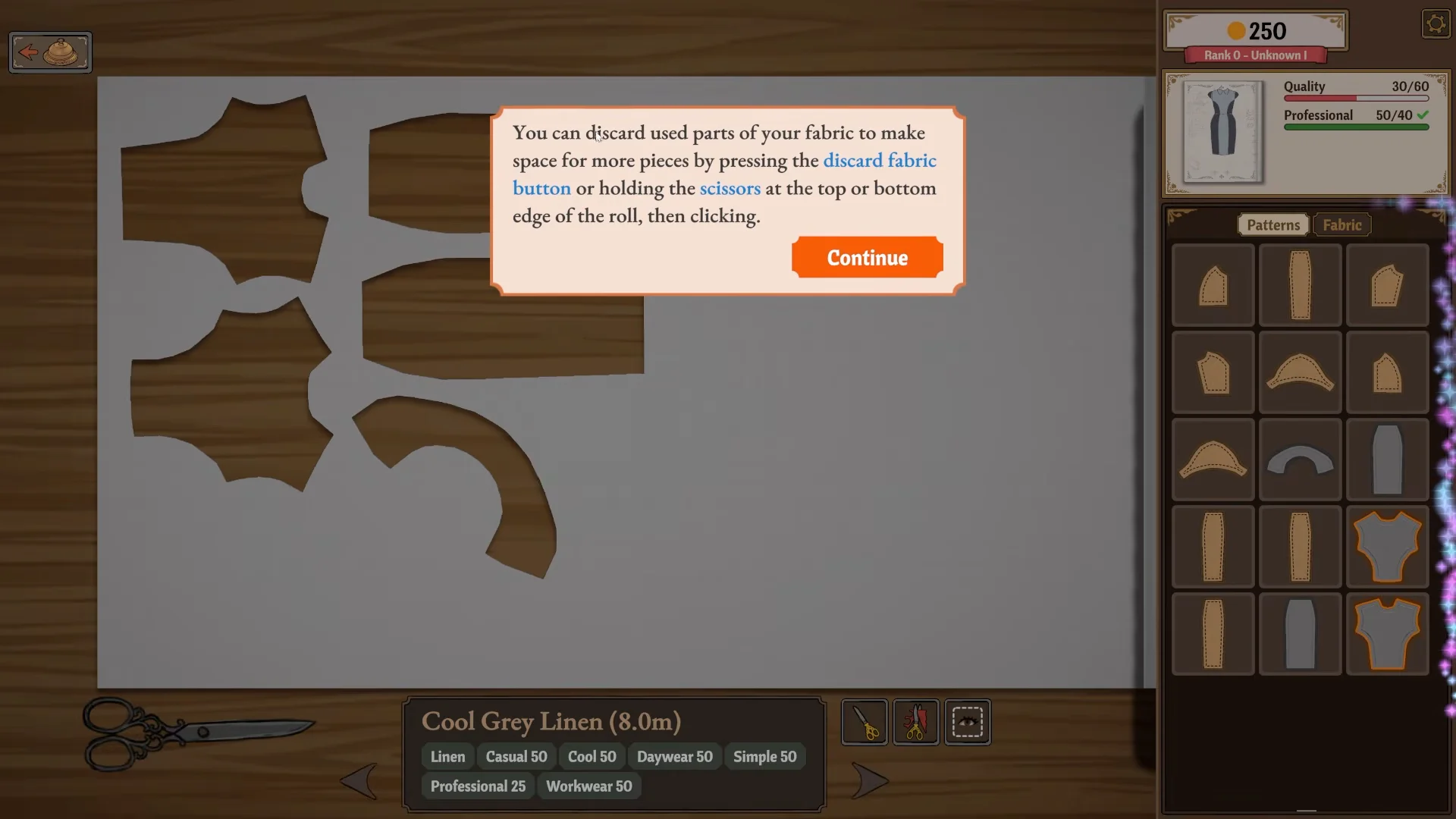
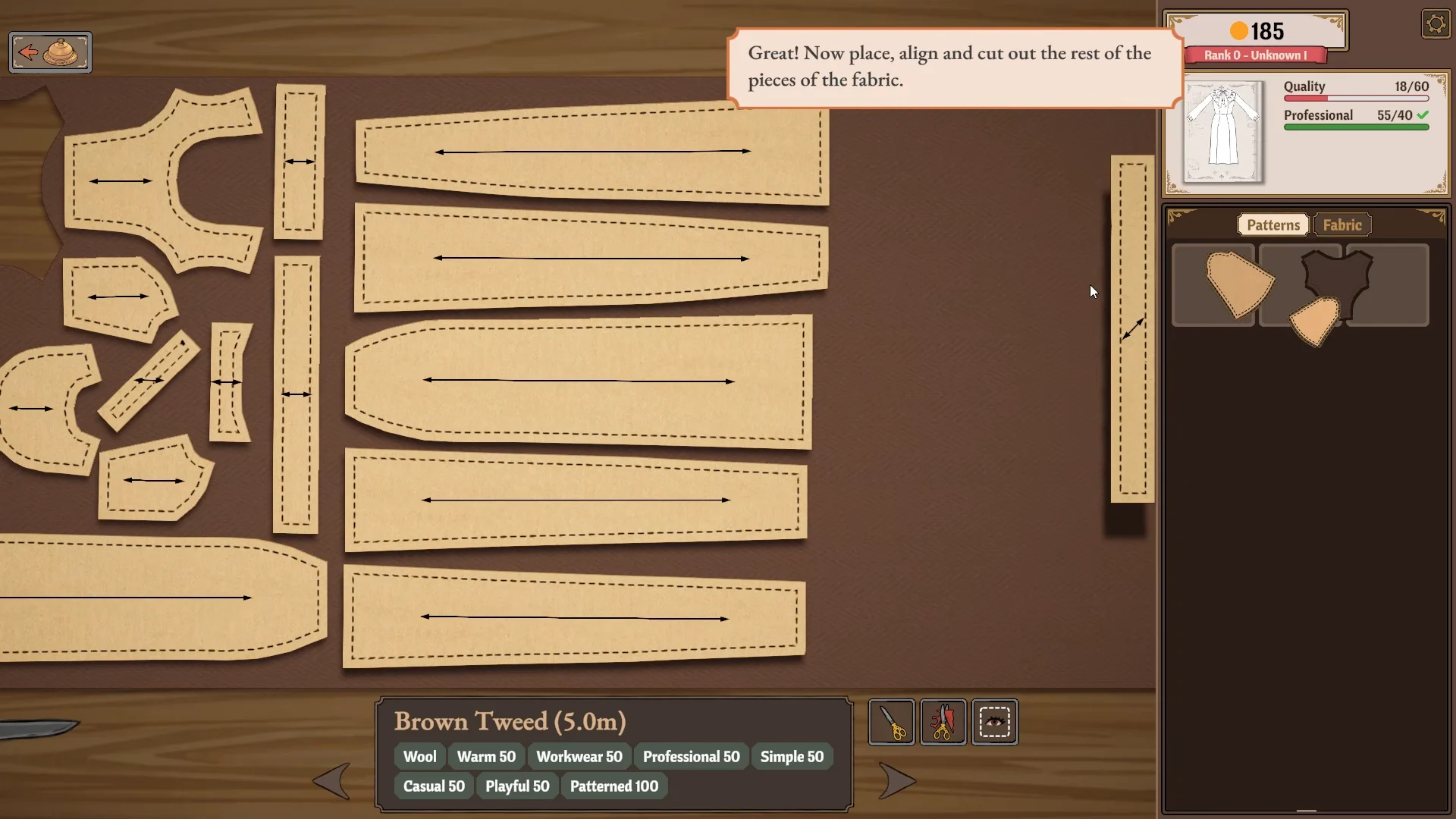
This is the mechanic that trips up most new players. Every pattern piece carries an arrow marking the grain line, the direction of the threads in the cloth. Place a piece so that arrow points left or right and the outline turns green. Leave it pointing up or down and there is no green outline.
Whatever you cut is what ends up on the finished dress, including bias-cut panels and any stripes that fail to line up. The game shows how much fabric a piece will consume before you commit, so arranging panels tightly is worth the effort.
Misaligned pieces cap your quality score outright. If your finished dress refuses to reach 100% quality despite clean stitching, the cause is almost always a panel that was cut off-grain.
Sewing machine controls and Sewing Assist
Each seam is its own small minigame. A marked stitch line shows the path, and you feed the fabric under the needle while the machine runs. Hold the space bar to sew and steer the cloth with the keyboard, or click and drag with the mouse to push the panel forward. Rotating the fabric as you approach a curve is the whole skill.
Quality is scored live. Drifting off the line drops the number fast, and going badly off course forces you to restart the seam. The machine carries momentum, so releasing the controls to pause and reposition is a legitimate tactic rather than a workaround.
Turn on Sewing Assist in the settings if steering is fighting you. It guides the fabric around curves automatically while you handle the pace.
Pinning, accessories, and the photo studio
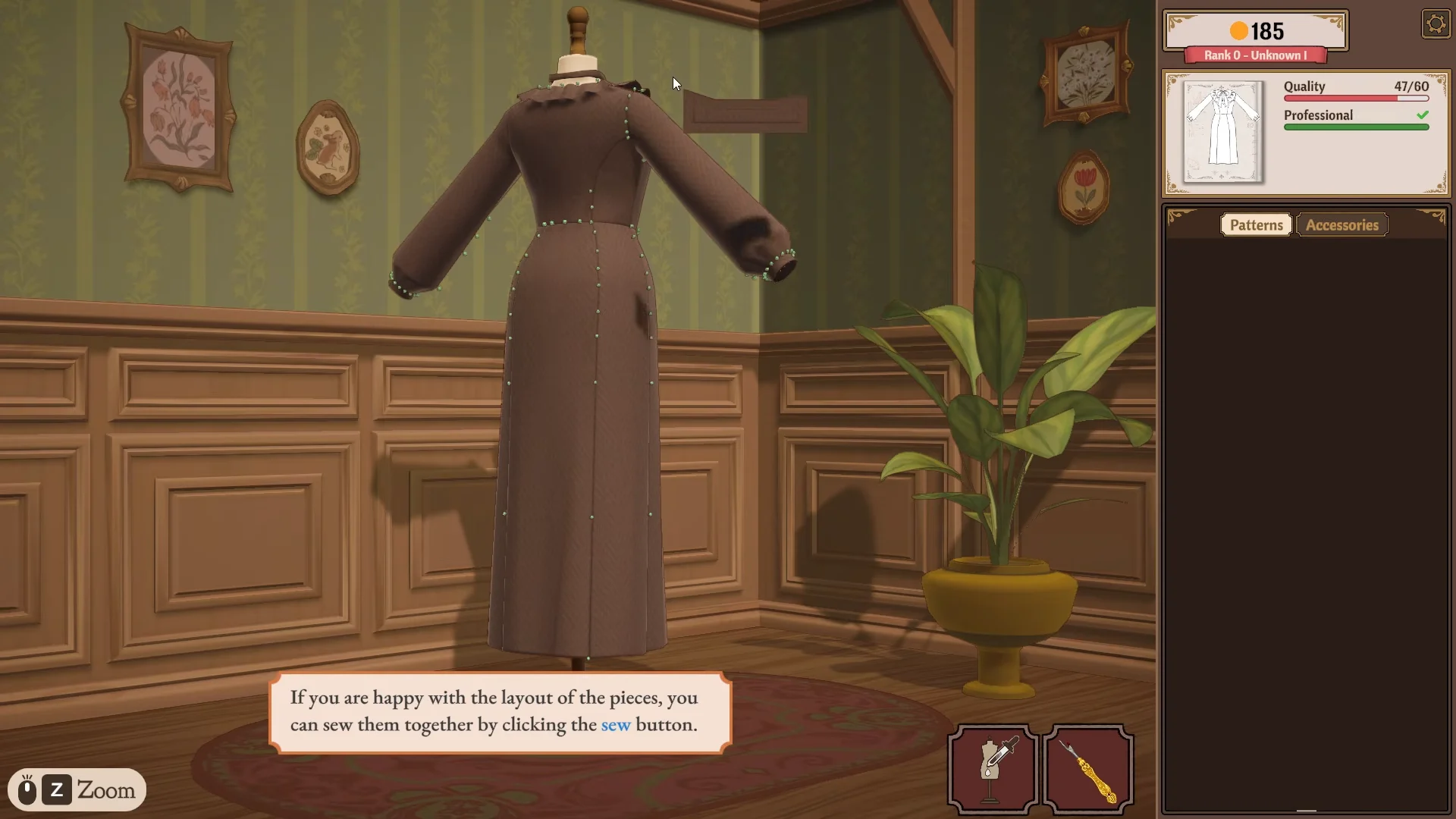
Before stitching, every cut panel gets pinned onto the dress form. That fitting pass is your chance to check alignment and how the colours block together, and it costs nothing to rearrange at this stage.
Decoration is free-form. Buttons go anywhere and in any quantity, bows and lace trim can be layered along hems, sleeves, waistlines, and open backs, and placement affects style stats — a skinny bow under a cutout, for instance, pushes elegance upward. There is no full undo for decoration, so place optional trim slowly.
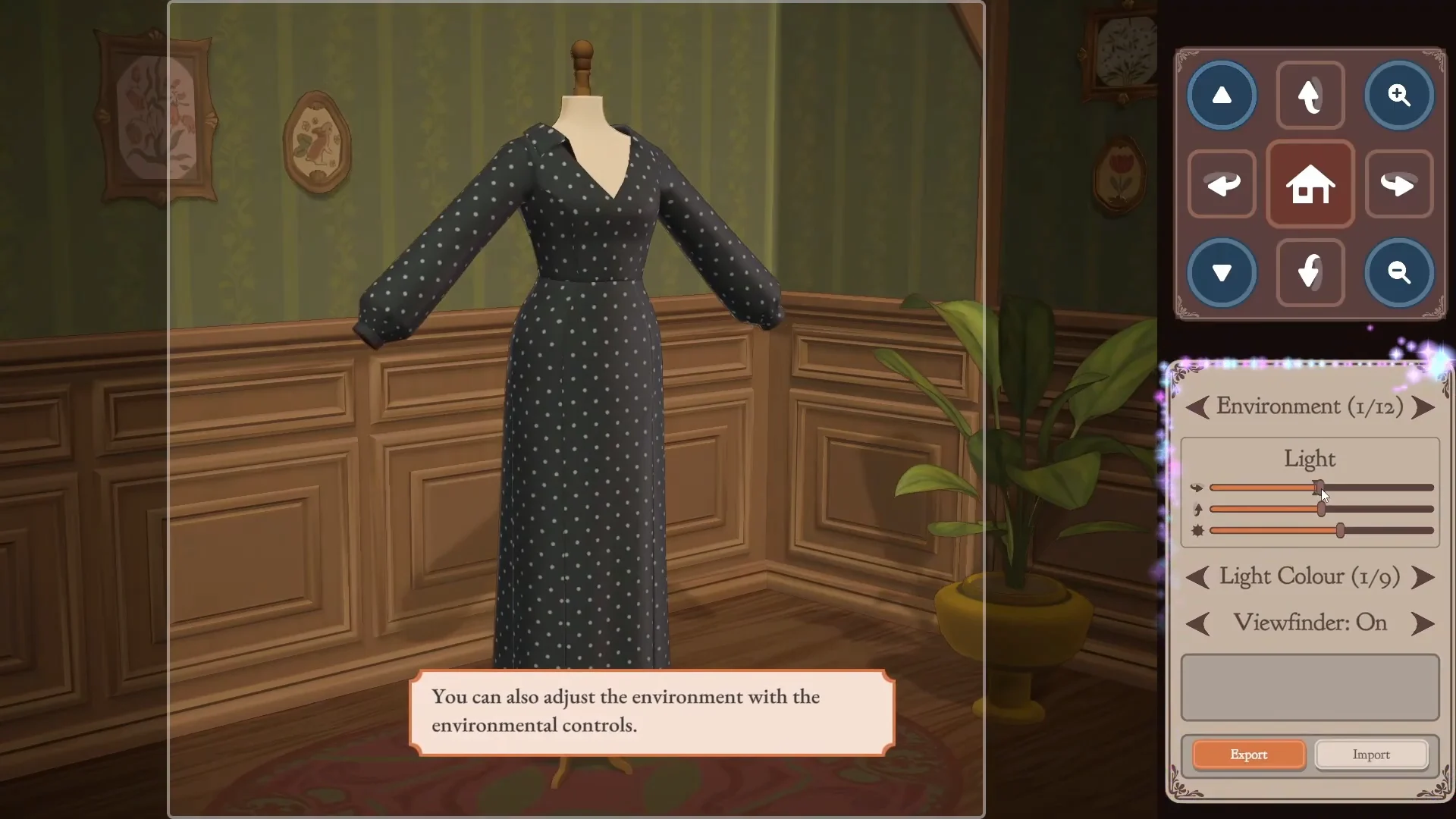
The finished garment then goes to the photo studio, where you set the camera angle and adjust lighting intensity and direction before saving a record shot of the dress.
How clients score the finished dress
Delivery is the confirmation step. The customer tries the dress on, reacts in dialogue, and awards a star rating up to five. A successful hand-off raises friendship and reputation, pays out the commission, and unlocks new dress patterns plus fresh stock in the shop — Rose’s job opens up new patterns, while Prudence Mortimer’s gown adds corset options. If none of that appears, the dress was not accepted.
Three things feed the evaluation: quality from grain alignment and stitching precision, how closely the design matches the requested style tags, and whether you stayed inside the budget. The commission brief spells out the targets up front.
| Client | Occasion | Targets |
|---|---|---|
| Rose | Librarian workwear | Quality 60, Professional 40 |
| Prudence Mortimer | Flamboyant funeral | Elegant 65, Glamour 40, Quality 75, avoid black |
| Priya | Funeral | Gothic, all-black, intimidating |
Your reputation is summarised in the newspaper at the end of the day, and every dress you finish is archived in the sketchbook so you can look back at earlier work.
Where to get Dressmaker
The full game arrived on Steam on September 21st, 2026, developed by Cozy Lives and published by Free Lives. It costs $14.99, with a 10 percent introductory discount bringing it to $13.49 until September 28th. It ships with 32 achievements, Steam Cloud, and full English, Simplified Chinese, and Japanese support. The minimum spec is Windows 10, an Intel Core i5 or AMD Ryzen chip, 8GB of RAM, and 1GB of storage; Mac builds need an Apple M1 or better.
The free prototype on itch.io
The original prototype is still available on a name-your-own-price basis, with Windows, macOS, and Linux builds of version 0.5.5. It was put together by Free Lives in roughly three weeks, with another month or two of work added later, so some mechanics are rougher than the released version and a few ideas never made it in.
The Mac build is not notarized, so macOS may warn that the app could be malicious. To run it, open System Settings, go to Privacy & Security, scroll down, and click Open Anyway, then confirm at the second prompt. The prototype download page lists each platform’s archive.
If you are deciding which to start with, the prototype is a fair sample of the cutting and sewing systems, but it stops well short of the full town of customers. And yes, there is a cat in the shop, and you can pet it.