King in the Mountain is a 2D pixel-art management game about an exiled king who sends dwarves into a mountain to dig up gold, gems, and artifacts, then uses the loot to rebuild his fallen hall. The demo trailer lays out the whole rhythm of the game: prepare a squad at home, run a timed expedition outside the base, and bring back resources before the light or the day runs out.
Quick answer: King in the Mountain is a dwarf management and mining sim. A free demo covering up to Mine level 2 of 3 is on Steam now, with the full game planned for Oct 30, 2026.
The core loop: base, then expedition
The game alternates between two modes. Inside the mountain fortress you recruit dwarves, build workstations, and research upgrades. Outside, you launch timed runs to gather materials. You do not control a single hero. Instead you manage a population of dwarf workers and miners, assigning them to buildings or to expedition squads.
Recruiting costs food, and the price climbs as your colony grows. The trailer shows “Recruit” buttons rising from 8 food to 9, then to 45, alongside a “Cap Full” state once you hit the population limit. Food is the currency that keeps the workforce expanding.
Two expedition types: forest and mines
Surface runs take place on a forest map. Dwarves clear paths, chop trees, and gather wood, berries, and stone. These runs are governed by a daytime timer, so the pressure comes from how much you can collect before the sun runs down. In the trailer this is toggled with a “Stop Farming” button.
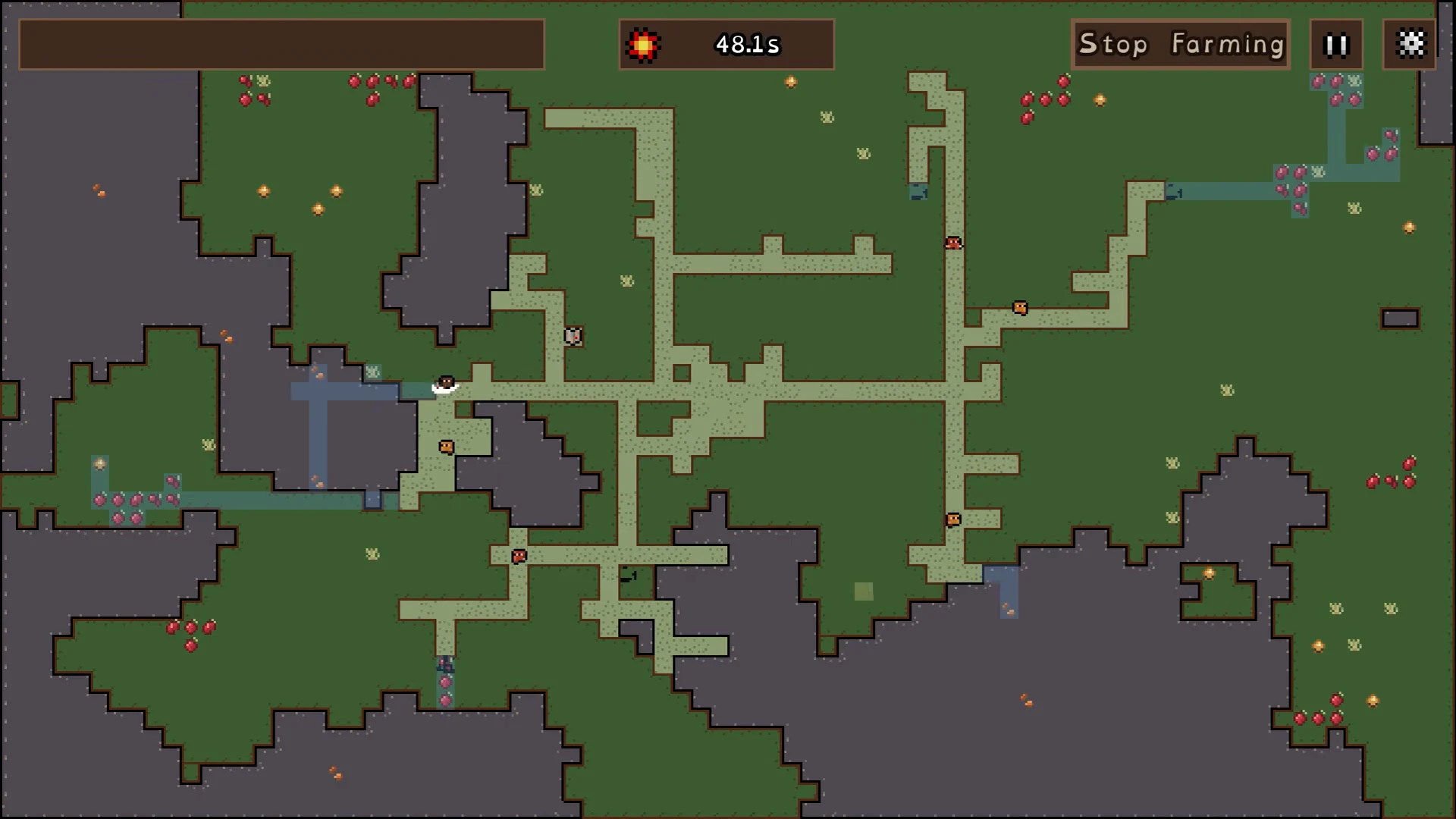
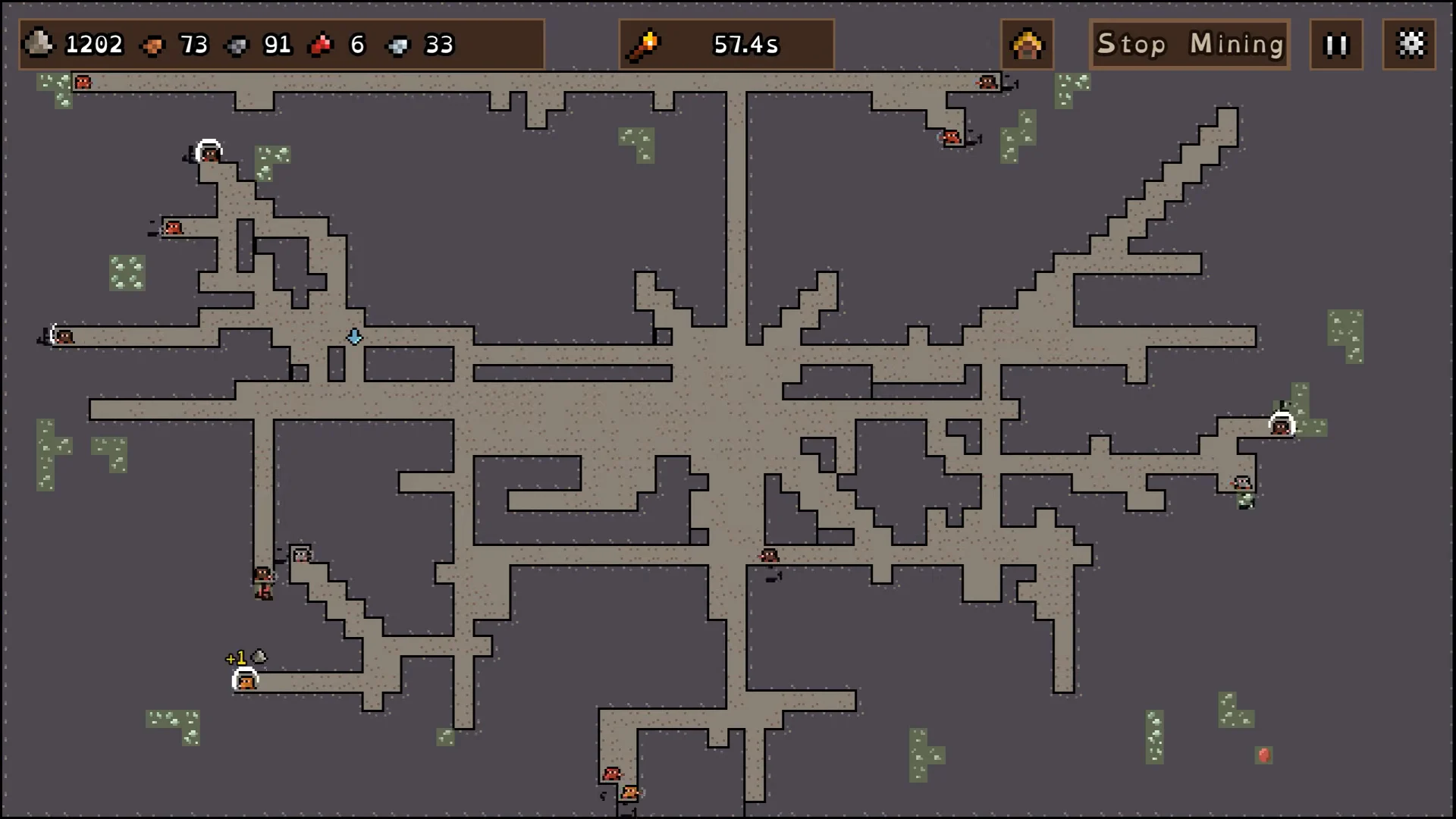
Underground runs are the other half. Dwarves excavate branching tunnels across multiple levels, hauling out ores and minerals. Instead of a daylight limit, mines run on torchlight. When the light burns out, the run ends, which is why every expedition is a trade-off between digging deeper and getting your dwarves out in time.
Rebuilding the Mountain Hall
The fortress is where loot is turned into progress. You place and arrange rooms and workshops, including sawmills, smelteries, ore mines, kitchens, and sleeping quarters. The trailer shows building menu entries such as “Sawmill 3” and “Sleeping 2,” pointing to leveled or numbered structures.
A busy hall fills with smelters, anvils, food storage, and kegs, with dwarves chatting through emote bubbles. Every dwarf carries an individual Norse-inspired name such as Sudri, Grimr, Asmund, Einar, and Nordri, which matters when you build squads and read the roster.
Tech tree, provisions, and gear
Research is handled through a branching tech tree with categories like Movement and Zoom. Nodes cover passive buffs and new recipes, and each shows a level count such as “Level 0 / 1” or “Level 1 / 1.” A few examples appear directly in the trailer.
- Lightfoot — +10% walk speed on expeditions.
- Feast Dishes — unlocks Pizza, with 15% faster swings and +10% move.
- Brewery — brews grain and water into ale.
Provisions are consumables you pack before leaving. Whetstones add +2 damage, Stick Torches add +10s of light, and Pitch Torches add +25s of light. Gear upgrades stack on top of that. A Copper Pickaxe, for example, gives +1 damage and +1 dwarf. Extending torch time and improving dig effectiveness are how you push into deeper mine levels.
Planning a descent
Before a run, you choose a map, assign a squad, and load provisions. The preparation screen tracks how many dwarves are going and how much light you will start with, showing values like “Dwarves: 9” and “Light: 29s,” or “Dwarves: 8” and “Light: 59s” once you pack extra torches.
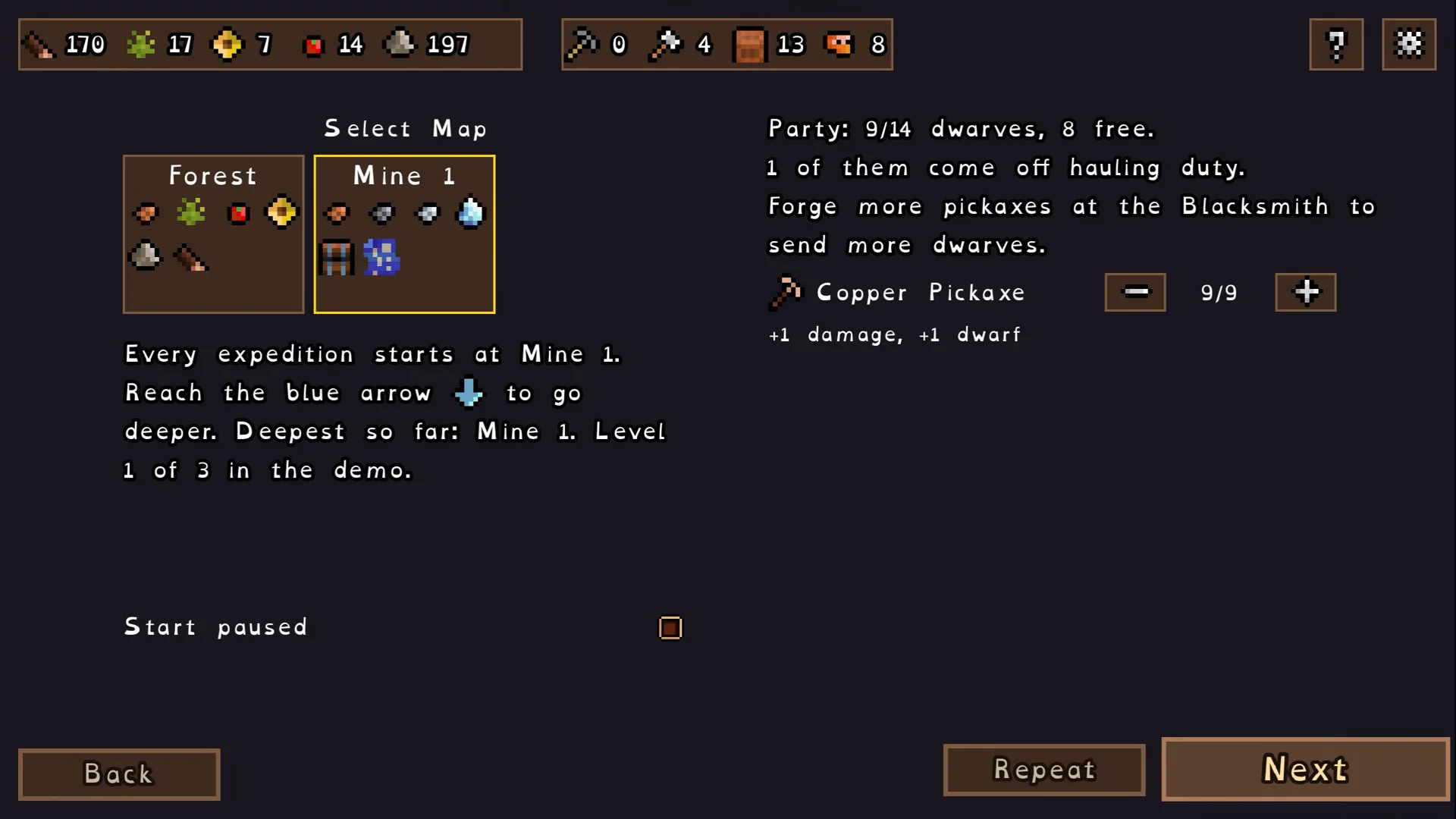
The map screen explains the descent rules plainly. Every expedition begins at Mine 1, and reaching the blue arrow underground takes you deeper. Party settings let you decide how many workers leave their buildings and come off hauling duty, with options to start paused, mark all resources, repeat, or move to the next step.
Demo contents and release date
The playable demo runs on PC through Steam and reaches Mine level 2 of 3, so it covers the early expedition ladder rather than the full descent. It is a single-player, top-down experience described by its makers as focused on planning, digging, and upgrading, with no monsters or combat.
The full game is developed by Milo Panta and published by Milo Panta and Human Qube Games, with a planned release date of Oct 30, 2026. Until then, the demo is the way to try the loop yourself.