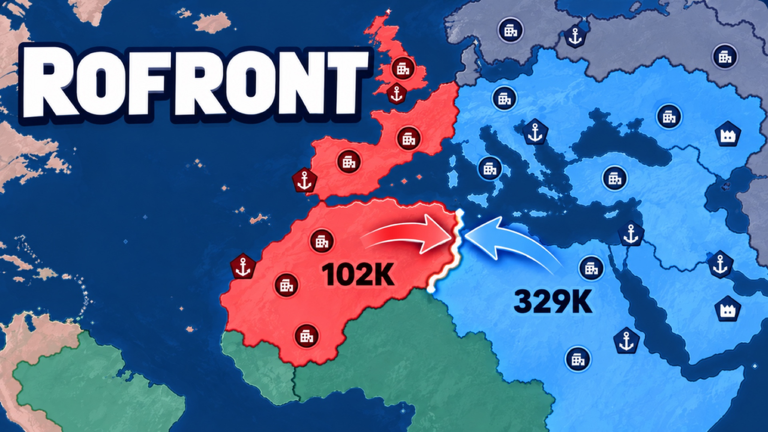
RoFront [World PvP] is a grand strategy game on Roblox built around a single idea printed on its title screen: conquer the real world. You command territory from a top-down tactical map rather than a character avatar, placing a capital and then spreading outward across recognizable countries and regions. Each match blends troop expansion, economy building, diplomacy, and escalating warfare that can end with atom bombs, hydrogen bombs, and missile interceptors trading fire across continents.
Quick answer: You win by capturing a set share of the map’s land. Victory screens in play trigger at roughly 80 percent control, worded as conquering the world “with 80.2% of the land outside fallout.”
Maps and game modes in RoFront
The map menu mixes a full planet with smaller regional and abstract boards. The global World map is the largest, covering every continent, while others focus on tighter areas or geometric layouts. One mode drops the country theme entirely and pits players as tribes against AI nations.
- WORLD — the full global map, played to a world-control victory
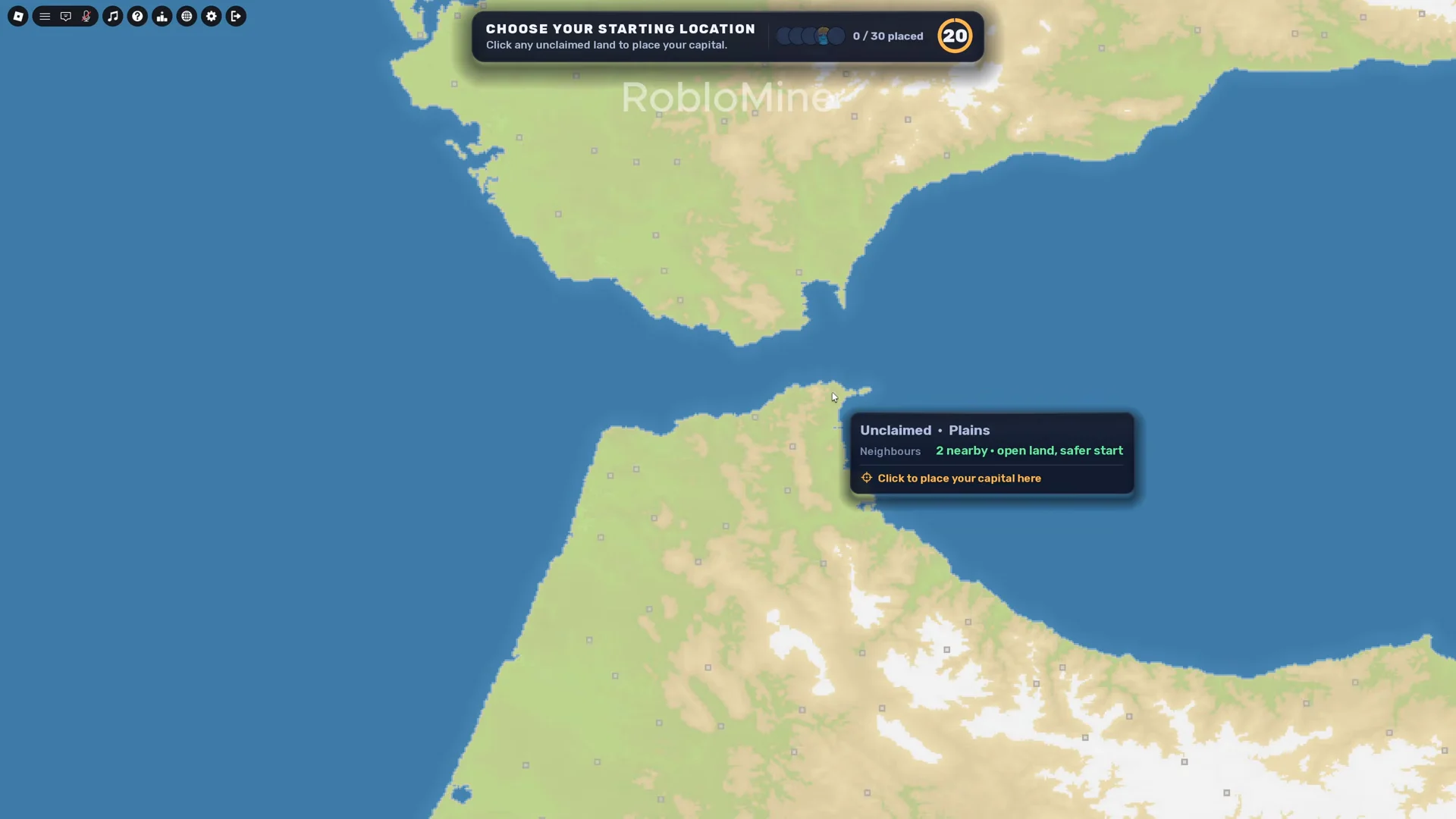
- STRAIT OF GIBRALTAR, LOS ANGELES, MONTREAL, CAPE COD — regional team maps
- CLEARWATER LAKES — an island-and-lake map used for team play
- ARCTIC, SIERPINSKI, THE BOX — smaller or abstract boards
- HUMANS VS NATIONS — a team mode where players face AI-held nations
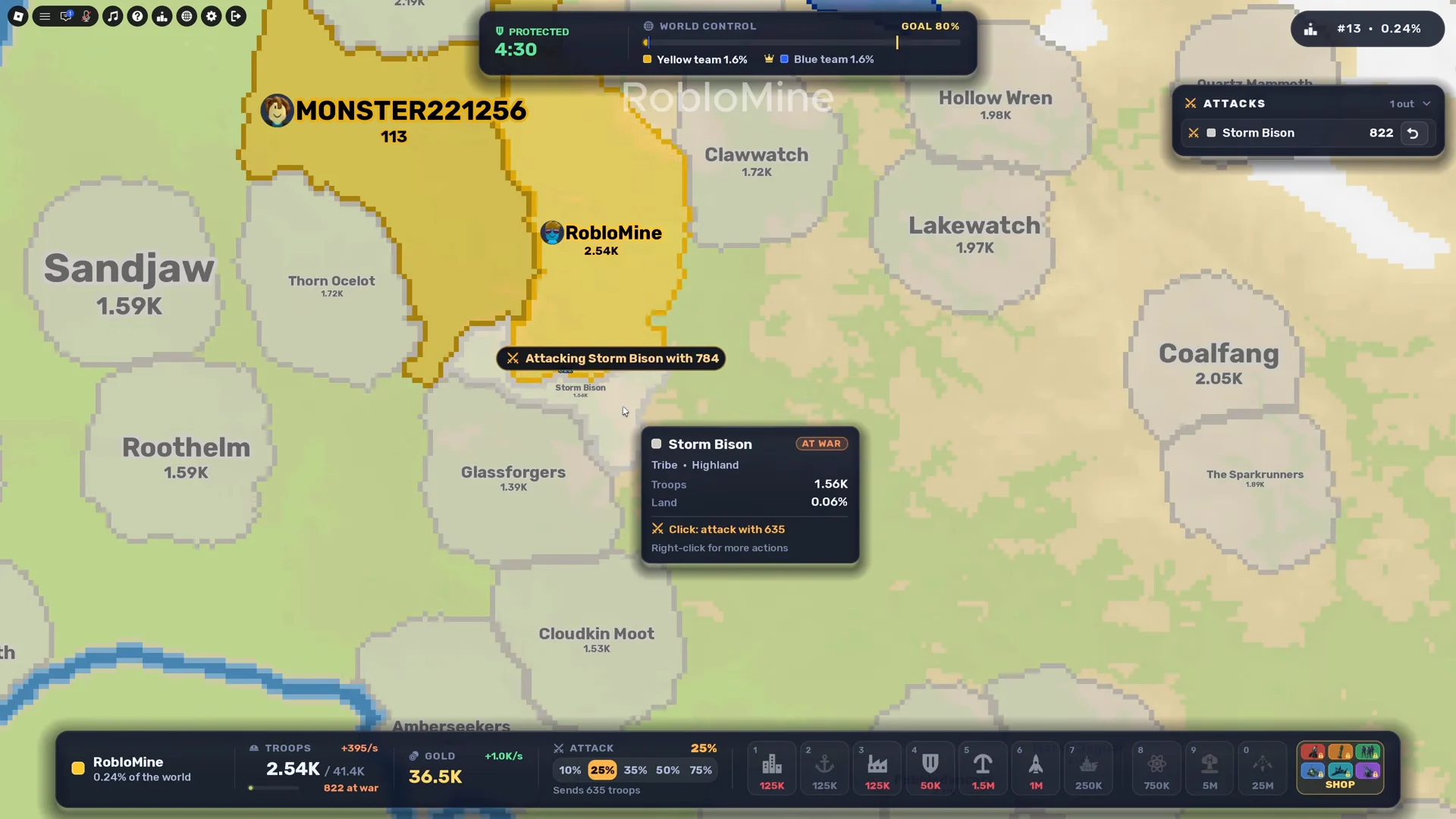
On the global map, nations carry real names like Chad, Kenya, India, Pakistan, Sweden, and Australia. Regional and tribal maps instead use invented factions such as Storm Bison, Clawwatch, Fenhearth, and Lake Nipischi, each holding its own cluster of territory.
Starting a match and expanding
Every match opens with a capital placement step. A prompt reads “CHOOSE YOUR STARTING LOCATION: Tap any unclaimed land to place your capital,” and you drop your starting territory anywhere that is still empty. Once the countdown ends, a “THE WAR BEGINS” banner appears and the game begins.
From the capital you push troops into adjacent empty nodes, labelled as unclaimed plains and mountains. An on-screen hint, “Keep going until you meet a neighbor,” steers early growth toward the nearest rival. Expansion uses percentage troop allocations, so you decide how much of your army to commit to each push while your troop count climbs.
Neighboring neutral factions are the first real targets. On tribal maps that means claiming groups like Tuskfell, Storm Bison, and Clawwatch, hammering each with repeated troop waves until its land flips to your color.
Naval invasions and warfare
When your territory reaches the shoreline, new options become available. The game displays: “You reached the sea. Click a distant coast to send a boat invasion.” Coastal borders make ports available, and transport boats use them to move troops over water to land masses you otherwise could not reach. Dotted lines show the boats’ routes on the map as they travel.
That amphibious reach is how a campaign jumps continents. On the global map, coastal expansion out of Africa feeds invasions of the Arabian Peninsula, Senegal, South Africa, and Madagascar, with land armies and warships working the same borders at once.
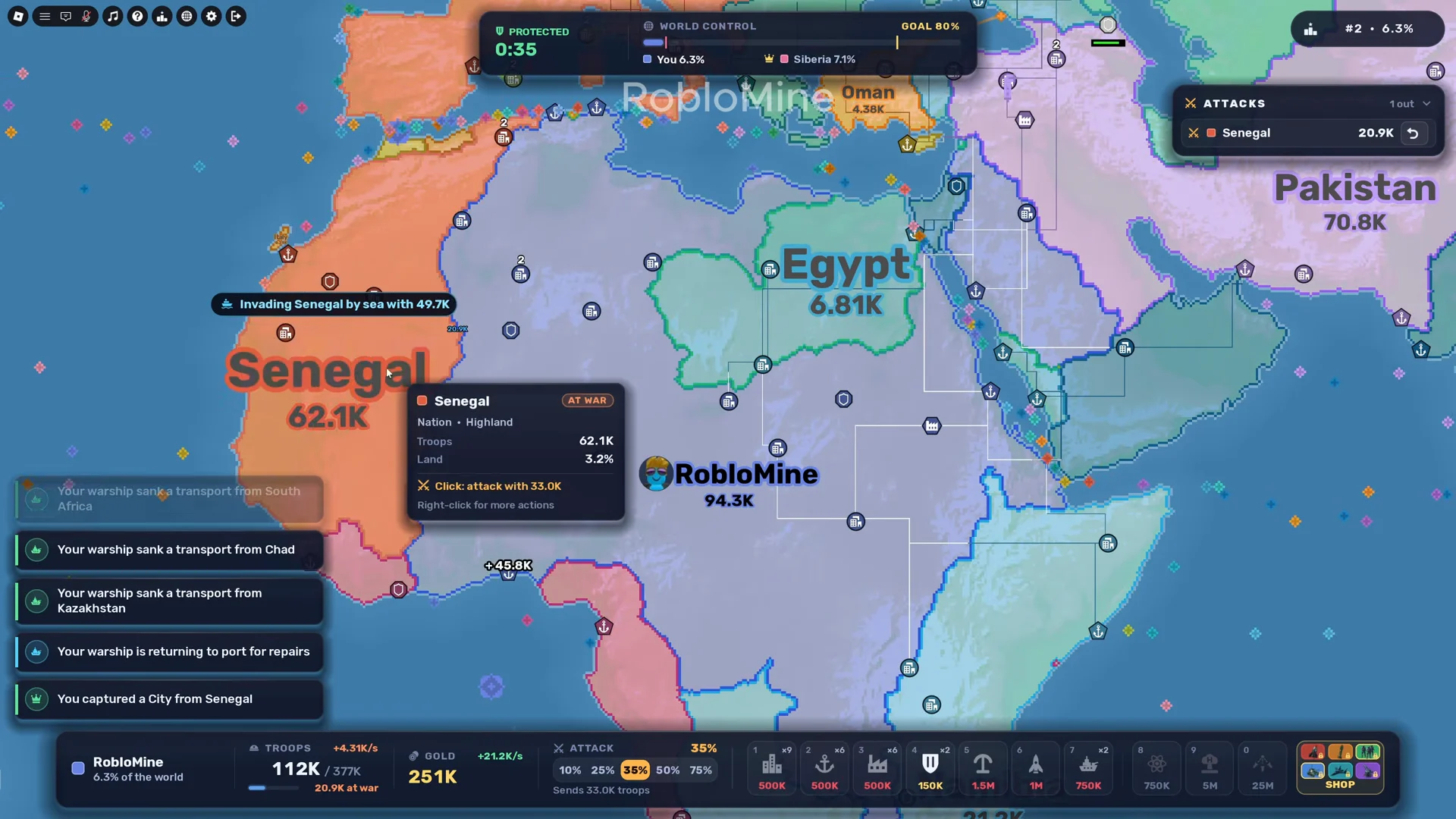
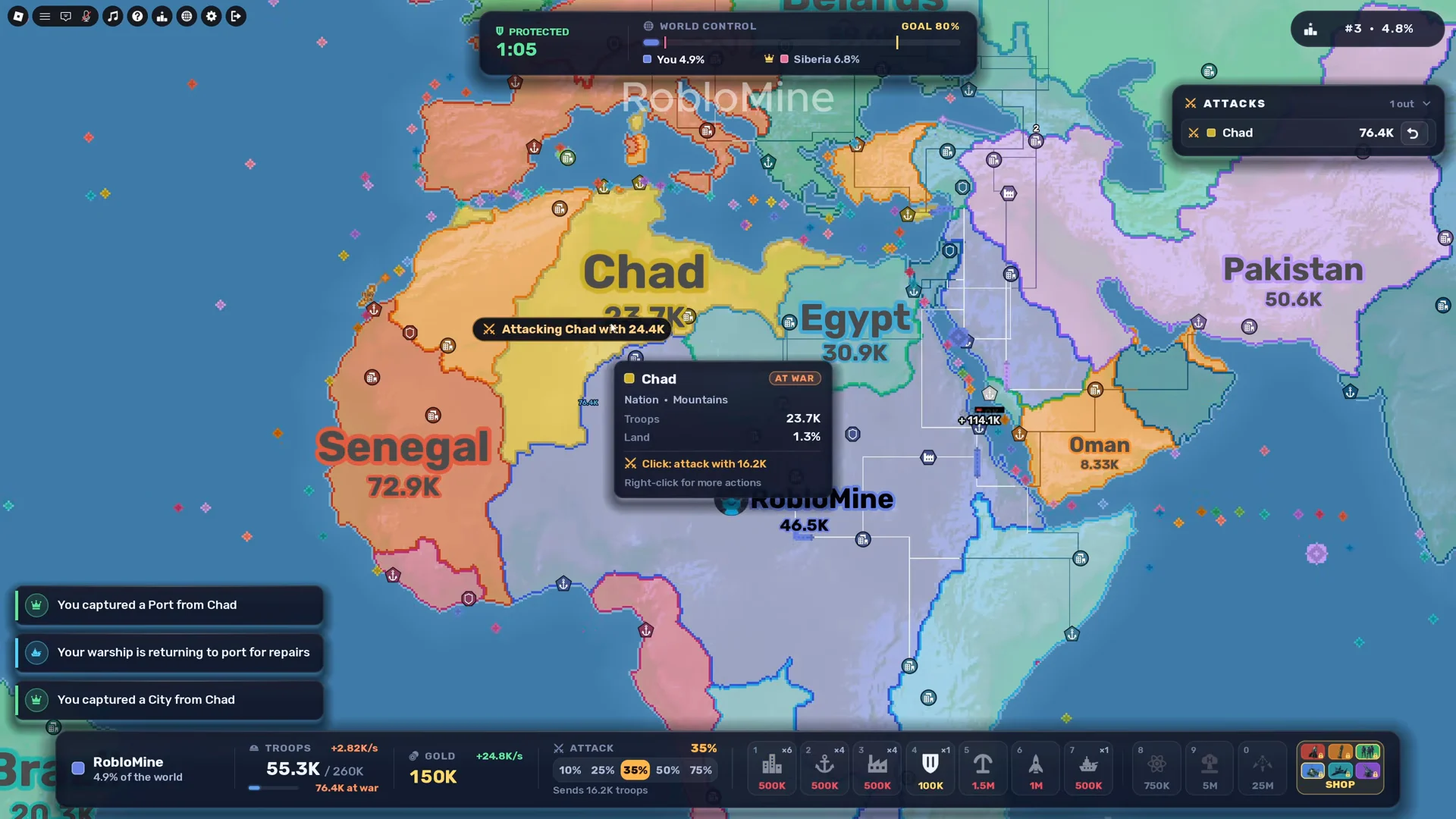
Warfare runs on many fronts at once. The game warns, “You are under attack! Track every front in the Attacks panel. Defense Posts make borders much harder to take.” Attacking a neighbor such as Chad while a captured port and a returning warship report in shows how land, sea, and defensive structures all feed one offensive.
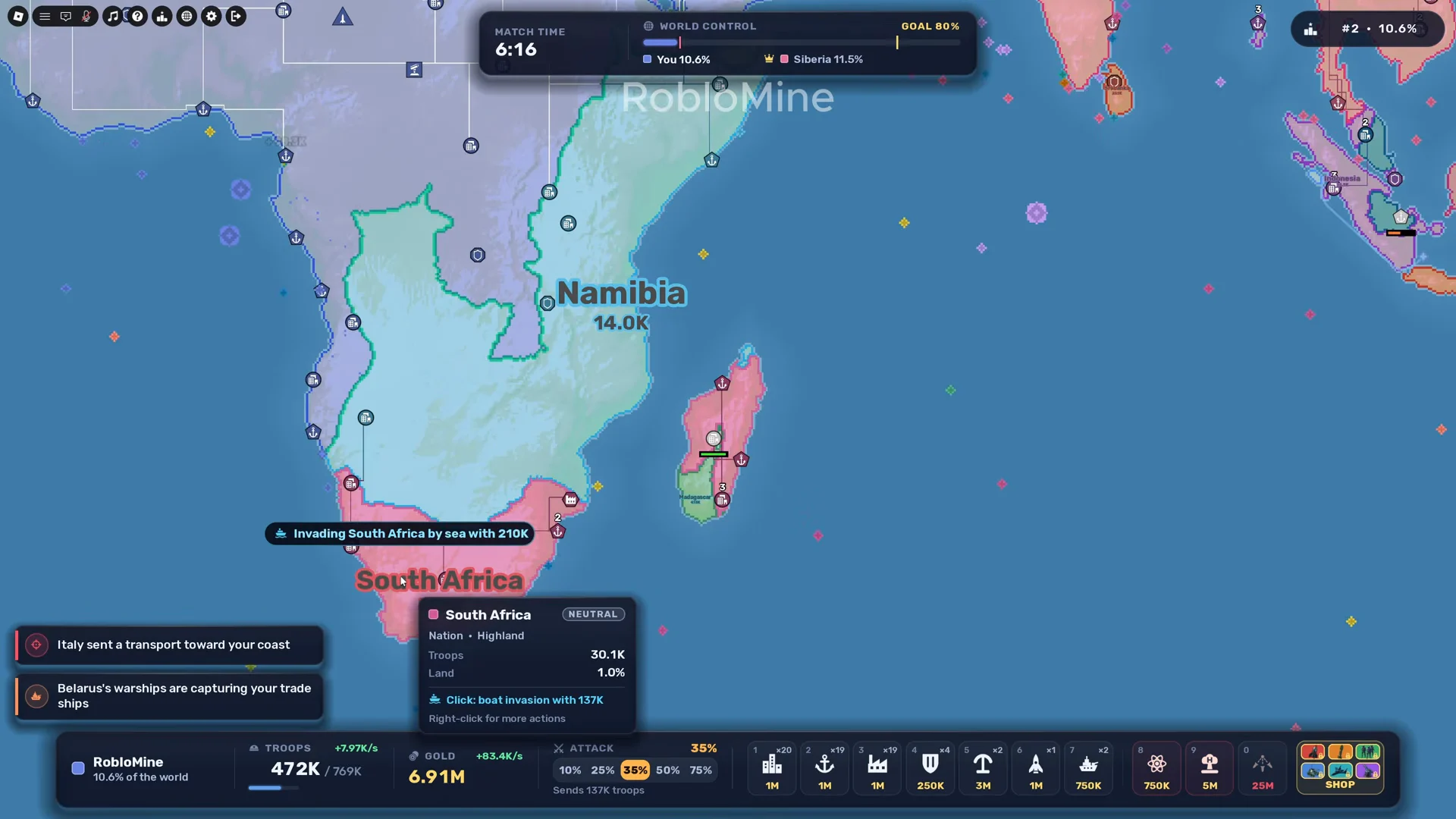
Southern campaigns lean heavily on boats. Naval landings carry armies onto South Africa and the island of Madagascar at the same time, letting a single push close out a whole corner of the map.
Buildings and economy
Gold funds everything you construct, and the build menu offers several structures that each come in upgrade tiers. Cities, factories, and ports raise income and troop output, while defense posts stiffen borders and warships patrol coastal waters. Missile silos and SAM launchers sit at the expensive end and open the door to nuclear play.
| Building | Cost tiers (gold) |
|---|---|
| City | 125K / 250K / 500K / 1M |
| Factory | 125K / 250K / 500K / 1M |
| Port | 125K / 250K / 500K / 1M |
| Defense Post | 50K / 100K / 150K / 200K / 250K |
| Warship | 250K / 500K / 750K / 1M |
| Missile Silo | 1M |
| SAM Launcher | 1.5M / 3M |
Upgrading core cities and ports into double-digit levels is how players build the gold and troop reserves needed to sustain long wars. Factories boost revenue, ports extend naval reach, and defense posts turn exposed frontiers into hard lines that absorb repeated assaults.
Arsenal, nukes, and missile defense
Once a missile silo is up, you gain access to tactical atom bombs, hydrogen bombs, and MIRVs that can flatten troop hubs and defensive lines before a ground invasion rolls in. SAM launchers answer that threat by automatically tracking and shooting down incoming ballistic and nuclear warheads, which is why late-game maps often turn into exchanges of missiles and interceptions.
A separate Arsenal menu sells one-off offensive abilities priced in Stars, scaling up from the Mega Nuke to the Railgun.
| Arsenal item | Cost (Stars) |
|---|---|
| Mega Nuke | 20,000 |
| Scattershot | 30,000 |
| Reinforcements | 40,000 |
| Artillery | 50,000 |
| Air Strike | 60,000 |
| Railgun | 75,000 |
Two paid boosts also sit in the menu. 2X Stars runs at R$ 499 and Rapid Reload at R$ 399, both charged in Robux rather than in-game currency.
Alliances and the traitor penalty
Diplomacy sits alongside combat. Nations send alliance requests, and accepting one lets you avoid fighting on every border at once. Those pacts rarely last, though, because breaking them is often the fastest way to grab a neighbor’s land.
Betrayal carries a clear cost. The confirmation reads, “Break the alliance with [Nation]? For 30 s you are a TRAITOR: every nation sees it and attacks on you cost only 50% of the troops.” For that half-minute, your borders are cheap for everyone else to hit, so the window rewards a fast, decisive strike before the penalty ends.
The traitor status alerts every nation, not just the one you betrayed, so breaking a pact while surrounded can invite attacks from several directions at once.
Winning a match and the land threshold
A match ends when you hold enough of the map. On the global map that is a world-control victory, confirmed by a screen reading “VICTORY” and “You conquered the world with 80.2% of the land outside fallout.” Team modes use the same threshold, with the completion screen worded as “Your team won with 80.1% of the land.”
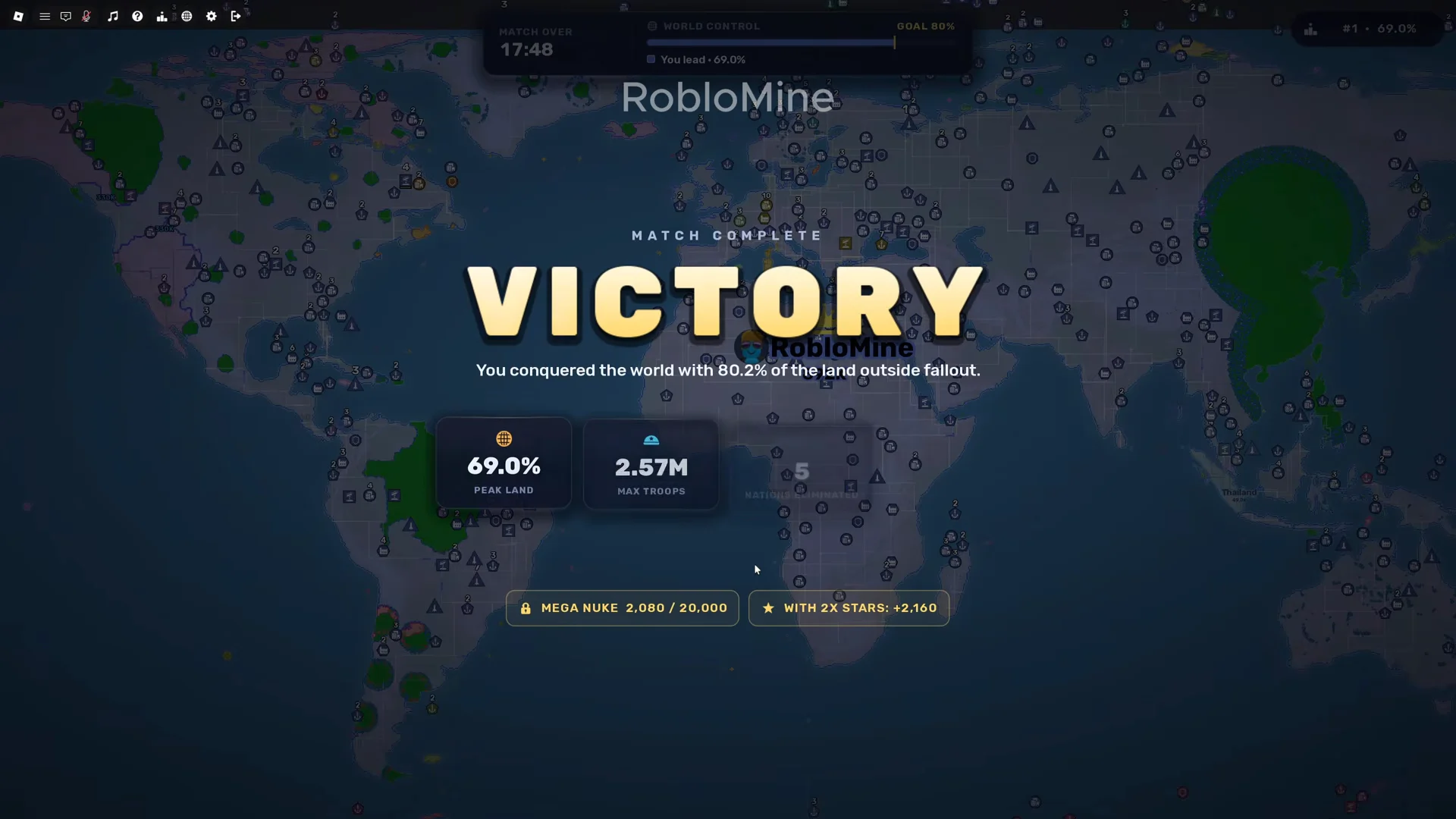
Losing is just as blunt. When your borders are overrun, the game shows “YOUR NATION HAS FALLEN” and an “ELIMINATED” screen, which can happen mid-match on a tight regional map where a single rival breaks through your defenses. Between the capital-placement opening and that land threshold at the end, RoFront [World PvP] packs a full arc of expansion, economy, diplomacy, and nuclear brinkmanship into each session on Roblox.