

Breeding in Palworld lets you pair a male and a female Pal at the Breeding Farm to produce an egg, and that egg’s species is decided by a hidden number rather than by luck. Once you understand how the game averages the parents’ “breeding power,” you can chain pairings toward a specific Pal and carry over the Passive Skills and stat rolls you want.
Quick answer: Build the Breeding Farm (unlocked at level 19), place at least one Cake in its chest, and assign one male and one female Pal. An egg appears, which you hatch in an Egg Incubator to get the offspring.

What you need before breeding
The Breeding Farm is a Technology you unlock at level 19. Crafting it costs 100 Wood, 20 Stone, and 50 Fiber, and it takes up a large footprint, so clear space in your base first.
Two conditions must both be true for an egg to appear:
- The two assigned Pals are opposite genders (species does not have to match).
- At least one Cake sits in the wooden chest to the right of the Breeding Farm.
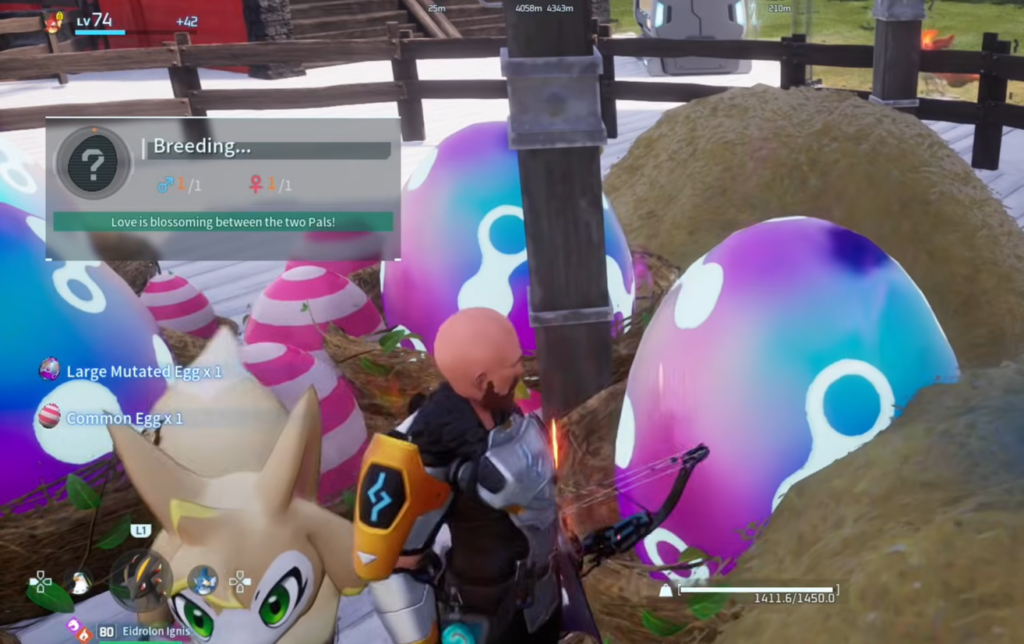
Assign a Pal by using the Pick Up keybind while hovering over it and throwing it at the building, or through the Monitoring Stand. Assigned Pals wander inside the farm until you remove them, pausing only at night. When a valid pair is set, the game shows “Love is blossoming between the two Pals” and a progress bar begins.
Cake placed in the Breeding Farm’s chest does not spoil. Breeding also runs to completion even if the Cake is consumed partway, so a paused progress bar is not caused by a missing Cake once it has started.
How to make Cake
Cake is the required fuel for every pairing. You cook it in a Cooking Pot from ingredients you can produce entirely at your base.
| Ingredient | Quantity | Base source |
|---|---|---|
| Flour | 5 | Wheat grown at base |
| Red Berries | 8 | Berry Plantation |
| Milk | 7 | Mozzarina in a ranch |
| Eggs | 8 | Chikipi in a ranch |
| Honey | 2 | Beegarde in a ranch |
How the offspring species is decided
Every Pal has a hidden breeding power between 10 and 1500. A lower number means a rarer or more powerful Pal. Blazamut sits near the bottom at 10, while Chikipi tops the range at 1500.
The game averages the two parents’ breeding power to find the egg’s value. Add both parents’ power plus 1, halve the result, then round down to the nearest whole number.
child_power = floor((parentA_power + parentB_power + 1) / 2)The game then picks the eligible child species whose rank is closest to that value. If two species are equidistant, the one with the lower index number in the game files wins. Because of this averaging, the offspring can never be rarer or stronger than your strongest parent. That single rule is the key to planning a breeding chain toward a rare target.
Some Pals ignore the rank system entirely. Specific parent pairings produce a fixed unique offspring that overrides whatever the averaged rank would otherwise create. Breeding two of the same species always returns that species, unless the species has a variant that can appear instead. Same-species pairs, variant Pals, and Tower Boss Pals are the main categories that use these fixed combinations.
Speeding up breeding time
Breeding speed is not tied to work speed, so a fast worker does nothing here. Instead, a few specific factors shorten the timer.
- Having a Braloha assigned in the base improves the breeding timer, and higher Rank may increase the effect.
- Either parent having the Philanthropist Passive Skill speeds up breeding.
- If both parents have Nocturnal, they keep working through the night instead of stopping, which cuts the total time significantly.
Passing down Passive Skills and IVs
Breeding is the reliable way to build a Pal with the exact abilities and stats you want. Passive Skills from either parent can be inherited by the offspring, so pairing two Pals that each hold strong Passives gives the egg a chance to carry a better combined set than either parent had alone. Repeating this over several generations lets you stack a full lineup of desirable Passives.
IVs are hidden per-stat values for HP, Attack, and Defense. A stat at 0 IV gets no bonus, while the maximum of 100 IV adds up to a 30 percent boost to that stat. You cannot edit a Pal’s IVs directly, but a parent’s high IVs can pass to its child. That makes breeding the route to a Pal with both top IVs and the Passive Skills you are aiming for.
Keep parents with strong Passives and high IVs as dedicated breeding stock. Pairing them into a growing chain lets you push those traits forward while you also steer the species using the breeding-power math above.
How to confirm it worked
You know breeding is active when the “Love is blossoming between the two Pals” message and progress bar appear at the farm. When the bar fills, an egg drops that you collect and place in an Egg Incubator to hatch. The hatched Pal is your offspring, complete with its inherited species, Passive Skills, and IVs.
If no egg ever starts, the cause is almost always one of two things. The pair is not opposite genders, or there is no Cake in the chest to the right of the building. Fix whichever is missing and the progress bar will begin.
With those rules in hand, you can treat breeding less like a gamble and more like a plan. Pick a target Pal, work backward through the averaged breeding power to choose parents, feed in the Passives and IVs you want carried forward, and keep a steady supply of Cake so the farm never idles.