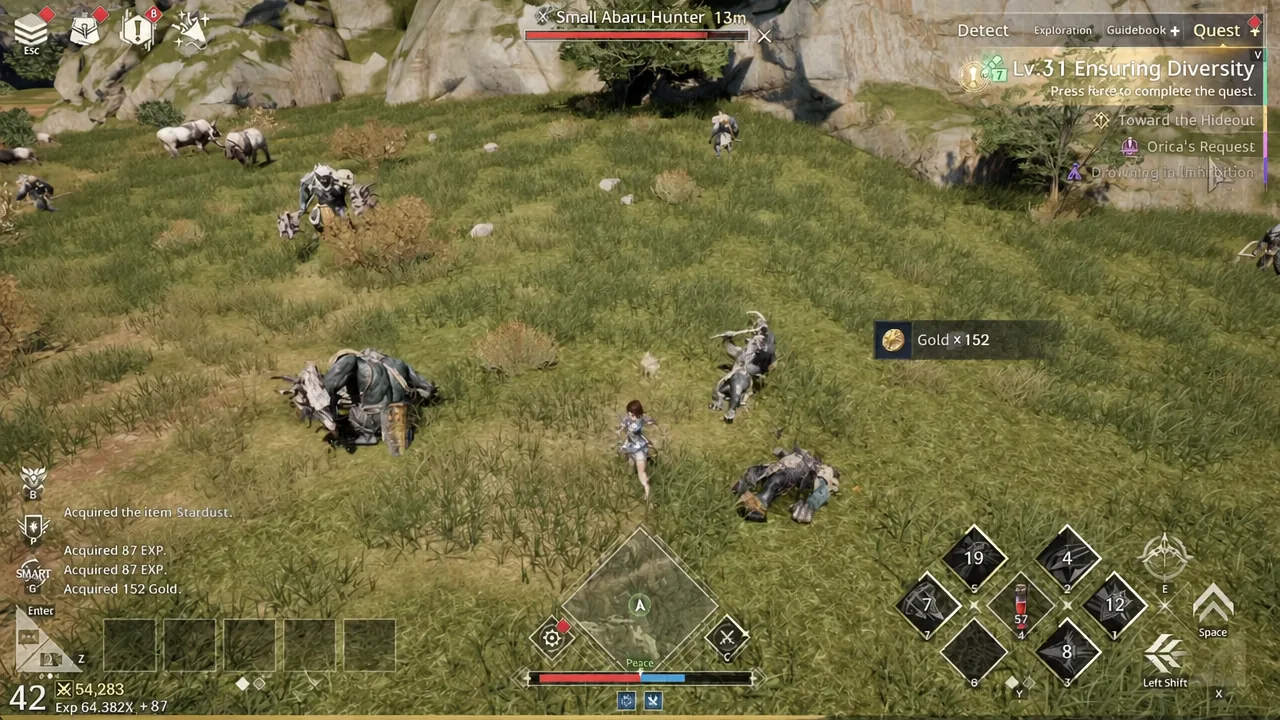
The Hunter is the bow class in Architect: Land of Exiles, and it plays as a ranged physical damage dealer built around critical hits, knockback, and constant repositioning. It clears open-world monster packs quickly, holds strong positions on the server rankings, and runs into one recurring wall — mana.
Quick answer: Play the Hunter as a hit-and-run ranged DPS. Stack critical rate and critical damage through Hunting Instinct and Master Archer’s Gaze, take Combat Will: Hunter for the +5% monster damage and +70 basic attack power, and build MP recovery on gear and awakening or you will run dry mid-pull.
How the Hunter farms in the open world
Farming with a bow comes down to range and area coverage. In zones like Brume-Veiled Meadow, where packs of Small Abaru Hunter and Abaru Spearman monsters sit close together, the Hunter can pull several enemies and drop them before anything closes the gap. Kill speed is fast because most of the class’s damage arrives as critical hits rather than as steady, chip damage.
The playstyle is deliberately mobile. You fire, back off, and fire again, using knockback skills to reset distance rather than tanking hits. That works well against normal field monsters and is the main reason the class dominates common monster kill counts.
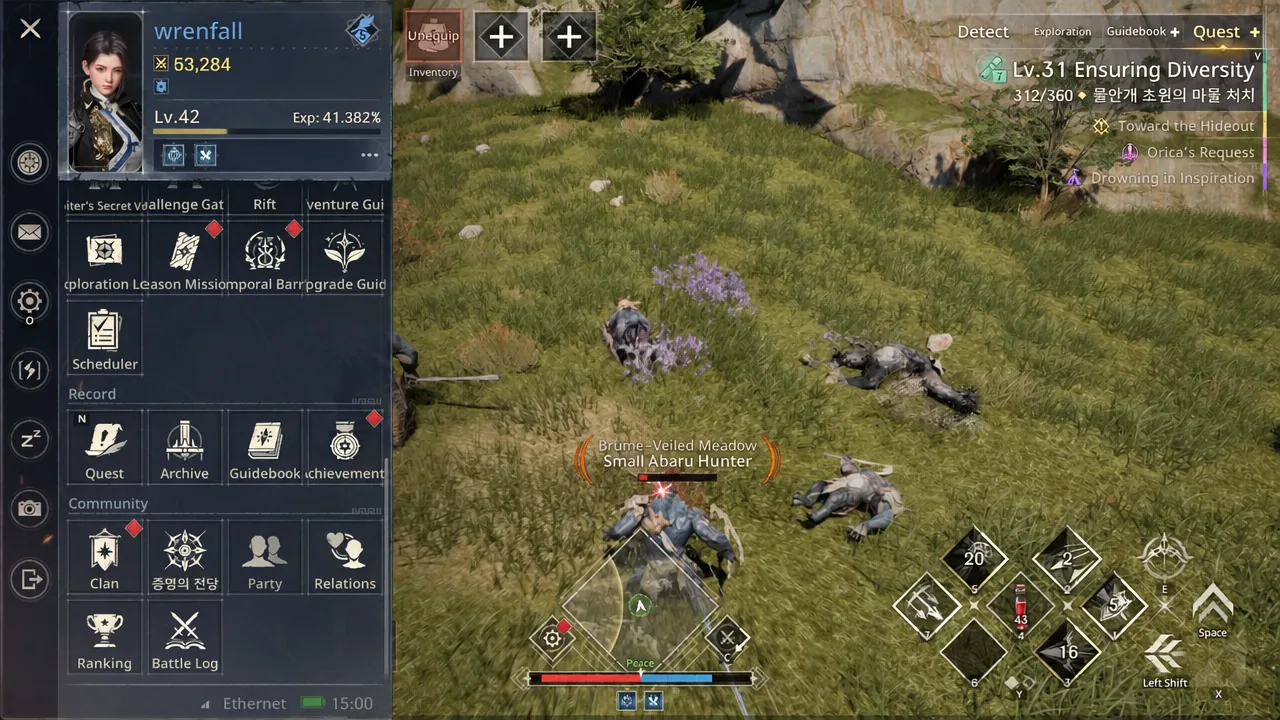
Where Hunters land on the rankings
The Ranking menu is the clearest read on class performance because it separates PvE and PvP activity. Hunters occupy top positions across common monster kills, Guardian Boss contribution, and Angbar Arena. On the PvP side, they appear inside the top ten for PvP score, kills, and assists, with assists being the category they reliably fill — sustained ranged pressure chips targets down even when someone else lands the finish.
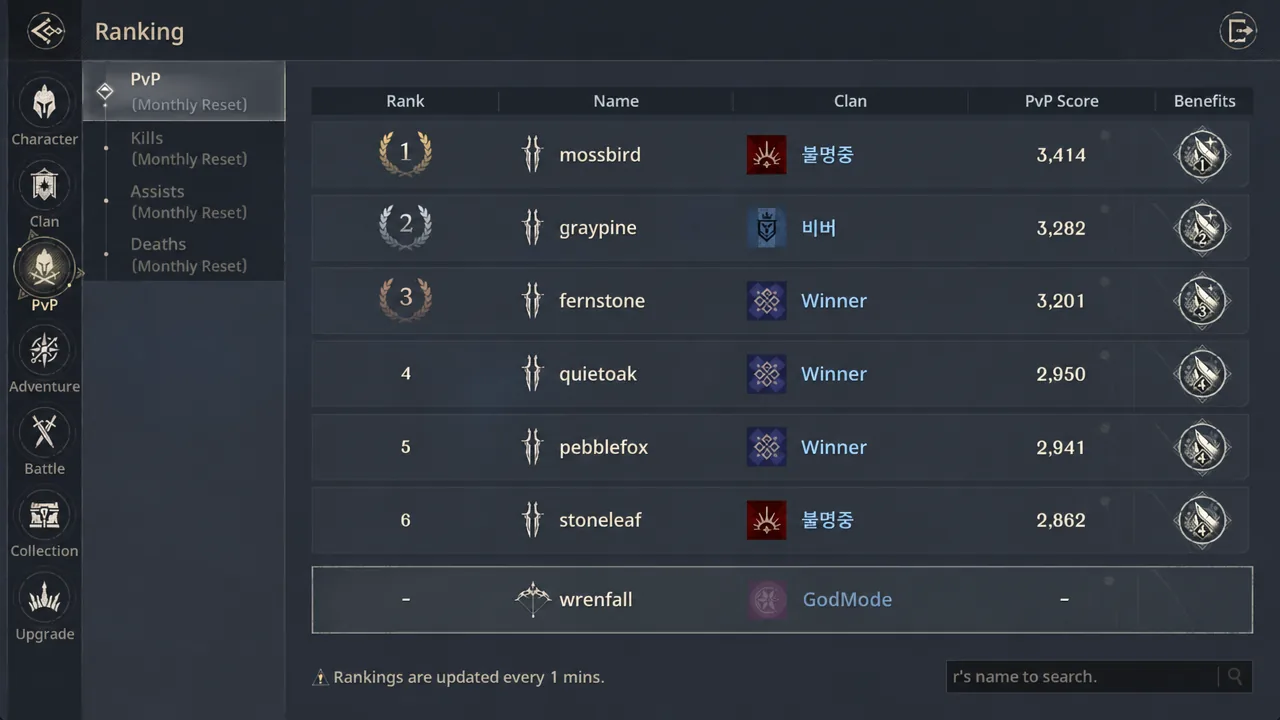
For context on the ceiling, a level 99 Hunter named 치치 of the clan 불명중 sits at rank 7 with 1,412,557 Combat Power. The top spot belongs to an Assassin, 보스, at level 101 with 1,658,573 Combat Power. Hunters are competitive at the top of the ladder without being the outright leader.
Active skills that carry the rotation
The Hunter’s active bar is a mix of area damage, single-target burst, and spacing tools. Volley and Gale Shot both apply knockback, which is what lets the class keep enemies at arm’s length in PvE and interrupt approaches in PvP. Explosive Arrow and Rapid Fire handle burst, while Preparing for Battle and Concentration are setup skills you use before committing.
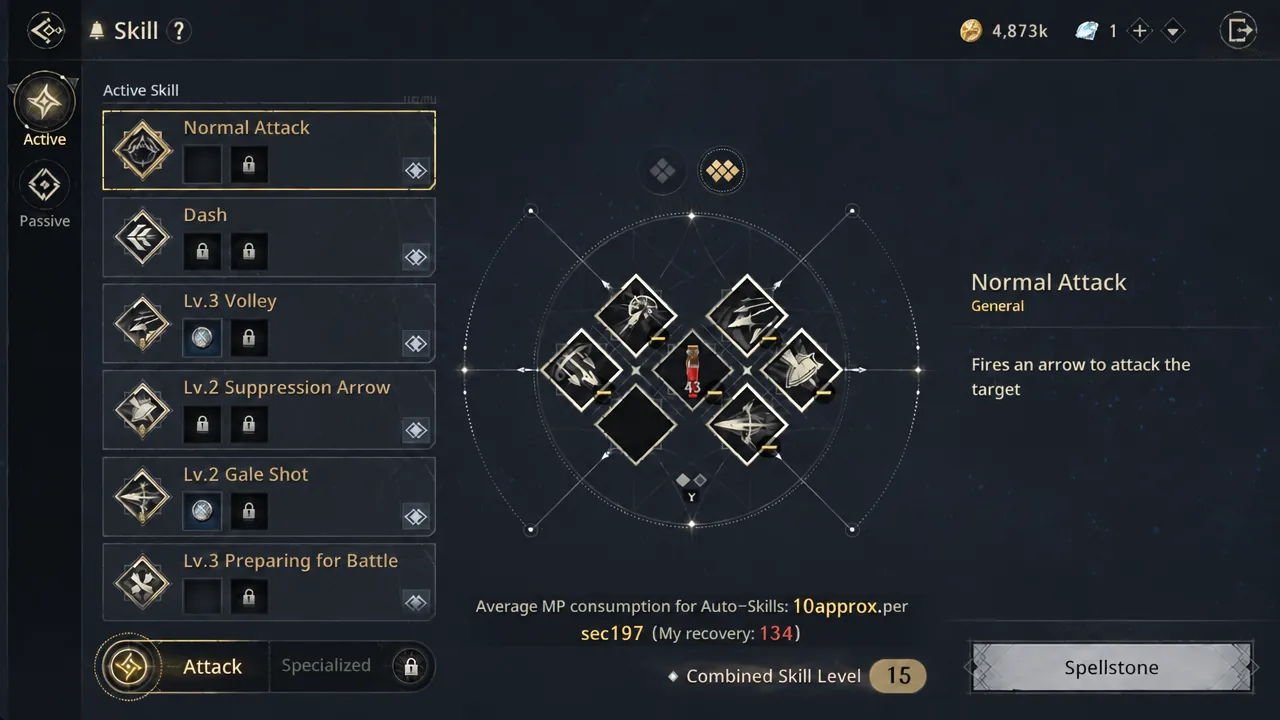
| Active skill | Role |
|---|---|
| Normal Attack | Baseline bow damage between cooldowns |
| Dash | Repositioning and gap creation |
| Volley | Area damage with knockback |
| Suppression Arrow | Pressure and control on a target |
| Gale Shot | Knockback for spacing in PvE and PvP |
| Preparing for Battle | Pre-fight setup |
| Explosive Arrow | Burst damage |
| Rapid Fire | Sustained damage output |
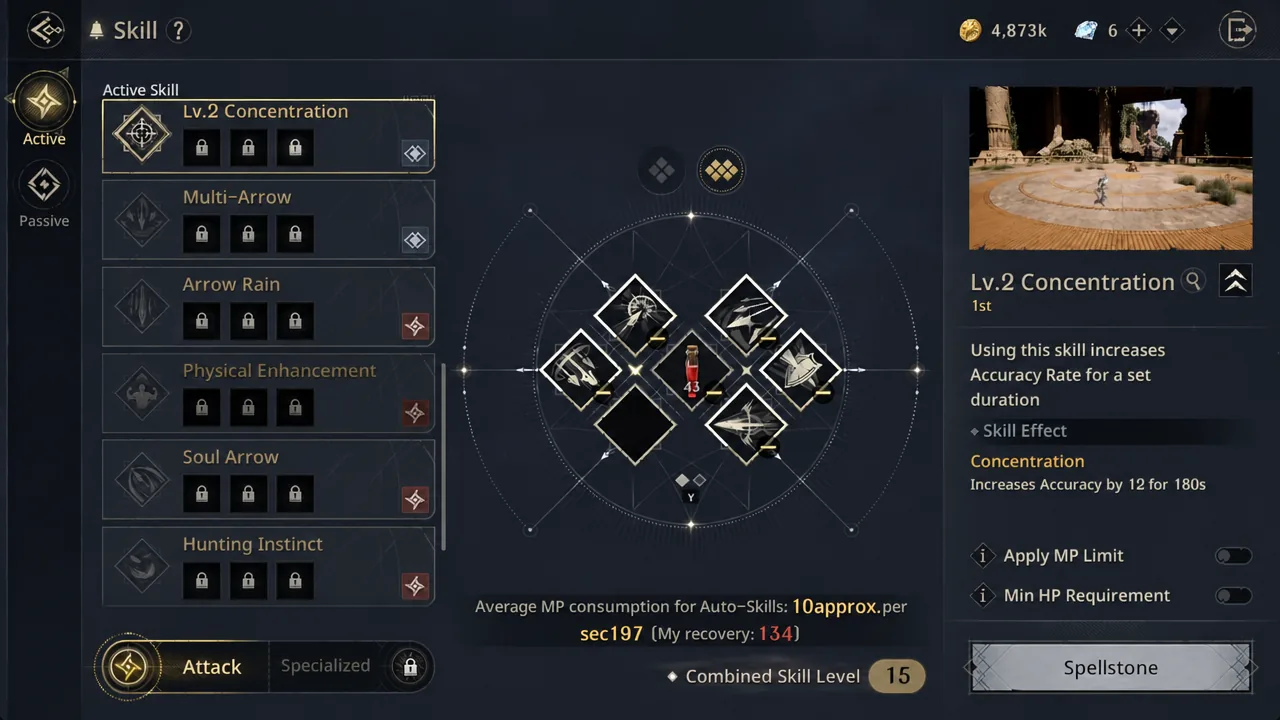
| Concentration | Damage setup buff |
Skills are slotted from the Active tab, and each one can be levelled independently. Concentration, for example, sits alongside the rest of the actives and gets configured the same way.
Skillbooks and where to buy them
Higher-level abilities come from the Skillbook Merchant, reachable by fast travel to Rappie Ranch. The stock covers damage, control, and buff options, so the choice depends on whether you are optimizing for field clearing or for arena fights.
| Skillbook | What it covers |
|---|---|
| Multi-Arrow | Multi-target output |
| Arrow Rain | Area damage over a zone |
| Tracking Arrow | Pursuit damage |
| Physical Enhancement | Offensive stat boost |
| Weakness Detection | Damage amplification through debuff |
| Soul Arrow | Additional attack option |
| Combat Unleashed | Combat buff |
| Hunting Instinct | Critical-focused buff |
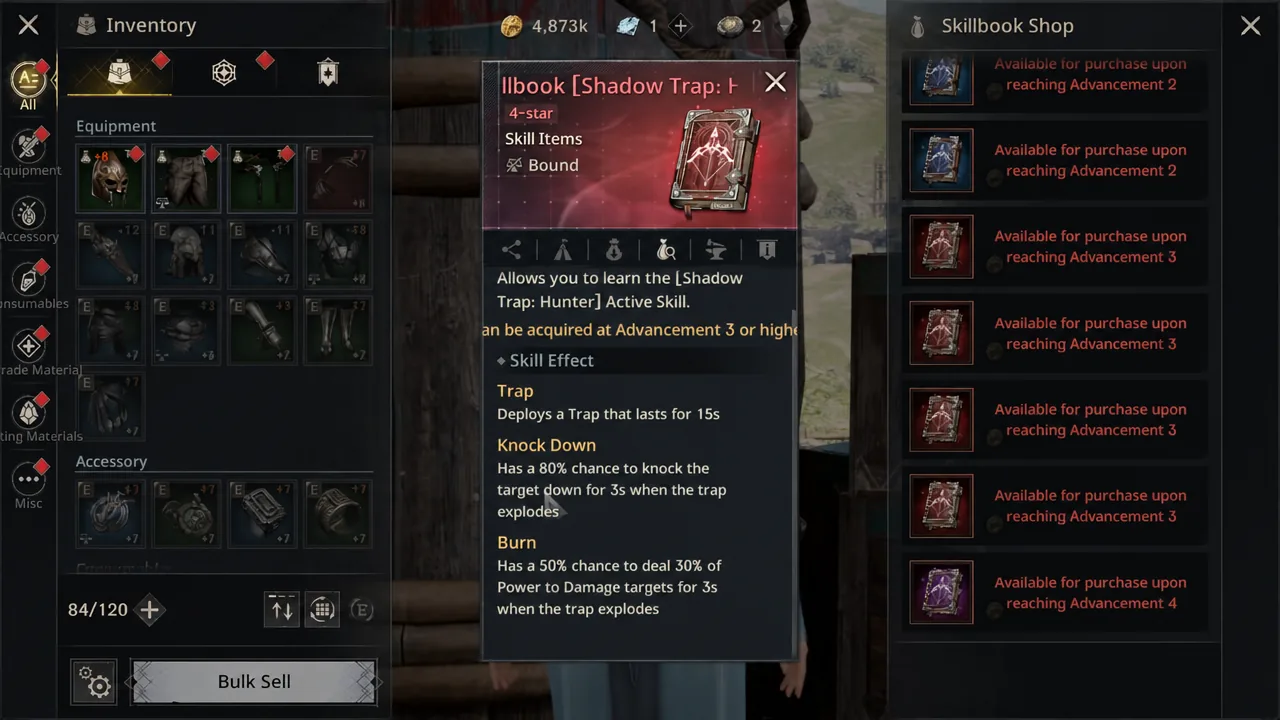
| Shadow Trap | Ground control |
| Chain Shackles | Restraint effect |
| Wind Snare | Movement control |
| Master Archer’s Gaze | Critical damage buff |
| Ruler’s Gaze | High-tier buff option |
Skillbooks appear in your inventory as items before they are learned, so you can inspect the exact effect and level requirement before spending.
Passive priorities: Combat Will: Hunter and Arrow’s Will
Passives are split into Shared, Attack, and Specialized trees. Two matter most for a farming-focused Hunter. Combat Will: Hunter increases damage dealt to monsters by 5% and adds 70 basic attack power, which is the single most efficient investment for open-world grinding. Arrow’s Will sits in the specialized side and reinforces the class’s bow damage.
Because the Hunter scales off critical hits rather than raw hit count, passives and buffs that raise critical rate or critical damage compound with each other. Hunting Instinct and Master Archer’s Gaze stack into that same scaling, which is why they are worth prioritizing over flat stat options.
The MP problem and how to work around it
The Hunter’s clearest weakness is low MP regeneration. Rotations that lean on Volley, Explosive Arrow, and Rapid Fire drain mana faster than it refills, and a Hunter without MP is reduced to normal attacks at exactly the moment burst is needed. This shows up in long farming sessions and in extended PvP fights.
The fix is stat allocation rather than rotation discipline alone. Build MP recovery through gear and awakening so the pool refills between pulls. Until that stat is in place, expect to pace your skill usage and lean on basic attacks between cooldowns.
Note: knockback cuts both ways in PvE. Pushing a monster out of your area damage can extend a fight, so time Volley and Gale Shot to break up incoming attacks rather than firing them on cooldown.
How the Hunter compares to the other four classes
Five classes are available at global launch. Warrior uses two-handed greatswords with slower attacks and heavy single-hit damage. Assassin runs dual daggers built around speed, stealth, and closing distance. Mage focuses on ranged elemental damage and area control. Battle Priest is a hybrid that mixes magic damage with team support rather than acting as a pure healer.
The Hunter’s niche among them is distance management. Knockback effects and debuffs let you dictate where a fight happens, which suits players who would rather never be touched than trade blows. Combat in the game is non-targeting, so aim direction and positioning are manual — that rewards a class designed around spacing more than it would in a lock-on system.
If you are picking a class for the global server, the Hunter is a safe choice for players who want fast field clearing and consistent ranking presence, provided you accept an early stretch where mana constrains your rotation until MP recovery is built up.