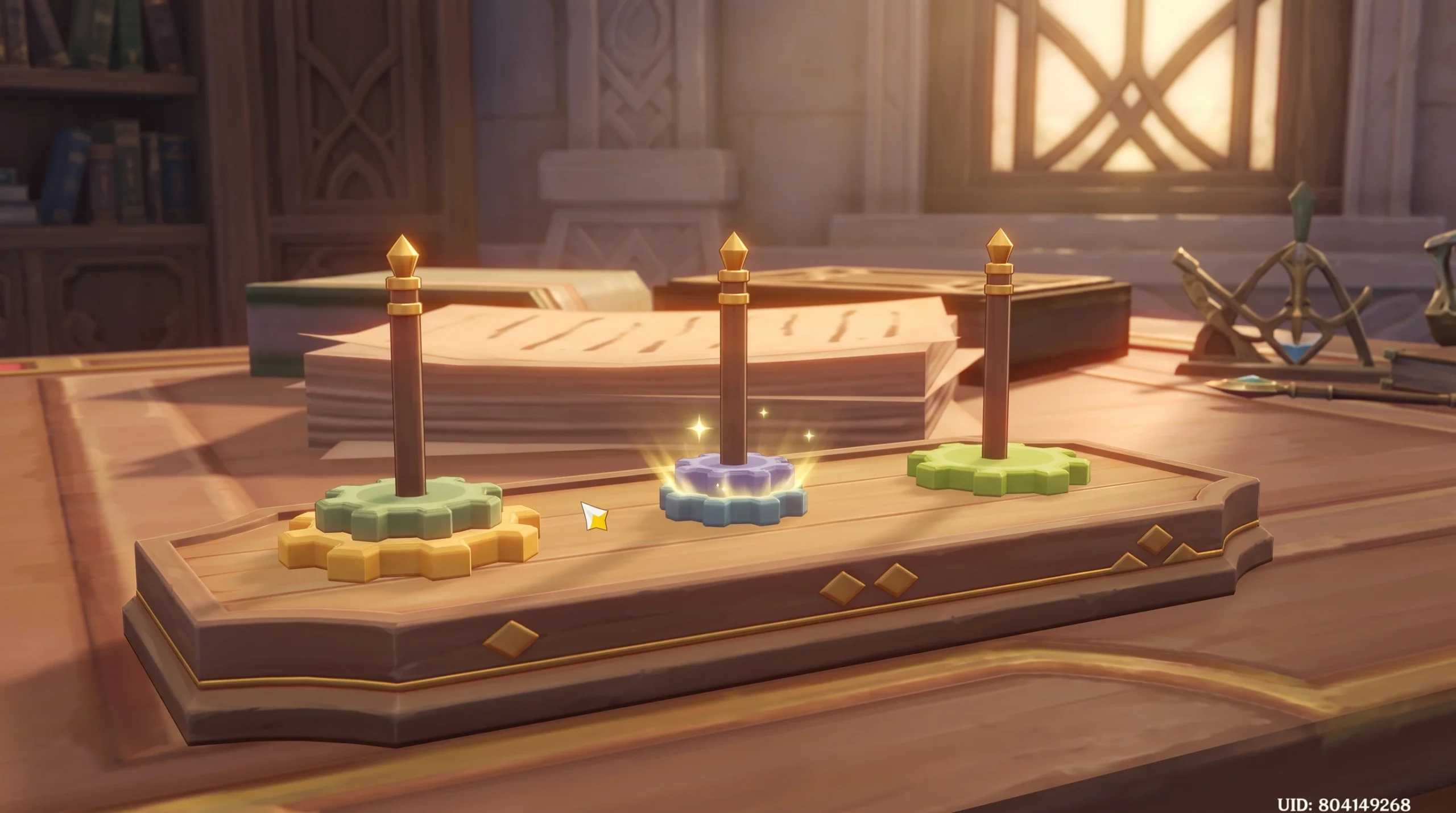
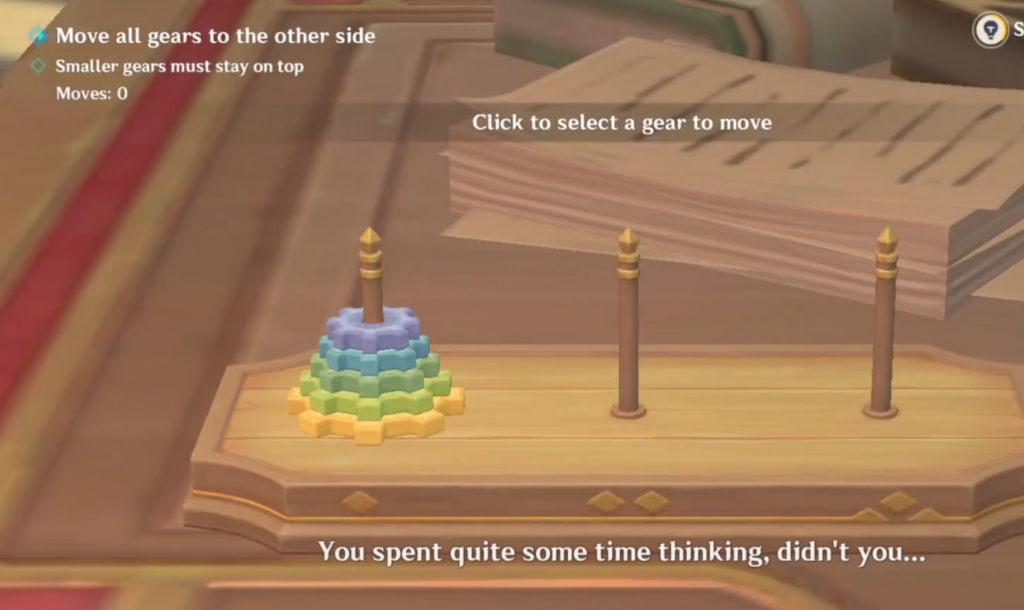
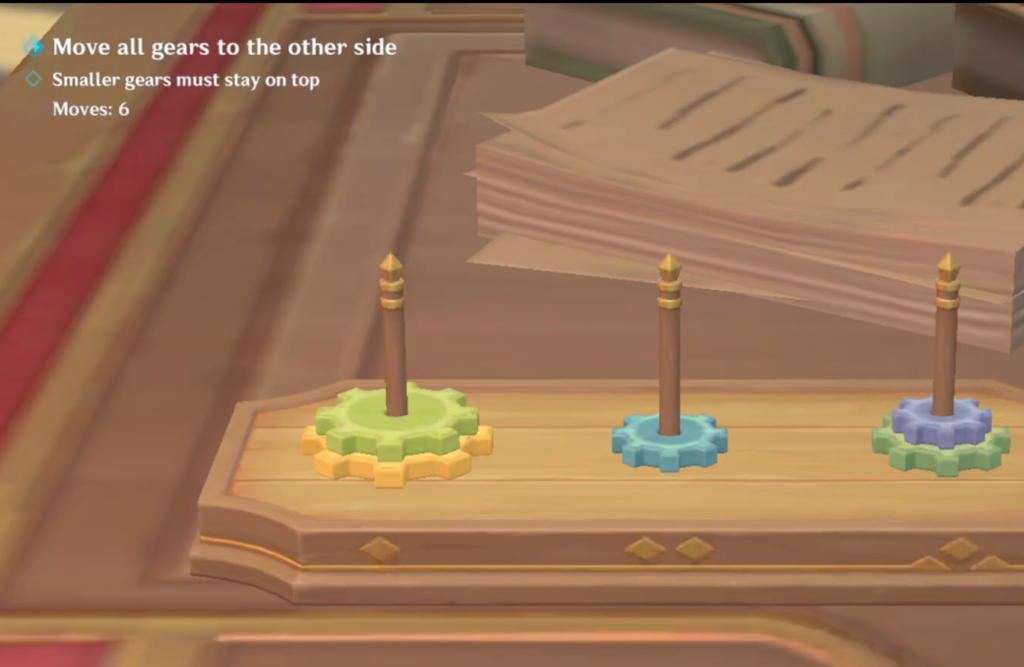
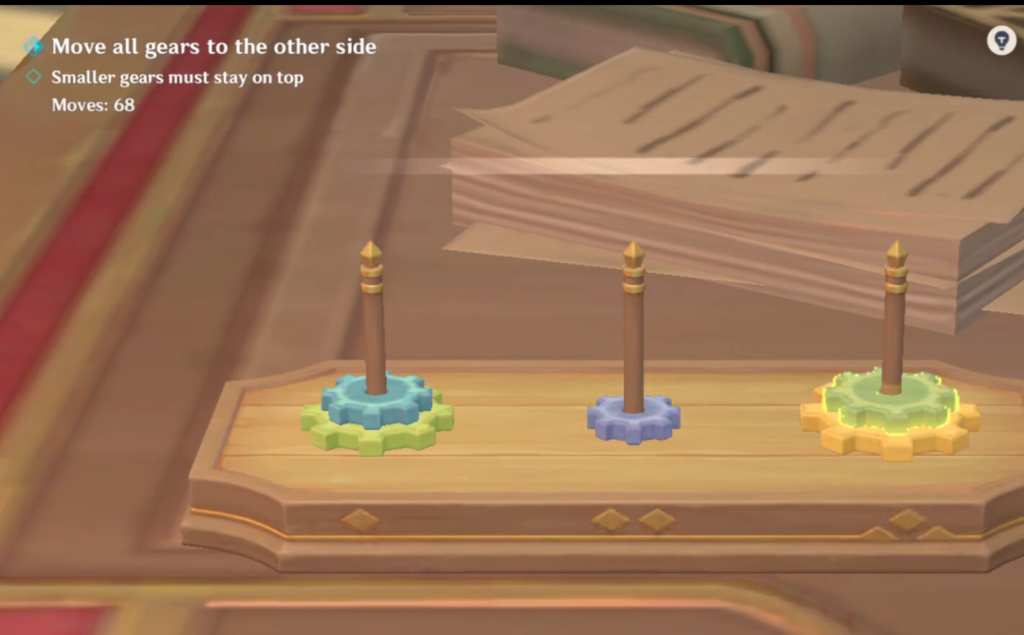
The gear-shifting puzzle in Genshin Impact’s Version 6.7 Luna VIII update follows one strict rule: you must move every gear onto the pillar on the opposite side, and a smaller gear can never sit under a larger one. If you have ever solved a Tower of Hanoi puzzle, this is exactly that, dressed up as clockwork. Once you know the pattern, it becomes a fixed sequence of moves that always works.
Quick answer: Move one gear at a time. Never place a bigger gear on top of a smaller one. Keep repeating a two-step rhythm — first move the smallest gear one pillar along in a set direction, then make the only other legal move available — until the whole stack sits on the far pillar.
The two rules that decide every move
Before touching anything, lock in the constraints. Breaking either one is why players get stuck and end up shuffling gears back and forth.
- You can only pick up and move one gear per action, and it is always the top gear of a stack.
- A larger gear can never rest on a smaller gear. Smaller gears always stay on top.
The goal is simply to rebuild the entire stack, in the same size order, on the pillar across from where it starts. The middle pillar is your temporary holding spot.
How to solve the gear puzzle step by step
The cleanest approach uses a repeating rhythm. Label the pillars Start, Middle, and Target. The trick is deciding which way the smallest gear travels, because that direction never changes once you pick it.
Move counts for common gear setups
The minimum number of moves is fixed for each stack size. If you are making far more moves than the count below, you have likely placed a gear the wrong way and are undoing your own progress.
| Number of gears | First gear moves toward | Minimum moves |
|---|---|---|
| 3 (odd) | Target pillar | 7 |
| 4 (even) | Middle pillar | 15 |
| 5 (odd) | Target pillar | 31 |
The pattern is always double the previous count plus one. A three-gear puzzle solves in seven moves, four gears in fifteen, and so on.
A worked example with three gears
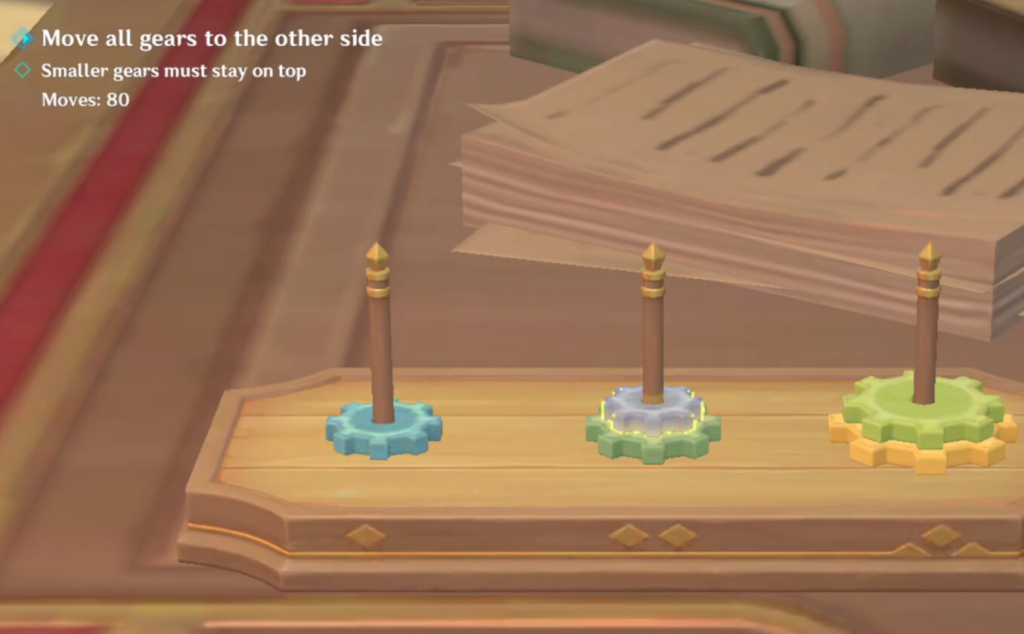
For a three-gear stack, the smallest gear cycles Start → Target → Middle. Here is the full seven-move solution, with gears sized small, medium, and large.
- Move small gear from Start to Target.
- Move medium gear from Start to Middle.
- Move small gear from Target to Middle.
- Move large gear from Start to Target.
- Move small gear from Middle to Start.
- Move medium gear from Middle to Target.
- Move small gear from Start to Target.
After the final move, all three gears sit on the Target pillar in order, and the puzzle is complete.
How to know it worked and why it fails
Success is obvious. Once the last gear settles onto the Target pillar with the stack in correct size order, the mechanism activates, and the associated reward or door unlocks. There is no partial credit, so the puzzle only resolves when the entire stack is on the far side.
If the puzzle refuses to complete, the cause is almost always one of these:
- A gear is on the wrong pillar because you sent the smallest gear the wrong direction on an early move.
- You moved the smallest gear twice in a row instead of alternating with the forced move.
- Not every gear reached the Target pillar, so the stack is split across two pillars.
If you lose track, reset the gears back to the Start pillar and begin the alternation again from move one. Because the sequence is deterministic, following the rhythm from a clean start will always finish the puzzle in the minimum number of moves.