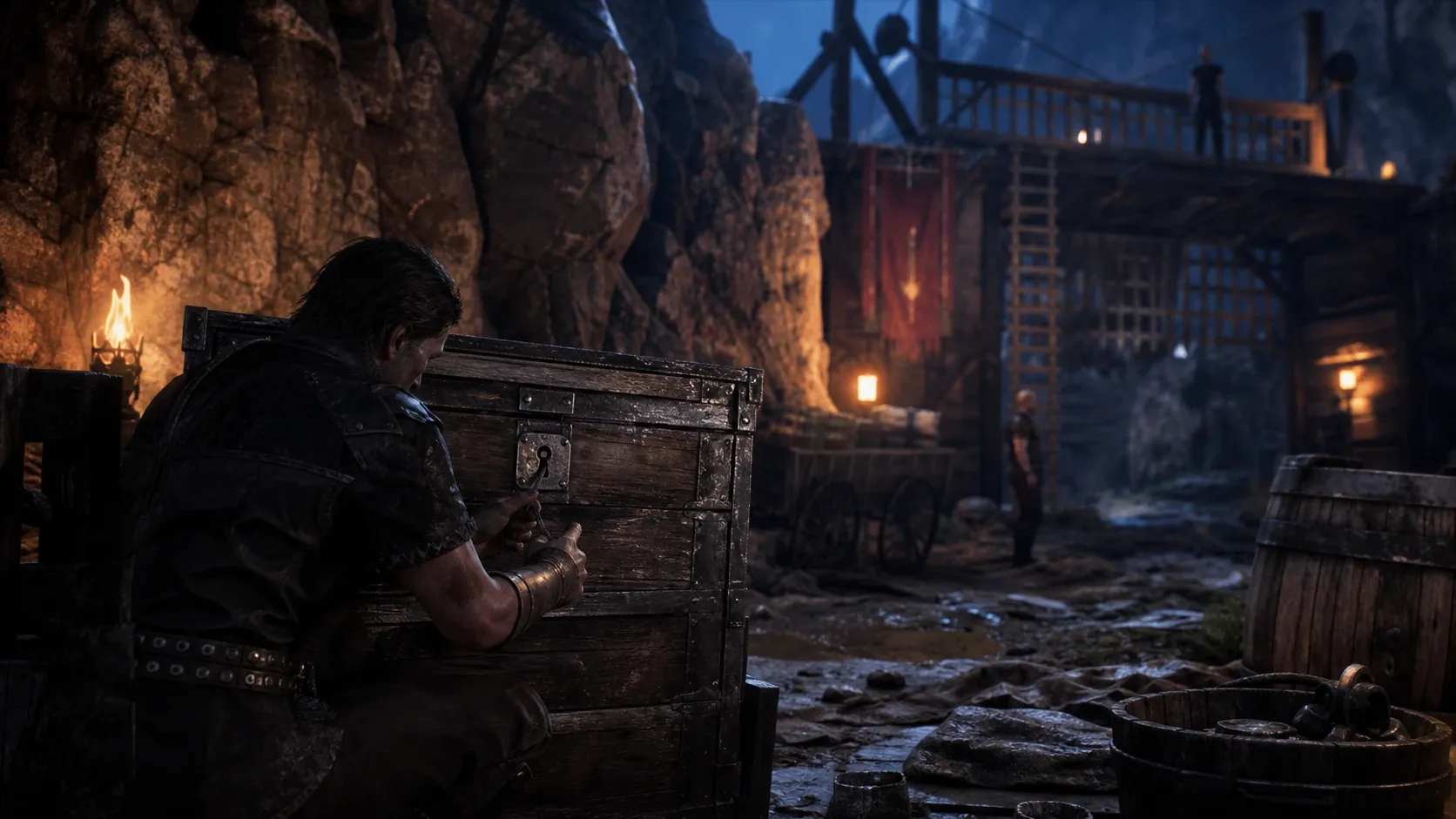
Lockpicking in Gothic 1 Remake is a slider puzzle, not the simple left-right tapping from the 2001 original. Each locked chest shows a set of plates with seven holes, and a copper pin sits on top of every plate. The lock opens only when every pin lines up through the center hole at the same time. The catch is that the plates are wired together, so moving one can shove others in the same or opposite direction.
Quick answer: Move one slider a single step, watch which other sliders move with it, then center every pin at the middle position (position 4) without letting any slider rattle against the edge. Edge hits damage the pick and can reset the lock if you are untrained.
How the Gothic 1 Remake lockpicking slider puzzle works
Every plate has several possible positions, and the correct one centers its pin. When all pins are centered, the chest unlocks. The difficulty comes entirely from the hidden links between plates. Some move alone, some pull other plates in the same direction, and some push connected plates the opposite way. That means a single move can fix one pin and ruin another.
The reliable approach is to test before you commit. Push one slider one step and look at the whole lock instead of just the plate you moved. If nothing else shifts, that slider is independent and safe to save for the end. If another plate moves, note the connection and use it deliberately. On simple locks you can correct by trial. On locks with more plates, random moves get punished fast because each bad push can drive a pin into the edge.
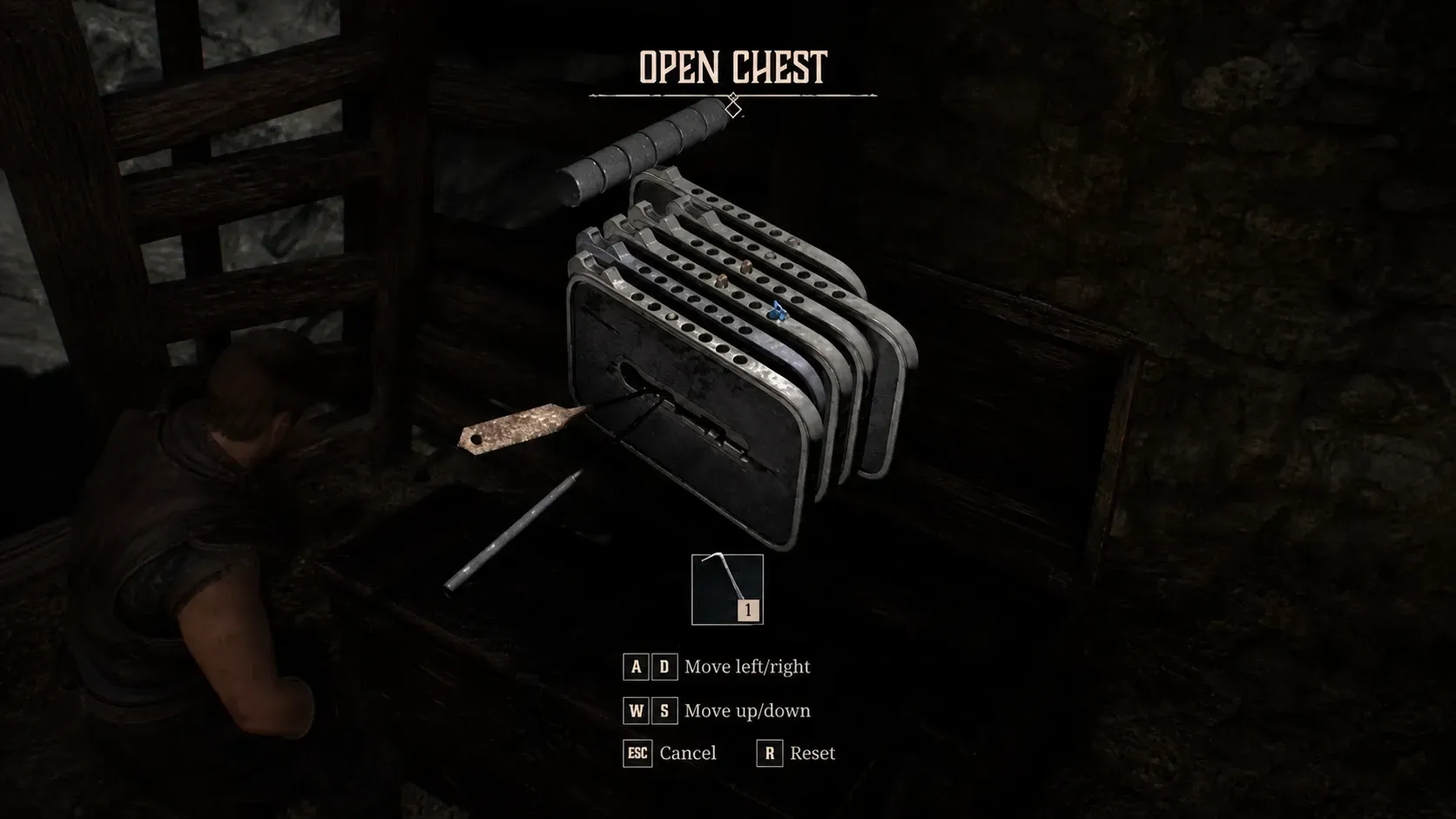
Rows are counted from the bottom up, so the bottom plate in the game is Row 1 and the top plate is the last row. The center of each row is position 4, and that is the target for every pin.
| Slider behavior | What it means | How to use it |
|---|---|---|
| Moves alone | It does not affect any other plate. | Save it for the final cleanup moves. |
| Moves others the same way | It is linked to plates in the same direction. | Use it when several pins need to shift together. |
| Moves others the opposite way | It pushes linked plates in reverse. | Use carefully when one pin needs to move and another needs correcting. |
Yellow and orange pin indicators
The clearest visual cue is the indicator color. A plate that is not fully aligned shows yellow, and the correct position shows orange. Watch for that color flip together with the centered position to confirm a pin is set. Do not trust color alone while other plates are still moving, because a connected slider can pull a nearly correct pin back out of place. Save the last few moves for plates that are independent or have the least harmful links.
Lockpick durability and why picks break
Picks have durability and lose it whenever a slider hits the edge of the lock and rattles. Untrained, a pick survives only a few mistakes before snapping. If your character is untrained and a pick breaks, the lock can also reset, wiping your progress. Pressing R resets the current attempt, which helps when the plates are in a bad spot, but backing out with a strained pick can still cost you the tool.
| Moment | What happens |
|---|---|
| Slider hits the edge | The pick takes strain. |
| Pick takes too much strain | The pick breaks. |
| Untrained pick breaks | The lock can reset to the start. |
| You press R | The current attempt resets. |
Tip: Save your game before attempting a hard chest. A quicksave lets you learn a lock’s behavior without permanently burning your supply of picks.
Where to learn lockpicking from Fingers
You learn the lockpicking skill from Fingers, a thief trainer in the Old Camp near the Arena. His shack sits up the slope after you head left from the castle entrance and pass Snaf’s cauldron. Asking Diego about teachers during the early Old Camp route points you toward him. The training costs 10 Learning Points and 100 ore.
Higher proficiency does not auto-open chests. It lowers the puzzle’s complexity and makes mistakes far cheaper. At Trained level, picks tolerate more strain and a broken pick no longer resets your progress. At Master level, picks survive even more strain, and a break can simplify the lock by removing one connection inside the puzzle.
| Trainer | Location | Skill | Cost |
|---|---|---|---|
| Fingers | Old Camp, near the Arena | Lockpicking | 10 Learning Points and 100 ore |
Where to get lockpicks in Gothic 1 Remake
You get lockpicks two ways. Buy them from vendors in the Old Camp market, or find them while exploring. Mordrag sits on a bench outside a shack on the east side of the southern cloth-covered market and sells picks for 13 ore each. Dexter, also in the Old Camp market and tied to The Cult’s Recipe quest, sells them for 15 ore each. Buying is reliable but drains ore quickly, so it is not worth it very early.
Exploration is the cheaper supply. Loot chests across the colony often contain picks, and so do enemy corpses, so check every body you defeat. One early chest near the locked mine, across the bridge by the opening area where you fight the first enemy, drops picks. An abandoned campsite on the upper ground near the bridge holds a few more, though a goblin guards it.
| Source | Location | Cost or note |
|---|---|---|
| Mordrag | Old Camp market area | 13 ore each |
| Dexter | Old Camp market area | 15 ore each |
| Loot chests and corpses | Camps, prisoner areas, near the locked mine | Free; best way to save ore |
Carry more picks than a lock looks like it needs. Walking up to a complex chest with a single pick usually ends with that pick snapping and the loot still locked.
Best strategy and whether it’s worth learning early
Work the connected plates first, then finish with the independent ones. Move a single step at a time, watch the entire lock rather than the plate you grabbed, and avoid edge hits. The common failure is perfectly centering one pin and immediately knocking it loose with the next move. Training before serious chest runs gives you enough durability to learn each lock’s pattern instead of losing a pick every time the puzzle behaves oddly.
As for timing, lockpicking is a strong utility skill but not a fix for combat. Learn it early if your build leans toward thieving, locked chests are blocking gear you want, and you have a stack of picks to spend. Hold off if you are still losing basic fights against wolves and scavengers, or if your Learning Points are better spent on Strength, Dexterity, Rune Magic, or Smithing first. It pays off most once you can safely reach chests, carry spare picks, and actually keep what you find.