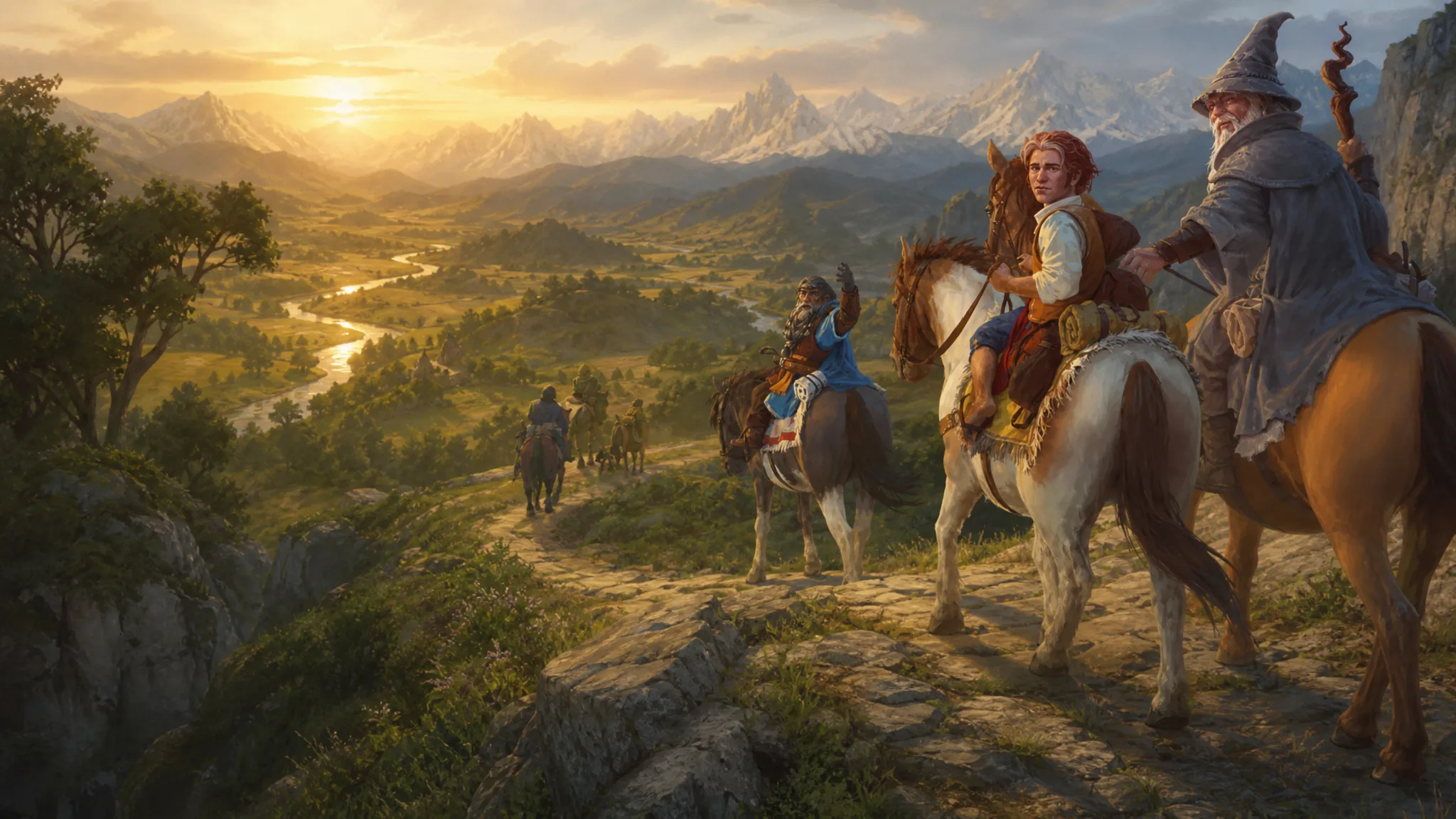
Magic: The Gathering pulled the curtain back on a batch of Hobbit cards during MagicCon Amsterdam, and the reveals lean hard into the book’s cast, from Thorin Oakenshield to a mono-red Gandalf and a scheming Gollum. This is the follow-up to the wildly popular Lord of the Rings crossover, but tighter in scope, sticking to Bilbo’s road from the Shire to the Lonely Mountain. Dwarves, Elves, Goblins, and a very angry Dragon all show up here.
Quick answer: The Hobbit releases on August 14, 2026, with prerelease events running August 7–13 and MTG Arena access starting August 11. The MagicCon Amsterdam reveals include Gandalf, Goblins’ Bane, Gollum, Riddle Master, Thorin Oakenshield, Desolation of Smaug, The Lonely Mountain, and more.
The Hobbit release dates and formats
The Hobbit is a Universes Beyond set that will be legal in Standard, so its cards matter well beyond casual Middle-earth decks. Paper release lands on August 14, 2026, while digital players get a head start on Arena. Here is the timing that has been confirmed.
| Milestone | Date |
|---|---|
| Prerelease week | August 7–13, 2026 |
| MTGA / MTGO release | August 11, 2026 |
| Paper release | August 14, 2026 |
| Set code | HOB |
Character cards shown at the presentation
A big part of the fun with a set like this is seeing how the book’s cast gets translated into cards. Some characters even get two versions to reflect how they grow through the story. Here are the legendary and named creatures that appeared.
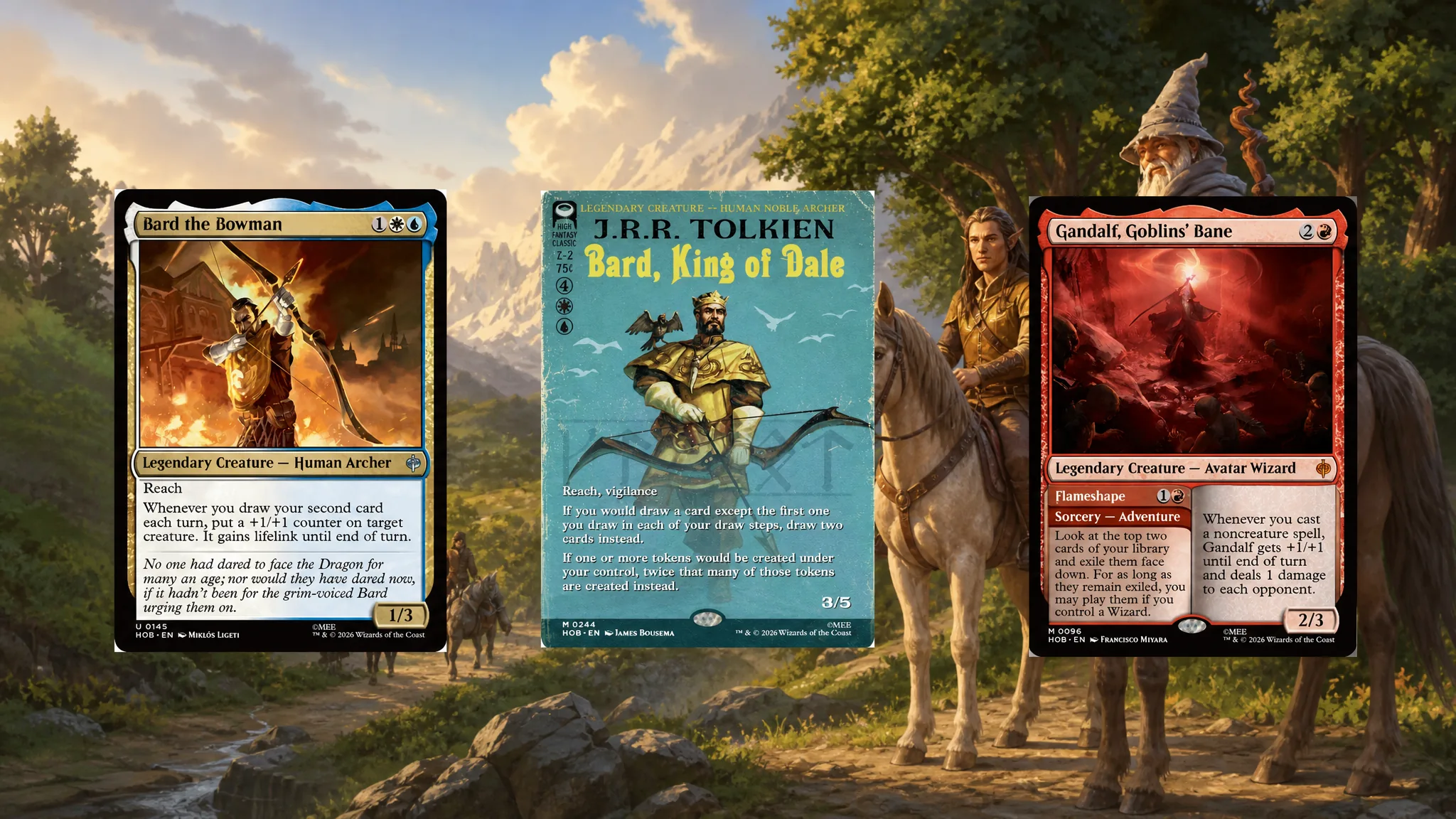
Bard the Bowman and Bard, King of Dale
Bard gets two cards to mirror his arc from hunter to ruler. Bard the Bowman is the uncommon starting point, a 1/3 with Reach that hands out a +1/+1 counter to a creature when you draw your second card each turn, and that creature also gains lifelink. It is a solid three-drop.
Bard, King of Dale steps up to a 3/5 with Reach and Vigilance. He still cares about card draw, but now if you would draw a card other than the first of your draw step, you draw two instead. On top of that, he doubles the tokens you control, which makes him an interesting pull toward White/Blue rather than the usual green token strategies.
Gandalf, Goblins’ Bane // Flameshape
A mono-red Gandalf is the headline surprise here. His Flameshape side lets you exile cards from your deck and cast them, as long as you control a Wizard. He also grows by +1/+1 until end of turn whenever you cast a noncreature spell, and deals 1 damage to each opponent when you do. That is a strong package for a mono-red Commander build.
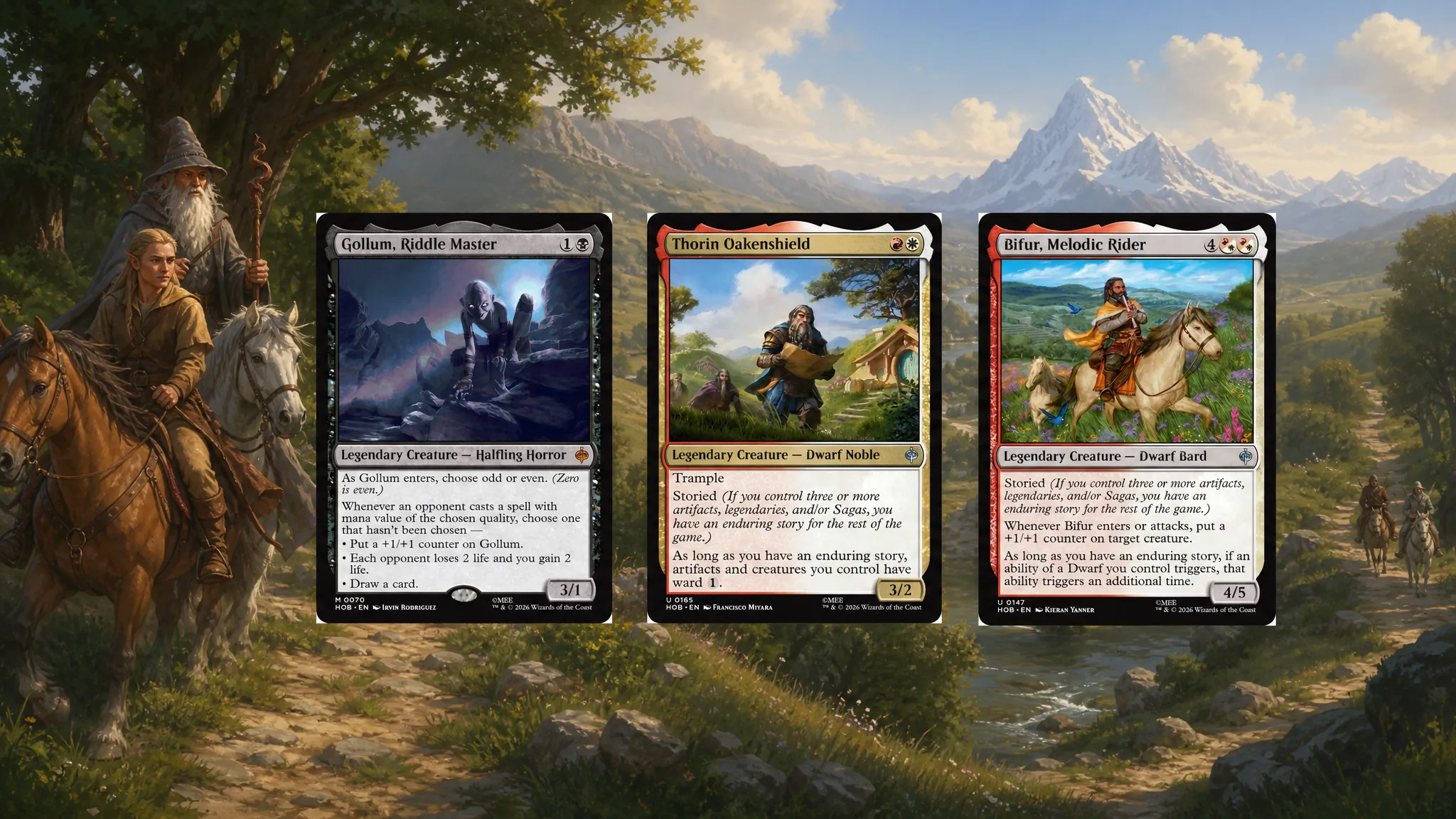
Gollum, Riddle Master
Gollum turns the riddle contest into a game of odds and evens. You choose even or odd, and whenever an opponent casts a spell matching that designation, you pick one option from a list that has not been chosen yet.
- Put a +1/+1 counter on Gollum.
- Each opponent loses 2 life and you gain 2 life.
- Draw a card.
Because the options can be re-used through flicker effects, decks that repeatedly blink Gollum can squeeze a lot of value out of him.
Thorin Oakenshield and Bifur, Melodic Rider
Thorin introduces a new but familiar mechanic called Enduring Story, tied to the keyword Storied. If you control three or more artifacts, legendaries, and/or Sagas, you have an Enduring Story for the rest of the game, which works much like City’s Blessing. For Thorin, artifacts and creatures you control cost 1 less while you have an Enduring Story.
Bifur, Melodic Rider is a White/Red Storied card that puts a +1/+1 counter on a creature whenever he enters or attacks. Once you have an Enduring Story, any Dwarf ability that triggers goes off an additional time, which can ramp your board quickly in the mid game.
Thranduil, the Elvenking
Thranduil is the set’s only three-color card, a Black/Green/Blue Elf. He carries all activated abilities of every Elf card in your graveyard, which is already powerful on its own. When another legendary Elf you control enters, you draw two cards and then discard, and with a wave of new blue Elves arriving, he has plenty to work with.
The Queen of Dale
The Queen of Dale Recruits whenever an opponent casts their first noncreature spell each turn. Recruit lets you draw a card and then discard a card, and if you discard a nonland, you make a 1/1 white Human Soldier token. She is a clean two-drop with real upside.
Bolg of the North and The Chief Warg
Bolg of the North is a 5/5 for five. When it enters, you may sacrifice a creature; if you do, Bolg deals damage equal to that creature’s power to another creature, and any excess damage triggers Amass Goblins X, where X is the leftover damage. That confirms Amass returns, this time in Goblin flavor.
The Chief Warg is a 3/3 green/black legendary Wolf with Menace. Its Ferocious ability means that whenever you attack while controlling a creature with power 4 or greater, you draw a card and lose 1 life, a strong steady source of card advantage.
Locations, moments, and items revealed
Beyond the cast, several cards capture famous places and scenes from the book. A fresh version of The One Ring has not appeared yet, but these pieces cover a lot of ground.
The Lonely Mountain
This is a red land that taps for red mana and enters tapped unless you control an Equipment. You can also pay 5 and tap it to make a 2/2 red Dwarf token, and that cost drops by 1 (down to a minimum of 4) for each Equipment you control. The token ability works only at sorcery speed, but it is a handy way to build a board in an artifact-heavy or Tron deck.
The Eagles Are Coming!
A white Instant with Kicker 4. On cast, you choose a creature you own, and if you paid the kicker you can choose as many creatures you own as you like. Return each of them to your hand, then during your next upkeep create a 4/4 white Bird Soldier token with flying for each creature removed this way. It is a strong out against a board wipe, letting you rescue your team and rebuild the following turn.
Burn, Burn, Tree and Fern
Named after the book’s song “Fifteen birds in five fir-trees,” this is a red Saga with a mix of removal and ramp across its chapters.
| Chapter | Effect |
|---|---|
| I | Deals 6 damage to target creature an opponent controls. |
| II | Destroy target artifact an opponent controls. |
| III | Add R. |
| IV | Add R. |
If you can reset its Saga counters near the end, it can keep pressuring a wide range of board states.
Desolation of Smaug
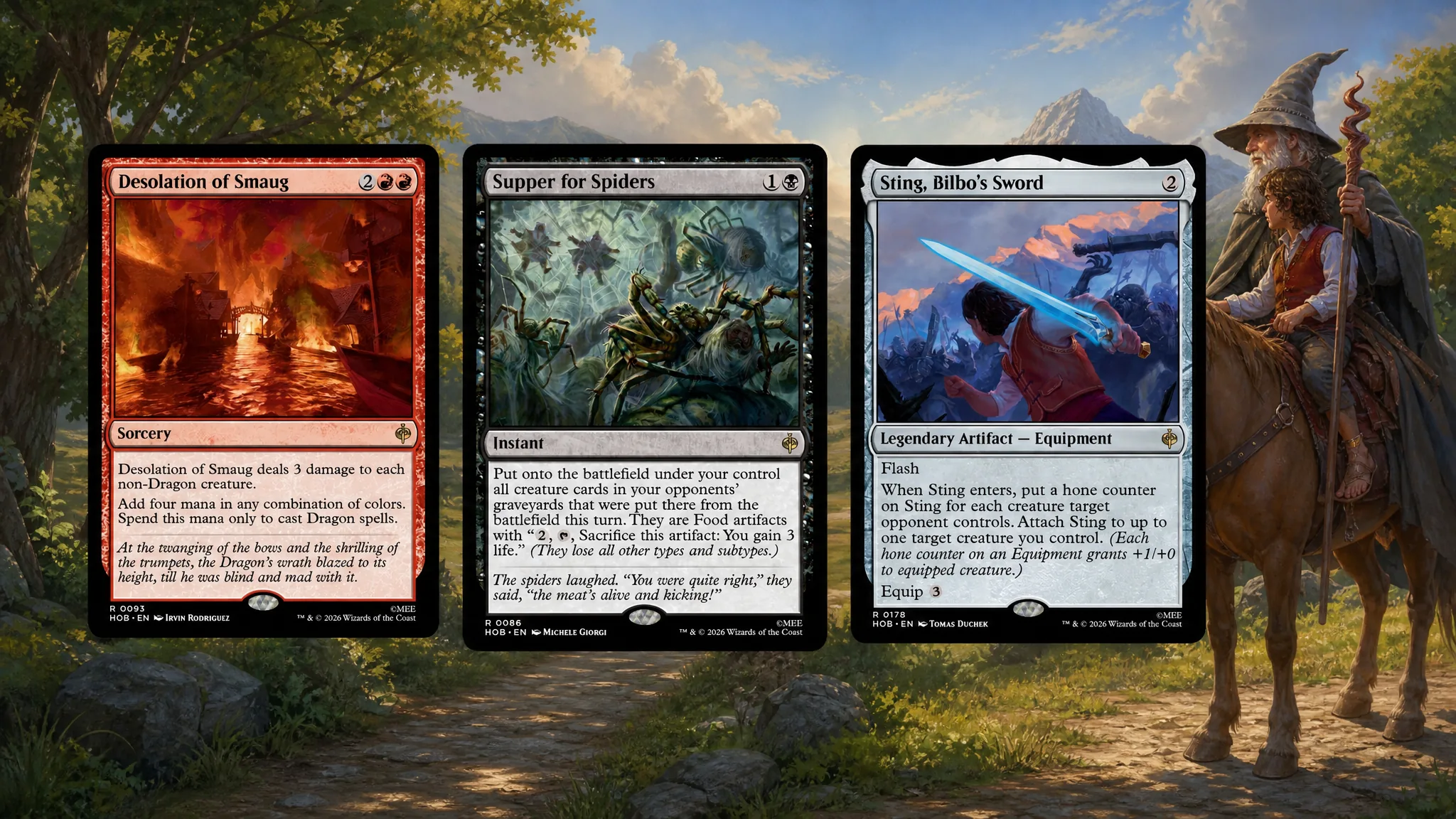
One of the standout spells. Desolation of Smaug deals 3 damage to each non-Dragon creature, then gives you four mana of any combination to cast Dragon spells. In practice you cast it and effectively get the mana back, making it a powerful board reset for a Dragon deck.
Supper for Spiders
A two-mana spell that puts onto the battlefield under your control all creature cards in your opponents’ graveyards that were put there from the battlefield this turn. They arrive as Food artifacts rather than creatures, so you cannot swing with them immediately, but there are plenty of ways to turn Food back into creatures. It is a cheap punish against sacrifice engines and post-board-wipe situations.
Sting, Bilbo’s Sword
Sting is a two-drop Equipment with Flash, so you can cast it at instant speed. It gains a Hone Counter for each creature a target opponent controls, then attaches to a creature you control, with each Hone Counter granting +1/+0. The more creatures your opponent has, the larger the bonus, which makes it another appealing option for artifact-focused Tron decks.
With Amass returning in Goblin form, a new Enduring Story mechanic, and a mono-red Gandalf leading the charge, The Hobbit is shaping up to give both Standard and Commander players plenty to test. There is still more to come before launch, but these first reveals already sketch out the journey from the Shire to the Lonely Mountain ahead of the August 14, 2026 paper release.